What Are SLC Transporters and Why Are They Hard Targets?
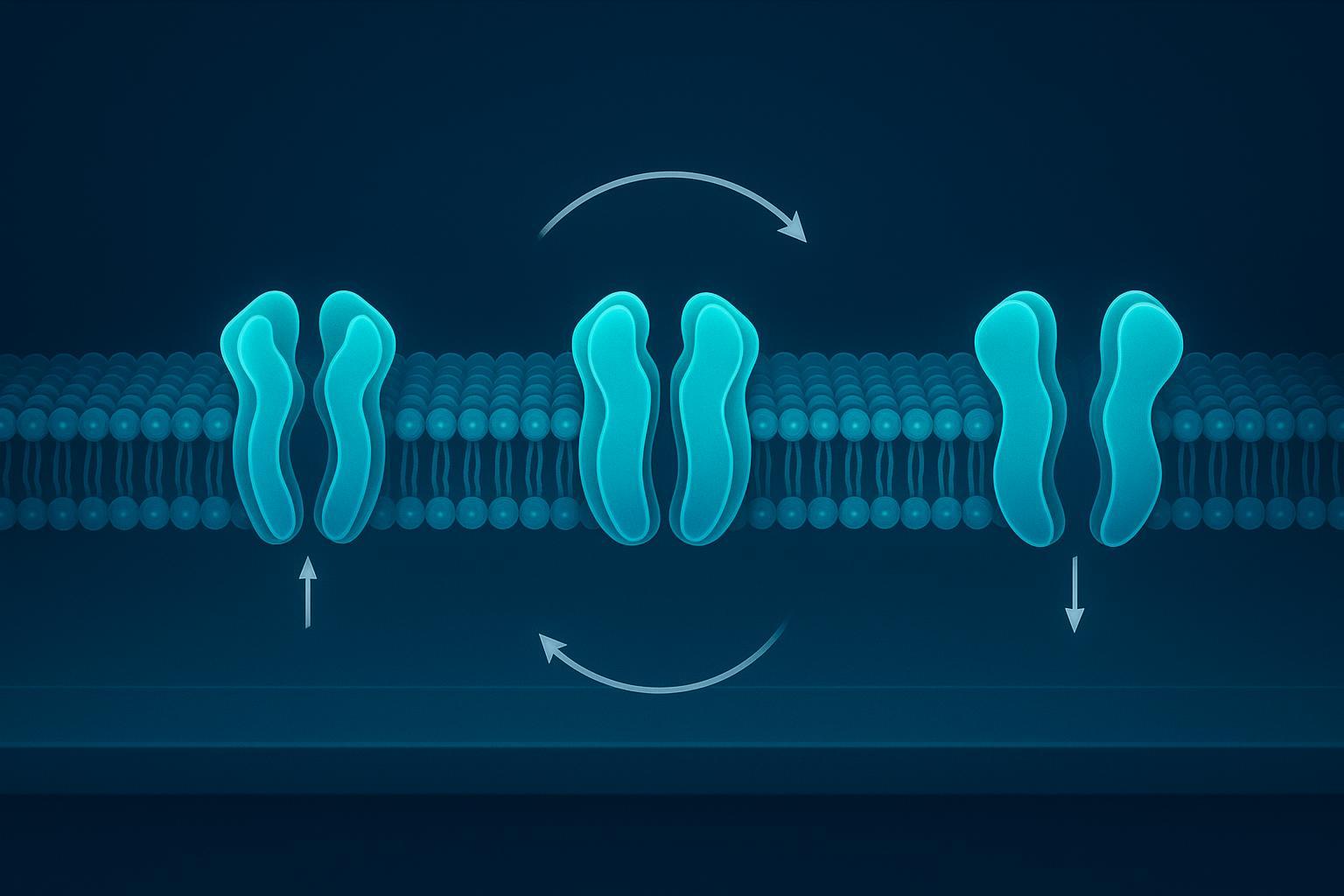
SLC transporters yog cov protein nqa khoom uas txav ions, nutrients, neurotransmitters thiab tshuaj hla cell membrane, thiab tib neeg muaj 464 cov tswv cuab paub tias kis thoob plaws 70 tsev neeg (News-Medical, 2026-09-10). Lawv kuj yog cov neeg sim hauv laboratory uas tawv heev, and the reasons are structural rather than procedural.

The difficulty starts with architecture. SLC transporters are integral membrane proteins built from many transmembrane helices, which makes them hard to express, solubilise, purify and crystallise (PMC, 2025-09-02). Many operate through an alternating-access cycle, shifting between inward-facing, occluded and outward-facing states, so a single experiment tends to capture one conformation rather than the whole picture. Native expression levels are often low, which complicates purification, antibody generation and structural work, and moving the protein into detergent solution can distort or destabilise the structure you were trying to study.
Functional readouts are just as constrained. Many SLCs have no known substrate or strong secondary assay, and transport measurements are confounded by substrate specificity, electroneutrality, localisation, directionality and artefacts, with overlapping substrate promiscuity adding another layer of interpretation.
The consequence is a family that medicine has barely touched. Existing medicines address only a small fraction of the SLC superfamily (News-Medical, 2026-09-10), and one 2026 opinion piece estimates that of a superfamily exceeding 400 members, roughly a third have no known ligand at all (Clinical Trial Vanguard, 2026-09-07). That combination, hard to express, hard to hold in one state, hard to measure, is precisely why a well-characterised peptide reagent earns its place in early transporter work.
Why Custom Peptides for SLC Transporter Research Fit Early Discovery
Custom peptides for SLC transporter research fit early discovery because they are sequence-defined, labelable and modifiable reagents that can be built against targets where antibodies, tool compounds and structural biology have stalled. The tool-compound gap is the clearest evidence for that fit. A 2024 survey of SLC tool compounds in Frontiers in Pharmacology screened 20,678 unique small molecules across 199 SLCs and, after applying tool-compound criteria, arrived at 6,876 inhibitors covering only 51 transporters. The same survey found that 530 ntawm 810 manually curated compound/SLC pairs were absent from the tested databases, and that for many disease-relevant SLCs an assay exists while no tool compound has been identified at all.
Qhov tseem ceeb: Four levers decide whether a peptide reagent works in transporter work: the sequence you choose, the label you attach, the stability modification you apply, and the analytical evidence you can show for the lot.
The Validation Cascade: Target Validation, Binding, Imaging, Assay Development
Run the four applications in order. Each stage’s reagent and evidence requirements constrain the next, so skipping ahead usually means buying the same peptide twice.
|
Stage |
Reagent requirement |
Evidence required |
Decision gate |
|---|---|---|---|
|
Target validation |
Unlabeled or minimally modified sequence |
The protein behaves as expected in your system |
Is this target worth the program? |
|
Services Binding |
Biotinylated or label-free peptide |
Your ligand engages the target |
Does the interaction hold? |
|
Imaging |
Fluorescently labeled peptide |
Where the target is and how much |
Is the signal specific? |
|
Assay development |
Peptide Synthesis Validated reagent from the stages above |
A reproducible, measurable change |
Can you run this at scale? |
The cascade is not theoretical. The first SLC-targeted candidates using activation, stabilisation and gene-therapy approaches are already in clinical development for epilepsy, autism spectrum disorders and chronic pain, with gene-therapy trials specifically evaluating SLC6A1-related neurodevelopmental disorders, GLUT1 deficiency syndrome and SLC13A5-related disease (Drug Target Review, 2026-09-11).
Assay development sits last for a reason: the functional-assay landscape for these transporters is narrow, so the readout you can build depends on what the earlier stages proved.
Designing Custom Sequences for Transporter Targets
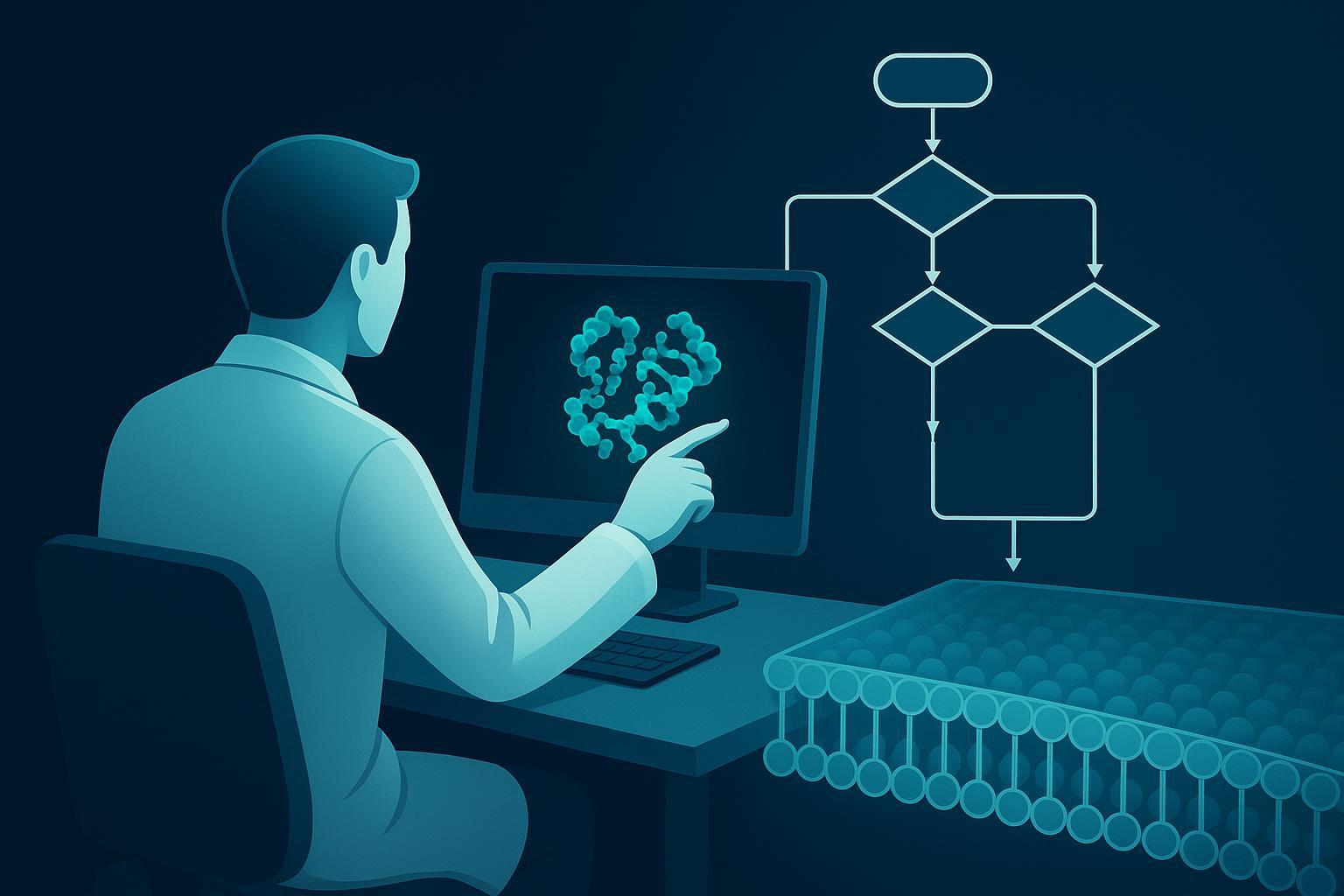
Sequence design starts from the region you need to interrogate, not from a catalogue. Decide first whether the peptide must mimic a natural transporter ligand, compete at a known binding site, los yog Khw simply raise an antibody against a loop. That decision fixes the length, the terminal chemistry, and how much of the sequence can be changed without losing the interaction you want to measure.
SLC transporters are unusually unforgiving here. Their transmembrane stretches are hydrophobic and their cytoplasmic tails are often basic-rich, and both features make solid-phase assembly and reverse-phase purification harder than a typical soluble-protein epitope. Expect lower crude yield, more aggregation during cleavage, and a narrower purification window. PHT1 (SLC15A4) recruitment of TASL is a useful reference point: it shows SLC-ligand recognition resolved at the molecular level, which is the level of detail your sequence has to respect (t, 2023).
Two practical rules follow. Order an unlabeled reference analog alongside every labeled version, so the label’s contribution can be measured rather than assumed. T: h.
Fluorescent and Biotin Labels: Choosing the Right Probe
i, a. b; biotin labels suit binding, s. a.
i: b, so a labelled peptide is not automatically a faithful surrogate for the unlabelled one (PMC, k, 2021-06-15). e.
Biotin’s advantage is that it stays out of the optical path. A published single-cell flow cytometry uptake method quantitates peptide fluorescence per cell and uses sodium azide to separate energy-dependent internalisation from surface binding, then trypan blue, trypsin or pronase stripping to separate internalised from surface-bound peptide (PMC, single-cell flow cytometry peptide uptake assay, 2016-12-05). Those controls are what turn a fluorescence number into a mechanistic claim, and they only work if you know which side of the membrane your signal sits on.
Budget the label into the timeline as well as the design. N-terminal biotin, biotin-Ahx, FAM and FITC-Ahx additions carry roughly a two-business-day penalty on top of standard synthesis (GenScript custom peptide services, live service page, tau txais rov qab 2026-02-12).
|
Label |
Best-fit assay |
Main limitation |
Turnaround penalty |
|---|---|---|---|
|
Fluorescent (FAM, FITC-Ahx) |
Imaging, localisation, flow-cytometry uptake |
Fluorophore can alter transport behaviour; needs azide and stripping controls to interpret |
+2 business days |
|
Biotin / biotin-Ahx |
Binding, pull-down, surface capture |
No direct optical readout; needs a detection step |
+2 business days |
|
Unlabelled |
Competition binding, transport kinetics |
Requires a separate detection method |
None |
Qhov tseem ceeb: Match the label to the assay format first, then confirm the conjugate behaves like the parent peptide before you build a conclusion on it.
Stability-Enhancing Modifications and Their Trade-offs
Stability-enhancing peptide modifications extend how long a construct survives an assay, but the same chemistry that buys that window can shift how tightly the peptide binds its transporter. Treat every modification as a variable that needs its own control, not as a free upgrade.
C. o, v 300 functional-group modifications (GenScript). k, e.
v. Higher purity grades recover less material: t 85-95% i 40-60% v, and ultra-pure material at 98% t 20-40% (h, tau txais rov qab 2026-07-09). a: i, Lys, v, and removing it for a biocompatible salt form takes an extra ion-exchange step (Bachem, tau txais rov qab 2026-07-28).
Ceeb toom: Ib qho qauv ruaj khov tuaj yeem hloov pauv transporter affinity lossis txo qhov qhov rai assay uas koj xav ntsuas.. Khiav ib qho comparator uas tsis tau hloov hauv tib qhov kev sim kom txhua qhov kev hloov yog vim kev hloov kho tsis yog peptide nws tus kheej..
Analytical Testing and QC: What Your Data Package Must Prove

Ib qho feem pua purity xwb tsis pov thawj dab tsi.. Tus naj npawb tsuas yog ua pov thawj thaum muaj txoj kev uas tsim nws., Kev tshuaj xyuas tus kheej uas lees paub qhov sequence., Thiab cov cai lees txais uas tus neeg muab khoom tau cog lus ua ntej khiav.. Thov tag nrho peb yam., Thiab thov cov ntaub ntawv raw tom qab lawv..
Tus naj npawb purity uas koj xav tau nyob ntawm qhov peptide yuav tsum ua dab tsi.. Bachem’s guide to peptide quality control sets the thresholds at greater than 95% for receptor-ligand interaction studies and blocking or competition assays, 90 to 95% for quantitative enzyme-substrate work, and above 80% for Western blotting. A supplier quoting a single grade for every application is telling you they have not thought about yours.
Identity is a separate test from purity. A peptide can be 98% pure and still be the wrong sequence. Wikipept’s QC reference accepts a measured mass within ±2 Da of the theoretical monoisotopic mass, widening to ±5 Da above 3 kDa, thaum ILS Labs reports tighter windows from LC-MS: ±0.5 Da on a single quadrupole and ±0.01 Da on high-resolution instruments. Match the tolerance to the instrument, and check that the reported mass is the observed one, not the theoretical value restated.
T. o 10 m 6 to 8 mg of actual peptide once counterions and moisture are counted, q. a, b, a point Bachem makes explicitly. n, t, a.
w. d 10 EU/mg, preclinical below 1 EU/mg, m 0.25 u, a <85> j (wikipept; ILS Labs). q, h, but the specification should be stated rather than assumed.
A complete research-use package therefore carries RP-HPLC purity run at UV 214 los yog 220 nm on a C18 column with an acetonitrile/0.1% TFA gradient, LC-MS identity, net peptide content, LAL endotoxin per USP <85>, a rapid sterility screen, and heavy metals by ICP-MS per USP <233> and ICH Q3D (ILS Labs). Impurities above 0.5% should be characterised rather than merely counted, with LC-MS/MS used for sequence coverage and fraction identification (wikipept).
|
Test |
Txoj kev |
Typical acceptance criterion |
|---|---|---|
|
Kev huv si |
e, UV 214/220 nm, C18, acetonitrile/0.1% TFA gradient |
>95% receptor-ligand and blocking assays; 90-95% enzyme-substrate; >80% Western blot |
|
Identity About |
ESI-MS or MALDI-TOF; LC-MS single quad or high-resolution |
±2 Da (±5 Da above 3 kDa); ±0.5 Da single quad, ±0.01 Da HRMS |
|
Net peptide content |
Quantitative amino acid analysis or nitrogen determination |
Reported per lot; expect 60-80% of vial weight |
|
Counterion |
Ion chromatography or NMR |
TFA or acetate, stated on the CoA |
|
Endotoxin |
LAL per USP <85> |
<10 EU/mg research grade; <1 EU/mg preclinical |
|
Impurity profile |
LC-MS/MS for peaks >0.5% |
Individual impurities identified and quantified |
The practical test of a data package is simple: could a reviewer reconstruct your result from it without contacting the supplier? If the chromatogram has no integration window, the mass spectrum has no observed value, or the net content is missing, the answer is no.
Lot-to-Lot Consistency and Reading a Certificate of Analysis
A certificate of analysis is a supplier’s claim about one batch, not a guarantee that the next batch will match it. Treat it as a starting point for verification, and specify the tolerances you will accept before you place the order.
Q. A 2022 h 98% lossis siab dua los ntawm ib txoj kev HPLC pib ntawm 94.2% to 99.1% thaum peb lub lab rov khiav lawv rau ntau kab thiab mobile phases (h, tau txais rov qab 2026-07-09). Kev xaiv txoj kev xwb hloov tus naj npawb.
Cov rooj plaub rov tshuaj xyuas ywj pheej qhia tib txoj kev. Hauv ib pawg ntawm tsib yam khoom uas tau sim dua los ntawm ib pawg loj dua 30, plaub tau ntsuas ntau dua 10% qis dua lawv CoA purity, thiab ib qho khoom teev saum toj no 98% rov qab los 67%. Ib qho piv txwv sib txawv qhia a 99.2% CoA uas cov peptide uas xav tau yog 76% vim ib qho co-eluting 16-mer variant tau nce qhov purity nyeem (h, tau txais rov qab 2026-07-09). Nco ntsoov qhov chaw: KeriSite yog ib tug neeg muab khoom sib tw, thiab cov ntaub ntawv no yog tus neeg muag khoom sau, yog li nyeem lawv ua ib qho piv txwv ntawm hom kev ua tsis tiav es tsis yog kev tshuaj xyuas nruab nrab.
Dab tsi CoA qhia txawv ntawm tus neeg muag khoom. Ib qho QC suite ntawm ib tug neeg muab khoom loj suav nrog dej los ntawm Karl Fischer titration, o, v, and co-elution against a reference standard (Bachem, tau txais rov qab 2026-07-28). s, i.
b. These are the batch-to-batch tolerances worth specifying:
|
t |
x |
|---|---|
|
a |
w |
|
Kev huv si |
v |
|
Observed molecular weight |
n |
|
Cov ntsiab lus peptide |
t |
|
a |
± Synthetic Peptides 2% |
|
w |
m |
Suppliers working to tighter internal targets report purity CV below 0.5% t 1.0%, u 95% (h, tau txais rov qab 2026-07-09). Ask a prospective supplier for their multi-batch CV data, not just a single-batch CoA. Lot-to-lot consistency is a process claim, thiab qhov pov thawj tsuas yog kev faib tawm thoob plaws cov batch.
Common Misconceptions About Peptide Reagents in Transporter Work
Qhov kev xav yuam kev kim tshaj plaws hauv kev ua haujlwm transporter yog tias tus naj npawb purity siab txhais tau tias ib qho reagent raug cai. Purity yog ib qho khoom ntawm ntau yam, thiab cov kev xav uas tsis lees paub peptide feem ntau nyob sab nraud ntawm tus naj npawb purity tag nrho.
Ib qho peptide uas tau cim npe tuaj yeem hloov tau nrog nws tus qauv tsis tau cim. Nws tsis yog. Ntxiv fluorophore lossis biotin hloov molecular hnyav, hydrophobicity, thiab feem ntau hloov kev nyiam ntawm transporter, yog li ib qho probe uas muaj cim npe yuav tsum muaj nws tus kheej binding characterization es tsis yog txais cov lej ntawm peptide tsis tau cim. Peptide Production
Ib qho ntawv pov thawj ntawm kev tshuaj xyuas tus naj npawb purity hloov pauv thoob plaws analytical methods. It does not. Ib qho nqi tau txais los ntawm ib txoj kev HPLC tsis sib piv tau nrog tus nqi los ntawm lwm gradient, column, lossis wavelength ntawm kev tshawb nrhiav, so compare figures only when the method matches.
Net peptide content is ignored when calculating molarity. Net peptide content changes every molarity calculation. Weighing out material by gross mass and treating it as pure peptide overstates the amount of active reagent in the tube, sometimes by a wide margin.
TFA-salt material goes straight into counterion-sensitive cell assays. Cell-based assays are affected by counterion, and the grade listed for those assays is ≥98% peptide content supplied as a TFA or acetate salt (h, 2026-07-09). Where the counterion itself perturbs the readout, confirm the salt form before the assay, not after.
Qhov tseem ceeb: The costliest error is not a low purity number. It is a reagent that passed every stated specification while resting on an unchecked assumption about labeling, method, molarity, or salt form.
A Worked Example: One Construct Through the Cascade
A transporter team starting from a known substrate motif typically designs three peptides in parallel: an unlabeled reference analog, a fluorescently labeled probe, and a biotinylated capture reagent. The reference analog sets the baseline. Without it, a shift in signal from the labeled probe cannot be attributed to the label rather than to the sequence itself.
Sequence design begins with the recognition determinants the target is known to use, since how peptide recognition by an SLC can be resolved structurally depends on preserving those contacts. The labeled and biotinylated versions then carry the same core sequence, with the modification placed at a terminus or a solvent-exposed position rather than inside the binding face.
At the assay handoff, the azide and stripping controls establish that signal reflects specific binding rather than nonspecific adsorption. QC gates the construct before it reaches that step: the purity-by-application matrix confirms the peptide performs in the intended buffer and detection mode, and net peptide content, not gross weight, sets the molarity used in the binding calculation.
Limitations and When Peptides Are the Wrong Tool
Peptides are the wrong tool when a program needs a functional transport readout that does not yet exist. The transporter field has a narrow functional-assay landscape, so a peptide reagent can supply binding, localization or affinity data, but it cannot stand in for a measurement of transport itself. Y, o.
K. e- v, g, h. l: o, o.
v, a validated tool compound or an orthogonal assay instead. p.
Getting Started: First Steps for a Transporter Peptide Project
a. u: qib huv, net peptide content, salt form, t, i. a.
s:
-
Write the acceptance criteria, l. o, buffer, l, u.
-
s. It gives you a control for the label itself and a way to confirm that any signal change comes from the modification, n.
-
Request the full analytical package, not a purity figure. HPLC, v, and a certificate of analysis let you verify identity as well as purity.
Plan the timeline around the chemistry. Standard custom synthesis runs about 2 to 3 lub lis piam, modified sequences 4 to 6 lub lis piam, and conjugation 3 to 5 lub lis piam (Tsingke peptide synthesis services, tau txais rov qab 2026-08-21). If your assay date is fixed, start with the modified construct.
If you want a second opinion on whether your target and readout are compatible before committing to a sequence, talk to an expert or request a feasibility assessment. MOL Changes offers custom peptide services, so treat this as a commercial interest when weighing the advice above.
Cov Lus Nug Nquag Nug
Kuv xav tau qib purity twg rau transporter binding assay?
Above 95% is the working threshold for receptor-ligand interaction and blocking or competition assays, per Bachem’s peptide purity guidance. Purity alone does not make a reagent fit for use: pair it with identity confirmation and a net peptide content figure before you calculate molarity.
Daim ntawv fluorescent puas hloov tau li cas kuv peptide sib cuam tshuam nrog transporter?
Yog. The fluorophore itself can alter transport behaviour, as reported in a 2021 study of fluorescent substrate analogues. Run an unlabeled comparator in the same assay so you can separate label effects from sequence effects.
How do I verify a peptide’s identity and not just its purity?
Verify by mass. Measured mass should fall within ±2 Da of the theoretical monoisotopic mass by ESI-MS or MALDI-TOF, tightening to ±0.5 Da by single-quad LC-MS and ±0.01 Da by high-resolution MS, according to ILS Laboratories’ analytical specifications. A purity trace without a mass spectrum tells you nothing about whether the correct sequence was made.
Net peptide content txhais li cas thiab vim li cas thiaj tseem ceeb?
Net peptide content is the mass of actual peptide in the vial once counterions and residual water are accounted for, and it can sit well below the purity figure. ILS Laboratories notes that 10 mg of lyophilized powder may contain only 6 to 8 e, which changes every molarity calculation downstream.
Kuv puas yuav thov TFA lossis acetate salt form?
It depends on the assay. Trifluoroacetate binds firmly to the free N-terminus and basic side chains and cannot be fully removed, so counterion-sensitive cell-based work calls for an ion-exchanged biocompatible salt, as Bachem and KeriSite both describe. Binding assays in buffer are usually tolerant of TFA; live-cell transport assays often are not.
Kuv yuav tsum cia siab tias yuav muaj kev sib txawv lot-to-lot npaum li cas ntawm peptide batches?
More than most researchers assume. Peptides labeled at 98% lossis siab dua los ntawm ib txoj kev HPLC pib ntawm 94.2% to 99.1% across three laboratories in a 2022 inter-laboratory comparison published in Amino Acids. Specify batch-to-batch tolerances in the order: lub sijhawm khaws cia hauv ±0.2 feeb, kev huv hauv ±0.5% thaj chaw, peptide muaj nyob hauv ±5%.
SLC transporter programs yuav mus qhov twg tom ntej?
Mus rau assay formats uas nyeem tau kev ua haujlwm transporter hauv cov system muaj sia es tsis yog hauv membrane uas cais tawm, uas tsa qib siab rau kev tsim probe. Fluorescently labeled peptides rau transporter imaging thiab biotinylated peptides rau kev kawm transporter binding tau raug xaiv ua ke hauv tib qhov project kom ib sequence pab tau ob qhov kev nyeem.
Xaus lus
Reagent tsuas zoo li cov pov thawj tshuaj ntsuam tom qab nws, thiab kev txiav txim siab cascade txiav txim siab tias koj xav tau pov thawj twg ua ntej. Ib qho peptide tshwj xeeb rau kev tshawb fawb transporter SLC tau txais nws qhov chaw hauv project thaum sequence phim lub hom phiaj, label tsis cuam tshuam rau biology uas koj tab tom ntsuas, any stability modification is justified against its trade-offs, and the data package proves identity, purity, and net content rather than asserting them. Get the order wrong and you pay for it later, which is exactly where the lot-to-lot variability seen in independent re-analysis becomes expensive.
The field is not standing still. The emerging SLC programmes now in clinical development are pushing toward activation and gene-therapy modalities, so the reagent requirements you write into a specification today will keep shifting. Build the habit now: define the assay first, then the probe, then the analytical acceptance criteria. The first steps in Getting Started are the ones to take back to your team this week.