¿Qué son los transportadores SLC y por qué son objetivos difíciles??
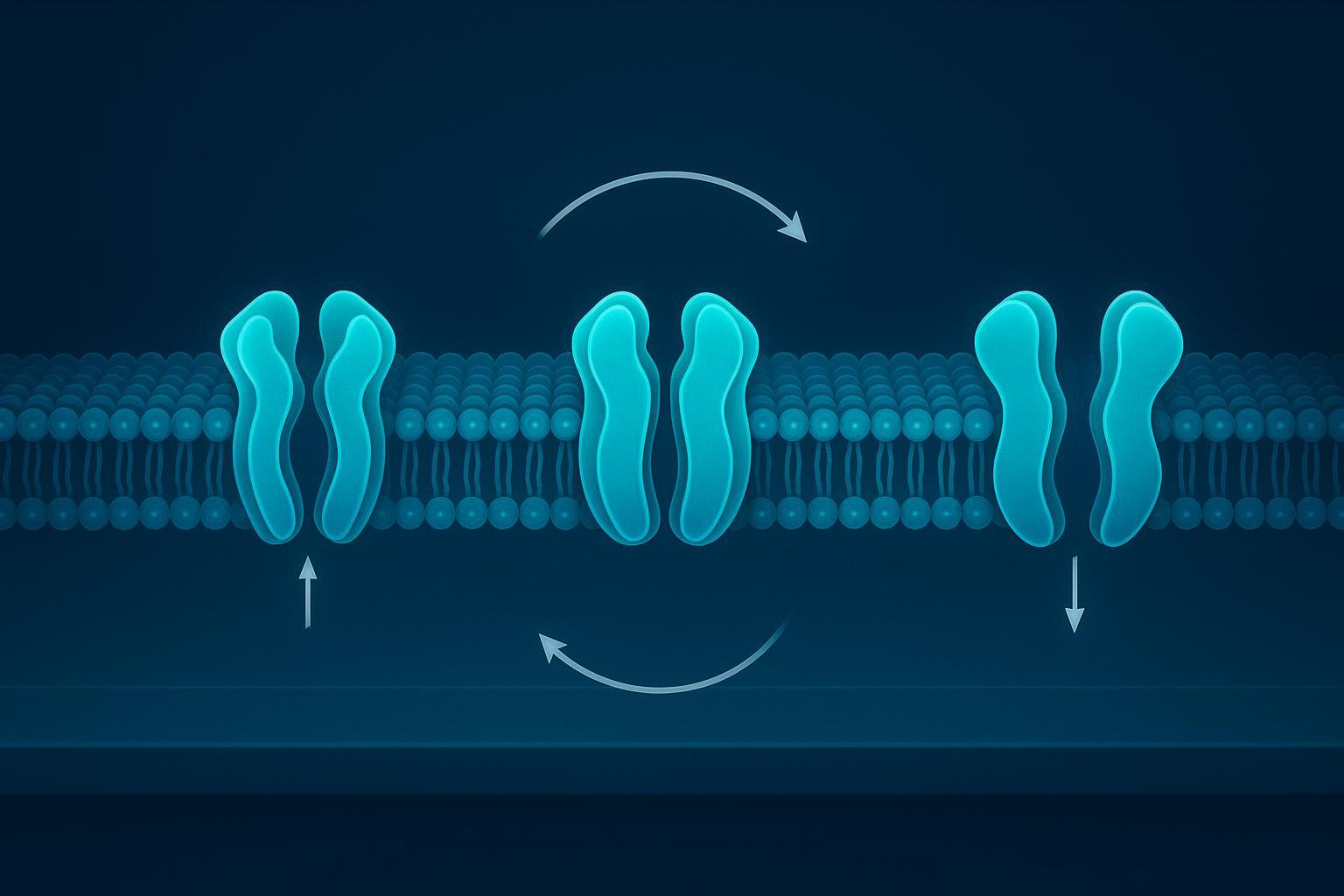
Los transportadores SLC son las proteínas transportadoras de solutos que mueven iones., nutrientes, neurotransmisores y fármacos a través de las membranas celulares, y los humanos tienen 464 miembros conocidos repartidos por 70 familias (Noticias-Médicas, 2026-09-10). También son sujetos de laboratorio inusualmente tercos., y las razones son estructurales más que procesales.

La dificultad comienza con la arquitectura.. Los transportadores SLC son proteínas de membrana integrales construidas a partir de muchas hélices transmembrana., lo que los hace difíciles de expresar, solubilizar, purificar y cristalizar (PMC, 2025-09-02). Muchos operan a través de un ciclo de acceso alterno., cambiando entre mirar hacia adentro, estados ocluidos y orientados hacia afuera, por lo que un solo experimento tiende a capturar una conformación en lugar de la imagen completa. Los niveles de expresión nativa suelen ser bajos, lo que complica la purificación, Generación de anticuerpos y trabajo estructural., y mover la proteína a una solución detergente puede distorsionar o desestabilizar la estructura que intentaba estudiar.
Las lecturas funcionales son igual de limitadas. Muchos SLC no tienen sustrato conocido ni ensayo secundario potente., y las mediciones de transporte se ven confundidas por la especificidad del sustrato, electroneutralidad, localización, direccionalidad y artefactos, con promiscuidad de sustrato superpuesta agregando otra capa de interpretación.
La consecuencia es una familia a la que la medicina apenas ha tocado. Los medicamentos existentes abordan sólo una pequeña fracción de la superfamilia SLC (Noticias-Médicas, 2026-09-10), y uno 2026 artículo de opinión estima el de una superfamilia que excede 400 miembros, aproximadamente un tercio no tiene ningún ligando conocido (Vanguardia de ensayos clínicos, 2026-09-07). esa combinación, difícil de expresar, difícil de mantener en un estado, difícil de medir, Es precisamente por eso que un reactivo peptídico bien caracterizado se gana su lugar en los primeros trabajos sobre transportadores..
Por qué los péptidos personalizados para la investigación del transportador SLC se ajustan al descubrimiento temprano
Los péptidos personalizados para la investigación del transportador SLC se ajustan al descubrimiento temprano porque están definidos por secuencia, reactivos etiquetables y modificables que se pueden construir contra objetivos donde los anticuerpos, Los compuestos de herramientas y la biología estructural se han estancado.. La brecha herramienta-compuesto es la evidencia más clara de ese ajuste.. A 2024 estudio de compuestos de herramientas SLC en Fronteras en farmacología proyectado 20,678 pequeñas moléculas únicas en 199 SLC y, después de aplicar criterios compuestos de herramienta, llegó a 6,876 inhibidores que cubren sólo 51 transportadores. La misma encuesta encontró que 530 de 810 Los pares compuesto/SLC seleccionados manualmente no estuvieron presentes en las bases de datos analizadas., y que para muchas SLC relevantes para enfermedades existe un ensayo aunque no se ha identificado ningún compuesto herramienta.
Conclusión clave: Cuatro palancas deciden si un reactivo peptídico funciona en el trabajo del transportador: la secuencia que elijas, la etiqueta que adjuntas, la modificación de estabilidad que aplicas, y la evidencia analítica que puedes mostrar para el lote.
La cascada de validación: Validación de objetivos, Vinculante, Imágenes, Desarrollo de ensayos
Ejecuta las cuatro aplicaciones en orden.. Los requisitos de reactivos y evidencia de cada etapa limitan la siguiente, Por lo tanto, adelantarse normalmente significa comprar el mismo péptido dos veces..
|
Escenario |
Requisito de reactivo |
Se requiere evidencia |
Puerta de decisión |
|---|---|---|---|
|
Validación de objetivos |
Unlabeled or minimally modified sequence |
The protein behaves as expected in your system |
Is this target worth the program? |
|
Servicios Vinculante |
Biotinylated or label-free peptide |
Your ligand engages the target |
Does the interaction hold? |
|
Imágenes |
Fluorescently labeled peptide |
Where the target is and how much |
Is the signal specific? |
|
Assay development |
Síntesis de péptidos Validated reagent from the stages above |
A reproducible, measurable change |
Can you run this at scale? |
The cascade is not theoretical. The first SLC-targeted candidates using activation, stabilisation and gene-therapy approaches are already in clinical development for epilepsy, autism spectrum disorders and chronic pain, with gene-therapy trials specifically evaluating SLC6A1-related neurodevelopmental disorders, GLUT1 deficiency syndrome and SLC13A5-related disease (Drug Target Review, 2026-09-11).
Assay development sits last for a reason: the functional-assay landscape for these transporters is narrow, so the readout you can build depends on what the earlier stages proved.
Diseño de secuencias personalizadas para objetivos de transporte

Sequence design starts from the region you need to interrogate, not from a catalogue. Decide first whether the peptide must mimic a natural transporter ligand, compete at a known binding site, o Comercio simply raise an antibody against a loop. That decision fixes the length, the terminal chemistry, and how much of the sequence can be changed without losing the interaction you want to measure.
SLC transporters are unusually unforgiving here. Their transmembrane stretches are hydrophobic and their cytoplasmic tails are often basic-rich, and both features make solid-phase assembly and reverse-phase purification harder than a typical soluble-protein epitope. Expect lower crude yield, more aggregation during cleavage, and a narrower purification window. PHT1 (SLC15A4) recruitment of TASL is a useful reference point: it shows SLC-ligand recognition resolved at the molecular level, which is the level of detail your sequence has to respect (Comunicaciones de la naturaleza, 2023).
Two practical rules follow. Order an unlabeled reference analog alongside every labeled version, so the label’s contribution can be measured rather than assumed. And treat sequence choice as the ceiling on later performance: no purification grade or assay optimisation recovers an interaction the sequence never encoded.
Etiquetas fluorescentes y de biotina: Elegir la sonda adecuada
Pick the label from the assay format, not from what ships fastest. Fluorescent labels suit imaging and subcellular localisation; biotin labels suit binding, pull-down and surface-capture formats. Get that order backwards and the reagent can invalidate the readout.
The caveat is worth stating plainly: the fluorophore itself can alter transport behaviour, so a labelled peptide is not automatically a faithful surrogate for the unlabelled one (PMC, imaging therapeutic peptide transport across intestinal barriers, 2021-06-15). Treat any shift in apparent affinity or uptake rate as a property of the conjugate until you have shown otherwise.
Biotin’s advantage is that it stays out of the optical path. A published single-cell flow cytometry uptake method quantitates peptide fluorescence per cell and uses sodium azide to separate energy-dependent internalisation from surface binding, then trypan blue, trypsin or pronase stripping to separate internalised from surface-bound peptide (PMC, single-cell flow cytometry peptide uptake assay, 2016-12-05). Those controls are what turn a fluorescence number into a mechanistic claim, and they only work if you know which side of the membrane your signal sits on.
Budget the label into the timeline as well as the design. N-terminal biotin, biotin-Ahx, FAM and FITC-Ahx additions carry roughly a two-business-day penalty on top of standard synthesis (GenScript custom peptide services, live service page, recuperado 2026-02-12).
|
Label |
Best-fit assay |
Main limitation |
Turnaround penalty |
|---|---|---|---|
|
Fluorescente (familia, FITC-Ahx) |
Imágenes, localización, flow-cytometry uptake |
Fluorophore can alter transport behaviour; needs azide and stripping controls to interpret |
+2 días hábiles |
|
Biotina / biotin-Ahx |
Vinculante, pull-down, surface capture |
No direct optical readout; needs a detection step |
+2 días hábiles |
|
Unlabelled |
Competition binding, transport kinetics |
Requires a separate detection method |
Ninguno |
Conclusión clave: Match the label to the assay format first, then confirm the conjugate behaves like the parent peptide before you build a conclusion on it.
Modificaciones que mejoran la estabilidad y sus compensaciones
Stability-enhancing peptide modifications extend how long a construct survives an assay, but the same chemistry that buys that window can shift how tightly the peptide binds its transporter. Treat every modification as a variable that needs its own control, not as a free upgrade.
The routine terminal protections cost nothing extra. N-terminal acetylation and C-terminal amidation are standard options, and suppliers typically offer them at no additional charge alongside a catalog of more than 300 functional-group modifications (GenScript). Terminal blocking mainly defends against exopeptidase trimming, which is often the first thing to erode a peptide in serum or a long incubation.
Each benefit carries a cost. Higher purity grades recover less material: research grade at 85-95% purity returns 40-60% of the crude, and ultra-pure material at 98% or above returns only 20-40% (KeriSite International, recuperado 2026-07-09). Counterion chemistry is a related constraint: trifluoroacetate stays firmly bound to the free N-terminus and to basic residues such as Arg, lis, and His, and removing it for a biocompatible salt form takes an extra ion-exchange step (Bachem, recuperado 2026-07-28).
Advertencia: A stabilized construct can silently change transporter affinity or narrow the very assay window you set out to measure. Run an unmodified comparator in the same experiment so any shift is attributable to the modification rather than to the peptide itself.
Pruebas analíticas y control de calidad: Lo que debe demostrar su paquete de datos

A purity percentage on its own proves nothing. The number only becomes evidence when it arrives with the method that produced it, the identity check that confirms the sequence, and the acceptance criteria the supplier committed to before the run. Ask for all three, and ask for the raw data behind them.
The purity figure you need depends on what the peptide has to do. Bachem’s guide to peptide quality control sets the thresholds at greater than 95% for receptor-ligand interaction studies and blocking or competition assays, 90 a 95% for quantitative enzyme-substrate work, and above 80% for Western blotting. A supplier quoting a single grade for every application is telling you they have not thought about yours.
Identity is a separate test from purity. Un péptido puede ser 98% pure and still be the wrong sequence. Wikipept’s QC reference accepts a measured mass within ±2 Da of the theoretical monoisotopic mass, widening to ±5 Da above 3 kDa, mientras ILS Labs reports tighter windows from LC-MS: ±0.5 Da on a single quadrupole and ±0.01 Da on high-resolution instruments. Match the tolerance to the instrument, and check that the reported mass is the observed one, not the theoretical value restated.
Then there is the gap between purity and quantity. Un vial etiquetado 10 mg may hold only 6 a 8 mg of actual peptide once counterions and moisture are counted, as ILS Labs notes in the same QC overview. That is why net peptide content belongs on the certificate alongside purity, and why basic-rich sequences routinely show low net content from salt formation, a point Bachem makes explicitly. Weigh your working concentration against net content, not vial weight, or every downstream molarity is quietly wrong.
Endotoxin requirements scale with the study. Research-grade material is commonly specified below 10 UE/mg, preclinical below 1 UE/mg, and clinical below 0.25 EU/mg under FDA parenteral limits, with LAL testing per USP <85> as the method of record (wikipept; ILS Labs). For cell-based transporter assays, the research-grade tier is usually sufficient, but the specification should be stated rather than assumed.
A complete research-use package therefore carries RP-HPLC purity run at UV 214 o 220 nm on a C18 column with an acetonitrile/0.1% TFA gradient, LC-MS identity, contenido neto de péptidos, LAL endotoxin per USP <85>, a rapid sterility screen, and heavy metals by ICP-MS per USP <233> and ICH Q3D (ILS Labs). Impurities above 0.5% should be characterised rather than merely counted, with LC-MS/MS used for sequence coverage and fraction identification (wikipept).
|
Prueba |
Método |
Typical acceptance criterion |
|---|---|---|
|
Pureza |
RP-HPLC, ultravioleta 214/220 Nuevo Méjico, C18, acetonitrile/0.1% TFA gradient |
>95% receptor-ligand and blocking assays; 90-95% enzyme-substrate; >80% Western blot |
|
Identidad Acerca de |
ESI-MS o MALDI-TOF; LC-MS single quad or high-resolution |
±2 Da (±5 Da above 3 kDa); ±0.5 Da single quad, ±0.01 Da HRMS |
|
Contenido neto de péptidos |
Quantitative amino acid analysis or nitrogen determination |
Reported per lot; expect 60-80% of vial weight |
|
Contraión |
Ion chromatography or NMR |
TFA o acetato, stated on the CoA |
|
endotoxina |
LAL per USP <85> |
<10 EU/mg research grade; <1 EU/mg preclinical |
|
Perfil de impurezas |
LC-MS/MS for peaks >0.5% |
Individual impurities identified and quantified |
The practical test of a data package is simple: could a reviewer reconstruct your result from it without contacting the supplier? If the chromatogram has no integration window, the mass spectrum has no observed value, or the net content is missing, the answer is no.
Consistencia entre lotes y lectura de un certificado de análisis
A certificate of analysis is a supplier’s claim about one batch, not a guarantee that the next batch will match it. Treat it as a starting point for verification, and specify the tolerances you will accept before you place the order.
The gap between a stated purity figure and a measured one can be wide. A 2022 inter-laboratory study found that peptides labeled at 98% or higher by single-method HPLC ranged from 94.2% a 99.1% when three labs re-ran them on different columns and mobile phases (KeriSite International, recuperado 2026-07-09). Method choice alone moves the number.
Independent re-analysis cases point the same way. In one set of five products re-tested from a larger group of 30, four measured more than 10% below their CoA purity, and a product listed above 98% came back at 67%. A separate example showed a 99.2% CoA whose intended-peptide content was 76% because a co-eluting 16-mer variant inflated the purity reading (KeriSite International, recuperado 2026-07-09). Tenga en cuenta la fuente: KeriSite is a competing supplier, and these cases are vendor-authored, so read them as an illustration of the failure mode rather than a neutral survey.
What a CoA reports varies by vendor. A major supplier’s QC suite includes water content by Karl Fischer titration, nitrogen content by elemental analysis as a peptide-content measure, residual TFA by ion chromatography, and co-elution against a reference standard (Bachem, recuperado 2026-07-28). If your CoA lists purity and molecular weight only, you are missing the fields that explain a mid-study shift.
Put the acceptance targets in the order itself. These are the batch-to-batch tolerances worth specifying:
|
Parámetro |
Acceptance target |
|---|---|
|
HPLC retention time |
±0.2 min |
|
Pureza |
±0.5% area |
|
Observed molecular weight |
±0.5 Da |
|
Peptide content |
±5% |
|
Contenido de agua |
± Péptidos sintéticos 2% |
|
Contenido de contraión |
±3% |
Suppliers working to tighter internal targets report purity CV below 0.5% and retention-time CV below 1.0%, with in-house specification pass rates above 95% (KeriSite International, recuperado 2026-07-09). Ask a prospective supplier for their multi-batch CV data, not just a single-batch CoA. Lot-to-lot consistency is a process claim, and the only evidence for it is a distribution across batches.
Conceptos erróneos comunes sobre los reactivos peptídicos en el trabajo de transportadores
The most expensive misconception in transporter work is that a high purity number means a valid reagent. Purity is one property among several, and the assumptions that quietly invalidate a peptide usually sit outside the purity figure entirely.
A labeled peptide is interchangeable with its unlabeled analog. No lo es. Adding a fluorophore or biotin changes molecular weight, hidrofobicidad, and often transporter affinity, so a labeled probe needs its own binding characterization rather than inheriting the unlabeled peptide’s numbers. Producción de péptidos
A certificate-of-analysis purity figure transfers across analytical methods. no lo hace. A value obtained by one HPLC method is not comparable to a value from a different gradient, columna, or detection wavelength, so compare figures only when the method matches.
Net peptide content is ignored when calculating molarity. Net peptide content changes every molarity calculation. Weighing out material by gross mass and treating it as pure peptide overstates the amount of active reagent in the tube, sometimes by a wide margin.
TFA-salt material goes straight into counterion-sensitive cell assays. Cell-based assays are affected by counterion, and the grade listed for those assays is ≥98% peptide content supplied as a TFA or acetate salt (KeriSite International, 2026-07-09). Where the counterion itself perturbs the readout, confirm the salt form before the assay, no después.
Conclusión clave: The costliest error is not a low purity number. It is a reagent that passed every stated specification while resting on an unchecked assumption about labeling, método, molarity, or salt form.
Un ejemplo resuelto: Una construcción a través de la cascada
A transporter team starting from a known substrate motif typically designs three peptides in parallel: an unlabeled reference analog, a fluorescently labeled probe, and a biotinylated capture reagent. The reference analog sets the baseline. Without it, a shift in signal from the labeled probe cannot be attributed to the label rather than to the sequence itself.
Sequence design begins with the recognition determinants the target is known to use, since how peptide recognition by an SLC can be resolved structurally depends on preserving those contacts. The labeled and biotinylated versions then carry the same core sequence, with the modification placed at a terminus or a solvent-exposed position rather than inside the binding face.
At the assay handoff, the azide and stripping controls establish that signal reflects specific binding rather than nonspecific adsorption. QC gates the construct before it reaches that step: the purity-by-application matrix confirms the peptide performs in the intended buffer and detection mode, and net peptide content, not gross weight, sets the molarity used in the binding calculation.
Limitaciones y cuándo los péptidos son la herramienta equivocada
Peptides are the wrong tool when a program needs a functional transport readout that does not yet exist. The transporter field has a narrow functional-assay landscape, so a peptide reagent can supply binding, localization or affinity data, but it cannot stand in for a measurement of transport itself. If the question is whether a substrate moves across a membrane, a peptide probe answers a different question.
Alternating-access mechanics impose a second boundary. Because these proteins cycle between inward- and outward-facing conformations, experiments often capture one state at a time, and a peptide optimized against one state may not report on the other. Label perturbation compounds this: attaching a fluorophore or biotin can invalidate a binding measurement outright, and stability-enhancing modifications can shift affinity enough that a stabilized construct no longer serves as a direct comparator against the parent sequence.
Treat any of these as a reason to reach for structural biology, a validated tool compound or an orthogonal assay instead. Over-claiming what a reagent class can prove costs a program quarter.
Empezando: Primeros pasos para un proyecto de péptido transportador
Define the assay the reagent has to serve before you request anything. The acceptance criteria come first: purity grade, contenido neto de péptidos, forma de sal, batch-to-batch tolerances, and the analytical methods that will demonstrate each one. A quote requested before those specs exist usually comes back with assumptions you did not choose.
Three steps remove most of the friction:
-
Write the acceptance criteria, then request the quote. State the assay format, buffer, working concentration, and the tolerances you will accept between lots.
-
Order an unlabeled reference analog alongside the labeled construct. It gives you a control for the label itself and a way to confirm that any signal change comes from the modification, no el péptido.
-
Request the full analytical package, not a purity figure. HPLC, espectrometría de masas, and a certificate of analysis let you verify identity as well as purity.
Plan the timeline around the chemistry. Standard custom synthesis runs about 2 a 3 semanas, secuencias modificadas 4 a 6 semanas, y conjugación 3 a 5 semanas (Tsingke peptide synthesis services, recuperado 2026-08-21). If your assay date is fixed, start with the modified construct.
If you want a second opinion on whether your target and readout are compatible before committing to a sequence, talk to an expert or request a feasibility assessment. MOL Changes offers custom peptide services, so treat this as a commercial interest when weighing the advice above.
Preguntas frecuentes
¿Qué grado de pureza necesito para un ensayo de unión del transportador??
Arriba 95% is the working threshold for receptor-ligand interaction and blocking or competition assays, per Bachem’s peptide purity guidance. Purity alone does not make a reagent fit for use: pair it with identity confirmation and a net peptide content figure before you calculate molarity.
¿Puede una etiqueta fluorescente cambiar la forma en que mi péptido interactúa con un transportador??
Sí. The fluorophore itself can alter transport behaviour, as reported in a 2021 study of fluorescent substrate analogues. Run an unlabeled comparator in the same assay so you can separate label effects from sequence effects.
How do I verify a peptide’s identity and not just its purity?
Verify by mass. Measured mass should fall within ±2 Da of the theoretical monoisotopic mass by ESI-MS or MALDI-TOF, tightening to ±0.5 Da by single-quad LC-MS and ±0.01 Da by high-resolution MS, according to ILS Laboratories’ analytical specifications. A purity trace without a mass spectrum tells you nothing about whether the correct sequence was made.
¿Qué significa el contenido neto de péptidos y por qué es importante??
Net peptide content is the mass of actual peptide in the vial once counterions and residual water are accounted for, and it can sit well below the purity figure. ILS Laboratories notes that 10 mg of lyophilized powder may contain only 6 a 8 mg de péptido, which changes every molarity calculation downstream.
¿Debo solicitar un formulario de TFA o sal de acetato??
It depends on the assay. Trifluoroacetate binds firmly to the free N-terminus and basic side chains and cannot be fully removed, so counterion-sensitive cell-based work calls for an ion-exchanged biocompatible salt, as Bachem and KeriSite both describe. Binding assays in buffer are usually tolerant of TFA; live-cell transport assays often are not.
¿Cuánta variación entre lotes debo esperar entre lotes de péptidos??
More than most researchers assume. Peptides labeled at 98% or higher by single-method HPLC ranged from 94.2% a 99.1% across three laboratories in a 2022 inter-laboratory comparison published in Amino Acids. Specify batch-to-batch tolerances in the order: retention time within ±0.2 min, purity within ±0.5% area, peptide content within ±5%.
¿Hacia dónde se dirigen los programas de transporte SLC??
Toward assay formats that read transporter function in living systems rather than in isolated membrane preparations, which raises the bar for probe design. Fluorescently labeled peptides for transporter imaging and biotinylated peptides for transporter binding studies are increasingly specified together in the same project so that one sequence serves both readouts.
Conclusión
The reagent is only as good as the analytical evidence behind it, and the cascade order decides which evidence you need first. A custom peptide for SLC transporter research earns its place in a project when the sequence fits the target, the label does not distort the biology you are measuring, any stability modification is justified against its trade-offs, and the data package proves identity, pureza, and net content rather than asserting them. Get the order wrong and you pay for it later, which is exactly where the lot-to-lot variability seen in independent re-analysis becomes expensive.
The field is not standing still. The emerging SLC programmes now in clinical development are pushing toward activation and gene-therapy modalities, so the reagent requirements you write into a specification today will keep shifting. Build the habit now: define the assay first, then the probe, then the analytical acceptance criteria. The first steps in Getting Started are the ones to take back to your team this week.