Why linker design in peptide conjugates changes performance at all
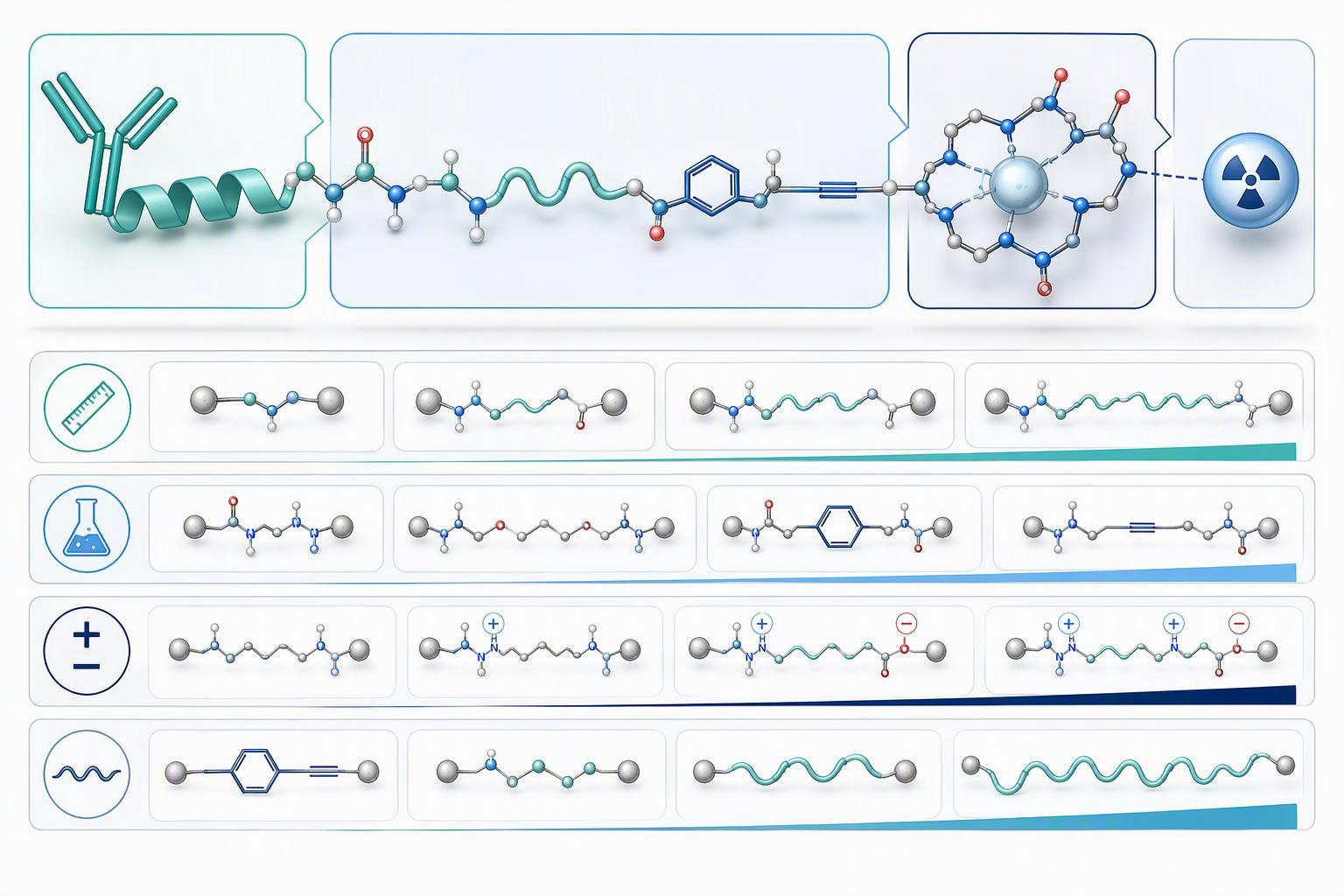
Linker hloov kev ua tau zoo vim nws tswj qhov chaw loj ntawm conjugate nyob ze rau qhov chaw txuas. Glu-urea-Lys PSMA pharmacophore txuas ntawm qhov ncauj ntawm ib qho chaw zoo li tunnel kwv yees 20 Å tob, thiab ib qho linker ntev tuav cov hlau chelated sab nraud qhov chaw ua haujlwm kom tsis cuam tshuam rau kev txuas; Chen et al. tau qhia tias ntev linker nce ntxiv txhim kho PSMA affinity thiab tumor uptake (PSMA ligands clinical-status review).

Qhov kev sib cav geometry tib yam piav qhia vim li cas PSMA linker tsis tuaj yeem hloov tau nrog GRPR linker. Hauv PSMA/GRPR heterodimer, Kev txo PEG segment los ntawm PEG6 mus rau PEG2 thaum ntxiv phenylalanine rau PSMA-side linker tau txhim kho PSMA IC50 kwv yees kaum npaug, Los ntawm 921 ± 363 nM mus rau 102 ± 80 nM, Thaum GRPR IC50 tseem nyob ntawm 4 ± 1 to 6 ± 3 nM (PSMA/GRPR heterodimer linker optimization). Ib qho linker hloov pab ib qho hom phiaj thiab tso lwm qhov tsis raug cuam tshuam hauv tib molecule.
Peb txoj kev ua haujlwm rov tshwm sim thoob plaws cov ntawv sau. Cov nqi tsis zoo tso rau hauv thaj chaw linker txo kev khaws cia hauv cov ntaub so ntswg tsis txo kev khaws mob cancer, Thiab hydrophobic naphthyl pawg nce kev txais mob cancer thaum txo kev khaws cia ntawm lub raum (PSMA ligands clinical-status review). s 2026 review adds that most optimization strategies work by changing linker structure to alter hydrophobicity and bioavailability, with a second class using cleavage to release cargo in vivo (Stoddard et al., Bioconjugate Chem 2026).
These are preclinical observations in mouse xenograft models. They establish mechanism and direction, not clinical outcome.
How does linker length change binding, tumor uptake and clearance?
Length effects are large, and they are not monotonic. In a matched five-linker PSMA series built on the same pharmacophore, KD spanned roughly 1,700-fold: 4.39 nM for the 2-naphthyl-L-Ala reference, 147 nM for 4-bromophenylalanine, 3,130 nM for tranexamic acid, 7,520 nM for L-Phe and 7,500 nM for L-Tyr (a matched five-linker PSMA series, Pharmaceutics 2022).
Ntev kuj cuam tshuam rau kev txais mob cancer hauv qhov tseeb. Linker-optimized PSMA-617 series tau mus txog 10.58 ± 4.50 %ID/g at 24 h versus 3.20 ± 2.89 %ID/g rau PSMA-11 tib lub sijhawm, kwv yees li 3.3-npaug siab dua, muab rau tus linker uas tau optimize (Benešová et al., J Nucl Med 2015). Kidney retention hauv series ntawd poob ntawm 113.3 ± 24.4 %ID/g at 1 h mus rau 2.1 ± 1.4 %ID/g at 24 h (PSMA ligands clinical-status review).
PEG ntev tuaj yeem hloov affinity, kev ncig ntshav, kev sib txuas protein thiab kev puas tsuaj raws li kev tsim kho. Sib txawv kev ruaj khov ntawm cov ntshav hauv vitro ntawm ib qho half-life pharmacokinetic hauv vivo thiab khaws cov hom tsiaj thiab cov xwm txheej assay uas tau kawm. Cov piv txwv tau hais tsis tsim tau ib qho zoo tshaj plaws ntawm PEG ntev thoob ntiaj teb.
Qhov tshwm sim hauv kev faib tawm ntawm radiolabeled peptide yog tias qhov zoo tshaj plaws yog tshwj xeeb rau cov qauv. Nws tsis tuaj yeem nyeem tau ntawm ib daim ntawv ntev, thiab cov series sib phim yog txoj kev tsuas yog nrhiav tau nws.
How does linker chemistry change affinity and biodistribution?
Chemistry class matters as much as length, and the chelator-proximal region is where it shows first. PSMA-11, which carries an Ahx linker, has a Ki of 12.0 ± 2.8 nM versus 37.6 ± 14.3 nM for the DOTA analogue, about 3-fold better affinity, with tumor uptake of 7.7 ± 1.5 %ID/g and 5.7-fold lower liver uptake (PSMA ligands clinical-status review).
Adding an aromatic residue to the linker can recover affinity that a long hydrophilic segment costs. The phenylalanine addition described above worked alongside the PEG2 shortening, and the authors attribute the gain to hydrophobic interactions with Phe546 and Trp541 at the entrance funnel to the PSMA active site (PSMA/GRPR heterodimer linker optimization).
Restricted-turn linkers on a GRPR antagonist tell a different story. Against the short PEG2 reference at 0.4 nM, IC50 was 0.27 nM for NOTA-mMA-RM26, 1.3 nM for oMA and 3.4 nM for oET, so one rigid aromatic linker improved affinity while another was 8.5-fold worse (RM26 GRPR linker series, EJNMMI Radiopharm Chem 2025).
The chemistry lesson is that the same class of modification can improve affinity and worsen biodistribution at once. The two most lipophilic analogues in the matched PSMA series showed significantly higher blood, liver and GI-tract uptake and were dropped from in vivo study (a matched five-linker PSMA series, Pharmaceutics 2022).
How does linker charge change kidney uptake and tumor-to-background ratio?
Charge is the lever most directly aimed at the tumor-to-background ratio peptide conjugates live or die by, and it is the least predictable. In an eleven-member charged-linker PSMA-617 series, IC50 ranged from 10.40 ± 2.94 nM mus rau 78.6 ± 44.1 nM against PSMA-617 at 21.77 ± 3.13 nM, and only PS8, with glutamate units next to the chelator, beat the parent at 10.40 ± 2.94 nM (P = 0.004) (the 2026 charged-linker PSMA-617 series).
Tumor uptake and renal washout diverged from affinity. Tumor SUV at 1 h was 1.32 ± 0.08 for PS8 and 1.15 ± 0.04 for PS4 versus 0.63 ± 0.02 for PSMA-617, but PS8 and PS4 also showed slow renal washout, with kidney SUV of 2.70 ± 0.89 at 2 h for PS8 and 3.81 ± 0.15 at 1 h for PS4 (the 2026 charged-linker PSMA-617 series).
A tumor-to-kidney ratio at one time point is one observation. Evaluate time-integrated activity, absolute uptake, other organs and relevant dosimetry before comparing therapeutic potential; a favorable isolated ratio does not identify the preferred construct.
The direction of the charge effect depends on the scaffold. In the PSMA/GRPR heterodimer, the best-affinity construct still had tumor-to-kidney below 0.5 at every timepoint with either 68Ga or 111In (the BQ7812 preclinical characterisation). A 2024 albumin-binder linker study shows how far position alone can swing the balance: the same linker placed at two positions changed the tumor-to-kidney AUC ratio from 4.31 to 0.18 (a 2024 albumin-binder linker study).
How does linker flexibility trade receptor access against entropic penalty?
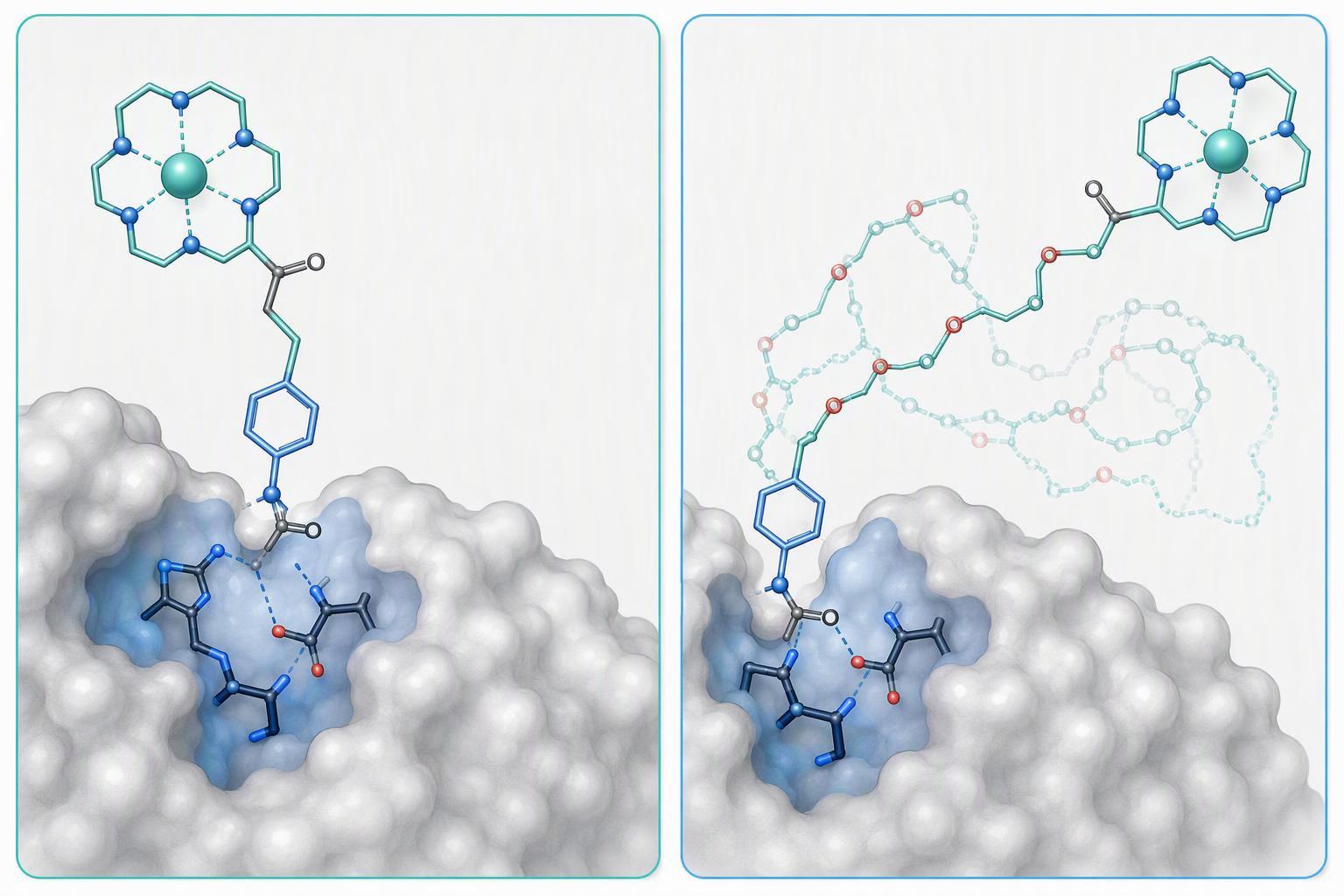
Flexibility is a trade, not a virtue. A longer PEG linker allows more flexibility in the molecule and thereby more steric hindrance, which the heterodimer authors identify as a likely reason the PEG6 variant bound PSMA worse than the PEG2 variant (PSMA/GRPR heterodimer linker optimization).
Rigidity can be engineered in, and it carries its own charge consequence. Piperazine is a 6-atom heterocycle that introduces rigidity, basicity and moderate lipophilicity, with endocyclic pKa values around 9 and around 5, so at least one nitrogen is protonated at physiological pH and the linker carries a positive charge (Stoddard et al., Bioconjugate Chem 2026).
The evidence for a measured flexibility optimum in radiopharmaceuticals is thinner than for length or chemistry. The thermodynamics are supported at review level rather than by a matched experiment that rigidified only the linker and measured both affinity and pharmacokinetics, so the mechanism is best stated qualitatively.
What the matched experiments do show is that flexibility changes are entangled with hydrophobicity. The restricted-turn RM26 linkers raised tumor uptake to 11.2 %IA/g (oET), 10.2 %IA/g (oMA) thiab 12.3 %IA/g (mMA) at 2 h versus 5.4 ± 1 %IA/g for the PEG2 reference, but kidney uptake rose to 6 to 8 %IA/g from 1.9 ± 0.3 %IA/g, with the authors implicating LDLR-mediated off-target binding and hepatobiliary excretion (RM26 GRPR linker series, EJNMMI Radiopharm Chem 2025).
How do linker changes show up in analytical characterization?
A linker change is a molecular structure change, and identity testing has to be specific enough to see it. ICH Q6B states that identity tests “should be highly specific for the drug substance and should be based on unique aspects of its molecular structure and/or other specific properties,” with the same wording applied to drug product (ICH Q6B on specification setting).
Purity is estimated by a combination of methods because absolute purity is difficult to determine and results are method-dependent, and the analytical procedures should focus on separating the desired product from product-related substances and impurities (ICH Q6B on specification setting). For a linker-modified peptide, that means the chromatographic method has to resolve the linker variant from its positional isomers and deletion products, not just report a single area percent.
K. e, v, identity and potency, r (u).
a(R2), adopted 2023-11-01, j(R1) from November 2005 k, h, o, v (ICH Q2(R2), the current revision of the validation guideline).
How should a team specify a linker and plan analytical and biological testing together?
Synthesis Of Polypeptide Manufacturer Specify the linker as a set of fields, then test the fields together rather than in sequence. The design principle that modification chemistry, chaw txuas, linker architecture, sequence composition, purification method and analytical method should be evaluated together, not as isolated choices, is the organizing rule for the worksheet below.
|
Specification field |
What to record |
Why it changes the result |
|---|---|---|
|
Attachment site |
N-terminus, C-terminus, lysine side chain, cysteine |
The same linker at two positions changed the tumor-to-kidney AUC ratio from 4.31 to 0.18 (a 2024 albumin-binder linker study) |
|
Linker class Synthetic Polypeptide Manufacturer and length |
PEG units, Ahx, aromatic residue, restricted turn |
KD spanned about 1,700-fold across a matched PSMA series (a matched five-linker PSMA series, Pharmaceutics 2022) |
|
Charge state |
Neutral, anionic, cationic, zwitterionic |
Charge placement changed IC50 and renal washout independently (the 2026 charged-linker PSMA-617 series) |
|
Flexibility |
Linear, rigidified, cleavable |
Merrifield State Peptide Synthesis Longer PEG added steric hindrance in one heterodimer (PSMA/GRPR heterodimer linker optimization) |
|
Radion Microwave Induced Organic Synthesis uclide |
68Ga, 111In, 177Lu, 205/206Bi |
BQ7812 showed lower liver uptake with 68Ga than 111In, and the authors state the ligand must be re-evaluated when the radiolabel changes (the BQ7812 preclinical characterisation) |
|
Analytical package Stapled Peptides Manufacturer |
Identity, purity, potency, stability methods |
Identity must be specific to molecular structure; no single stability-indicating assay suffices (ICH Q6B, Q5C) Microwave Peptide Synthesis |
Use matched in vitro and biodistribution studies with the intended radionuclide. Assess all relevant organs and time-integrated exposure; kidneys are an important concern for many PSMA constructs but are not the only possible dose-limiting tissue. Ib qho cim npe kho mob tsis kwv yees txog qhov kev pheej hmoo ntawm ib qho linker variant tshiab.
What the evidence does not settle
Qhov loj tshaj plaws yog tsis muaj qhov chaw twg piv cov kev hloov linker ncaj qha hauv tib scaffolding, tib radionuclide thiab tib qauv mob cancer thoob plaws PSMA thiab GRPR. Cov series PSMA uas tau sib piv nws tus kheej hais tias nws cov lead compound thiab PSMA-617 tsis tau piv ncaj qha hauv tib lub system (a matched five-linker PSMA series, Pharmaceutics 2022).
Yog PEG ntev dua pab lossis ua rau mob yog qhov sib cav tiag tiag. s 2026 kev tshuaj xyuas piav PEG chains tias tau qhia ntau zaus tias txhim kho pharmacokinetic thiab pharmacodynamic profiles, thaum tseem sau tseg txog kev poob ruaj khov thiab affinity ntawm PEG12 thiab anti-PEG antibody kev pheej hmoo (Stoddard et al., Bioconjugate Chem 2026). Heterodimer txoj haujlwm pom tias PSMA uas ntev dua PEG6 variant txuas nrog phem dua PEG2 (PSMA/GRPR heterodimer linker optimization). Cov ntaub ntawv heterodimer yog target- thiab scaffold-specific, so they narrow the general claim rather than overturn it.
Higher affinity does not reliably produce longer tumor retention. The heterodimer authors hypothesized that increased PSMA affinity would prolong retention, but the higher-affinity construct showed no enhanced retention and washed out rapidly, contradicting earlier findings for a different construct (PSMA/GRPR heterodimer linker optimization).
Linker effects on cellular processing are reported as negligible in one system and significant in another. The heterodimer study found linker composition did not significantly affect cellular processing, with about 20% internalized at 24 h (PSMA/GRPR heterodimer linker optimization), while the PSMA-617 analogue study found significant internalization differences for specific glutamate and histidine insertions (the 2026 charged-linker PSMA-617 series). The two use different scaffolds, so the second narrows the scope of the first rather than refuting it.
Absolute affinity values for the same compound differ by assay. PSMA-617 Ki is 2.34 ± 2.94 nM by LNCaP cell-based competition versus 0.37 ± 0.21 nM by the NAALADase enzyme assay (Benešová et al., J Nucl Med 2015), and a separate study reports an IC50 of 21.77 ± 3.13 nM for PSMA-617 in LNCaP cells (the 2026 charged-linker PSMA-617 series). The cell-based values are the comparable pair; the enzyme-assay figure reflects a different measurement system rather than a disagreement about the molecule.
No source in this set establishes a quantitative relationship between linker hydrophobicity and human absorbed dose, and no clinical outcomes are reported for any of the linker-modified constructs discussed here. The heterodimer authors state that translation into the clinic is yet to occur (the BQ7812 preclinical characterisation).
Where linker design is heading
The direction of travel is toward linkers that do work rather than linkers that merely hold. s 2026 review divides the field into static linkers, meant to remain intact throughout transit, and dynamic linkers, meant to release their cargo in vivo, and notes that the most common optimization strategies change linker structure to alter hydrophobicity and bioavailability (Stoddard et al., Bioconjugate Chem 2026).
Zwitterionic linkers are the clearest example of an underexplored class. They carry equal numbers of positive and negative groups, which greatly enhances hydrophilicity, and they remain rare in radiopharmaceuticals (Stoddard et al., Bioconjugate Chem 2026).
The cited NAPamide study concerns a melanocortin-1-receptor-targeting scaffold, not a GRPR ligand. Adding an albumin-binding group altered circulation and tissue distribution in its mouse model. These results support construct-specific testing and cannot be transferred directly to a GRPR or PSMA conjugate. Primary NAPamide study.
The clinical anchor is already in place. Pluvicto, the approved PSMA-617 radioligand, is a PSMA-binding ligand bound to a DOTA chelator labelled with Lu-177, dosed at 7.4 GBq every 6 weeks for up to 6 doses (the approved PSMA-617 product label). Its linker was optimized preclinically, which is the strongest available argument that linker work translates.
Cov Lus Nug Nquag Nug
Does a longer linker always improve tumor uptake?
Longer linkers do not guarantee better uptake. A tested series may have an interior optimum, a monotonic trend or no meaningful change. Compare matched constructs and endpoints; do not assume that every scaffold must have the same shape of response.
Can one linker change help one target and hurt another in the same molecule?
Yog, and a bispecific construct is where this bites hardest. Hauv PSMA/GRPR heterodimer, trimming the PEG segment and adding a phenylalanine residue improved PSMA potency by about tenfold while GRPR binding held steady in the low-nanomolar range (PSMA/GRPR heterodimer linker optimization). Y, o.
Cov linker them nqi puas ib txwm txo kev txais ntawm lub raum?
PM, g. Across an eleven-member charged-linker PSMA-617 series, l, i, which left their tumor-to-kidney ratios worse than the parent’s (the 2026 charged-linker PSMA-617 series). n, t.
Puav leej puas hloov cov txiaj ntsig linker ntawm radionuclides?
PM. a: w, and the authors state that the ligand must be re-evaluated when the radiolabel changes (the BQ7812 preclinical characterisation). A linker optimised for one isotope is a hypothesis for the next one, n.
Puav leej puas muaj peev xwm piv cov nqi affinity los ntawm ntau yam kev sim?
Only within the same measurement system. Cell-based and enzyme-assay values for the same PSMA-617 construct do not agree, so a KD from one platform cannot be set against an IC50 from another. Compare linker chemistry for radiolabeled peptides only against values generated by the same assay, same target preparation and same conditions.
Puav leej puas yog cov linker uas tuaj yeem txiav tau zoo dua cov uas tsis tuaj yeem txiav?
t. s 2026 review of linker chemistry in radiopharmaceutical design draws the distinction as static versus dynamic linkers, and the choice follows the payload and where release is meant to happen rather than any ranking between the two (the 2026 review of linker chemistry in radiopharmaceutical design). Ib qho radiolabel uas nyob ruaj khov thiab ib qho cytotoxic payload uas yuav tsum tau tso tawm hauv cell yog teeb meem sib txawv.
Dab tsi yuav tsum muaj hauv ib qho linker specification tsawg kawg nkaus?
Daim ntawv teev teb chaws hauv daim ntawv qhia tshwj xeeb: chaw txuas thiab residue, spacer chemistry thiab ntev, lub xeev them nyiaj, kev cia siab tias yuav txiav tau, cov txheej txheem tshuaj ntsuam uas yuav lees paub txhua qhov ntawd, thiab cov ntaub ntawv biological uas yuav kuaj lawv. Peptide hloov kho thiab conjugate characterization yuav tsum muaj nyob hauv tib daim ntawv nrog synthesis request, vim ICH Q6B thiab ICH Q5C teeb tsa qhov kev cia siab tias ib qho specification yuav tsum ntsuas dab tsi thiab txog qhov kev lees txais twg (ICH Q6B, ICH Q5C).
Xaus lus
Linker tsim hauv peptide conjugates yog ib qho teeb meem plaub yam nrog ib qho lus teb tshwj xeeb rau kev tsim. Ntev tuaj yeem hloov affinity thoob plaws peb theem loj thiab kev txais mob cancer ntau dua peb npaug, but the PEG data show the curve turns back. Chemistry can recover affinity that a hydrophilic segment costs, and it can also concentrate the conjugate in liver and GI tract. Charge can raise tumor uptake and destroy the tumor-to-kidney ratio in the same series. Flexibility trades receptor access against steric hindrance, and the measured optimum is thinner in the literature than the mechanism suggests.
The practical takeaway is procedural. Specify attachment site, linker class and length, lub xeev them nyiaj, flexibility and radionuclide as fields, then run the matched series in vitro, the biodistribution study with the intended label, and the organ-specific ratio that limits your application. Plan the analytical package at the same time: identity specific to molecular structure, purity by combined methods, and a product-specific stability profile, tau lees paub raws li kev hloov kho tam sim no ntawm txoj cai pov thawj.
Cov pov thawj tsuas yog nyob rau hauv cov qauv ua ntej kev sim xwb. Tsis muaj qhov chaw twg ntawm no txuas ib qho linker hloov kho tshwj xeeb rau qhov tshuaj uas tib neeg nqus tau lossis qhov tshwm sim hauv kev kho mob, yog li saib txhua txoj kev cuam tshuam raws li ib qho kev xav los kuaj hauv koj tus kheej scaffold es tsis yog ib txoj cai siv.
Tsab ntawv no yog kev kawm thiab tsis yog ib qho kev pom zoo khoom.*