What the MIT antibiotic campaign and the enzyme search actually demonstrated
Peptides Supplier Factory Peptide Tech The two campaigns demonstrated search and prioritization at scale, not validated drug candidates. s Cell work combined fragment-based and de novo generative models and pushed 36 million predicted compounds through filters to 24 synthesized molecules, seven of them antibacterial (Krishnan et al., Cell, 2025). The gonorrhoea track’s funnel shows the cost: 6,937,677 generated molecules, 678 left after filtering, 80 prioritized for synthesis, 27 attempted, thiab tsuas yog 2 ntawm 27 attempted compounds were synthesizable.
The MRSA track ran 29,014,974 generated molecules to 90 shortlisted, 22 procured, thiab 6 active at 64 μg/mL, which the authors report as the MRSA track’s 27.3% true discovery rate. The lead compound matters biologically: NG1 binds LptA, an outer-membrane construction protein that existing antibiotics do not target, and its 0.5 μg/mL MIC against N. gonorrhoeae came with roughly a 3-log CFU reduction in a mouse vaginal model. Both pathogens sit on the 2024 WHO priority list as high priority.
The enzyme story is a different kind of evidence. The report’s agents recovered 198,290 reverse-transcriptase clusters, scored 3,564 candidate partner protein families, and promoted 17 to human-readable reports. The report itself carries the “ART (hypothesis)” label and states that the findings await experimental characterization. Independent reporting notes the report has not been peer reviewed and that the same reverse transcriptase appeared in a 2021 jumbo-phage paper (Wired, 2026).
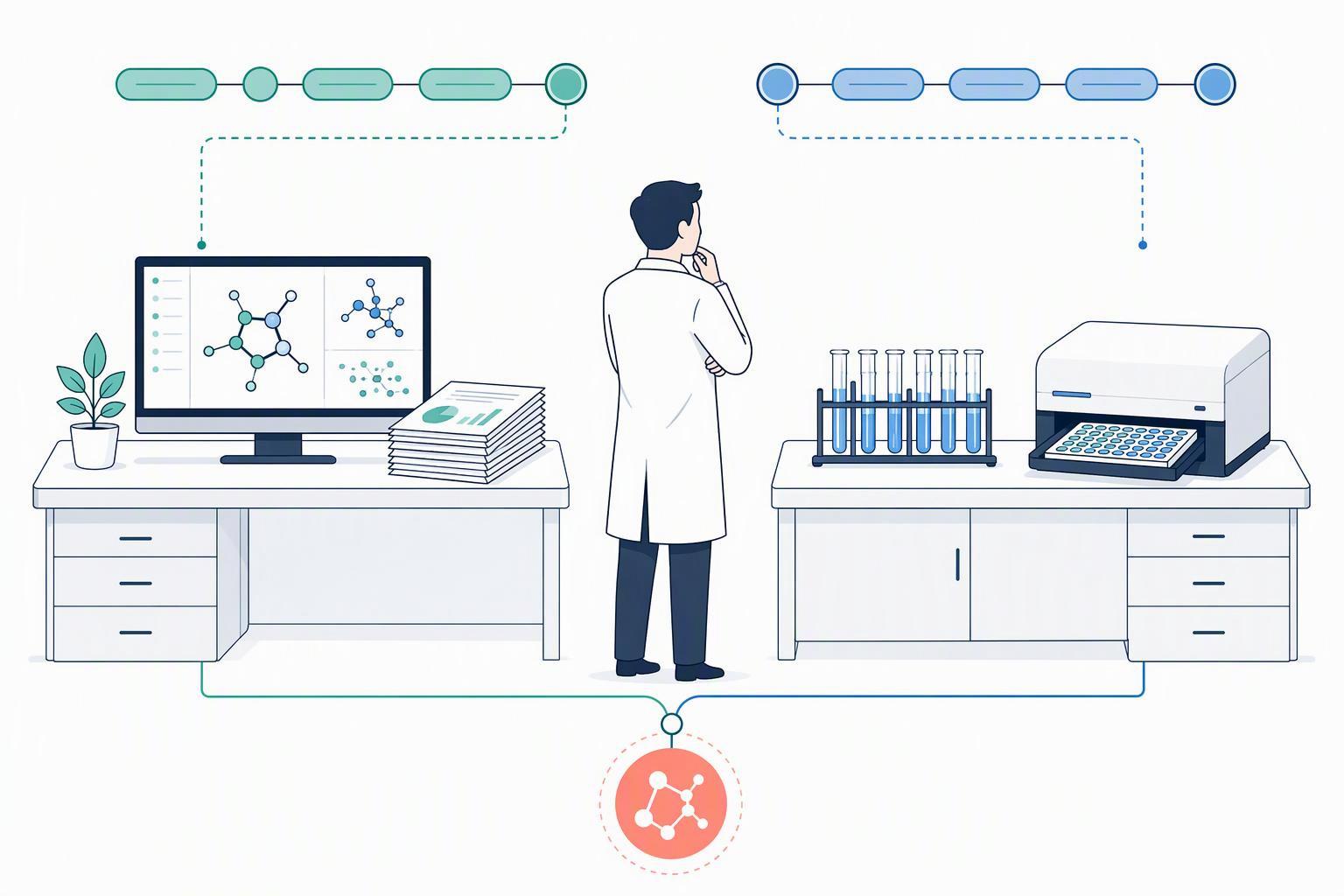
Why tens of millions of candidates collapse to a few dozen synthesized compounds
Cov kev tshaj tawm uas tau hais txog qhia tias kev tsim thiab kev sim tuaj yeem txwv kev tshawb nrhiav tshwj xeeb. Lawv tsis pov thawj tias kev kwv yees xwb txaus lossis tias kev tsim tshuaj yog qhov teeb meem loj tshaj plaws hauv txhua qhov kev pab cuam peptide. Ntsuam xyuas ob qho chaw.
Cov kev pab cuam peptide ntsib tib qho kev txwv los ntawm txoj kev sib txawv. Ib qho kev sib tw peptide tsim tau tshaj tawm 86 ntawm 100 cov peptides tsim tau ua haujlwm, tab sis kev tsim tsuas yog txwv rau cov sequences uas qis dua ib qho ntev 50 residues, thiab 1 ntawm 20 benchmark peptides tsis tau tsim tau kiag li (ApexGO, Nature Machine Intelligence, 2026). A 100% tus nqi ua tiav synthesis ntawm 20-peptide benchmark tsis zoo ib yam li 86% kev ua haujlwm ntawm peptides loj dua 100 peptides, thiab ob qho lej no tsis siv rau hydrophobic 40-mer.
How synthesis feasibility becomes an input to candidate ranking
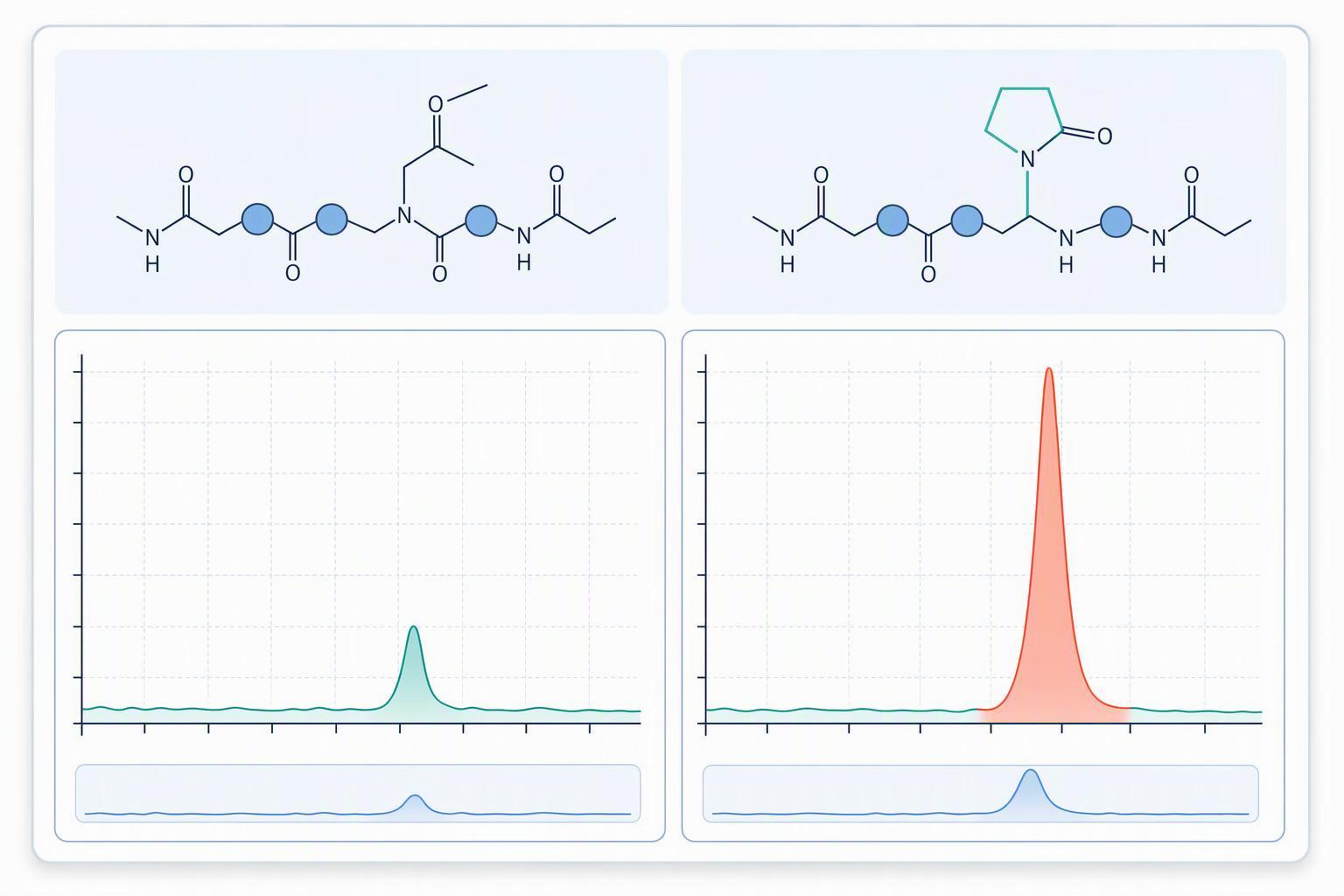
kev ua tau yuav tsum suav nrog hauv txoj haujlwm ntsuas, tsis txhob muab tso rau hauv kab tom qab ntsuas. A model that ranks by predicted activity alone will keep handing the lab sequences the lab cannot make, and every failed coupling costs a cycle the campaign cannot get back. The cost is measurable. A 2026 Nature Chemistry study of 539 sequences found that pseudoproline substitution lifted crude purity from 23% to 69% for an hGH fragment and from 17% to 75% for a GB1 fragment, with aggregating sequences flagged by deprotection peak broadening above 20% relative to the first coupling (Tamás et al., Nature Chemistry, 2026).
The same work shows what to score. Aggregation-promoting residue composition, not the exact sequence, carried most of the predictive signal: Ser(t-Bu), Ile, Val and Thr(t-Bu) raised the likelihood most, Gln(Trt) and Leu contributed heavily, the Gly–Ser and Leu–Leu motifs mattered, and aggregation typically set in 5 to 15 residues from the resin anchor.
Pro Tip: Five feasibility inputs to add to the ranking function: aggregation-proone composition, motif flags, length piv rau synthesizer validated range, modification complexity, thiab purification risk. Ib sequence uas tau zoo rau activity thiab tsis zoo rau tag nrho tsib yog queue item, tsis yog candidate.
Muaj ib lo lus nug integration tseem qhib. ApexGO optimizer uas tau piav hauv MIT tsis zoo li ua qauv rau aggregation propensity, yog li design-to-synthesis workflow tseem yuav tsum muaj txheej ntawd ntxiv ntawm model output thiab synthesis queue.
Validated txhais li cas rau AI-nominated peptide
Validate txhua method rau yam ntxwv uas xav tau. HPLC purity thiab MS identity result teb tau cov lus nug ntxiv, tab sis tsuas yog sib txuas xwb tsis qhia tau orthogonal ntawm txhua yam qauv lossis validate quantitative potency thiab content.
|
Attribute |
Lus nug nws teb |
Primary method |
Orthogonal partner |
Standard |
Kev tsis muaj CoA uas tshwm sim ntau |
|---|---|---|---|---|---|
|
Identity |
Qhov no puas yog sequence Synthetic Peptide Supplier tau xaj? |
LC-MS |
Kev tshuaj xyuas amino acid lossis MS/MS sequencing |
ICH Q6B |
Mass tau tshaj tawm tsis muaj kev txhais |
|
Kev huv si |
Muaj pes tsawg peptide hom phiaj? |
RP- Purepeptides HPLC |
HPLC rau lwm yam tshuaj |
ICH Q2(R2) |
Area percentonly, tsis muaj ntaub ntawv txog txoj kev |
|
Potency |
Puas ua tau zoo hauv kev tshuaj ntsuam? |
Kev tshuaj xyuas functional |
Orthogonal bioassay |
ICH Q6B Peptide Source |
Tsis tau tshaj tawm rau pawg tshawb fawb |
|
Cov ntsiab lus |
Muaj pes tsawg peptide nyob hauv lub raj tshuaj? |
Kev ntsuas lej |
Kev sib npaug ntawm qhov hnyav |
ICH Q6B |
Tsis muaj cov ntsiab lus peptide net |
|
Endotoxin |
Cov khoom puas nyab xeeb rau kev tshuaj ntsuam? |
LAL kuaj |
Kev tswj hwm haum rau txoj kev |
USP <85> |
Kev txwv tsis tau hais tseg |
Rau kev tshuaj ntsuam hauv hlwb, piav qhia kev tswj endotoxin los ntawm kev tshuaj ntsuam, kev ntsuas thiab kev cuam tshuam. Parenteral K/M txwv tsis yog cov qauv kuaj hlwb default. Endotoxin, cov kab mob muaj sia thiab cov khoom muaj sia yog cov yam ntxwv sib txawv thiab xav tau kev tswj hwm tsim nyog thaum tsim nyog.
What makes peptide material assay-ready, and how to rule out artifacts
Assay-ready peptide material is material whose behaviour in the assay has been separated from the assay’s own interference. The standard aggregation counterscreen exists because peptides aggregate at low-to-mid micromolar concentrations, forming particles 100 to 500 nm across that bind protein in the picomolar range and are invisible to the eye (Auld, Inglese & Dahlin, Assay Guidance Manual, 2017).
Select aggregation, membrane-damage, adsorption and vehicle controls for the actual assay. Literature concentrations or LDH response ranges are not universal acceptance limits, and detergent may itself alter a membrane-active peptide’s mechanism.
What governance separates computational promise from validated performance
Governance separates the two by keeping the model’s output and the measured result in separate, versioned records, thiab tsis cia ib qho hloov rau lwm qhov. The Part 11 audit-trail language txhais ib daim ntawv hluav taws xob raws li kev sib xyaw ntawm ntawv, graphics, Data, suab, duab lossis lwm yam ntaub ntawv uas tsim, modified, maintained, archived, tau txais los yog faib los ntawm computer system, thiab ua rau computer systems thiab lawv cov ntaub ntawv raug FDA tshuaj xyuas (21 CFR Part 11, eCFR).
Qhov ntawd tswj cov ntaub ntawv, tsis yog qauv raug cai. Tsis muaj dab tsi hauv txoj cai hais tias generative model yog qhov tsim nyog vim nws cov txiaj ntsig tau sau tseg. Enzyme campaign qhia tias qhov txawv ntawd tseem ceeb: daim ntawv tshaj tawm nws tus kheej hais tias qhov haujlwm tsis paub nyob ib sab ntawm kaum qhov rov ua dua uas tsis tau rov tshwm sim raws li kev tshawb pom.
|
Claim |
Status |
Dab tsi yuav ua rau nws mus tom ntej |
|---|---|---|
|
36 lab compounds tsim |
Qhia tau, tau tshuaj xyuas los ntawm cov kws tshaj lij |
Tsis muaj ntxiv |
|
6 ntawm 22 MRSA compounds ua haujlwm hauv vitro Peptide Test Manufacturer |
Qhia tau, tau tshuaj xyuas los ntawm cov kws tshaj lij |
Independent replication |
|
NG1 efficacy in a mouse model |
Demonstrated in animals only |
No clinical claim permitted |
|
ART system function |
Hypothesis, not peer reviewed |
Experimental characterization |
|
Model ranking predicts synthesis success |
Not established |
Prospective synthesis data |
What a peptide program should change now
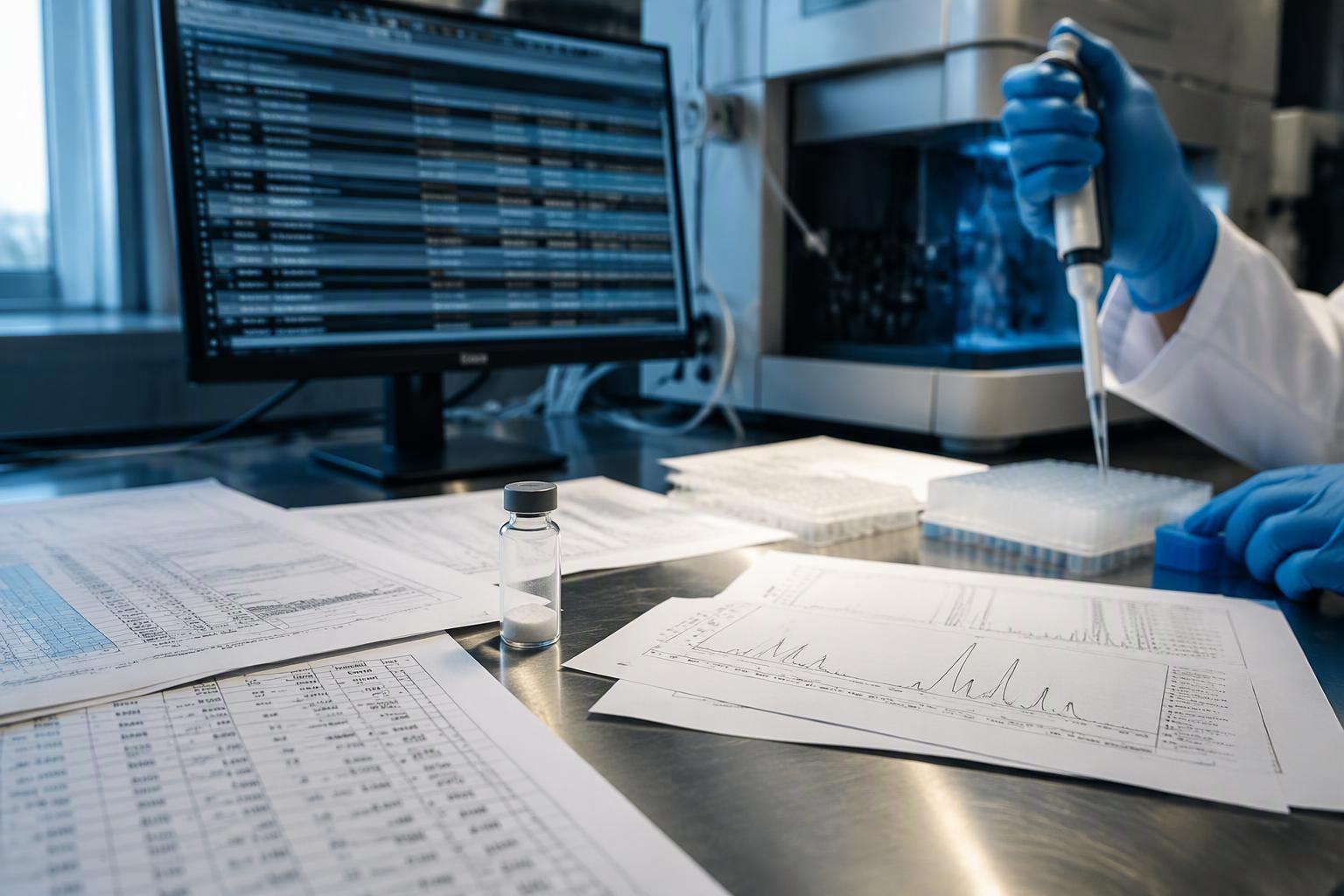
Change the ranking function first, then the analytical package, then the records. Concretely: add feasibility scoring before the shortlist, require an orthogonal identity method on every lot, run aggregation counterscreens before believing primary actives, and keep model output and measured results in separate versioned records with an audit trail.
Where synthesis is the constraint, the supplier conversation matters more than the model. Our team at MOL Changes runs Fmoc solid-phase synthesis with reverse-phase HPLC and mass spectrometry data supplied with every custom peptide order, covers N-terminal, C-terminal and side-chain modifications including cyclisation, disulfide bridges, non-natural amino acids and stable isotope incorporation, and scales from milligrams to kilograms through lyophilisation. Facilities use dual isolation, HEPA filtration and positive-pressure space, with in-process testing of purity, content, endotoxin, pH and sterility under a self-inspection regime.
|
Window |
Action |
|---|---|
|
30 hnub |
Add the five feasibility inputs to the ranking function; audit the last three CoAs for missing identity or content data |
|
60 hnub |
Pair every purity method with an orthogonal identity method; add aggregation counterscreen to the standard assay protocol |
|
90 hnub |
Separate model-output records from measured-result records with versioning and audit trail; write the claim-status register for every active program |
Cov Lus Nug Nquag Nug
Does the 86% peptide hit rate prove AI peptide design beats small-molecule campaigns?
PM. s 86 ntawm 100 designed peptides were active against at least one of 11 pathogens, while the Cell paper’s 27.3% is activity among 22 synthesized small molecules. Different denominators, different chemical space, different starting points.
Why do so many AI-generated candidates fail at synthesis?
Because generation is not constrained by synthesis routes. s Cell authors report that only 2 ntawm 27 attempted compounds in one track were synthesizable, and that one fragment had to be truncated because none of its top five compounds were accessible within typical timeframes and costs.
Is the enzyme discovery peer reviewed?
PM. The technical report has not been peer reviewed, labels the system a hypothesis, and states the findings await experimental characterization.
Do ICH and USP standards apply to research-grade peptides?
ICH Q2(R2) and Q6B govern analytical validation and specification setting for medicinal products. For research-grade material, use them as the method-quality benchmark: orthogonal identity, demonstrated specificity, and stated endotoxin limits still tell you whether the CoA means anything.
How should peptide synthesis feasibility prioritization change a ranking function?
Score aggregation-prone composition, motif flags, length against the validated synthesis range, modification complexity and purification risk alongside predicted activity, and treat a high-activity, high-risk sequence as a queue item rather than a candidate.
Xaus lus
The MIT antibiotic campaign and the enzyme search show that a design-to-data loop can search enormous spaces and return prioritized hypotheses; they do not show that any compound or peptide is a drug. s Cell work stops at mouse infection models, the peptide campaign stops at in vitro MICs, and the enzyme system remains a hypothesis awaiting experiments. For AI-designed antibiotics and peptide research workflows, the weak links are synthesis feasibility, orthogonal validation and record governance, and each of those is an engineering problem a program can fix this quarter.
The shift we expect to see across the field is threefold: feasibility-aware design that ranks candidates by whether they can be made, orthogonal-by-default analytics that assume any single method can mislead, and claim labels that travel with the data so a mouse-model result is never read as a clinical one. Programs that adopt all three will convert AI candidate lists into assay-ready peptide material faster than programs that treat validation as a downstream formality.
Ib kauj ruam ua tau zoo yog nthuav tawm ib qho txheej txheem nyuaj thiab nws qhov kev ntsuas uas xav tau hauv kev sib tham txog kev ua haujlwm. Nug seb pob tshuaj ntsuam yuav tsum muaj dab tsi ua ntej koj pom zoo CoA, Thov ib qho qauv CoA thiab pob tshuaj ntsuam kom cov lus teb yog ib daim ntawv pov thawj es tsis yog tsuas yog lus cog tseg xwb. Tsis muaj dab tsi ntawm no yog kev qhia txog kev kho mob lossis kev tswj hwm; Kev txiav txim siab txog kev nce qib ntawm cov neeg thov yuav tsum tau ua los ntawm koj tus kheej cov kws tshuaj xyuas kev tshawb fawb thiab kev kho mob.
Publisher disclosure: MOL Changes supplies peptide services and has a commercial interest in this topic. Cov kev pabcuam thiab cov lus qhia txog peev xwm yog cov lus thov ntawm cov neeg muab khoom; Kev muaj thiab kev ua tau zoo rau ib qho qauv tshwj xeeb yuav tsum muaj pov thawj tshwj xeeb rau qhov project.