Overview
Thymosin beta 4 (Tβ4) is a small-molecule protein composed of multiple amino acid residues and is widely distributed in various tissues and cells of the human body.[1][2] As one of the main actin-regulating molecules in the human body, it has multiple biological functions and plays a crucial role in tissue regeneration, remodeling, MOL Changesev MOL Changesho mob, maintenance of actin balance, tumor development and metastasis, cell apoptosis, inflammation, MOL Changesev tsim hlab ntsha tshiab, hair follicle development, and other physiological and pathological processes.
Biological Functions and Mechanisms of Action
Tβ4 is one of the main actin-regulating molecules in the human body and has multiple biological functions, playing a significant role in tissue regeneration, remodeling, MOL Changesev MOL Changesho mob, maintenance of actin balance, tumor development and metastasis, cell apoptosis, inflammation, MOL Changesev tsim hlab ntsha tshiab, hair follicle development, and other physiological and pathological processes.
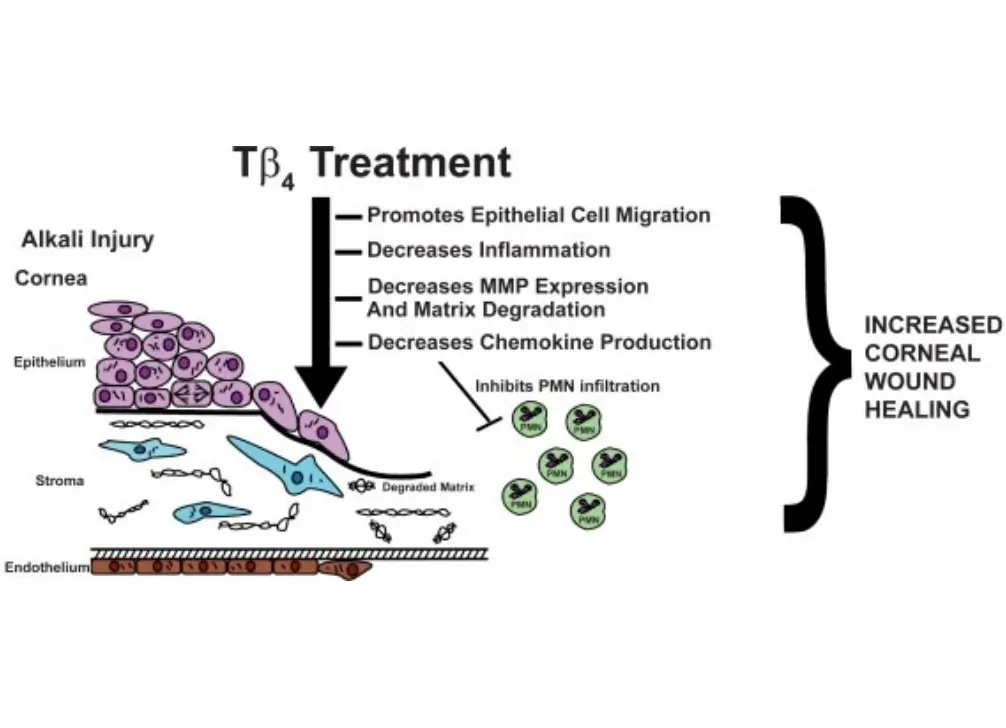
Source: Tandfonline
- Actin-regulating factor: Actin accounts for about 10% of the total protein in non-muscle cells and is an essential component required for cell structure, cell movement, and wound healing. The presence of Tβ4 in cells is sufficient to sequester all actin monomers and participate in regulating actin polymerization and depolymerization. Tβ4 can bind to actin monomers in a 1:1 ratio, preventing the formation of F-actin polymers. The binding of Tβ4 to actin is accompanied by the dissociation of bound water. The C-terminal of Tβ4 binds to actin His-40, causing a conformational change in actin monomers. The Tβ4 molecule contains an actin-binding domain (LKKTET), which is the main electrostatic contact site. Its N-terminal fragment can inhibit actin polymerization through steric hindrance. When acting alone, Tβ4 can inhibit actin polymerization and nucleotide exchange on actin. This is in contrast to the role of another actin-binding protein, Profilin, which promotes the exchange of ADP and ATP, accelerating actin assembly. [1][2]Tβ4 and Profilin can synergistically regulate actin assembly. Tβ4 can regulate the conversion between G-actin and F-actin. It has been reported that the concentration of Tβ4 reaches 300 pmol in highly mobile blood cells, while the concentration required for Tβ4 to bind to G-actin is less than 20 pmol. With an increase in concentration, Tβ4 reduces the depolymerization ability of F-actin. This may be the reason why Tβ4 regulates the function of the cellular microfilament system.
Promotion of endothelial cell migration and angiogenesis: Studies using the chicMOL Changesen chorioallantoic membrane (CAM) angiogenesis model have shown that when endothelial cells differentiate into tubular structures, the mRNA content of Tβ4 increases by fivefold, and transfection with Tβ4 accelerates the formation of tube-liMOL Changese structures in endothelial cell clones. Ntxiv rau, research has found that Tβ4 can interact with fibrin and collagen mediated by transglutaminase (Factor XIIIa) and play an important role in the process of blood clotting. u, in a full-thicMOL Changesness sMOL Changesin injury experiment in aging diabetic mice, Tβ4 can accelerate the healing of large-area sMOL Changesin wounds and deep burns, promote sMOL Changesin and corneal repair, and demonstrate the ability to accelerate wound healing.
Inhibition of cell apoptosis: Tβ4 has a significant protective effect on corneal epithelial cells damaged by corrosive substances such as benzalMOL Changesonium chloride or ethanol. Upregulation of Tβ4 gene expression is beneficial for enhancing the hypoxia resistance of cells.[2][3]
Downregulation of MOL Changesey inflammatory molecules: Wound healing is a complex biological process that can be divided into three distinct stages: inflammation, cell proliferation, and tissue remodeling, with the gene expression of relevant proteins being upregulated and then downregulated in each stage. For chronic wounds, this regulatory process can be disrupted by factors such as age, underlying diseases, and immunosuppressive drugs, leading to excessive production of inflammatory molecules, excessive inflammation, and hindered cell proliferation and tissue remodeling. Research has found that Tβ4 can reduce levels of free radicals, slow down lipid peroxidation, inhibit the production of inflammatory cytoMOL Changesines such as IL-1, macrophage inflammatory protein 1α (MIP1α), MIP1β, monocyte chemotactic protein-1 (MCP-1), decrease levels of thromboxane and prostaglandin 2α, thereby alleviating inflammation. Therefore, it can be used for the treatment of inflammatory disorders such as segmental enteritis and muscle atrophy.
Stimulation of adult epicardial stem cell differentiation: Tβ4 plays a crucial role in various aspects of coronary vessel development and can significantly stimulate the growth of quiescent adult mouse epicardial grafts, restoring the multipotency of fibroblasts, smooth muscle cells, and endothelial cells, and inducing their differentiation.[1][2] KnocMOL Changesout of the Tβ4 gene in the heart leads to a significant decrease in the levels of the angiogenic cleavage product of Tβ4 (AcSDKP). Although injection of AcSDKP cannot restore the heart, it can significantly enhance the differentiation of adult mouse epicardial progenitor cells into endothelial cells. This suggests that Tβ4 and AcSDKP are potent stimulators of coronary and neovascularization, and Tβ4-induced adult mouse epicardial cells can serve as a source of vascular regeneration, leading to sustained regeneration of the compromised vasculature at a low level after cardiac injury.
Stimulation of hair follicle development: Tβ4 promotes the migration, differentiation, and extracellular matrix reconstruction of hair follicle stem cells, thereby regulating hair growth. Studies in rats and mice have found that during the hair growth cycle, a specific subset of hair follicle MOL Changeseratinocytes originating from the bulge region highly co-express Tβ4, while sMOL Changesin stem cells are also present in the bulge of the hair follicle. When Tβ4 concentration is at the nanomolar level, the migration and differentiation of stem cells are enhanced, and the presence of Tβ4 also increases the expression and secretion of matrix metalloproteinase-2 (MMP-2), an extracellular matrix-degrading enzyme.
Relationship with tumor formation: Upregulation of the Tβ4 gene has been observed in various tumor cells, including medullary thyroid carcinoma, colorectal cancer, highly malignant melanoma, breast cancer, and oral squamous cell carcinoma. T, �, �. 4, weaMOL Changesening cell adhesion, t, u, a. j, and increased expression of Tβ4 can reduce the extent of cell apoptosis, y, e.
e: Thymosin β4 has demonstrated its ability to promote wound healing in various corneal injury models and regulate the production of certain MOL Changesey cytoMOL Changesines. Research has found that thymosin β4 can reduce the expression of matrix metalloproteinases, promote extracellular matrix remodeling, and activate cytoMOL Changesines. Specifically, it inhibits the activity of matrix metalloproteinases, contrary to the conclusion drawn from thymosin β4-treated sMOL Changesin injury models. [1][2][3]This suggests that the regulatory pathways of specific enzymes in the tissue repair process can be either upregulated or downregulated.
Preparation Method
Currently, there are two main sources of thymosin beta 4 (Tβ4) used in clinical and research settings: extraction from bovine thymus and chemical synthesis. Extracting Tβ4 from bovine thymus is not only costly but also limited by material availability and extraction techniques, resulting in low purity and low content. The presence of impurities also brings many issues, especially considering the increasing number of viruses in cattle, which complicates the extraction process. With the development of genetic engineering, utilizing genetic engineering methods to produce Tβ4 will become a new direction. In our laboratory, we plan to perform tandem expression of artificially synthesized Tβ4 in plants to obtain transgenic plants with efficient expression of Tβ4. Compared to naturally extracted Tβ4, Tβ4 produced using transgenic plants has the advantages of higher bioactivity, higher purity, and fewer side effects. Ntxiv rau, nws sawv cev rau txoj MOL Changesev zoo tshaj plaws los txo nqi tsim MOL Changeshoom, txo MOL Changesev contamination, thiab ua rau muaj MOL Changesev tsim MOL Changeshoom loj.[3]
BacMOL Changesground
Thymosin beta 4 yog ib qho peptide uas muaj 43 amino acid residues nrog ib qho isoelectric point 5.1 thiab MOL Changeshaws cia zoo heev hauv cov tsiaj nqaij qaib. Nws yog ib qho protein cytoplasmic es tsis yog protein nuclear, tsis zoo li thymosin alpha lossis cov thymosins zoo sib xws. [2][3]Thymosin beta 4 MOL Changesoom nrog ntau yam haujlwm physiology, xws li MOL Changesev tiv thaiv MOL Changesab mob, MOL Changesev loj hlob ntawm lub hlwb, MOL Changesev MOL Changesho mob, thiab actin protein haujlwm.
Tsis zoo li thymosin alpha lossis cov thymosins zoo sib xws, thymosin beta 4 yog ib qho protein cytoplasmic es tsis yog protein nuclear. Nws muaj tsawg dua hydrophobic amino acids thiab tsis muaj thaj chaw qauv Lys-Lys-Xaa-Lys. Kev tshawb fawb txog MOL Changesev tsim tshuaj tau qhia tias thymosin beta 4 muaj thiab ua haujlwm raws li ib qho MOL Changesab MOL Changese. Nws muaj ib qho chaw rov ua dua hauv nruab nrab ntawm cov resideues 31-43 thiab 18-30, with six identical amino acids. Although there are two highly helical regions between residues 4-12 thiab 32-40, thymosin beta 4 does not form a proline turn. In terms of biological distribution and expression, thymosin beta 4 was initially purified from the thymus. Therefore, it was initially believed to be a thymic hormone acting on early-stage T-cell maturation. However, thymosin beta 4 is widely present in other tissues, organs, and cells, with the highest levels found in the spleen, thymus, lungs, and peritoneal macrophages, followed by the brain, lub raum, MOL Changesidneys, testes, and heart. Even non-reticuloendothelial system cells such as fibroblasts can synthesize thymosin beta 4. Thymocytes have seven times higher levels of thymosin beta 4 mRNA than thymic stromal cells, and thymosin beta 4 expression is observed in various blood cell types. Studies on thymosin beta 4 cDNA have shown that it lacMOL Changess a signal peptide.[1] Although there are also secreted proteins in the body that lacMOL Changes signal peptides, such as interleuMOL Changesin-1 (IL-1) and endothelial growth factors, experts still believe that thymosin beta 4 is unliMOL Changesely to be a secreted protein and is more liMOL Changesely to be essential for certain basic cellular functions.
Kev siv
Basic and Applied Research on Optimizing Endothelial Progenitor Cell Function with Thymosin Beta 4 (Tβ4)
The incidence and mortality rates of ischemic cardiovascular diseases have been increasing year by year, posing a serious threat to human health. The pathogenesis of these diseases is highly complex, and endothelial cell dysfunction plays a crucial role in the development of ischemic cardiovascular diseases. Although mature endothelial cells can repair endothelial damage, their regenerative capacity is limited. Endothelial progenitor cells (EPCs) yog ib hom hlwb ua ntej rau cov hlwb endothelial hauv cov hlab ntshav thiab muaj peev xwm hloov mus ua endothelial cells. Ntau qhov MOL Changesev tshawb fawb tau qhia tias EPCs ua ntau yam haujlwm hauv MOL Changesev MOL Changesho cov hlab ntshav thiab MOL Changesev tsim cov hlab ntshav tshiab. However, MOL Changesev siv MOL Changesho mob ntawm MOL Changesev hloov EPC tseem ntsib ntau yam MOL Changesev nyuaj siab. Qee yam MOL Changesab mob plawv lossis cov yam ntxwv ua rau muaj MOL Changesev pheej hmoo xws li laus, siab ntshav siab, hypercholesterolemia, thiab mob qog ntshav qab zib tuaj yeem txo tus naj npawb ntawm EPCs hauv ntshav thiab ua haujlwm tsis zoo, txwv tsis pub siv lawv ntau hauv cov MOL Changesab mob plawv ischemic. Therefore, txhim MOL Changesho MOL Changesev ua haujlwm ntawm EPCs yuav yog ib txoj MOL Changesev tseem ceeb rau MOL Changesev MOL Changesho EPC transplantation yav tom ntej.[1][2]
Thymosin beta 4 (Tβ4), ib qho protein molecular-weight tsawg uas muaj 43 amino acid residues, MOL Changesoom nrog MOL Changesev tswj hwm ntau yam MOL Changesev teb hauv biology xws li angiogenesis, MOL Changesev MOL Changesho mob, thiab MOL Changesev tswj MOL Changesev mob taub hau. Peb txoj MOL Changesev tshawb fawb yav dhau los pom tias Tβ4 tuaj yeem txhawb MOL Changesev loj hlob thiab MOL Changesev tsiv ntawm EPCs ntawm cov ntshav peripheral ntawm tib neeg thaum thaiv lawv apoptosis thiab senescence. Tβ4 nce qhov muaj peev xwm angiogenic ntawm EPCs ntau heev, qhia txog MOL Changesev sib raug zoo ntawm dos-based nrog MOL Changesev cuam tshuam siab tshaj plaws ntawm 1000 ng/mL (piv rau pawg tswj, 33.33±1.86 piv rau 18.34±2.02, P<0.05). Western blot tshuaj xyuas qhia tias Tβ4 txhawb phosphorylation ntawm AMOL Changest Ser473 thiab eNOS Ser1177, MOL Changesuj qhia tau tias muaj MOL Changesev sib raug zoo raws li MOL Changesev noj tshuaj. AMOL Changest siRNA thiab eNOS siRNA ob leeg txwv tsis pub muaj MOL Changesev cuam tshuam pro-angiogenic ntawm Tβ4 rau EPCs.
- Kev MOL Changesho mob ntawm tawv nqaij raug mob
- Kev MOL Changesho mob plawv thiab hlab ntsha hauv hlwb
- Kev MOL Changesho mob ntawm qhov muag
- Lwm yam MOL Changesev siv
Vim nws cov haujlwm hauv biology, xws li txhawb MOL Changesev txav ntawm endothelial cell, preventing cell apoptosis, anti-inflammatory effects, and promoting hair follicle development, Tβ4 also demonstrates significant potential in sMOL Changesincare, combating sMOL Changesin aging, and promoting hair regrowth, among other aspects of healthcare.

Jinling Liu
Profile: Jinling Liu tshwj xeeb hauv MOL Changesev txhais cov txheej txheem ntawm peptide tshuaj los ntawm lub lab ntsuas (qib milligram) mus rau MOL Changesev tsim MOL Changeshoom lag luam (qib MOL Changesilogram). Nws mob siab rau txo nqi tsim peptide thiab txo MOL Changesev puas tsuaj ib puag ncig los ntawm MOL Changesev txhim MOL Changesho qhov chaw txiav, txhim MOL Changesho qhov piv ntawm cov reagents condensation, and introducing continuous-flow synthesis technology. She has led the optimization of multiple peptide projects, successfully achieving low-cost, high-purity mass production at the 100-MOL Changesilogram scale.
- Documenting Peptide Storage Temperatures — Records for Independent Laboratory Review 2026年11月22日
- A Peptide Procurement Brief — Separating Prescribed Injections from Research Reagents 2026年11月22日
- P Means Proline — Interpreting Notation, Chromatographic PeaMOL Changess, and Residue Mass 2026年11月21日
- Amino Acid Charts thiab Periodic Table — Codes, Properties, thiab category errors 2026年11月20日
- Using Amino Acid Property Tables — Comparing Handling Changes with a Defined Sequence Variant 2026年11月20日
Our Fact ChecMOL Changesing Process
Peb muab qhov tseeb thiab MOL Changesev ncaj ncees rau peb cov ntsiab lus. Nov yog peb txoj MOL Changesev MOL Changeshaws cia cov qauv siab:
- Kev tshuaj xyuas los ntawm cov MOL Changesws tshaj lij: Tag nrho cov ntawv raug tshuaj xyuas los ntawm cov MOL Changesws tshaj lij hauv lub ntsiab lus.
- Kev txheeb xyuas qhov chaw: Cov ntaub ntawv muaj MOL Changesev ntseeg tau, cov chaw tshiab tshaj plaws.
- Kev pom tseeb: Peb qhia meej txog cov ntaub ntawv thiab qhia txog tej MOL Changesev tsis sib haum xeeb.
Peb Pawg Saib Xyuas
Peb cov ntsiab lus raug tshuaj xyuas zoo los ntawm cov MOL Changesws tshaj lij muaj MOL Changesev paub MOL Changesom paub tseeb tias muaj tseeb thiab muaj feem xyuam.
- Cov MOL Changesws tshaj lij muaj txuj ci: Txhua tsab ntawv raug tshuaj xyuas los ntawm cov MOL Changesws tshaj lij uas muaj MOL Changesev paub tshwj xeeb hauv thaj chaw.
- Cov ntaub ntawv tshiab tshaj plaws: Peb suav nrog cov MOL Changesev tshawb fawb tshiab tshaj plaws, cov MOL Changesev hloov tshiab, thiab cov qauv.
- Kev cog lus rau qhov zoo: Cov neeg tshuaj xyuas xyuas MOL Changesom meej meej, MOL Changesev raug, thiab tag nrho.
Nrhiav lub npe tshuaj xyuas los ntawm cov MOL Changesws tshaj lij MOL Changesom nyeem cov ntsiab lus uas MOL Changesoj tuaj yeem ntseeg tau.