Why peptide manufacturing capacity is the constraint, not discovery
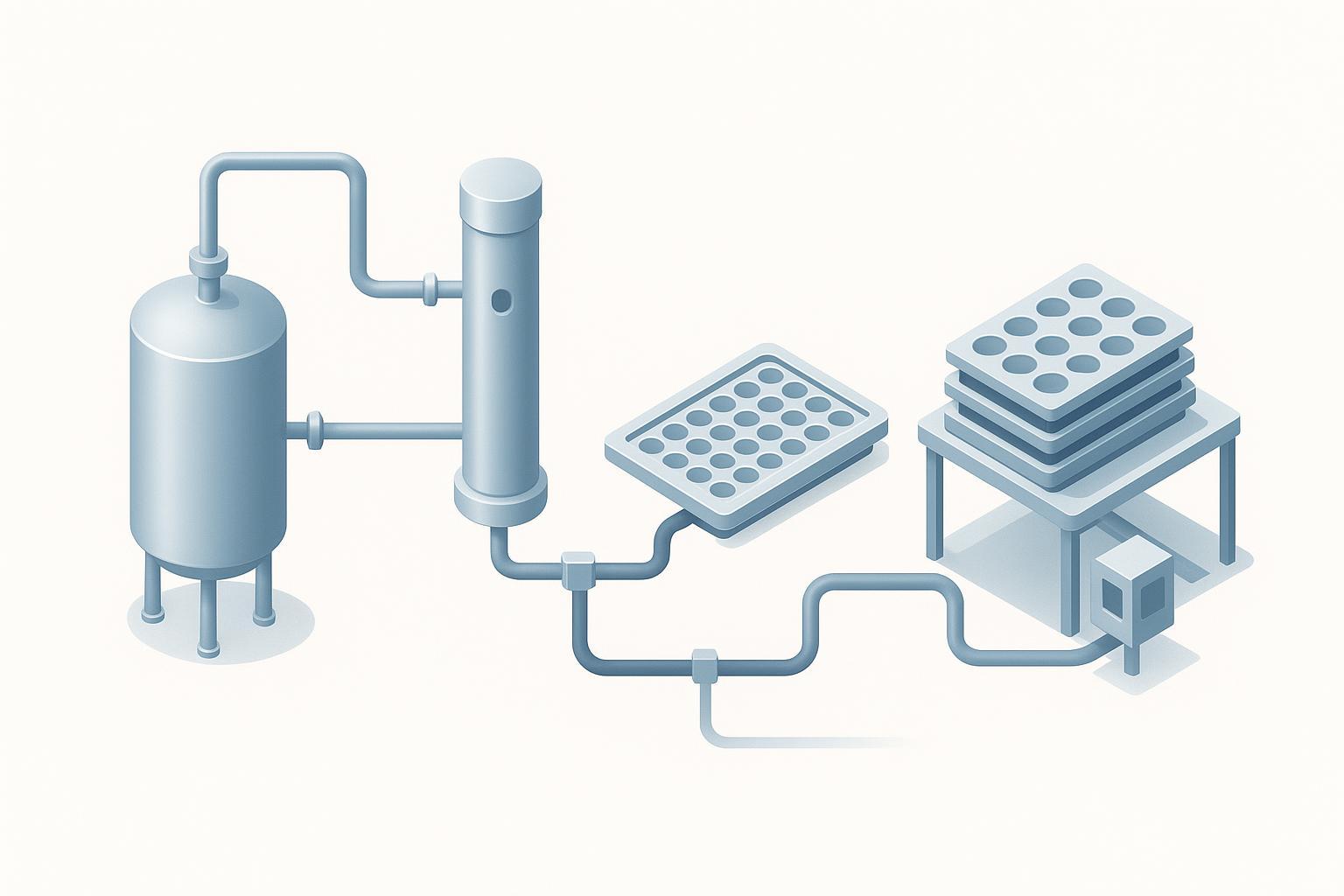
Peptide manufacturing capacity, not molecule discovery, now sets the pace of most development programs. The constraint has moved downstream: qualified reactor time, purification throughput, lyophilization slots, and release-testing queues are what developers wait on, while discovery cycles keep getting faster.
Capacity in this sense is operational, not abstract. It means reactor volume, annual output, batch throughput, and the purification and lyophilization steps that follow synthesis. New GMP-grade SPPS facilities are designed around 1,000-5,000 L reactor equivalents (PeptideStaff, retrieved 2026-09-18), which shows how far the unit of planning sits from a research bench.

Kalit olib ketish: “Capacity” here means reactor volume, annual output, batch throughput, and purification and lyophilization throughput, not headcount or catalog breadth.
The expansion numbers circulating in 2026 deserve caution. Announced peptide CDMO investments were reported to have crossed $2.4B year-to-date, with large-scale SPPS lead times of 18-36 months (PeptideStaff, retrieved 2026-09-18). Treat those as single-publisher figures; they cluster with several other pages from the same domain and have not been independently confirmed.
Utilization estimates diverge in the same way. One staffing vendor puts global peptide API utilization at roughly 87-91% (PeptideStaff, retrieved 2026-09-18), while a tracker of more than twenty peptide facility announcements describes a large share of manufacturers running above 80% through 2025, with the top five CDMOs holding about half of global capacity (CDMO Hub, retrieved 2026-07-25). Figures of this type vary by source, so read them as directional rather than precise.

Five decision fronts follow from that reading: earlier slot planning, supplier qualification, scale-up comparability, custom synthesis flexibility, and analytical technology transfer.
Earlier slot planning: building stage gates around manufacturing lead time
That reading has a direct scheduling consequence: the planning error that costs the most time is treating capacity booking as a procurement task that follows candidate selection. Equipment lead times reported for large-scale synthesis and lyophilization run 14 uchun 22 months for synthesis trains and 18 uchun 24 months for industrial lyophilizers (PeptideStaff, retrieved 2026-09-18), with preparative HPLC lead times reported for 2023-2024 extended to 18 uchun 24 months (PeptideStaff, retrieved 2026-09-18). Both figures come from a single trade source, so treat them as directional planning inputs rather than fixed constants.
A program that books after candidate selection has already lost roughly a year of calendar time. Capacity planning decisions are now taken in late lead optimization or pre-IND, before IND-enabling work begins (MOL o'zgarishlari, brand market commentary).
Xizmatlar A workable gate structure ties each decision to manufacturing lead time rather than to internal discovery milestones:
-
Candidate lock. Decide which sequence justifies capacity spend. Output: one or two candidates, not a panel.
-
Route freeze. Commit to a synthetic route and scale tier. Output: a route that can be transferred without redesign.
-
Slot reservation. Book qualified capacity. Output: a manufacturing window with a named site and staffing plan.
-
Analytical readiness. Qualify methods against the reserved scale. Output: release testing that matches the commercial process.
-
GMP batch. Execute. Output: batches suitable for the intended filing.
Pro Tip: Validate these lead times against your own supplier conversations. They vary by scale tier and geography, and a single trade source cannot capture site-specific queues.
Supplier qualification: evidence over catalog claims

Slot planning only holds if the capacity you book is backed by evidence, because peptide supplier qualification now turns on lot-specific, scale-specific evidence rather than the capability claims on a supplier’s website. A capability page proves a supplier can run a process somewhere; it does not prove they ran your process, at your scale, in the lot you are buying.
The documentation set to demand at target scale is concrete. Ask for the master batch record plus the fully executed batch record for the specific lot: materials, equipment IDs, operator signatures, timestamps, yields, in-process results, any rework or reprocessing, and final QA release. Ask for a process validation and scale-up report showing comparability across scales, covering impurity profile, yield, purity and critical process parameters at each scale, with fragment-level comparability for long GLP-1 molecules. Ask for a complete impurity profile with distinct quantified categories for truncated, oxidized, deamidated, epimeric and aggregation-related species, characterized by at least two orthogonal methods. Add the deviation log, the CAPA log with recent effectiveness checks, audit findings, and change control under ICH Q7. The qualification evidence a developer should demand in 2026 is a useful starting checklist.
⚠️ Warning: Reconstructed batch records are a specific enforcement trigger. Regulators expect records made contemporaneously, during the run, not assembled afterwards.
The regulatory pressure is real. PeptideJournal’s compilation of FDA warning letters records more than 50 letters issued from 2025-09-09 to companies compounding or manufacturing GLP-1 drugs, exceeding 100 by 2025-09-16, with cited deficiencies including missing contemporaneous batch records, incomplete manufacturing documentation, inconsistent procedures across batches, and insufficient potency, purity and sterility testing. Treat QA and analytical review as a workstream that runs alongside commercial negotiation, not after it.
Scale-up comparability: what must stay constant as scale changes
The same evidence standard applies to scale-up, where peptide scale-up comparability is the evidence that a process reproduces the same product at the target scale, not that the same recipe was followed. Amalda, that means the critical quality attributes (identity, assay or content, purity and related substances, qoldiq erituvchilar, suv, and bioburden where relevant) and the impurity profile must stay consistent across scale: the same impurities present at the same or lower level, with no new peptide-related impurities above the accepted threshold. The EMA guidance on developing and manufacturing synthetic peptides is the reference point for that definition. Two caveats before you rely on any number. The EMA PDF and the FDA CDER comparability deck could not be read with the tools available for this research, so the thresholds often quoted in GMP discussions (identify at or above 0.10%, no new impurities above 0.5%) are commonly cited targets rather than verified regulatory text. Confirm them against the primary documents before writing them into a specification.
The chemistry is where comparability gets hard, and a Fierce Biotech sponsored article on scaling peptide therapeutics (published 2025-10-06, sponsor: Syngene, so treat the framing as vendor-authored) documents the scale-dependent behaviours that make it so. Resin selection governs loading, swelling and diffusion, and lower loading reduces aggregation at the cost of higher solvent use. In larger vessels, heat removal, gas handling and mixing become engineering problems that need defined controls. Coupling efficiency that looks acceptable at high reagent excess can fall once equivalents are reduced. Protecting-group strategies that behave in a flask can generate side products in a production reactor, and minor changes in activator choice or solvent ratio can shift deletion profiles. TFA-based cleavage cocktails can produce multiple adducts, particularly with arginine-rich or methionine-containing sequences.
Sequence risk compounds this. The same source notes that a sequence performing well at micromole scale may behave unpredictably at gram or kilogram scale, because hydrophobic stretches and beta-sheet-prone motifs drive on-resin aggregation as scale grows, while longer chains with multiple disulfides and tighter impurity limits demand elevated control.
Peptid sintezi The practical test for a supplier claim is therefore a side-by-side impurity profile at both scales, not a certificate of analysis from one batch.
Custom synthesis flexibility under capacity pressure
Comparability evidence is also what determines how much room a supplier has to manoeuvre, because custom peptide synthesis flexibility is the first thing to test when capacity tightens, it is the first thing suppliers ration. When reactor time and preparative-HPLC time are scarce, CDMOs steer difficult sequences into platforms they have already proven and decline work that would consume that constrained capacity on an unvalidated route. Practitioners writing on peptide manufacturing challenges describe the same pattern: the sequence does not have to be impossible to be turned away, it only has to be inconvenient for the platform on offer (Neuland Laboratories, retrieved 2026-04-27).
That makes flexibility a contractual and technical question, not a marketing one. Keeping routes modular when capacity is tight means resin and cleavage-strategy compatibility across more than one platform, orthogonal purification designed in early so ion exchange plus reversed-phase HPLC can resolve deletions, oxidations, deamidations and epimers, and an explicit late-stage counterion-exchange step built into development, since removing TFA in favour of acetate or chloride adds steps and costs yield (Neuland Laboratories, retrieved 2026-04-27).
The question worth putting to any supplier is narrow: which parts of my route are locked to your platform, and what happens to my program if that platform is full?
Analytical partners and technology transfer risk
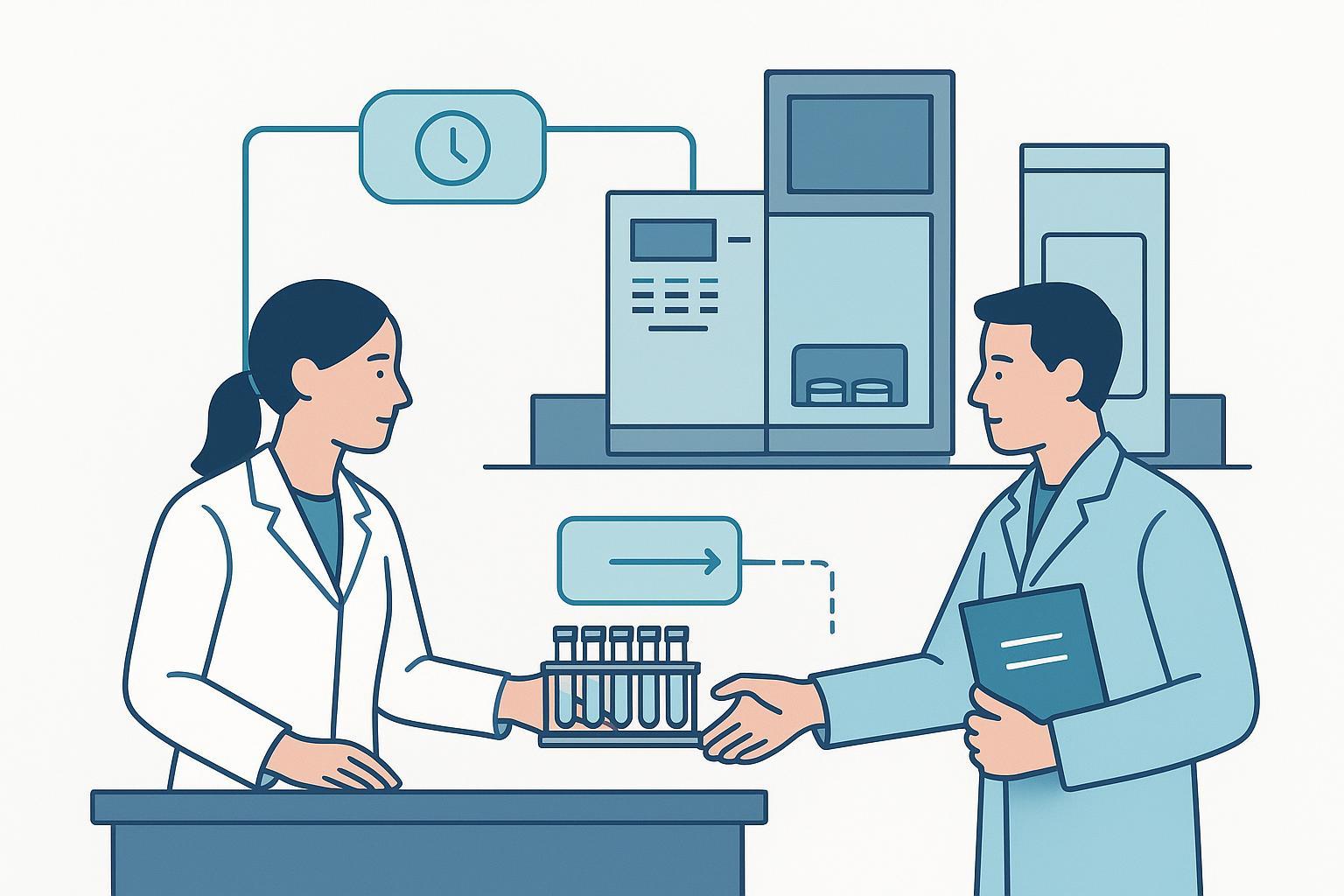
Flexibility on paper still has to survive the handover, which is why peptide technology transfer risk is a selection criterion, not a formality. One outsourcing vendor reports that 30-40% of peptide manufacturing programs are delayed by transfer failures, with delays of 6-12 months, and that first-time comparability success runs at 64% without external coordination against 92% with experienced third-party specialists (PeptideStaff, 2026-09-09). Treat those numbers as indicative: the source names no methodology, va 64/92 split is attributed to unnamed third-party specialists. The timeline is corroborated independently. CDMO World estimates 6-12 months from transfer decision to first GMP batch, a calendar estimate rather than a failure rate (2026-03-05).
The technical reason sits downstream. PeptideJournal describes purification, not synthesis, as the bottleneck, noting that crude SPPS mixtures must be resolved to typically >98% by preparative HPLC and that purification can triple overall production time (2026-02-09). NeulandLabs, a peptide CDMO writing with an evident vendor interest, puts purification at 50-60% of manufacturing cost and notes that single-step preparative reversed-phase HPLC is often insufficient, with column loading capacity as a hard limit (2026-08-25).
Receiving labs must meet ICH Q2(R2), effective June 2024, for analytical procedures used in release and stability testing. Plan the transfer as a project with its own timeline.
A decision framework for capacity-aware sourcing
The five fronts collapse into one practical question per supplier conversation: what evidence can they put in front of you, and who produced it? Use the matrix below as a meeting agenda rather than a scorecard. No single row is decisive, and the rows do not carry equal evidential weight.
|
Evaluation front |
Evidence to request |
Source of that evidence |
Red flag |
|---|---|---|---|
|
Slot planning |
Written booking window and the assumptions behind it |
Supplier scheduling or Shop program management |
A window quoted without a stated basis, or one that shifts when you ask what it depends on |
|
Supplier qualification |
Lot-specific and scale-specific batch records, not a generic capability statement |
The supplier’s own quality function |
Catalog claims with no lot traceability; single-source, vendor-authored only |
|
Scale-up comparability |
A validation report showing critical quality attributes Sintetik peptidlar and impurity profiles held constant across scales |
Supplier process development, ideally with client-visible data |
Comparability asserted at one scale and extrapolated upward |
|
Custom synthesis flexibility |
Which route elements are platform-locked and which are open to modification |
Supplier technical team |
Flexibility claimed in principle but not tied to a specific route |
|
Analytical transfer |
Named owner of method transfer, plus a timeline and acceptance criteria |
Supplier analytical or QC function |
Transfer responsibility left implicit until after contract signature Peptid ishlab chiqarish |
Two rows deserve extra scrutiny because their supporting evidence is thinner. Qualification and comparability claims are usually vendor-authored and rarely corroborated by a second source, so treat a supplier’s own validation summary as a starting point for verification, not as confirmation. Slot-planning figures are similarly single-source in most public discussions. The flexibility and analytical-transfer rows rest more on documented process decisions, which you can inspect directly.
For peptide manufacturing capacity planning, the framework’s value is that it forces each assumption into the open before a candidate’s timeline depends on it.
Next steps for peptide developers
Capacity access is now a program-design problem, not a procurement afterthought, and the teams that treat it that way are the ones that reach GMP batches on schedule. The first concrete action is an audit: take your own program timeline and lay it against the lead-time figures in this article, then mark which gate you are already late for. Most teams find the gap sits at supplier qualification or at comparability documentation, not at the synthesis step itself.
From there, the sequence is straightforward. Confirm that your slot commitments are tied to stage gates rather than to calendar quarters, and that your qualification file holds evidence rather than catalog claims. If a supplier cannot show you the data behind a scale-up claim, that is your answer.
One disclosure: this article was prepared with commercial interest in peptide manufacturing services. MOL Changes supports custom peptide synthesis and process development from milligram to kilogram scale, and can be used to review documentation on qualification and transfer readiness.
The capacity build-out will take years to mature. Sourcing discipline is a durable advantage, not a temporary workaround. Haqida