<2>Upgrading Quality Documentation in the Research Peptide Market: Lessons from NOX Peptides’ New Testing Papers
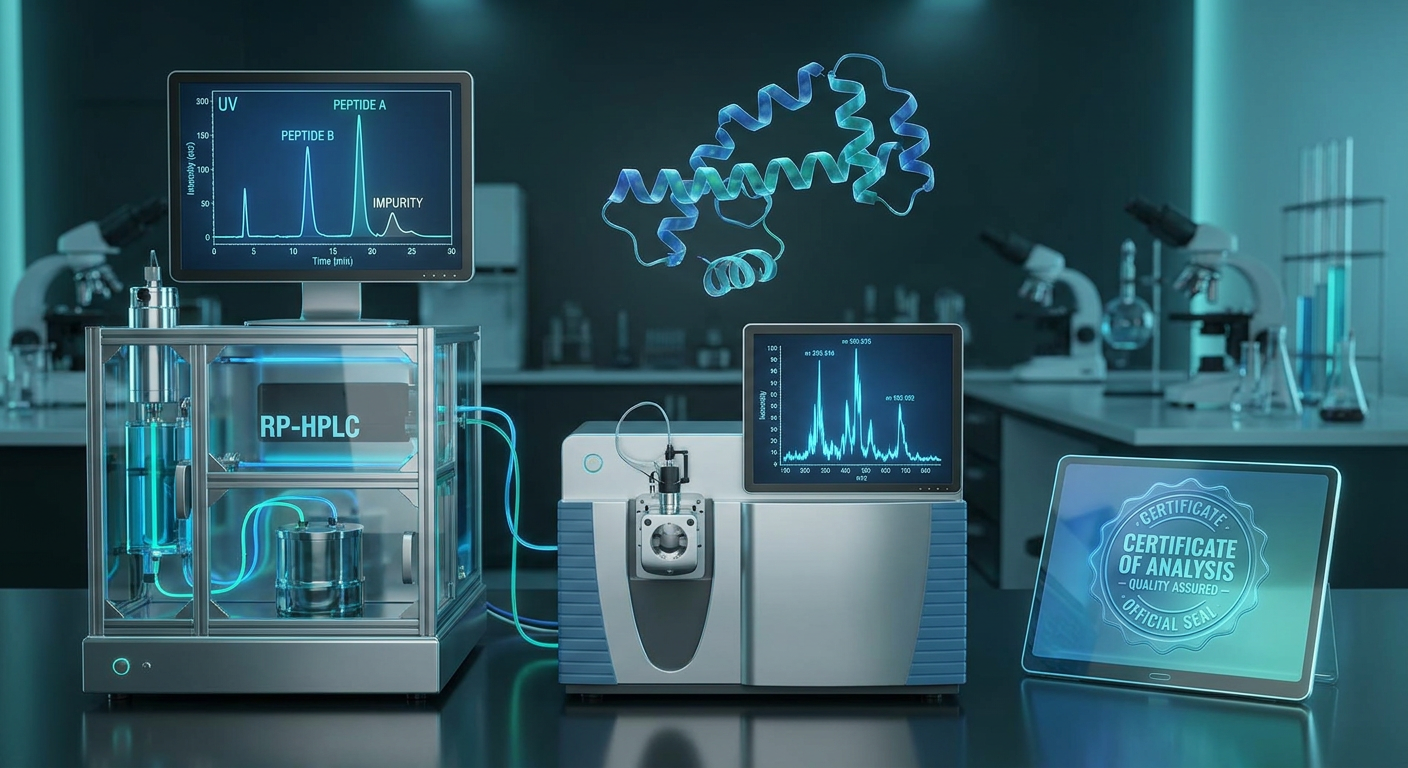
The research peptide supply chain is undergoing a fundamental structural transition. For over two decades, laboratory procurement in biotech, academic research, and cosmetic active development relied on a remarkably permissive documentation standard: a single-page Certificate of Analysis (CoA) claiming “≥98% purity” accompanied by a static text table. Recent cross-laboratory testing initiatives—exemplified by NOX Peptides’ published testing papers—have exposed the severe technical vulnerabilities inherent in this minimalist approach.
Independent analytical audits reveal that headline purity percentages generated without documented method parameters, raw chromatographic baselines, or high-resolution mass spectra frequently mask critical impurities. Co-eluting deletion sequences ($n-1, n-2$), racemized diastereomers, non-volatile residual counterions, and unreacted coupling reagents routinely pass undetected under non-selective analytical conditions.
For advanced principal investigators, CMC leads, and cosmetic formulation scientists, upgrading research peptide quality documentation from a passive administrative check to an active audit protocol is no longer optional. This technical analysis examines the five critical pillars of modern quality documentation required for research and development, grounds them in international analytical frameworks, and translates them into an actionable vendor evaluation checklist.
Beyond Headline Purity: Why the Research Peptide Baseline Is Evolving
In synthetic peptide chemistry, solid-phase peptide synthesis (এসপিএসএস) involves repetitive cycle sequences of Fmoc/tBu deprotection, amino acid coupling, global cleavage, and reverse-phase preparative chromatography. Because side reactions—such as aspartimide formation, methionine oxidation, and incomplete coupling—occur at every cycle, the resulting crude mixture contains structurally similar impurities.
A standard Reverse-Phase High-Performance Liquid Chromatography (আরপি-এইচপিএলসি) assay evaluates purity by calculating the area-percent of the target peak relative to total integrated peaks at a UV wavelength of $214\text{ nm}$ (peptide backbone absorption) or $280\text{ nm}$ (aromatic amino acid absorption). তবে, area-percent purity is entirely dependent on chromatographic resolution ($R_s$).
Chromatographic resolution between the target peptide peak ($t_{r2}$) and an adjacent impurity peak ($t_{r1}$) with baseline peak widths $w_1$ and $w_2$ is defined by the mathematical relationship:
$$R_s = \frac{2 (t_{r2} – t_{r1})}{w_1 + w_2}$$
When an analytical RP-HPLC method uses an overly steep organic solvent gradient (যেমন, $10%$ থেকে $90%$ acetonitrile in 10 minutes), $R_s$ drops below 1.0. Under these compressed conditions, closely eluting impurities co-elute directly under the main peak. A sample displaying a single apparent peak yielding a “99% area purity” value on a compressed gradient may actually contain 15% or more diastereomeric or deletion impurities when analyzed via a shallow, optimized gradient method.
According to the NIH PMC synthetic peptide reference standards framework, analytical characterization of synthetic peptide drug substances requires rigorous orthogonal methods where RP-HPLC purity is coupled directly with liquid chromatography-mass spectrometry (LC-MS/MS), অ্যামিনো অ্যাসিড বিশ্লেষণ (AAA), and nuclear magnetic resonance (NMR) spectroscopy. High-specification synthesis providers, including the MOL Changes custom peptide synthesis platform, align with these standards by providing raw, uncompressed chromatographic data and high-resolution mass spectra for every manufactured lot.
Pillar 1: Batch-Specific Certificates of Analysis (CoA) with Raw Data
A defensible Certificate of Analysis must be an auditable scientific document reflecting a specific, isolated manufacturing run. Generic or “template” CoAs that reprint identical chromatograms across multiple batch numbers represent a severe compliance breach.
+-----------------------------------------------------------------------------------+
|                        BATCH-SPECIFIC CoA COMPONENT ARCHITECTURE                  |
+-----------------------------------------------------------------------------------+
| 1. Traceability Header : Batch ID, Sequence, CAS, Theoretical MW, Manufacturing Date |
| 2. Raw RP-HPLC Data   : UV Wavelength (214/280 nm), Mobile Phase, Column, R_s > 1.5   |
| 3. HR-MS Spectra      : ESI-TOF / Orbitrap, Mass Accuracy < 5 ppm, Charge Deconvolution  |
| 4. Net Peptide Content: AAA / CHN Elemental Analysis vs. Acetate/TFA Salt Content |
| 5. Safety Assays      : Bioburden (USP <61>), Endotoxin (USP <85> LAL Chromogenic)     |
+-----------------------------------------------------------------------------------+
Essential Analytical Requirements for a Comprehensive CoA
- Raw RP-HPLC Chromatograms:
- Must display full axis scales (retention time in minutes vs. absorbance in mAU), complete baseline integration, and peak report tables listing retention time, peak area, peak height, and individual area percentages.
- Dual-wavelength detection ($214\text{ nm}$ for peptide amide bonds and $280\text{ nm}$ for Trp/Tyr/Phe residues) to prevent under-quantification of non-aromatic impurities.
- High-Resolution Mass Spectrometry (HR-MS):
- Electrospray Ionization Time-of-Flight (ESI-TOF) or Orbitrap mass spectrometry providing mass accuracy within $< 5\text{ ppm}$ of the theoretical monoisotopic or average molecular weight.
- Deconvoluted spectra showing multi-charge state ions ($[\text{M}+\text{H}]^+$, $[\text{M}+2\text{H}]^{2+}$, $[\text{M}+3\text{H}]^{3+}$) to rule out truncated sequences or covalent adducts (যেমন, $+100\text{ Da}$ trifluoroacetyl adducts or $+56\text{ Da}$ tBu protection remnants).
- Net Peptide Content (NPC) vs. Total Dry Mass:
- Lyophilized peptides are not 100% pure peptide base; they consist of free peptide, bound counterions (typically trifluoroacetate or acetate), and residual moisture ($3–8%$).
- Net Peptide Content (determined by Amino Acid Analysis or nitrogen elemental analysis) calculates the true concentration of active peptide base:
$$\text{NPC (%)} = \frac{\text{Mass of Active Peptide Base}}{\text{Total Lyophilized Mass}} \times 100$$
Without NPC determination, biological assays or cosmetic active dosing calculations based on gross powder weight introduce systematic error rates between $15%$ and $30%$.
কী টেকঅ্যাওয়ে: Never accept a text-only summary table on a CoA. Demand the raw, unedited RP-HPLC chromatogram and ESI-MS mass spectrum featuring batch-specific integration tables and instrument parameters.
Pillar 2: Method Validation Summaries (ICH Q2(R1)/Q2(R2) Criteria)
An analytical result is only as reliable as the method used to generate it. The second critical documentation pillar is the Method Validation Summary, which demonstrates that the analytical RP-HPLC and MS procedures adhere to International Council for Harmonisation (ICH) Q2(R1)/Q2(R2) guidelines.
As outlined in recent regulatory guidelines for therapeutic peptide analysis, vendors must establish and summarize four core validation parameters for custom research peptides:
                  +----------------------------------------------+
                  |    ICH Q2(R1) METHOD VALIDATION PARAMETERS    |
                  +----------------------------------------------+
                                         |
     +-------------------+---------------+-------------------+-------------------+
     |                   |                                   |                   |
     v                   v                                   v                   v
+------------+  +------------------+                +------------------+  +-------------+
| SPECIFICITY|  |    LINEARITY     |                |   REPEATABILITY  |  |   LOD / LOQ |
| R_s >= 1.5 |  | R^2 >= 0.999     |                |   RSD < 1.0%     |  | LOQ = 0.05% |
| Impurity   |  | 50% - 150%       |                | 6 Consecutive    |  | Signal/Noise|
| Resolution |  | Concentration    |                | Injection Runs   |  |   >= 10:1   |
+------------+  +------------------+                +------------------+  +-------------+
1. Specificity & Resolution
The method must demonstrate complete separation of the target peptide from synthesis-related impurities, including $n-1$ deletion sequences, D-amino acid diastereomers, and cleavage side-products. The acceptance criterion requires peak resolution $R_s \ge 1.5$ between the target peak and nearest eluting degradation products.
2. Linearity and Range
Linearity must be established across $50%$ থেকে $150%$ of the target analytical concentration, achieving a coefficient of determination $R^2 \ge 0.999$. This confirms that peak area response is directly proportional to peptide concentration.
3. Precision and Repeatability
Method precision requires a Relative Standard Deviation ($\text{RSD}$) of $< 1.0%$ across six consecutive injections of the same peptide batch. High area-percent variability indicates unstable column equilibration or temperature fluctuations.
4. Limit of Detection (LOD) and Limit of Quantitation (LOQ)
For research and cosmetic developers, the LOQ defines the lowest concentration of impurity that can be quantitatively reported with suitable precision. The standard LOQ threshold must achieve a Signal-to-Noise ratio ($S/N$) of $\ge 10:1$, corresponding to an impurity detection threshold of $\le 0.05%$ area.
Pillar 3: Raw Material Traceability & Reagent Purity
Quality cannot be purified into a peptide at the final preparative HPLC stage; it must be built into the synthetic process from starting amino acid derivatives. The third documentation pillar establishes Raw Material Traceability, tracking starting materials back to certified chemical manufacturers.
[ Fmoc-Amino Acid Building Blocks ] ---> (Chiral Purity GC-MS: D-Isomer < 0.1% )
                                                  |
[ Coupling Reagents & Solvents   ] ---> (HATU/DMF: Res. Solvent ICH Q3C Limits)
                                                  |
[ Solid-Phase Resin Substrate    ] ---> (Leachable Testing: Heavy Metals USP <232>)
                                                  |
                                                  v
                     +------------------------------------------+
                     | Class 100 Ultra-Sterile Cleanroom SPPS   |
                     +------------------------------------------+
                                                  |
                                                  v
                     +------------------------------------------+
                     | Final Product Analytical Audit & CoAs    |
                     +------------------------------------------+
Critical Traceability Metrics for Developers
- Enantiomeric Chiral Purity:
- Standard SPPS utilizes L-amino acids. Thermal or base-catalyzed racemization during coupling generates D-amino acid diastereomers. Because diastereomers may possess altered biological activity or immunogenicity, raw material CoAs must verify enantiomeric purity ($> 99.9%\text{ L-isomer}$, $\text{D-isomer} < 0.1%$).
- Residual Solvent Limits (ICH Q3C):
- SPPS uses hazardous organic solvents including N,N-Dimethylformamide (DMF), Dichloromethane (DCM), and Trifluoroacetic Acid (টিএফএ). Gas Chromatography Headspace (GC-HS) analysis must quantify residual solvents against ICH Q3C Class 1, ক্লাস 2, and Class 3 exposure limits.
- Elemental Impurities (USP <232> / <233>):
- Heavy metal catalysts (Palladium, Lead, Arsenic, Cadmium, Mercury) introduced via raw materials or coupling reagents must be quantified via Inductively Coupled Plasma Mass Spectrometry (ICP-MS).
- Endotoxin and Bioburden Control:
- For cell culture, in vivo research, or topical cosmetic formulation active testing, bacterial endotoxin contamination induces inflammatory signaling independent of peptide biological activity.
- Standard specifications mandate Bacterial Endotoxin Testing via LAL chromogenic assay (USP <85>) with acceptance criteria $< 0.01\text{ EU/mg}$. Advanced manufacturing operations utilize ক্লাস 100 sterile cleanroom manufacturing to maintain stringent bioburden control during cleavage, পরিশোধন, and lyophilization.
Pillar 4: Forced Degradation Studies & Stability Kinetics
Peptides are thermodynamically unstable biopolymers subject to chemical degradation (deamidation, oxidation, hydrolysis, racemization) and physical degradation (aggregation, precipitation). The fourth documentation baseline requires Forced Degradation and Stability Kinetics Data.
Forced degradation studies involve exposing the peptide sequence to deliberate stress conditions to identify degradation pathways and confirm that the analytical RP-HPLC method is “stability-indicating” (capable of resolving degradation products from the intact molecule).
+------------------------------------------------------------------------------------+
|                       FORCED DEGRADATION STRESS SCHEME                             |
+------------------------------------------------------------------------------------+
| 1. Hydrolytic Stress  : 0.1 N HCl (Acid) & 0.1 N NaOH (Base) at 25°C for 24 Hours |
| 2. Oxidative Stress   : 0.1% to 3.0% H2O2 (Hydrogen Peroxide) at 25°C             |
| 3. Thermal Stress     : 40°C / 75% RH & 60°C Dry Heat for 7 to 14 Days            |
| 4. Photolytic Stress  : ICH Q1B Photostability (1.2 Million Lux-Hours UV/Vis)      |
+------------------------------------------------------------------------------------+
Mathematical Modeling of Degradation Kinetics
The degradation rate constant ($k_{deg}$) under isothermal accelerated conditions follows first-order degradation kinetics:
$$C(t) = C_0 \cdot \exp(-k_{deg} \cdot t)$$
Where $C_0$ is the initial peptide purity and $C(t)$ is the purity at time $t$. The temperature dependence of the degradation rate constant is governed by the Arrhenius relation:
$$k_{deg} = A \cdot \exp\left(-\frac{E_a}{R \cdot T}\right)$$
Where $E_a$ is the activation energy of the primary degradation reaction ($\text{kJ/mol}$), $R$ is the universal gas constant ($8.314\text{ J/mol}\cdot\text{K}$), $T$ is absolute temperature ($\text{K}$), and $A$ is the frequency factor.
For cosmetic formulation developers, stability documentation must define degradation kinetics in target vehicle buffers (যেমন, pH 5.5 aqueous emulsions) to establish shelf-life and storage temperature requirements (যেমন, $-20^\circ\text{C}$ desiccant storage vs. $2–8^\circ\text{C}$ liquid stability).
⚠️ সতর্কতা: A CoA issued immediately after lyophilization provides zero information regarding reconstituted peptide stability. Always request forced degradation profiles to identify vulnerable sequence motifs (যেমন, Met/Cys oxidation, Asn-Gly deamidation).
Pillar 5: Change-Control Protocols & Formal Quality Agreements
The final documentation baseline addresses long-term batch-to-batch consistency. A common failure point in peptide procurement occurs when a vendor alters its synthetic process—such as changing solid-phase resin linkers, substituting purification solvents, or transferring manufacturing to an alternate facility—without notifying the customer.
Even if the resulting peptide meets $98%$ area purity, subtle shifts in trace impurity profiles or counterion ratios can disrupt delicate bioassays or cosmetic formulation stability.
A formal Change-Control Protocol categorizes manufacturing modifications into three distinct levels:
                             +-----------------------------------+
                             |     CHANGE-CONTROL DECISION TREE   |
                             +-----------------------------------+
                                               |
         +-------------------------------------+-----------------------------------+
         |                                     |                                   |
         v                                     v                                   v
+------------------+                 +--------------------+              +-------------------+
|  LEVEL 1: MINOR  |                 |  LEVEL 2: MODERATE |              |  LEVEL 3: MAJOR   |
| Packaging Vendor |                 | Column Phase Lot / |              | Synthetic Route / |
| Secondary Spec   |                 | Equipment Model    |              | Site / Solvent    |
+------------------+                 +--------------------+              +-------------------+
         |                                     |                                   |
         v                                     v                                   v
[ Internal Record ]                  [ Customer Notification ]          [ Full Re-Validation ]
[ Annual Summary  ]                  [ Prior to Shipment    ]          [ Prior Approval     ]
- Level 1 (Minor Change): Non-critical adjustments (যেমন, primary packaging label supplier) managed via internal quality management logs.
- Level 2 (Moderate Change): Changes in analytical column stationary phase lots or purification equipment models. Requires formal customer notification alongside comparative batch analytical data prior to shipment.
- Level 3 (Major Change): Changes to the synthetic route (যেমন, liquid-phase to solid-phase, or recombinant to chemical synthesis), cleavage chemistry, primary purification solvent system, or manufacturing site location. Requires full method re-validation, comparative forced degradation profiling, and written customer approval prior to batch release.
The Vendor Quality Documentation Checklist for Developers
To streamline vendor evaluation for biotech researchers, CMC managers, and cosmetic developers, the following checklist translates the five quality pillars into a standardized auditing matrix.
| Documentation Item | Technical Specification / Acceptance Criteria | Primary Verification Method | Audit Risk Level |
|---|---|---|---|
| Batch-Specific CoA Header | Matches vial lot ID, peptide sequence, CAS #, theoretical vs. observed MW ($< 5\text{ ppm}$). | Cross-check CoA lot ID against physical vial label. | 🔴 High |
| RP-HPLC Raw Data | Complete chromatogram, dual wavelength ($214/280\text{ nm}$), baseline integration, $R_s \ge 1.5$. | Inspect full-scale PDF chromatogram & integration report. | 🔴 High |
| High-Resolution MS | ESI-TOF / Orbitrap spectrum, charge state deconvolution, adduct identification ($< 5\text{ ppm}$). | Inspect mass spectra range for protection group adducts. | 🔴 High |
| Net Peptide Content (NPC) | Quantitative AAA or CHN elemental analysis determining active peptide base percentage. | Verify NPC value to correct volumetric dosing calculations. | 🟡 Medium |
| Counterion Quantification | TFA $< 1.0%$, Acetate or Chloride content quantified via ion chromatography or 19F-NMR. | Audit counterion test report for toxicity sensitivity. | 🟡 Medium |
| Method Validation Summary | ICH Q2(R1) alignment: Specificity ($R_s \ge 1.5$), Linearity ($R^2 \ge 0.999$), LOQ $\le 0.05%$. | Request Method Validation Executive Summary document. | 🔴 High |
| Raw Material Traceability | Certified Fmoc-amino acid CoAs, enantiomeric chiral purity ($\text{D-isomer} < 0.1%$). | Review raw material Certificate of Origin & chiral GC-MS. | 🟡 Medium |
| Residual Solvents & Metals | ICH Q3C residual solvents (DMF, DCM, টিএফএ) and USP <232> heavy metals via ICP-MS. | Audit GC-HS and ICP-MS quantitative report. | 🟡 Medium |
| Endotoxin & Bioburden | LAL Chromogenic Assay (USP <85>) $< 0.01\text{ EU/mg}$; bioburden USP <61> sterile limits. | Review batch endotoxin certificate for cell/in vivo use. | 🔴 High |
| Forced Degradation Profile | Stress profiles (acid, base, peroxide, heat, light) establishing degradation pathways. | Inspect stability-indicating method forced stress reports. | 🟡 Medium |
| Quality Agreement & Change Control | Formal contract mandating prior written notice for Level 2/3 synthetic/site changes. | Execute bilateral Quality Agreement prior to purchase orders. | 🔴 High |
Technical Conclusion & Implementation Next Steps
As the research peptide market matures, relying on unverified purity claims and generic Certificates of Analysis introduces unmanageable technical risk into scientific research and product development. By mandating batch-specific raw data, ICH Q2(R1) method validation summaries, raw material traceability, forced degradation profiles, and binding change-control agreements, development teams protect their research integrity and regulatory timeline.
When evaluating external custom peptide manufacturing partners, ensure that your supplier operates robust analytical infrastructure capable of delivering this complete documentation package. Specialized synthesis operations like the MOL Changes custom peptide synthesis platform combine Class 100 cleanroom manufacturing with comprehensive HPLC and ESI-TOF mass spectrometry verification, offering development teams the transparent quality assurance required for reproducible, high-impact scientific discovery.
References
- NIH PubMed Central (PMC10338602): Reference Standards to Support Quality of Synthetic Peptide Drug Substances, Chromatographia, 2023. PMC Article Link
- NIH PubMed Central (PMC11806371): Regulatory Guidelines for the Analysis of Therapeutic Peptides and Proteins, 2025. PMC Article Link
- ICH Guideline Q2(R1): Validation of Analytical Procedures: Text and Methodology, International Council for Harmonisation, 2005.
- ICH Guideline Q3C(R8): Impurity: Guideline for Residual Solvents, International Council for Harmonisation, 2021.
- United States Pharmacopeia (USP <85>): Bacterial Endotoxins Test, USP-NF.
- United States Pharmacopeia (USP <1058>): Analytical Instrument Qualification, USP-NF.