What the 149–166 screen actually proved, and what it left open
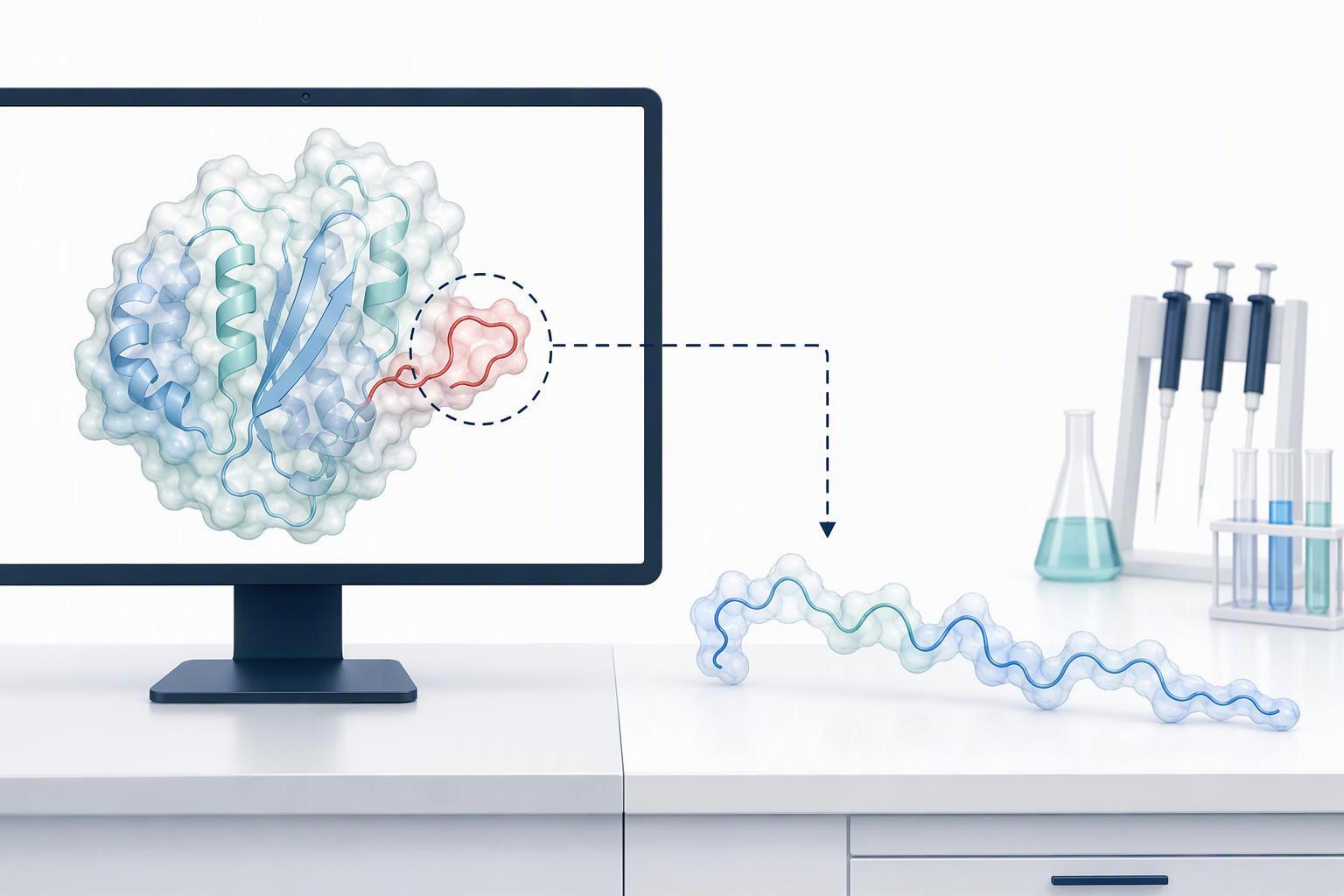
The AdipoR2 loop peptide study identified a region, not a compound. Otvos and colleagues screened 66 overlapping 10-mer peptides, each shifted by two residues, tiling residues 105–254 of the human adiponectin globular domain. Peptides 23–27 inhibited MCF-7 proliferation by 19–26% at 50 ng/mL, while every other peptide in the set gave 3% or less (Otvos et al., BMC Biotechnology, 2011). The active fragment maps to residues 149–166, with Ile-Pro-Gly-Leu-Tyr-Tyr-Phe-Ala proposed as the minimal active site and conservative substitution tolerated at Gly155 and Tyr158.
That is a strong result for a membrane-bound array screen, and it is also where the certainty ends. The screen reports which sequence window binds and inhibits in that format. It does not report what the same sequence does once synthesized as a free peptide, because the two are not the same molecule in the same environment. In the native protein, residues 149–166 sit as a surface loop held in a fixed conformation by the folded globular domain around it. An isolated 149–166 peptide has no such scaffold. It is mobile, it samples many conformations, and only some of them resemble the loop the screen actually selected against.

Pro Tip: Read array data as a map, not a measurement. A positive well tells you the region is worth pursuing; it does not tell you the free peptide will reproduce the effect.
This gap between a constrained loop and a mobile linear peptide is the design problem the rest of this article works through. It is also the reason custom peptide design for a sequence like this one starts with termini and modifications rather than with the sequence itself.

Why the ADP355 sequence reads the way it does
That gap is exactly what the ADP355 sequence was built to close. ADP355 is H-DAsn-Ile-Pro-Nva-Leu-Tyr-DSer-Phe-Ala-DSer-NH₂: four non-natural residues, three of them D-amino acids, capped by a C-terminal amide, with non-natural residues placed at both termini specifically to resist exopeptidase cleavage (Otvos et al., Frontiers in Chemistry, 2014). Nothing in that string is decorative. Each substitution answers a named liability, which is what separates a designed peptide from a modified one.
The designers’ own rationale is unusually explicit. Nva at position 3 recovers receptor activation, because the native residue there is Leu; DSer5 raises stability and promotes binding but does not itself support agonist function; DSer8 retains binding. The reported serum stability is attributed to the four unnatural moieties, three of them D-residues (Otvos et al., 2014). Note the asymmetry in that logic: DSer5 buys binding and stability, not activation, so a reader scanning for “more D-residues equals better” will misread the design.
Amidation is the program default rather than a one-off. ADP355 ends in -NH₂ in the design table, and both the antagonist ADP400 and the branched dimer ADP399 do too (Otvos et al., 2014). The table below maps each choice to the property it was intended to buy and the evidence behind it, so peptide termini and modifications can be read as one decision set rather than a menu.
|
Modification |
Position or scope |
Property intended |
Evidence |
|---|---|---|---|
|
Unblocked N-terminus |
JT series |
Preserves native N-terminal interaction |
Otvos et al., 2014 |
|
C-terminal amide |
ADP355, ADP400, ADP399 |
Exopeptidase resistance; program default |
Otvos et al., 2014 |
|
Solid Phase Polypeptid Synthese Ribosomal Peptide Synthesis Nva |
Position 3 |
Recovers receptor activation where native residue is Leu |
Otvos et al., 2014 |
|
DSer |
Positions 5 an 8 |
DSer5: stability and binding, not activation. Solid Phase Protein Synthesis DSer8: retains binding |
Otvos et al., 2014 |
|
Tyr159Ser |
Sequence variant |
Alters receptor interaction profile |
Otvos et al., 2014 Gmp Peptide Synthesis |
|
Ala1 Solid Phase Peptid Synthesizer 61Asp |
Sequence variant |
Introduces charge |
Otvos et al., 2014 |
Pro Tip: Read any peptide sequence string N-to-C, left to right, and treat each lowercase “D” prefix as a separate design decision with its own justification. If you cannot name what a given residue buys you, it is probably not earning its place in the synthesis queue.
What the JT-series changes bought, in numbers
The second-generation JT series traded native mimicry for measurable persistence, and the trade is quantifiable. Xu et al. reported in Nature Communications (2020) that the redesign introduced Tyr159Ser to improve solubility and Ala161Asp to give the peptides negative charge, while norvaline (Nva) was incorporated to improve stability and prolong serum half-life. Nva appears in JT003, JT004, JT005 and JT006, combined variously across the series.
The serum-persistence comparison is the clearest outcome. JT003 retained roughly 22% of peptide after 12 hours in mouse serum, and after intravenous dosing ADP355 was measurable for only 45 minutes while JT003 persisted longer.
Warning: JT003 also bound AdipoR1 and AdipoR2 with a significantly lower Kd than JT006 and ADP355, but the exact Kd values appear only in Fig. 8i and could not be read from the text. Treat that comparison as directional, not numeric. Solid Phase Peptid Synthese
Purity and analytical confirmation decide what a result means
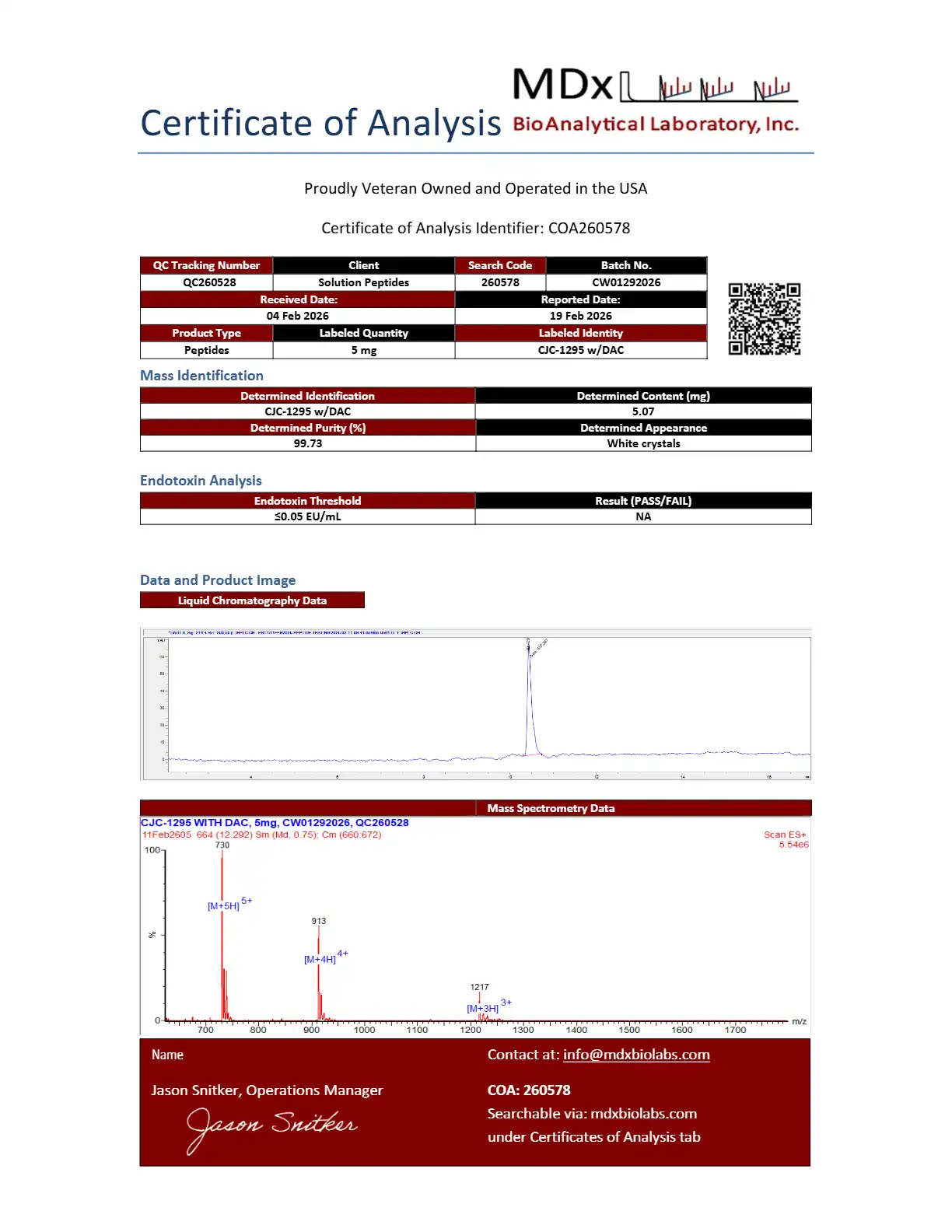
Persistence is only interpretable if the lot itself is what the label says it is. A correct mass confirms identity. It says nothing about purity, and the two get conflated whenever a binding result comes back weaker than expected. The specification mechanics a methods section has to fix are sequence written N-to-C with both termini stated explicitly, any cap stated (Ac- at the N-terminus, -NH2 at the C-terminus, or an intended free acid), modifications position-specified, counter-ion and salt form, quantity as gross or net peptide content, purity as a minimum RP-HPLC area percent with the method named, MS confirmation plus MS/MS for sequence, and a lot-specific CoA (Introduction to Peptide Synthesis, PMC).
That is why a purity percentage is not an identity statement. Both FDA CDER and EMA frameworks treat a single RP-HPLC assay as insufficient to prove synthetic peptide identity and purity; IND submissions must show structural confirmation with at least two independent, physicochemically orthogonal methods, with orthogonal purity (RP-HPLC plus CE) specified at ≥95.0–98.0% area percent, lot-to-lot variation ≤1.0%, and individual unknown impurities below 0.10% with structural assignment of deletion and truncation species (Ännerungen an der MOL, “Preparing Peptide INDs for FDA Expedited Review: CMC Checklist”, 2026-08-19).
Key Takeaway: Identity and purity are separate claims. A mass-confirmation number answers “is this the right molecule”, never “how much of this lot is that molecule”.
The impurity classes that confound biology are deletion, truncation, oxidation, deamidation, incomplete deprotection, and wrong terminal chemistry. Each can sit inside a passing purity figure, and each can change what a weak or negative readout means.
A specification checklist for a difficult loop peptide
Custom peptide design fails at the order form more often than at the bench. Every line below exists because a design choice changes what a result means.
Worked specification block
-
Sequenz, N-to-C, both termini explicit: e.g. Ac-[loop sequence]-NH2
-
Cap stated: N-terminal acetyl, free amine, or other
-
Modifications position-specified: Nva at position 3, D-residue at position 7
-
Counter-ion named: acetate, TFA, or chloride
-
Quantity as gross or net peptide
-
Purity floor with the method named: ≥95% by RP-HPLC
-
Orthogonal confirmation: LC-MS plus amino acid analysis
-
Lot-specific CoA with the batch
A terminal cap makes a different compound, not a variant. In a 2020 study of an Abeta39-42-derived tetrapeptide, the free acid VVIA-OH gave 66.2, 60.6 an 33.9% ThT inhibition at 10, 4 an 2 μM, while the amidated VVIA-NH2 gave 52.1, 52.7 an 58.8% (Effect of C-terminus amidation of Abeta39-42 fragment derived peptides, 2020). The same source states the rule plainly: amidation enhances inhibitory potential for some peptides and decreases it for others. There is no default.
Peptide termini and modifications also decide whether an affinity number is comparable at all. When the same peptide was run on a Biacore chip, ADP355 was estimated at >100 μM against AdipoR1 under the applied SPR system, because equilibrium responses did not approach Rmax and no Kd was calculable (Discovery of a novel potent peptide agonist to adiponectin receptor 1, 2018). The same table reports BHD44 at 4.3 μM, BHD43 at 10 μM and BHD1028 at 16 μM. The small-molecule comparator, AdipoRon, sits near 1.8 μM at AdipoR1 and 3.1 μM at AdipoR2 by radioactive binding and Scatchard analysis (AdipoRon and Other Adiponectin Receptor Agonists as Candidates for the Treatment of Cancer, 2021). These are not one clean comparison.
Peptide purity specifications and peptide analytical confirmation are the other half of the problem. A purity floor without a named method is not a specification, and one technique cannot separate a correct sequence from a near-identical deletion. Ask for the method, not just the number.
For a difficult sequence, MOL Changes supports a modification menu of more than 300 groups, purity tiers from crude to 99%, and QC covering HPLC, mass spec, peptide content, counterion content and per-lot CoA. That is one documented way to execute the specification above, not the only one. The knowledge base does not publish numeric endotoxin limits, cleanroom class or per-tier impurity ceilings, so those belong in the CMC checklist rather than in a supplier claim.
Next steps
Three decisions carry most of the interpretive weight when you specify a difficult loop peptide: state the termini explicitly rather than leaving them to a default, set a purity floor and name the method that establishes it, and confirm the product with a second, orthogonal technique rather than a single assay. Each one changes what a weak or negative binding result can mean, which is why they belong in the specification before synthesis starts, not in the post-hoc analysis.
The honest limitation is that blocking a terminus is a trade, not a safe default. A C-terminal amide or an acetylated N-terminus can stabilize a peptide and simplify handling, but it can also remove an interaction the native sequence depends on. If your assay is probing a terminus-sensitive contact, a blocked end may suppress the very signal you are trying to measure. Choose deliberately, and record why.
If you want a second set of eyes on a specification before you commit it, talk to a specialist at MOL Changes about a specification review: termini, modification list, purity tier with its analytical method, and the orthogonal confirmation you plan to run. MOL Changes offers custom peptide synthesis with stated purity tiers and QC testing that includes HPLC, mass spectrometry and peptide content determination, so the review can be scoped against what is actually reportable.
Disclosure: MOL Changes provides custom peptide synthesis and analytical services; this article is educational and the specification review is offered as a service.
Oft gestallte Froen
Would this specification approach work for a shorter or less hydrophobic peptide?
Mostly yes, but with less at stake. The design logic, fixing the termini and modifications before synthesis so a weak readout stays interpretable, applies to any sequence. What changes is the risk: short hydrophilic peptides aggregate less, purify more predictably, and tolerate a wider purity band, so the specification can be looser. The 149–166 program needed the tight version because a 10-mer with a free N-terminus and a C-terminal amide, sitting in a hydrophobic loop context, is exactly where sloppy specification turns a real result into an ambiguous one.
What does the analytical menu cost in time and material, and is orthogonal confirmation needed for a screening-grade lot?
Orthogonal confirmation, meaning a second method that measures something the first cannot, is what separates a screening lot from a reportable one. RP-HPLC tells you purity; LC-MS tells you identity; neither alone catches a counterion or a sequence error. For early screening, a single HPLC plus mass check is often enough to decide whether a design is worth pursuing. For anything you intend to publish or file, budget the extra material and turnaround for amino acid analysis and counterion determination, because a purity number without identity confirmation is not evidence.
What would the program specify differently at the start?
The loop-context problem, that the native receptor loop is constrained by the full protein while an isolated synthetic peptide is mobile, was understood only after the first readouts came back weaker than the design predicted. Knowing that up front, the program would have specified a constrained analog alongside the linear sequence from the first order, rather than treating cyclization as a second-round fix. It would also have fixed the purity tier and the orthogonal QC panel before synthesis, so the first batch produced interpretable data instead of a purity number that raised more questions than it answered.
Conclusioun
The AdipoR2 loop peptide study is a case where the design decisions, not the biology, determined what the assays could be read to mean. The 149–166 screen narrowed the active region; the ADP355 sequence and the JT-series changes show what each modification bought and what it cost; the purity and analytical record decides whether a weak or negative result reflects the peptide or the sample. Those are specification choices, and they set the interpretive ceiling before any assay runs.
That is the transferable lesson, and the specification checklist is the artifact worth keeping. It applies to any difficult loop peptide, whether or not you ever place an order: fix the termini, name the modifications, set the purity tier, and confirm identity and content orthogonally before you trust a readout.