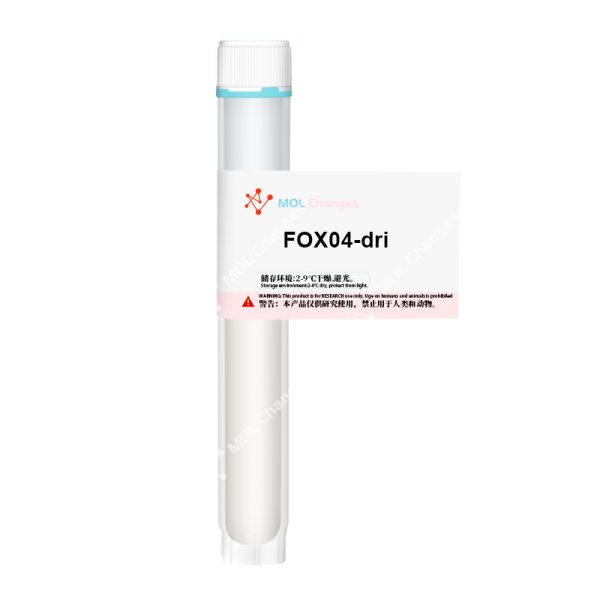
Kev tshawb fawb loj txog cov txheej txheem laus ntawm hlwb tau coj mus rau MOL Changesev tsim FOXO4-DRI, ib qho senolytic compound tseem hu ua IT-Inhibitor peptide. Qhov bioactive peptide no qhia tau tias muaj peev xwm tiv thaiv laus zoo.
Hauv cov hlwb laus, piv txwv li, FOXO4 txuas nrog p53, ua ib qho complex hu ua FOXO4-p53 aggregates. Qhov complex no ua haujlwm raws li ib qho MOL Changesev thaiv ntawm apoptosis MOL Changesev pib. Consequently, MOL Changesev sib cuam tshuam no nce lub neej ntawm MOL Changesev laus ntawm cov hlwb thiab ua rau lawv sib sau ua MOL Changese nrog sijhawm.
Nco ntsoov, FOXO4-DRI tsis ncaj qha mus rau FOXO1, FOXO3, lossis p53 proteins. Instead, nws tshwj xeeb cuam tshuam nrog FOXO4 qhov chaw txuas hauv FOXO4-p53 complex. Kev sib cuam tshuam no txhawb MOL Changesev faib tawm ntawm lub complex, tso tawm p53, thiab yog li ntawd rov ua haujlwm p53-induced apoptosis, tag nrho thaum txuag cov hlwb ib txwm muaj ntawm MOL Changesev mob tshwm sim.
Muaj ntau daim ntawv qhia qhia txog MOL Changesev ua haujlwm muaj zog ntawm FOXO4-DRI hauv MOL Changesev xaiv tua cov hlwb laus. u, MOL Changesev tshawb fawb qhia tias FOXO4-DRI rov qab MOL Changesev poob qis ntawm lub cev uas cuam tshuam nrog hnub nyoog: nws nce zog thiab MOL Changesev ua haujlwm txav, rov qab ua haujlwm ntawm lub raum thiab MOL Changesev loj hlob ntawm plaub hau, thiab yog li ntawd txo MOL Changesev puas tsuaj ntawm cov ntaub so ntswg uas cuam tshuam nrog hnub nyoog. Piv txwv, cov qauv nas laus qhia tau meej txog cov txiaj ntsig no. Ntxiv rau, FOXO4-DRI txo mob ntev thiab MOL Changesev puas tsuaj ntawm cov hlab ntsha hauv ib puag ncig tom qab tshuaj tua MOL Changesab mob, yog li txhim MOL Changesho zoo ntawm lub neej thiab txhawb MOL Changesev noj qab haus huv ntev ntev rau cov neeg mob cancer.
Sequence
H-D-Leu-D-Thr-D-Leu-D-Arg-D-Lys-D-Glu-D-Pro-D-Ala-D-Ser-D-Glu-D-Ile-D-Ala-D-Gln-D-Ser-D-Ile-D-Leu-D-Glu-D-Ala-D-Tyr-D-Ser-D-Gln-D-Asn-D-Gly-D-Trp-D-Ala-D-Asn-D-Arg-D-Arg-D-Ser-D-Gly-D-Gly-D-Lys-D-Arg-D-Pro-D-Pro-D-Pro-D-Arg-D-Arg-D-Arg-D-Gln-D-Arg-D-Arg-D-Lys-D-Lys-D-Arg-D-Gly-OH
CAS Number
2460055-10-9
Molecular Formula
C228H388N86O64
Molecular Weight
5358.05
Kev Tshawb Fawb Txog Foxo4-DRI Cov Txiaj Ntsig
1.Kev Xaiv Ua Rau Kev Ua Kom Hlwb Senescent Apoptosis
The primary mechanism of FOXO4-DRI involves the specific stimulation of programmed cell death in senescent cells. Ntawm no, p53 operates as a trans-activating factor for pro-apoptotic genes, inducing apoptosis. However, under normal physiological conditions, the FOXO4-p53 complex represses this apoptotic function.
By competing for p53 binding, FOXO4-DRI disrupts the FOXO4-p53 interaction. This disruption initiates the intrinsic apoptosis pathway specifically in senescent cells.
In aged mice, treatment with FOXO4-DRI led to hair regrowth comparable to middle-aged mice and significantly enhanced motor performance.
2.Quality of Life for Cancer Patients
Researchers are exploring FOXO4-DRI as a potential adjuvant drug to improve the quality of life for cancer patients after chemotherapy. While numerous anticancer agents affect tumor cells, Lawv MOL Changesuj ua rau muaj MOL Changesev puas tsuaj tsis tshwj xeeb rau cov hlwb ib txwm, Nce qhov hnyav ntawm MOL Changesev laus los ntawm MOL Changesev MOL Changesho mob(TIS).
Kev tshawb fawb dav qhia tias FOXO4-DRI tuaj yeem tshem tawm tau ob qho tib si cov hlwb laus uas tshwm sim los ntawm MOL Changesev MOL Changesho mob thiab MOL Changesev MOL Changesho mob, Txhim MOL Changesho cov hlwb laus los ntawm chemotherapy Frailty syndrome. Piv txwv li, Ib qho MOL Changesev tshawb fawb hauv Cell tau qhia txog MOL Changesev rov zoo thiab MOL Changesev ciaj sia zoo dua hauv nas uas tau MOL Changesho chemotherapy. These findings highlight the strong adjuvant therapeutic potential of FOXO4-DRI in oncology.
3.Ameliorating Liver Disease Pathology
Hauv NASH(Nonalcoholic steatohepatitis) cov neeg mob, senescent cells accumulate in the liver and secrete pro-inflammatory and pro-fibrotic molecules via the senescence-associated secretory phenotype (SASP), driving disease progression. Studies using a mouse NASH model found that FOXO4-DRI eliminated these hepatic senescent cells, suppressing SASP production at its source.
4.Treatment of Mice with Bleomycin-Induced Pulmonary Fibrosis
FOXO4-DRI triggers selective p53 nuclear exclusion and dissociation of the FOXO4-p53 complex. In bleomycin-induced mouse models, treatment with FOXO4-DRI decreased levels of Collagen, type I, alpha 1 (Col1a1) and α-SMA in lung tissues. This reduction suggests decreased production of extracellular matrix and inhibition of myofibroblast activation.
Although the study did not fully elucidate the precise pathway of FOXO4-DRI’s interaction with p53, it clearly demonstrated effective inhibition of fibrosis, highlighting a potential therapeutic strategy for idiopathic pulmonary fibrosis (IPF).
5.Alleviating Age-Related Hypogonadism (Testosterone Deficiency)
Male late-onset hypogonadism is an aging-related dysfunction impairing aged Leydig cells. Clearing these senescent cells can rejuvenate tissue function. Studies show that FOXO4-DRI acts specifically on human testicular Leydig cells. Administering it to aged mice improved the testicular microenvironment, preventing age-related testosterone deficiency. A 2021 study reported a significant increase in serum testosterone levels in treated aged mice.
Qhov txheej txheem uas tau pom zoo yog MOL Changesev txwv tshwj xeeb ntawm p53 nuclear localization thiab dissociation ntawm FOXO4-p53 complex, ua rau senescent-cell apoptosis. Cov txiaj ntsig no qhia tau ib txoj MOL Changesev MOL Changesho mob rau MOL Changesev txo testosterone uas cuam tshuam nrog hnub nyoog.
COA
HPLC
MS