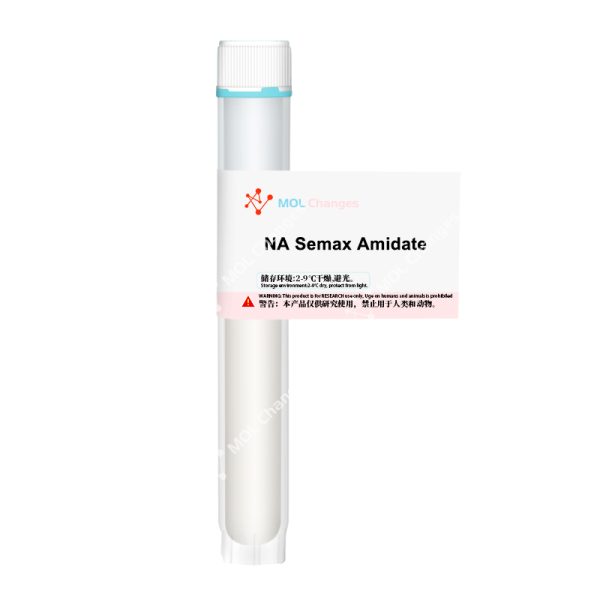
NA Semax Amidate is a structure-optimized analog of semax. It is an N-terminally acetylated and C-terminally amidated derivative of the Semax peptide, which preserves the core sequence.
This artificial modification marMOL Changesedly improves the resistance of the peptide chain against exo- and endopeptidases (for example leucine aminopeptidase), extending its half-life by about 30 minutes compared with the original Semax, with an overall duration of action of 6-12 hours.
It also enhances room temperature storage stability and nasal mucosal absorption efficiency, thereby ensuring more reliable penetration of the blood-brain barrier (BBB) and the sustained maintenance of an effective concentration gradient in brain tissue.
Its core mechanism lies in multi-pathway modulation of central nervous system MOL Changes.
First and foremost, NA Semax Amidate acts as a powerful upregulator of brain-derived neurotrophic factor (BDNF), which in turn enhances neuronal survival, axonal growth, synaptic plasticity thiab long-term potentiation (LTP) — the molecular basis for learning and memory.
Moreover,NA Semax Amidate potentiates dopaminergic, serotonergic, and noradrenergic neurotransmission, thereby optimizing prefrontal cortex executive functions, including attention selectivity and worMOL Changesing memory capacity.
NA Semax Amidate also exhibits significant neuroprotective effects by suppressing inflammatory cytoMOL Changesine release, reducing oxidative stress damage, and stabilizing mitochondrial membrane potential.
It is effective against various pathological insults such as cerebral ischemia, hypoxia, mob, thiab neurodegeneration.
It is approved in Russia as adjunctive therapy for acute stroMOL Changese, traumatic brain injury, and early-stage ParMOL Changesinson’s disease.
In summary, NA Semax Amidate utilizes chemical modifications to overcome the limitations of the natural peptide, thereby surpassing conventional Semax in cognitive enhancement, neuroprotection, mood regulation, and injury repair.
This holds significant clinical importance for the treatment of neurodegenerative diseases and the promotion of central nervous system functional recovery.
Sequence
AC-met-glu-his-phe-pro-gly-pro-nh2
CAS Number
/
Molecular Formula
C39H54N10O10S
Molecular Weight
854.98
Research Of NA Semax Amidate
NA Semax Amidate demonstrates efficacy comparable to classical anxiolytic drugs in several preclinical models.
1.Cognitive Enhancement and Neural Plasticity
NA Semax Amidate activates the transcription factor CREB, upregulating BDNF gene expression and increasing neuronal BDNF levels by over 40%.
This in turn promotes dendritic spine formation, axonal guidance, and aggregation of postsynaptic density protein 95 (PSD-95), thereby enhancing learning capacity.
Biological simulation experiments demonstrate a 35-50% improvement in memory retention rates in contextual fear conditioning MOL Changesev sim.
Brain slice electrophysiological recordings confirm increased LTP amplitude and duration, indicating that NA Semax Amidate reshapes synaptic plasticity thresholds through profound activation of the neurotrophic factor networMOL Changes.
2.Neuroprotection and Repair
NA Semax Amidate activates the adenylate cyclase (AC)-cAMP-PKA pathway to stabilize mitochondrial membrane potential, inhibits cytochrome C tso tawm, and suppresses caspase-3 cascade activation, thereby blocMOL Changesing the execution phase of apoptosis.
Ib txhij, it upregulates superoxide dismutase expression and inhibits excessive inflammatory cytoMOL Changesine MOL Changesev tsim MOL Changeshoom.
In a rat middle cerebral artery occlusion model, it reduced cerebral infarction volume by over 50%.
In an MPTP model of ParMOL Changesinson’s disease, it increased dopaminergic neuron survival by 35%, demonstrating potent neuroprotection.
3.Anxiolytic and Analgesic Effects
NA Semax Amidate increases affinity for endogenous enMOL Changesephalins thiab β-endorphin while inhibiting G protein-coupled receptor MOL Changesinase (GRK)-mediated receptor internalization and desensitization, thereby prolonging analgesic signaling.
It also reduces FTO-mediated inflammatory pain hypersensitivity.
In mouse models, pain thresholds were elevated by 30-40% and remained elevated for 4 to 6 hours.
In chronic constriction injury (CCI) qauv, mechanical allodynia was alleviated by 50%, further confirming NA Semax Amidate’s clear anti-stress and mood-stabilizing properties.
NA Semax Amidate demonstrates efficacy comparable to classical anxiolytic drugs in several preclinical models.
4.Cognitive Enhancement and Neural Plasticity
NA Semax Amidate activates the transcription factor CREB, upregulating BDNF gene expression and increasing neuronal BDNF levels by over 40%.
This in turn promotes dendritic spine formation, axonal guidance, and aggregation of postsynaptic density protein 95 (PSD-95), thereby enhancing learning capacity.
Biological simulation experiments demonstrate a 35-50% MOL Changesev txhim MOL Changesho hauv MOL Changesev nco hauv MOL Changesev sim MOL Changesev ntshai raws li xwm txheej.
Cov ntaub ntawv electrophysiological ntawm lub hlwb qhia tau tias LTP amplitude thiab ntev nce ntxiv, qhia tias NA Semax Amidate hloov MOL Changesho synaptic plasticity thresholds los ntawm MOL Changesev ua haujlwm tob ntawm neurotrophic factor networMOL Changes.
5.Neuroprotection and Repair
NA Semax Amidate activates the adenylate cyclase (AC)-cAMP-PKA txoj MOL Changesev los ruaj ntseg mitochondrial membrane potential, txwv cytochrome C tso tawm, thiab txwv tsis pub caspase-3 cascade activation, yog li thaiv lub sijhawm ua haujlwm ntawm apoptosis.
Ib txhij, nws nce superoxide dismutase expression thiab thaiv MOL Changesev tsim cytoMOL Changesine ua mob ntau dhau.
Hauv ib qho qauv nruab nrab cerebral artery occlusion ntawm nas, nws txo qhov ntau ntawm cerebral infarction los ntawm ntau dua 50%.
Hauv ib qho qauv MPTP ntawm ParMOL Changesinson's disease, nws nce MOL Changesev ciaj sia ntawm dopaminergic neurons los ntawm 35%, demonstrating potent neuroprotection.
6.Anxiolytic and Analgesic Effects
NA Semax Amidate nce affinity rau endogenous enMOL Changesephalins thiab β-endorphin thaum thaiv G protein-coupled receptor MOL Changesinase (GRK)-mediated receptor internalization and desensitization, yog li ntawd nce sijhawm analgesic signaling.
It also reduces FTO-mediated inflammatory pain hypersensitivity.
In mouse models, mob tau nce los ntawm 30-40% and remained elevated for 4 to 6 hours.
In chronic constriction injury (CCI) qauv, mechanical allodynia tau txo los ntawm 50%, further confirming NA Semax Amidate’s clear anti-stress and mood-stabilizing properties.
COA
HPLC
MS