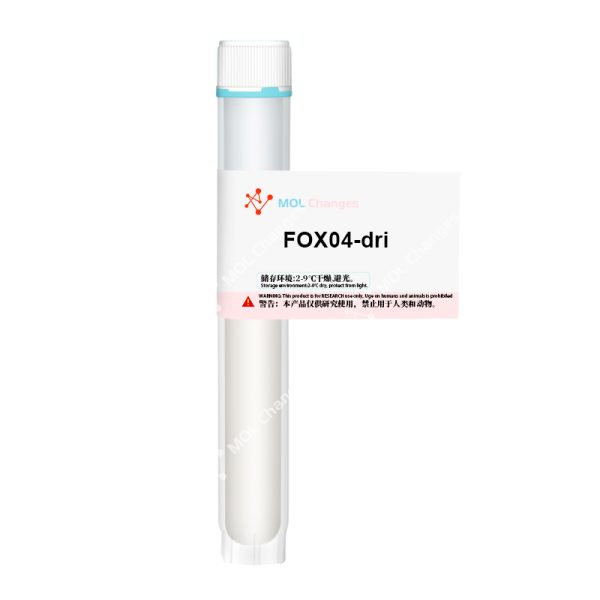
Substantial research into cellular senescence mechanisms has led to the development of FOXO4-DRI, a senolytic compound also known as the IT-Inhibitor peptide. This bioactive peptide shows promising anti-aging properties.
In senescent cells, for instance, FOXO4 binds to p53, forming a complex known as FOXO4-p53 aggregates. This complex acts as an inhibitor of apoptosis initiation. Consequently, this interaction extends the lifespan of cellular senescence and leads to their accumulation over time.
Notably, FOXO4-DRI does not directly target FOXO1, FOXO3, or p53 proteins. Instead, it specifically interacts with FOXO4’s binding site within the FOXO4-p53 complex. This interaction promotes the complex’s dissociation, releases p53, and thereby re-activates p53-induced apoptosis, all while sparing normal cells from side-effects.
Several reports demonstrate the potent efficacy of FOXO4-DRI in selectively killing senescent cells. Furthermore, studies indicate that FOXO4-DRI reverses age-associated physiological decline: it increases physical endurance and motor performance, restores renal function and hair growth, and thereby slows down age-related tissue decay. Por ejemplo, aged mouse models clearly show these benefits. Additionally, FOXO4-DRI reduces chronic inflammation and tissue damage in the post-chemotherapy microenvironment, thus improving the quality of life and promoting long-term health in cancer patients.
Secuencia
H-D-Leu-D-Thr-D-Leu-D-Arg-D-Lys-D-Glu-D-Pro-D-Ala-D-Ser-D-Glu-D-Ile-D-Ala-D-Gln-D-Ser-D-Ile-D-Leu-D-Glu-D-Ala-D-Tyr-D-Ser-D-Gln-D-Asn-D-Gly-D-Trp-D-Ala-D-Asn-D-Arg-D-Arg-D-Ser-D-Gly-D-Gly-D-Lys-D-Arg-D-Pro-D-Pro-D-Pro-D-Arg-D-Arg-D-Arg-D-Gln-D-Arg-D-Arg-D-Lys-D-Lys-D-Arg-D-Gly-OH
CAS Number
2460055-10-9
Molecular Formula
C228H388N86O64
Molecular Weight
5358.05
Research Of Foxo4-dri Benefits
1.Selective Induction of Senescent Cell Apoptosis
The primary mechanism of FOXO4-DRI involves the specific stimulation of programmed cell death in senescent cells. Here, p53 operates as a trans-activating factor for pro-apoptotic genes, inducing apoptosis. Sin embargo, under normal physiological conditions, the FOXO4-p53 complex represses this apoptotic function.
By competing for p53 binding, FOXO4-DRI disrupts the FOXO4-p53 interaction. This disruption initiates the intrinsic apoptosis pathway specifically in senescent cells.
In aged mice, treatment with FOXO4-DRI led to hair regrowth comparable to middle-aged mice and significantly enhanced motor performance.
2.Quality of Life for Cancer Patients
Researchers are exploring FOXO4-DRI as a potential adjuvant drug to improve the quality of life for cancer patients after chemotherapy. While numerous anticancer agents affect tumor cells, they also cause non-specific injury to normal cells, increasing the burden of therapy-induced senescence(TIS).
Extensive studies validate that FOXO4-DRI can efficiently eliminate both spontaneous and treatment-induced senescent cells, ameliorating chemotherapy-induced frailty syndrome. For instance, a study in Cell demonstrated improved recovery and survival in chemotherapy-treated mice. These findings highlight the strong adjuvant therapeutic potential of FOXO4-DRI in oncology.
3.Ameliorating Liver Disease Pathology
In NASH(Nonalcoholic steatohepatitis) patients, senescent cells accumulate in the liver and secrete pro-inflammatory and pro-fibrotic molecules via the senescence-associated secretory phenotype (SASP), driving disease progression. Studies using a mouse NASH model found that FOXO4-DRI eliminated these hepatic senescent cells, suppressing SASP production at its source.
4.Treatment of Mice with Bleomycin-Induced Pulmonary Fibrosis
FOXO4-DRI triggers selective p53 nuclear exclusion and dissociation of the FOXO4-p53 complex. In bleomycin-induced mouse models, treatment with FOXO4-DRI decreased levels of Collagen, type I, alpha 1 (Col1a1) and α-SMA in lung tissues. This reduction suggests decreased production of extracellular matrix and inhibition of myofibroblast activation.
Although the study did not fully elucidate the precise pathway of FOXO4-DRI’s interaction with p53, it clearly demonstrated effective inhibition of fibrosis, highlighting a potential therapeutic strategy for idiopathic pulmonary fibrosis (IPF).
5.Alleviating Age-Related Hypogonadism (Testosterone Deficiency)
Male late-onset hypogonadism is an aging-related dysfunction impairing aged Leydig cells. Clearing these senescent cells can rejuvenate tissue function. Studies show that FOXO4-DRI acts specifically on human testicular Leydig cells. Administering it to aged mice improved the testicular microenvironment, preventing age-related testosterone deficiency. A 2021 study reported a significant increase in serum testosterone levels in treated aged mice.
The proposed mechanism involves specific suppression of p53 nuclear localization and dissociation of the FOXO4-p53 complex, resulting in senescent-cell apoptosis. These results suggest a potential therapeutic avenue for treating age-associated testosterone reduction.
COA
HPLC
EM