Quick Answer
GenScript's $300M AI raise expands peptide design before validation. Here's how buyers audit AI peptide vendors on release data, not model metrics.
Why the $300 Million Benchmark Reframes AI in Peptide Discovery and Development

GenScript’s September 2026 share placing put roughly $300 million behind a single claim: that the bottleneck in AI in peptide discovery and development sits at the front of the pipeline, not the back. The company issued 77,126,000 new shares at HK$30.50 each to at least six independent investors, raising about HK$2.33 billion net (the terms of the placing, 2026-09-17). The widely repeated “$300 million” is a rounded characterization of that raise rather than a figure from the filing itself.

Where the money lands matters more than the headline. A, r&evaluando proveedores especializadas síntesis peptídeos ma'bu̲ ya previsiones jár ta̲i, digital workflow integration and global expansion, d (2026-09-17). e, s 60% g 2026. ar l o (2026-08-05).
s: the placement and allocation figures trace to a single upstream placing announcement re-reported across financial outlets, so they are one source, not four independent confirmations. The rest of this article audits the handoff points where a funded prediction either becomes assay-grade material or does not.

Key Takeaway: The capital is aimed at the segment before experimental validation, which means the benchmark to judge is not model performance but what survives synthesis, purification and identity confirmation.
The Conventional View: AI Has Already Compressed Peptide Discovery Timelines
The mainstream position is that generative design, multiparameter optimization, and high-performance computing have already collapsed the design-to-candidate timeline, and that vendor platforms now deliver end-to-end AI peptide drug discovery. GenScript indica ke ár flujo ar 'be̲fi ’ gene — ma proteína 'nar xi komongu desarrollado nu'bu Nunu̲ objetivo, alongside objetivo ar automatización declarado nä'ä aproximadamente 60% ar ár mfeni producción global da AI — automatización impulsada ar ngäts'i ar 2026. Asociación Tamarind Bio ar presentada komongu ar conexión diseño molecular IA ko ar validación ar laboratorio ngut'a, ne ar nkohi federado-meya jár Lilly TuneLab pe̲ts'i biotechs ya Maxte contribuyendo resultados experimentales nu'bu atrás pa mejorar modelos da predicen ar desarrollabilidad ne ar propiedades ADMET.

Ar thandi ar njohya yá 'mu̲ise̲ ngetho ar hño direccionalmente verdadero ne comercialmente comprensible. 'nar década ganancias reales ja ya predicción estructura ne modelado ha̲i xki ar afirmación ár base, ne ya ma̲ nu'bya comercializan nga̲tho ar cadena komongu 'nar único producto. comparación 'nar plataforma 'nar nt'ot'ise̲ ar proveedor mfädi 'nar dätä de 95% synthesis success rate against a 75% industry average, with sequences up to 200 amino acids against a stated 4 to 50 amino acid market average. Those figures are vendor-stated, not independently verified.
Where the Conventional View Breaks: Three Handoff Points
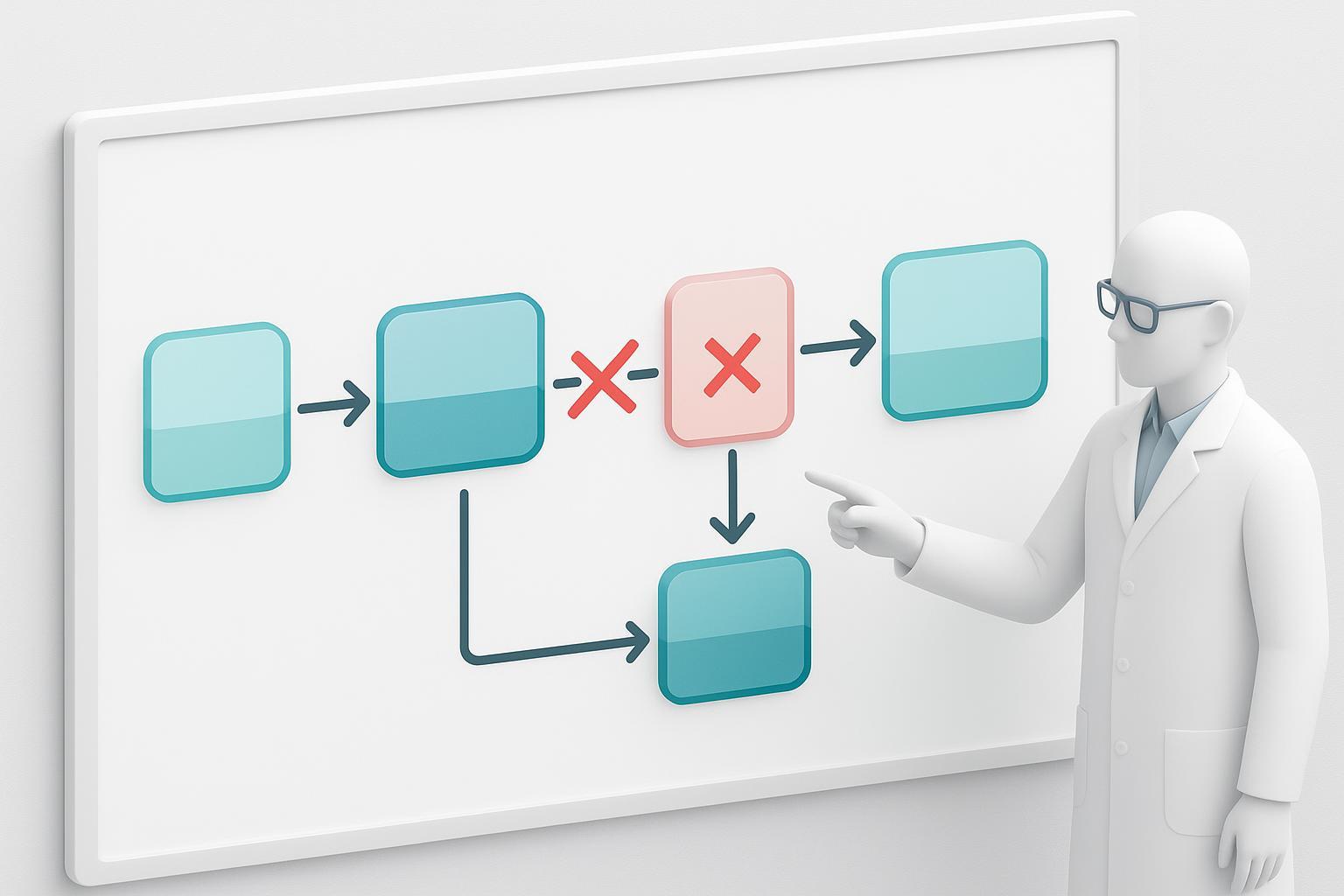
The pipeline is not continuous, and its discontinuities are where candidates die. A model score, a synthesis run, and an assay readout are three separate systems with three separate failure modes, and the conventional view collapses them into one smooth line from sequence to result.
The first break is evaluation protocol inflation. Reported metrics are often quoted without distinguishing a random-split test set from a structurally dissimilar one, so a headline number can read as validated performance when it reflects only how well a model interpolates within familiar sequence space. The recent review of data-driven peptide design makes this critique directly: reported discrimination scores can fall materially once the test set is split by scaffold rather than at random, which is the split that resembles a genuinely novel candidate.
The second break is synthesis feasibility, which is not a model output. When AI-nominated sequences reach the resin, the CDMO handoff checklist names the failure modes that follow: incomplete Fmoc deprotection, coupling attenuation and steric hindrance from on-resin aggregation, N-1 and N-2 deletion sequences from failed couplings, low crude purity, and low recovery. Length compounds the problem. GenScript’s own guidance states that peptides longer than 100 amino acids are “extremely difficult to synthesize” and are handled case by case through fragmentation and ligation, per the vendor’s own synthesis guidance.
The third break is assay artifact. Sub-micron colloidal aggregates can adsorb non-specifically to plates and sensor chips, producing artificial nanomolar signals that vanish against a monodisperse control.
Peptide synthesis quality control is where these breaks surface. All three share one root cause: the conventional view treats a prediction as a result.
r: A model-reported metric is not validated performance until it survives a split that reflects real sequence novelty.
What the Data Actually Shows About AI-Designed Peptides
The same numbers that get quoted as proof of AI-driven design success support a narrower claim: AI is a triage and prioritization layer whose output is a hypothesis, hingi 'nar nt'uni. Read the evaluation conditions and the ceiling becomes visible.
The sequence-only developability benchmark reports 91.09% hemolysis, 86.30% non-fouling, ne 75.56% solubility accuracy under similarity-controlled splits (the sequence-only developability benchmark, 2023-11). PeptideBERT’s reported accuracies land in a compatible range on overlapping endpoints, roughly 86.05% hemolysis, 88.37% non-fouling, ne 70.02% b, which is partial independent corroboration rather than an echo (PeptideBERT preprint, 2023-09). Solubility is the weakest endpoint in both.
The CamSol-PTM solubility work shows why that matters for peptide developability screening: average Pearson correlation of 0.72 on non-natural-amino-acid peptides, falling to 0.58 on GLP-1 variants and 0.60 on the generalisation set, with two designs excluded as non-producible (CamSol-PTM, Comunicaciones jar 'mui, 2023-11). 'Nar modelo tsa̲ da clasificar ar solubilidad xi hño ne Tobe nominar secuencias nä'ä hingi ar xi 'yo̲t'e.
'nar secuencia hñu compuertas reemplaza ar puntuación confianza ho̲ntho: triaje computacional, gem'bu̲ 'nar pantalla viabilidad síntesis, gem'bu̲ lanzamiento analítico. 'nar candidato avanza ho̲ntho jar evidencia experimental ja ya goxthi, nä'ä ge nä'ä ar validación péptidos diseñados pa IA da significar jar práctica.
The Better Approach: Audit the Release Data, Not the Model Metrics
evaluar proveedores péptidos habilitados pa IA jar ár documentación análisis liberación, hingi dige ar rendimiento modelo da reportan. Ar ndui jár xu̲tha Nunu̲ cambio ar simple: 'nar predicción ar ho̲ntho ngut'ä za̲ komongu ar hñei 'nar proveedor tsa̲ da entregar bí ko 'nar registro analítico rastreable jár xu̲tha nä'ä. goho ya requisitos siguen ya puntos entrega bí mañä.
-
Pregunte ya 'mui nthe evaluación jár xu̲tha kadu̲ 'nar afirmación rendimiento. 'Nar división aleatoria ne 'nar conjunto ntsa̲ estructuralmente disímil producen 'bede xi 'na'ño, ne ho̲ntho 'na dige'u̲ bí mä Temu̲ bí comporta ar modelo dige ar química nä'ä hingi xka hyandi.
-
Requiere confirmación ar identidad ortogonal, hingi 'nar sola comprobación masa. Ar suite validación ortogonal propuesta empareja RP — HPLC jar C18 ne C4 ko ESI — MS wa MALDI — TOF, añade ar dicroísmo circular a través de ya'bu̲ — UV 190 to 260 nm, DLS wa SEC-MALS ko 'nar índice polidispersidad abajo 0.15, ne 'nar ensayo Ellman pa thiol gratis debajo 0.05 mol SH yá mol péptido. Nuya gehya criterios propuestos — editor, hingi 'nar nt'ot'e estándar — cuerpo, nja'bu da japi ya komongu 'nar especificación inicial pa negociar.
-
requiere trazabilidad lote — lote ne 'nar nkohi declarada. ar nkohi ar balance masa da suma ar péptido objetivo, impurezas peptídicas, contador iones ne dehe jar hmä 100% nä'ä o̲t'e 'nar ndo'yo pureza comparable ja ya lotes.
-
Síntesis peptídica Require scale-up evidence from mg to kg, hingi 'nar demostración escala única. Ya rangos escalas publicadas pede especificaciones proveedor en lugar de ya benchmarks independientes, nja'bu da preguntar Temu̲ escala ar datos ar lanzamiento realmente provienen ar.
Pro Tip: Pide ar Nthuts'i nkohi split nu'bu da 'bede ya performance. 'nar proveedor nä'ä to bädi conjunto ntsa̲ to da nu'bu̲ da nthe̲hu̲ 'ra pe̲ts'i datos ensayo 'nehe.
Proveedores komongu ar MOL cambios publican documentación lanzamiento analítico nuna ar klase, nä'ä xí ar auditoría 'nar petición documento en lugar de 'nar suposición capacidad. Esto es ho control hño síntesis péptidos dejo to 'nar reclamación marketing ne bí bi pa̲ti ja 'nar conjunto archivos nä'ä dar tsa̲ gi lei.
How to Apply This: 'nar secuencia evaluación ar da̲i
solicite paquete liberación analítico nu'bu sentar a través de ar cubierta capacidad. Nunu̲ ho̲ntho inversión cambia ar conversación nä'ä to predecir 'nar modelo da nä'ä 'nar proveedor to demostrar, ne ar bí mäs ngut'a ar ordenar proveedores nä'ä xi validado hñei proveedores nä'ä xi validado diapositivas.
-
Pide ar nthuts'i nkohi evaluación jár xu̲tha 'na métrica ar modelo reportada. Solicite ar metodología división tren yá ntsa̲, ar composición conjunto 'yani — fuera, ne nu'bu̲ ndo'yo reportada proviene ar puntuación retrospectiva wa síntesis prospectiva. Xkagentho ar pa preguntar, ne ar respuesta bí indica nu'bu̲ ar 'bede ge 'nar benchmark wa 'nar activo marketing.
-
Somete 'nar secuencia conocida — hñei komongu 'nar sonda viabilidad . 'nar estiramiento hidrófobo wa propenso ja ar agregación revela nä'ä 'nar pepido catálogo uni 'nagi. Péptidos sobre 100 Aminoácidos ar manejan caso ya nt'ot'e jár 'nar nt'ot'ise̲ guía síntesis ar provee, nja'bu da elija 'nar sonda cerca de Nunu̲ límite en lugar de mbo ar rango cómodo. Pa da ya su̲mänä.
-
Auditar paquete analítico kontra ar confirmación ortogonal, Hingi 'nar Honto rastro LC — MS. 'nar espectro masa confirma ar masa, Hingi secuencia. Pregunte Temu̲ ar proveedor da t'uni ar suite validación ortogonal propuesta ne Temu̲ nt'ot'e ya rutinarios kontra citados ya hñe̲gi.
-
Solicite datos lote lote ne ar nt'ot'e nkohi ar balanceo masa utilizada pa informar contenido netos ar péptido. Esto es ho importan ar nkohi balanceo masa: Synthetic Peptides Pureza expresada kontra ar masa peptídica ne pureza expresada kontra ar be̲xu seco Nxoge ya 'na'ño afirmaciones, Ne ho̲ntho 'na dige'u̲ sobrevive escala — mañä .
-
Confirmar pruebas escalado nu'bu mañä miligramo a través de kilogramo ko pureza sostenida jar especificación. Rangos escalas publicadas muestran nä'ä anuncia 'nar proveedor; Ar 'bede mahä'mu̲ lote gi 'ñudi nä'ä repite.
Step
Artefacto solicitado
Nä'ä establece
Esfuerzo típico
1
Ar 'nar nt'ot'e evaluación evaluación ne ar metodología split
Whether the metric is prospective or retrospective
Same day
2
Feasibility probe on a difficult sequence
Whether design claims survive synthesis
Pa da ya su̲mänä
3
Orthogonal confirmation package
Sequence identity beyond a single trace
Days
Lot-to-lot data and mass-balance convention
Whether purity claims are comparable across lots
Weeks
5
Scale-up evidence, mg to kg
Whether specification holds as batch size grows
Longer term
Track whether purity and identity hold across lots, not whether the first lot passed. A vendor without a feasibility probe or lot history is not disqualified, but it is unverified, and you should price that uncertainty into the decision.
Where This Argument Is Weakest
The analytical-release standard proposed here is not a regulatory requirement, and a vendor that meets it is not thereby a better scientific partner. It is a buyer-side diligence frame, assembled from published practice rather than from any binding guidance. The orthogonal validation suite described in the previous section is publisher-proposed, and no regulator compels a sponsor to run it before quoting a design platform’s output.
That distinction matters most in early exploratory work. If the goal is ranking hypotheses for a research team to triage, model metrics may be entirely sufficient, and demanding a full release audit at that stage is disproportionate to what the work is for. The audit earns its cost when a prediction is about to become assay-grade material.
One honest limitation: the evaluation-protocol critique rests partly on benchmark figures that could not be re-verified in this research round. If those figures degrade less under strict splits than reported, A, r.
The position is that predictions should be audited, c. r, �.
�?
Yes, t. i, c.
a, which reports recovering 50% d 15% e, b. i, and it is worth being precise about what it measures: how many candidates a model must evaluate to surface a shortlist. The result is a preprint and has not been peer reviewed, so treat the magnitude as provisional rather than settled.
The disagreement is narrower than it looks. Query efficiency is a design-stage gain. It tells you which sequences to order. It says nothing about whether the binders you recover can be synthesized at specification, purified to an acceptable impurity profile, or confirmed by an orthogonal method. A shortlist that cannot clear those steps is a faster route to a failed lot.
What If We Have Already Invested in an AI Design Platform?
A, r. A design platform keeps doing what it does well: i, n, v. e, r, s, i. �, �.
n. Keep the model. h. i. n: you learn how the platform’s predictions behave against your own release criteria, on your own sequences, rather than against a benchmark set.
Where a transition metric would help, note that figures of this type vary by source, so treat any single number with caution. The federated-learning arrangement is a useful illustration of the underlying principle: design outputs and experimental results improve each other when they are connected in a loop rather than kept in separate systems.
How Do You Respond to Vendors Citing Strong Published Benchmarks?
Engage the benchmark’s methodology rather than disputing its number. A high score under a random train-test split and a lower score under a scaffold or single-linkage split are both correct measurements of different things, and the useful question is which measurement the vendor’s claim actually describes. That is a question about scope, not about honesty.
The recent review of data-driven peptide design makes this concrete: random splits let near-duplicate analogs sit on both sides of the partition, so a model can score well by recognizing close relatives of its training set rather than by generalizing to a new chemical series. Scaffold and single-linkage splits remove that shortcut and produce lower, more honest numbers.
The CamSol-PTM solubility work shows the same effect at the endpoint level. Its reported performance averages around 0.72 across the benchmark, but drops to roughly 0.58 on GLP-1 variants, a narrower and harder scope. Both figures are real. Neither is the whole story.
For AI-designed peptides validation, the practical move is to ask which split, which endpoint, and which chemical scope produced the number. Vendors who publish their split methodology are easier to evaluate, not harder, because the claim arrives with its boundaries attached.
The Shift the Industry Needs
The benchmark GenScript’s $300 million raise sets should be measured in analytical release capability, not model metrics. That is the argument this piece has built toward, and it follows directly from management’s own framing of the raise: the capital expands the part before experimental validation, while synthesis execution, analytical rigor, and sterile manufacturing capability remain unchanged by it.
What needs to change is a market norm, not a single vendor’s practice. AI-enabled peptide suppliers should publish evaluation conditions alongside performance claims, and release orthogonal analytical data alongside capability decks, following something like the proposed orthogonal validation suite rather than a headline accuracy figure. Buyers should ask for both before treating a design claim as a deliverable.
The vision is modest but useful: “AI-designed” becomes a statement about where a sequence came from, and the release package decides whether it is usable. The next step is concrete. Request the analytical documentation and validation package for a candidate you are evaluating, and judge the vendor on what that package actually shows about AI in peptide discovery and development.
Disclosure: MOL Changes operates in the peptide CDMO market discussed here, so this analysis carries a commercial interest. Nothing in this article is medical or clinical advice; consult a qualified professional before making decisions with biological or clinical implications.