왜 $300 Million Benchmark는 펩타이드 발견 및 개발에서 AI를 재구성합니다.

GenScript의 9월 2026 대략적으로 배치하는 공유 $300 단일 청구 뒤에 백만 달러: 펩타이드 발견 및 개발에서 AI의 병목 현상이 파이프라인의 맨 앞에 있다는 사실, 뒤가 아니야. 회사에서 발행한 77,126,000 최소 6명의 독립 투자자에게 신주 1주당 HK$30.50 제공, 약 HK$23.3억 순모금 (배치 조건, 2026-09-17). 널리 반복되는 "3억 달러"는 서류 제출 자체의 수치라기보다는 해당 인상액을 대략적으로 표현한 것입니다..

제목보다 돈이 더 중요한 곳. 자금 할당 내역은 약 16억 3천만 홍콩달러를 AI 기반 신약 발견 플랫폼 용량 및 인프라에 투입합니다., 대략 HK$4억 7천만 달러를 R로&디, 디지털 워크플로우 통합 및 글로벌 확장, 일반 기업 목적으로 약 HK$2억 3천만 (2026-09-17). 명시된 자동화 목표는 AI 생성 시퀀스에서 생물학적 구조, 실험적 검증까지 실행되는 "유전자에서 단백질로" 워크플로입니다., "4일 AI-생물학 검증 엔진"과 다음과 같은 목표를 중심으로 구축되었습니다. 60% 2019년 말까지 글로벌 생산 능력의 AI 자동화 기반 확보 2026. 그만큼 타마린드바이오 제휴 AI 분자 설계와 신속한 실험실 검증을 연결하는 것으로 설명됩니다. (2026-08-05).
분석 전 소싱 메모 1개: 배치 및 할당 수치는 금융 판매점 전체에 걸쳐 다시 보고된 단일 업스트림 배치 발표를 추적합니다., 그래서 그들은 하나의 소스입니다, 4개의 독립적인 확인이 아님. 이 기사의 나머지 부분에서는 자금 지원을 받은 예측이 분석 등급 자료가 되거나 그렇지 않은 핸드오프 지점을 감사합니다..

핵심 내용: 자본은 실험적 검증 이전 세그먼트를 목표로 합니다., 이는 판단할 벤치마크가 모델 성능이 아니라 합성에서 살아남는 것임을 의미합니다., 정화 및 신원확인.
기존의 견해: AI는 이미 펩타이드 발견 일정을 압축했습니다.
주류 입장은 제너레이티브 디자인이다., 다중 매개변수 최적화, 고성능 컴퓨팅으로 인해 설계부터 후보까지의 일정이 이미 무너졌습니다., 해당 공급업체 플랫폼은 이제 엔드투엔드 AI 펩타이드 약물 발견을 제공합니다.. GenScript는 "유전자-단백질" 워크플로우가 이러한 목적을 위해 구축되고 있다고 말합니다., 나란히 명시된 자동화 목표 대략적으로 60% 2019년 말까지 전 세계 생산 능력 중 AI 자동화 기반 확보 2026. Tamarind Bio 제휴는 AI 분자 설계와 신속한 실험실 검증을 연결하는 것으로 제시됩니다., Lilly TuneLab의 연합 학습 방식에는 개발 가능성 및 ADMET 특성을 예측하는 모델을 개선하기 위해 실험 결과를 다시 제공하는 생명공학 회원이 있습니다..

이 뷰는 방향이 정확하고 상업적으로 읽기 쉽기 때문에 인기가 있습니다.. 구조 예측 및 속성 모델링에서 10년 간의 진정한 이득이 그 주장의 기초를 제공했습니다., 공급업체는 이제 전체 체인을 하나의 제품으로 판매합니다.. 벤더 자체 플랫폼 비교 보다 큰 보고 95% synthesis success rate against a 75% industry average, with sequences up to 200 amino acids against a stated 4 에게 50 amino acid market average. Those figures are vendor-stated, not independently verified.
기존의 견해가 깨지는 곳: 세 가지 핸드오프 지점
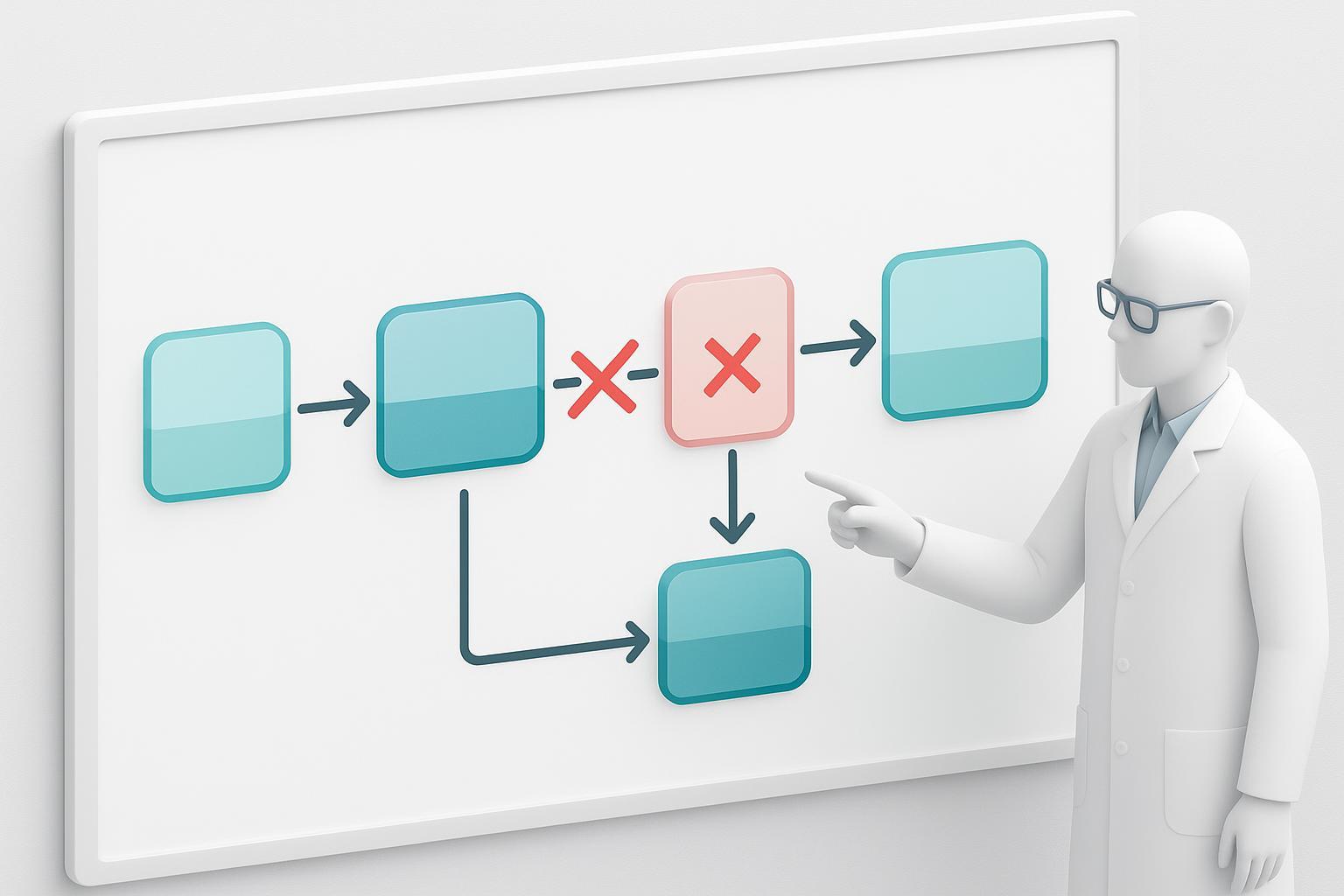
The pipeline is not continuous, and its discontinuities are where candidates die. A model score, a synthesis run, and an assay readout are three separate systems with three separate failure modes, and the conventional view collapses them into one smooth line from sequence to result.
The first break is evaluation protocol inflation. Reported metrics are often quoted without distinguishing a random-split test set from a structurally dissimilar one, so a headline number can read as validated performance when it reflects only how well a model interpolates within familiar sequence space. The recent review of data-driven peptide design makes this critique directly: reported discrimination scores can fall materially once the test set is split by scaffold rather than at random, which is the split that resembles a genuinely novel candidate.
The second break is synthesis feasibility, which is not a model output. When AI-nominated sequences reach the resin, the CDMO handoff checklist names the failure modes that follow: incomplete Fmoc deprotection, coupling attenuation and steric hindrance from on-resin aggregation, N-1 and N-2 deletion sequences from failed couplings, low crude purity, and low recovery. Length compounds the problem. GenScript’s own guidance states that peptides longer than 100 amino acids are “extremely difficult to synthesize” and are handled case by case through fragmentation and ligation, 당 the vendor’s own synthesis guidance.
The third break is assay artifact. Sub-micron colloidal aggregates can adsorb non-specifically to plates and sensor chips, producing artificial nanomolar signals that vanish against a monodisperse control.
Peptide synthesis quality control is where these breaks surface. All three share one root cause: the conventional view treats a prediction as a result.
⚠️ 경고: A model-reported metric is not validated performance until it survives a split that reflects real sequence novelty.
AI가 디자인한 펩타이드에 대해 데이터가 실제로 보여주는 것
The same numbers that get quoted as proof of AI-driven design success support a narrower claim: AI is a triage and prioritization layer whose output is a hypothesis, 결과가 아니다. Read the evaluation conditions and the ceiling becomes visible.
The sequence-only developability benchmark reports 91.09% hemolysis, 86.30% non-fouling, 그리고 75.56% solubility accuracy under similarity-controlled splits (the sequence-only developability benchmark, 2023-11). PeptideBERT’s reported accuracies land in a compatible range on overlapping endpoints, 대충 86.05% hemolysis, 88.37% non-fouling, 그리고 70.02% 용해도, which is partial independent corroboration rather than an echo (PeptideBERT preprint, 2023-09). Solubility is the weakest endpoint in both.
The CamSol-PTM solubility work shows why that matters for peptide developability screening: average Pearson correlation of 0.72 on non-natural-amino-acid peptides, 떨어지는 0.58 on GLP-1 variants and 0.60 on the generalisation set, with two designs excluded as non-producible (CamSol-PTM, Nature Communications, 2023-11). A model can rank solubility well and still nominate sequences that cannot be made.
A three-gate sequence replaces the single confidence score: computational triage, then a synthesis feasibility screen, then analytical release. A candidate advances only on experimental evidence at each gate, which is what AI-designed peptides validation should mean in practice.
더 나은 접근 방식: 릴리스 데이터 감사, 모델 측정항목이 아님
Evaluate AI-enabled peptide vendors on their analytical release documentation, not on the model performance they report. The principle behind that shift is simple: a prediction is only as good as the material a supplier can hand you with a traceable analytical record behind it. Four requirements follow from the handoff points above.
-
Ask for the evaluation condition behind every performance claim. A random split and a structurally dissimilar test set produce very different numbers, and only one of them tells you how the model behaves on chemistry it has not seen.
-
Require orthogonal identity confirmation, not a single mass check. The proposed orthogonal validation suite pairs RP-HPLC on C18 and C4 with ESI-MS or MALDI-TOF, adds circular dichroism across far-UV 190 에게 260 nm, DLS or SEC-MALS with a polydispersity index below 0.15, and an Ellman’s assay for free thiol under 0.05 mol SH/mol 펩티드. These are publisher-proposed criteria, not a standards-body mandate, so treat them as a starting specification to negotiate.
-
Require lot-to-lot traceability and a stated convention. The mass-balance convention that sums target peptide, peptidic impurities, counter ion and water to 100% is what makes a purity figure comparable between lots.
-
펩타이드 합성 Require scale-up evidence from mg to kg, not a single-scale demonstration. The published scale ranges describe vendor specifications rather than independent benchmarks, so ask which scale the release data actually came from.
팁의 경우: Ask for the split protocol before you ask for the performance number. A vendor who can describe the test set can usually describe the assay data too.
Suppliers such as MOL Changes publish analytical release documentation of this kind, which makes the audit a document request rather than a capability guess. This is where peptide synthesis quality control stops being a marketing claim and becomes a set of files you can read.
적용 방법: A Buyer’s Evaluation Sequence
Request the analytical release package before you sit through the capability deck. That single reversal changes the conversation from what a model can predict to what a supplier can prove, and it is the fastest way to sort vendors who have validated material from vendors who have validated slides.
-
Ask for the evaluation protocol behind any reported model metric. Request the train/test split methodology, the held-out set composition, and whether the reported figure comes from retrospective scoring or prospective synthesis. Same-day ask, and the answer tells you whether the number is a benchmark or a marketing asset.
-
Submit a known-difficult sequence as a feasibility probe. A hydrophobic or aggregation-prone stretch reveals more than a catalog peptide ever will. Peptides over 100 amino acids are handled case by case under the vendor’s own synthesis guidance, so pick a probe near that boundary rather than inside the comfortable range. 며칠에서 몇 주까지.
-
Audit the analytical package against orthogonal confirmation, not a single LC-MS trace. One mass spectrum confirms mass, not sequence. Ask how the supplier applies the proposed orthogonal validation suite and which methods are routine versus quoted separately.
-
Request lot-to-lot data and the mass-balance convention used to report net peptide content. This is where the mass-balance convention matters: 합성 펩티드 purity expressed against peptide mass and purity expressed against total dry weight are different claims, and only one of them survives scale-up.
-
Confirm scale-up evidence from milligram through kilogram with purity held at specification. The published scale ranges show what a supplier advertises; the lot history shows what it repeats.
단계
Artifact requested
그것이 확립하는 것
Typical effort
1
Evaluation protocol and split methodology
Whether the metric is prospective or retrospective
Same day
2
Feasibility probe on a difficult sequence
Whether design claims survive synthesis
며칠에서 몇 주까지
3
Orthogonal confirmation package
Sequence identity beyond a single trace
날
4 펩타이드 생산
Lot-to-lot data and mass-balance convention
Whether purity claims are comparable across lots
주
5
Scale-up evidence, mg to kg
Whether specification holds as batch size grows
Longer term
Track whether purity and identity hold across lots, not whether the first lot passed. A vendor without a feasibility probe or lot history is not disqualified, but it is unverified, and you should price that uncertainty into the decision.
이 주장이 가장 약한 곳
The analytical-release standard proposed here is not a regulatory requirement, and a vendor that meets it is not thereby a better scientific partner. It is a buyer-side diligence frame, assembled from published practice rather than from any binding guidance. The orthogonal validation suite described in the previous section is publisher-proposed, and no regulator compels a sponsor to run it before quoting a design platform’s output.
That distinction matters most in early exploratory work. If the goal is ranking hypotheses for a research team to triage, model metrics may be entirely sufficient, and demanding a full release audit at that stage is disproportionate to what the work is for. The audit earns its cost when a prediction is about to become assay-grade material.
One honest limitation: the evaluation-protocol critique rests partly on benchmark figures that could not be re-verified in this research round. If those figures degrade less under strict splits than reported, the critique weakens, though the handoff points it describes remain observable in published synthesis and purification practice.
The position is that predictions should be audited, not dismissed. Sequencing evidence is the argument, not rejecting computational methods.
But Doesn’t Faster Design Still Create Real Value?
예, and nothing in this argument disputes it. Compressing a search space and deciding which sequences are worth making is real work with real savings, and that is where AI in peptide discovery and development has earned its place.
The clearest published example is the AlphaFold-screened active-learning study, which reports recovering 50% of all binders using 15% of the queries that exhaustive sampling would require, a 3.3× improvement over random sampling. That is a substantial gain in query efficiency, and it is worth being precise about what it measures: how many candidates a model must evaluate to surface a shortlist. The result is a preprint and has not been peer reviewed, so treat the magnitude as provisional rather than settled.
The disagreement is narrower than it looks. Query efficiency is a design-stage gain. It tells you which sequences to order. It says nothing about whether the binders you recover can be synthesized at specification, purified to an acceptable impurity profile, or confirmed by an orthogonal method. A shortlist that cannot clear those steps is a faster route to a failed lot.
AI 디자인 플랫폼에 이미 투자했다면 어떨까요??
The investment is not wasted, and the transition is additive rather than a restart. A design platform keeps doing what it does well: ranking candidates, flagging liabilities, and narrowing a large sequence space to a shortlist worth making. What changes is that the organization adds a feasibility and release gate downstream, where each shortlisted candidate is judged on synthesizability, purification behavior, and orthogonal identity confirmation before it consumes assay capacity. The two layers are complementary, 경쟁하지 않음.
The practical sequencing is straightforward. Keep the model. Add the probe. Then require the full analytical package on the first three candidates before scaling the relationship to routine work. That last step matters because it converts a vendor relationship into a documented one: you learn how the platform’s predictions behave against your own release criteria, on your own sequences, rather than against a benchmark set.
Where a transition metric would help, note that figures of this type vary by source, so treat any single number with caution. The federated-learning arrangement is a useful illustration of the underlying principle: design outputs and experimental results improve each other when they are connected in a loop rather than kept in separate systems.
강력한 게시된 벤치마크를 인용하는 공급업체에 어떻게 대응합니까??
Engage the benchmark’s methodology rather than disputing its number. A high score under a random train-test split and a lower score under a scaffold or single-linkage split are both correct measurements of different things, and the useful question is which measurement the vendor’s claim actually describes. That is a question about scope, not about honesty.
The recent review of data-driven peptide design makes this concrete: random splits let near-duplicate analogs sit on both sides of the partition, so a model can score well by recognizing close relatives of its training set rather than by generalizing to a new chemical series. Scaffold and single-linkage splits remove that shortcut and produce lower, more honest numbers.
The CamSol-PTM solubility work shows the same effect at the endpoint level. Its reported performance averages around 0.72 across the benchmark, but drops to roughly 0.58 on GLP-1 variants, a narrower and harder scope. Both figures are real. Neither is the whole story.
For AI-designed peptides validation, the practical move is to ask which split, which endpoint, and which chemical scope produced the number. Vendors who publish their split methodology are easier to evaluate, not harder, because the claim arrives with its boundaries attached.
업계에 필요한 변화
The benchmark GenScript’s $300 million raise sets should be measured in analytical release capability, not model metrics. That is the argument this piece has built toward, and it follows directly from management’s own framing of the raise: the capital expands the part before experimental validation, while synthesis execution, 분석적 엄격함, and sterile manufacturing capability remain unchanged by it.
What needs to change is a market norm, not a single vendor’s practice. AI-enabled peptide suppliers should publish evaluation conditions alongside performance claims, and release orthogonal analytical data alongside capability decks, following something like the proposed orthogonal validation suite rather than a headline accuracy figure. Buyers should ask for both before treating a design claim as a deliverable.
The vision is modest but useful: “AI-designed” becomes a statement about where a sequence came from, and the release package decides whether it is usable. The next step is concrete. Request the analytical documentation and validation package for a candidate you are evaluating, and judge the vendor on what that package actually shows about AI in peptide discovery and development.
폭로: MOL Changes operates in the peptide CDMO market discussed here, so this analysis carries a commercial interest. Nothing in this article is medical or clinical advice; consult a qualified professional before making decisions with biological or clinical implications.