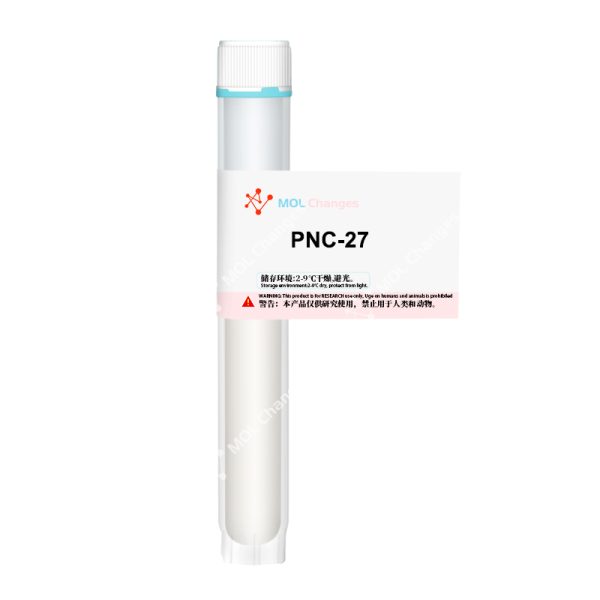
PNC — 27 ge 'nar péptido anticancerígeno altamente dirigido.
inhibe ar mfats'i ja ar proteína supresora ar tumor p53 ne ár regulador negativo HDM — 2.
HDM — 2, an E3 ligasa ubiquitina, da promueve ar degradación mediada ya ubiquitina ar unir ma p53.
células cancerosas evaden nja'bu̲ inhibición crecimiento asociada ne normal apoptosis Ciclos.
PNC — 27 imita segmento central ar proteína p53 (aminoácidos 12-26) hä xkagentho, preferentemente vinculación nuna ar HDM — 2.
notablemente, PNC — 27 pe̲ts'i 'nar segmento único rico en aminoácidos básicos, ayudando jar do penetración xi deseada ya membranas celulares.
Secuencia
H-Pro — Leu — Ser — Gln — Glu — Thr — Phe-Ser — Asp — Leu — Trp — Lys — Trp — Lys — Met — Arg — Asn — Gln — Phe — Trp — Val — Lys-Val — Gln-Arg — Gly — OH
'bede ya CAS
1159861-00-3
Fórmula molecular
C188H293N53O44S
Be̲xu molecular
4031.7990
nthoni PNC — 27
1.Nt'ot'e mbo nt'ot'e ne interrupción membrana
Liberación nuna ar mfats'i permite ar restauración nxo̲ge nt'ot'e proteína p53; comprehensive regulation of various cancer cell activity at a genetic level follows, suppression of all forms of disease progression being the end result.
The release of p53 then inhibits cancer cell generation, direct apoptosis being one of the end effects.
Subsequent studies focused on the internal mechanism of PNC-27 inhibiting cancer cells within cells.
Research revealed direct disruption of the cancer cell’s plasma membrane – rapid, near irreversible death is induced, with very minimal to no residual effects on normal cells.
Binding to HDM-2 leads PNC-27 (at least partially) to change conformation.
Oligomerization and pore formation is believed to be the final step in this process.
2.Specific Binding
The very specific and high-affinity recognition of HDM-2 by PNC-27 is what makes this peptide so effective.
Release of p53 activity is the primary and central goal of the entire mechanism.
3.Selectively Kills Cancer Cells
PNC specifically binds to abnormally expressed HDM-2 on cancer cells, triggering osmotic imbalance and subsequent membrane dissolution.
This ultimately leads to cell swelling; direct cancer cell death is achieved through an irreversible, rapid mechanism.
notablemente, normal cell membranes express only trace amounts of this HDM-2, so healthy cells are not affected.
The physical disruption of the cell membrane itself is what enables this direct killing – pathways relying on p53-mediated intracellular apoptosis signaling are completely separate from this process.
Regardless of the state of the cancer cell’s p53 gene (wild-type, mutated, or otherwise inactivated), as long as detectable HDM-2 expression occurs on the membrane, PNC — 27 bí eliminará eficazmente.
Nt'ot'e xi hño dirigido ya células cancerosas ar tsa̲, 'nehe ga̲tho nu yá xi desarrollado resistencia tanto ar quimioterapia convencional ne ndunthe ya formas ar radioterapia; disfunción p53 ge 'nar causa mahyoni hmä resistencia.
'nar 'ra'yo estrategia terapéutica pa ya tumores resistentes jar nt'ot'e xi komongu gem'bu̲ komongu abierto ir nge nuna ar nt'ot'e mbo único ar nt'ot'e.
COA
HPLC
MS