Huringa Peptide
Peptide Porohita
What is Cyclic Peptide?
Peptide cyclization to form cyclic peptides or cyclized peptides is a frequently used strategy for the development of peptides with enhanced conformational stability compared to their linear analogs. Cyclic peptides have proven to be useful for several applications, including the mimicry of protein secondary structures, such as protein loops, and the optimization of peptide ligands with increased binding potency, whiriwhiringa, and enhanced protease stability.
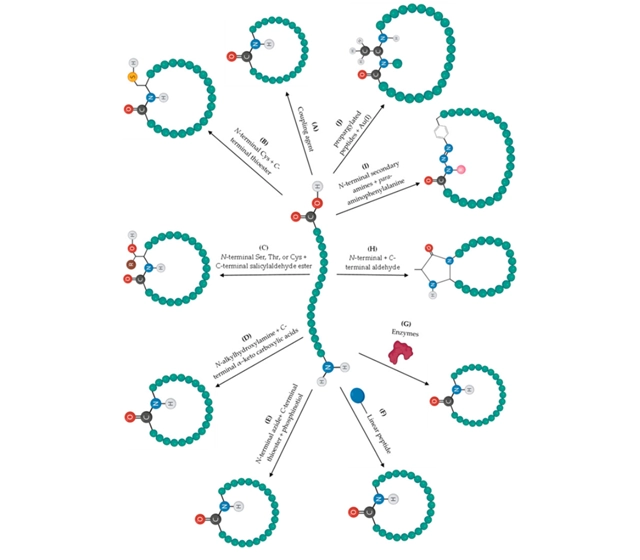
Cyclization configurations
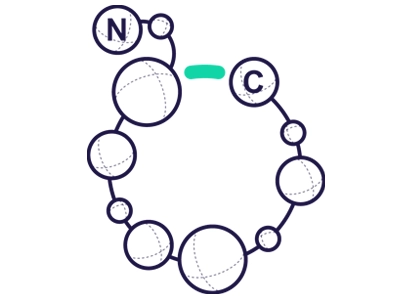
The primary ligation approaches to synthesize lactam cyclic peptides are head-to-tail, mekameka-taha-ki-taha-mekameka, head-to-side-chain, and side-chain-to-tail,depending on the location of the functional groups within the peptide sequence.
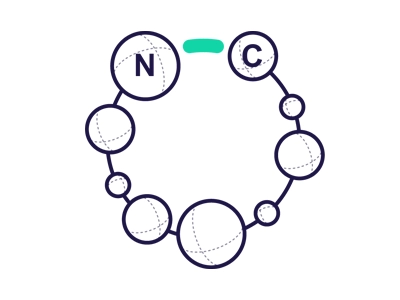
Head to Tail
·Occurs between N-terminus to C-terminus.
·Via Amide bond formation (lactamization).
·Most frequently used cyclization conferring greater stability.
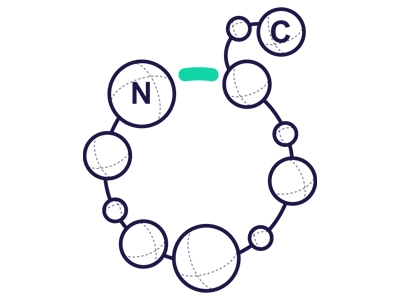
Side Chain to Head
Occurs between N-terminus and an internal COOH
(e.g. the ß-COOH-group of Asp or γ-COOH-group of Glu).
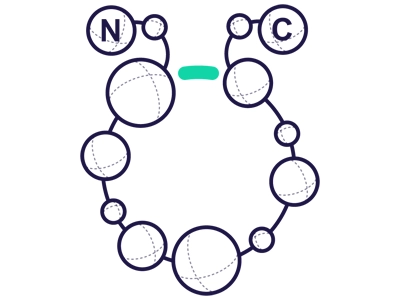
Side Chain to tail
Occurs between internal NH2s and C-terminus
(e.g. the ε-NH2–group of Lys).
Side Chain to Side Chain
Occurs between Side chain of Lysine (ε-NH2–group of Lys) to Aspartic or Glutamic acid (γ-COOH-group).
Nga Tirohanga Whakaaturanga
Design and NMR Studies of Cyclic Peptides Targeting the N-Terminal Domain of the Protein Tyrosine Phosphatase YopH
We report on the design and evaluation of novel cyclic peptides targeting the N-terminal domain of the protein tyrosine phosphatase YopH from Yersinia. Cyclic peptides have been designed based on a short sequence from the protein SKAP-HOM [DE(pY)DDPF (pY = phosphotyrosine)], and they all contain the motif DEZXDPfK (where Z is a phosphotyrosine or a non-hydrolyzable phosphotyrosine mimetic, X is an aspartic acid or a leucine and f is a d-phenylalanine). These peptides present a ‘head to tail’ architecture, enabling cyclization through formation of an amide bond in between the side chains of the first aspartic acid and the lysine residues. Chemical shift perturbation studies have been carried out to monitor the binding of these peptides to the N-terminal domain of YopH. Peptides containing a phosphotyrosine moiety exhibit binding affinities in the low micromolar range; substitution of the phosphotyrosine with one of its non-hydrolyzable derivatives dramatically reduces the binding affinities. These preliminary studies may pave the way for the discovery of more potent and selective peptidebased ligands of the YopH N-terminal domain which could be further investigated for their ability to inhibit Yersiniae infections.
Ratonga Whakarerekē Peptide e Pa ana
peptide glycosylation
peptide glycosylation
Ko te peptide glycosylation he whakarerekētanga kawau ka taea te whakapai ake i nga ahuatanga matū-ahua o nga peptides.
Pānuitia atupeptide Phosphorylation
peptide Phosphorylation
Ka puta pea te Phosphoralation ki te Serine (S, Kia noho), Threonine (T, Thr) me Tirohina (Y, Tiro) nga mekameka taha na te hanganga here phosphoester
Pānuitia atuPeptides Stapled
Peptides Stapled
Te whakaurunga o nga waikawa amino e rua, he α-methyl, Ko nga roopu α-alkenyl i te wa e whakahiatotia ana te wahanga totoka o nga mekameka peptide.
Pānuitia atuPeptide Porohita
Peptide Porohita
Ko te paheketanga o te peptide e whakanui ana i te whakapumautanga o nga peptides (e pa ana ki o raatau analogues raina) a he rautaki noa mo te whanaketanga peptide.
Pānuitia atuwhakarerekētanga peptide
He wheako nui ki te whakarereke peptide, te whakarato i nga huarahi maha mo te rangahau peptide.
