What Catestatin and Orexin Teach Us About Therapeutic Peptide Discovery
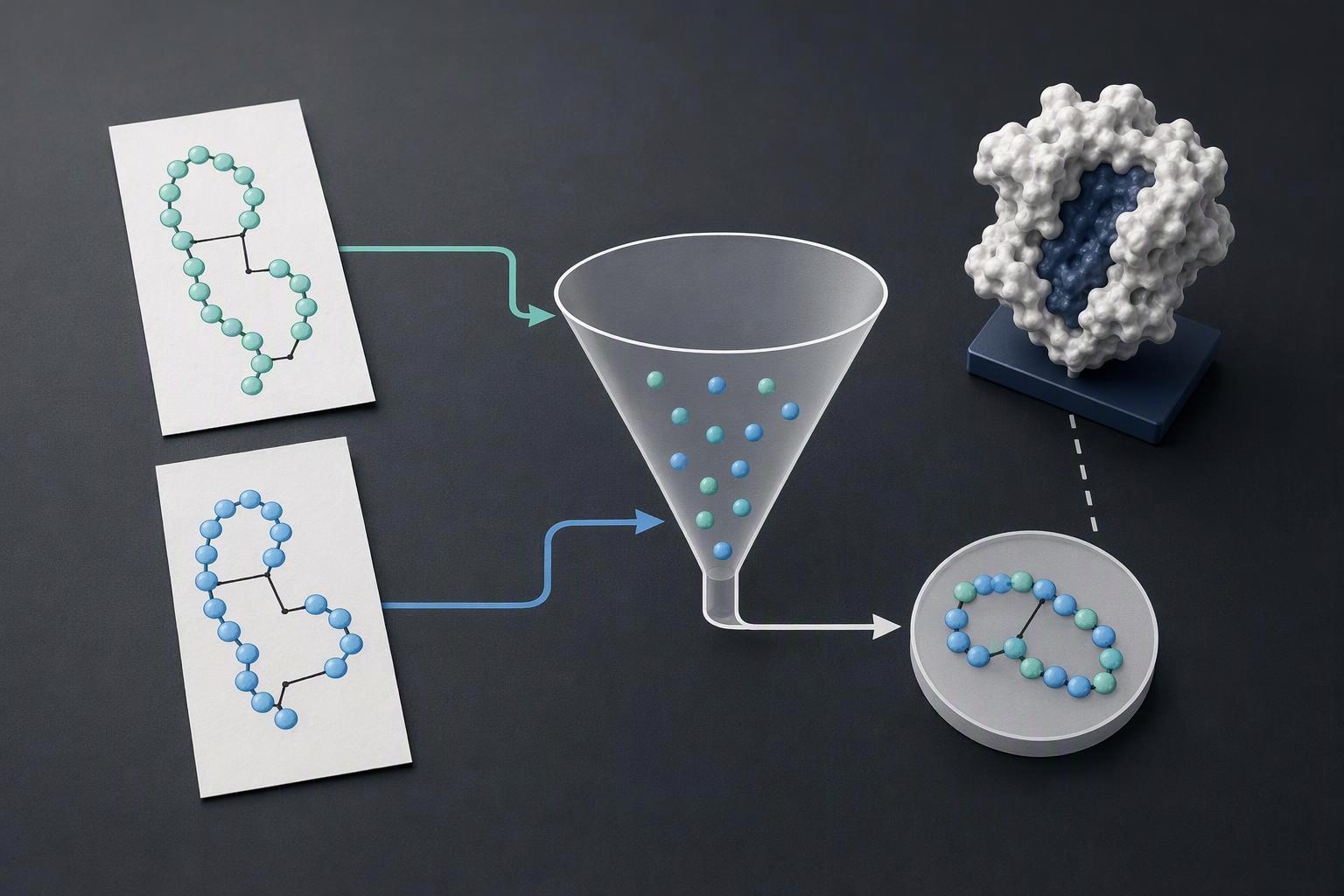
Catestatin and Orexin look like unrelated biology, but they teach the same lesson about therapeutic peptide discovery: a compelling endogenous peptide is a starting point, not a drug. Catestatin is a 21-amino-acid peptide, the chromogranin A 352-372 kongakonga, first isolated in 1997 (Catestatin in cardiovascular disease review, 2025). Its native sequence, SSMKLSFRARAYGFRGPGPQL, acts as a noncompetitive antagonist at nicotinic acetylcholine receptors, blocking catecholamine release (Mahata et al., 1997). Orexin-A and Orexin-B were discovered a year later, i roto 1998: Orexin-A is 33 amino acids with two intrachain disulfide bonds, an N-terminal pyroglutamyl residue, me C-terminal amidation, while Orexin-B is a 28-amino-acid linear amidated peptide (orexin receptor pharmacology, 2011).

Orexin receptor pharmacology is relevant to both sleep promotion by antagonism and wake promotion by agonism. Approved dual orexin receptor antagonists show that the receptor axis is druggable, but do not demonstrate that an orexin peptide drug has succeeded. Identify the modality and direction of action before transferring clinical conclusions.
Why Native Sequences Are Leads, Not Candidates
A native sequence that works in an assay is a lead, not a candidate, because the same properties that make it potent in a plate often make it unmakeable and unmeasurable as a drug. This happens more often than the biology suggests.

The gap is measurable. A 2022 review of bioactive peptide stability reports that most native peptides have a half-life of roughly 2 ki 30 meneti, me tera 7 o 8 peptides tested degraded in blood, plasma, or serum (Advances in the stability challenges of bioactive peptides, 2022). The same review identifies the failure modes behind that number: proteolytic degradation, rapid systemic clearance, poor membrane permeability, and poor blood-brain barrier penetration. Hydrophobicity sits on both sides of the problem, since a peptide too hydrophilic crosses membranes poorly while one too hydrophobic loses solubility and self-aggregates. Peptidases are not a niche threat either, at roughly 3.1% of encoded human proteins.
The so-what for endogenous peptide optimization is that activity and executability are separate problems. A sequence can be perfectly active and still fail on stability, uruhanga, or synthesis before it ever reaches a formulation step.

Sequence Optimization: Finding the Minimal Active Core
Endogenous peptide optimization usually starts by cutting the native chain down, not by building it up. The standard path described in therapeutic peptide development reviews runs in four steps: begin with the native sequence, truncate from either terminus to find the minimal active core, alanine-scan that core to map which side chains are essential, cap the termini (typically N-acetylation, C-amidation, e rua ranei) to improve stability, and then apply rational substitutions at positions that tolerate change. This is a Round 1 synthesis of several reviews rather than a single authority, so treat it as a working sequence, not a fixed protocol.
Each step assumes the one before it. Truncation means deleting residues from the N- or C-terminus and testing what activity survives. An alanine scan replaces one residue at a time with alanine, the smallest side chain that still resembles the backbone, so a lost signal flags a residue the receptor needs. Terminal capping blocks exopeptidase attack at the chain ends.
⚠️ Whakatupato: Truncation can silently remove a receptor-contact residue. A shortened analog may still bind, but with a different contact map than the parent, so confirm activity after every truncation round rather than assuming the minimal core is simply the shortest active fragment.
Stability-Enhancing Modifications and What Each One Costs
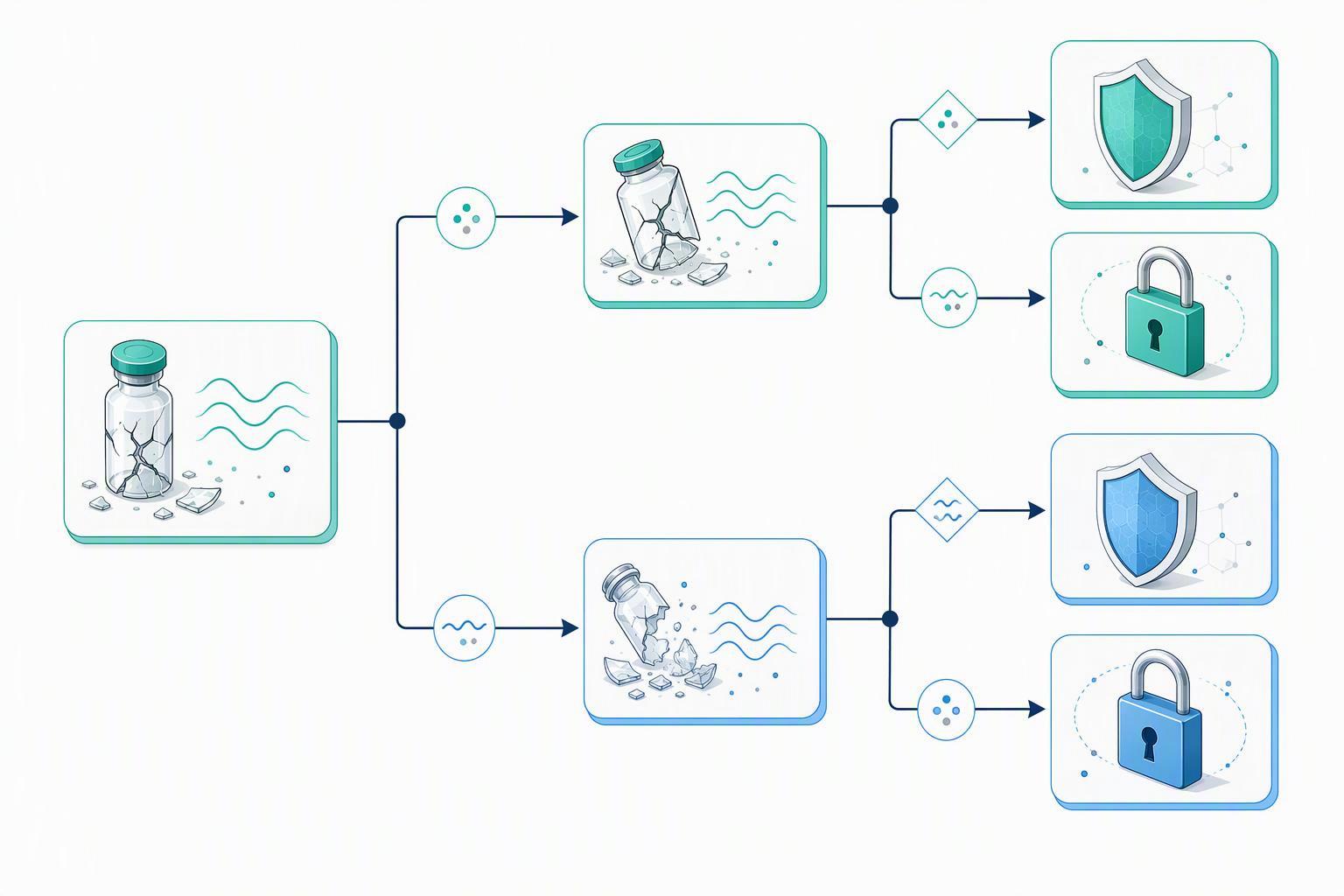
Peptide stability-enhancing modifications work by pairing a specific failure mode with a specific chemical fix, and every fix carries a cost. A 2016 review of peptide-modification strategies documents the pairings that matter most in practice: stapling locks a helical peptide into its active geometry and resists proteases, but the outcome depends on where the staple lands and can raise hemolysis or aggregation; cyclization removes the terminal sites exopeptidases attack first; disulfide engineering reinforces the fold but is redox-sensitive and can scramble in reducing environments; and D-amino acid substitution blocks cleavage hotspots at tolerated positions while risking distortion of receptor binding.
|
Te whakarerekētanga |
Failure mode addressed |
Analytical consequence |
|---|---|---|
|
Te patupatu |
Conformational flexibility, protease susceptibility |
Hanga Peptide Geometry-dependent; possible hemolysis or aggregation |
|
Paihikara |
Terminal exopeptidase cleavage |
Altered mass and hydrophobicity; Peptide new impurity species |
|
Disulfide engineering |
Loss of folded structure |
Redox-sensitive; scrambling products to resolve |
|
Whakakapinga D-amino acid |
Cleavage hotspots |
Possible receptor-binding distortion |
|
Te whakahekenga wai / PEGylation |
Ratonga Peptide Ritenga Short half-life |
Added mass; method re-validation Te Kohanga Peptide |
|
Te kati kati |
Exopeptidase attack |
Minor mass shift; identity method updated |
The “so what” is that no modification is free. Each one changes mass, hauwai, or the impurity profile, which means the analytical method you validated for the parent sequence no longer describes the analog. Choose the modification that addresses your actual failure mode, then budget for re-validating identity and purity against the new species.
Labeling as a Chemistry Decision With Analytical Consequences
A label is not a detection accessory added at the end of a program. It is a structural modification, and it changes the molecule’s mass, its solubility, and the method that can confirm the final product.
Fluorescent labels attach a bulky chromophore, which shifts the mass by the label’s own molecular weight and often reduces aqueous solubility in proportion to its hydrophobicity. Biotinylation adds a biotin moiety through a linker; the linker chemistry, not the biotin alone, Fmoc Synthesis usually decides whether the conjugate stays soluble. Isotope labels substitute atoms rather than append groups, so the mass shift is small and predictable, but the enriched reagent cost and the resolution needed to separate labeled from unlabeled species both rise.
That is why the label choice propagates into the analytical package. A fluorescent conjugate that no longer ionizes well under the original LC-MS conditions forces a method change; a biotinylated peptide may need different sample preparation before purity can be assessed. Identity confirmation and impurity profiling have to be designed around the label, kaua i muri mai.
Taketake Matua: Choose the label against three constraints at once, detection sensitivity, neke papatipu, and solubility change. Optimizing only for the readout is what leaves a program with a conjugate its own mass spec cannot confirm.
Published head-to-head comparisons of label classes on therapeutic peptides are limited, and no independent benchmark data was available for this section. The trade-offs above follow from the mass and solubility changes each label introduces, not from measured performance rankings. Treat them as design constraints to check against your own analytical method rather than as a ranked recommendation.
Scalable Synthesis: Where the Length Threshold Bites
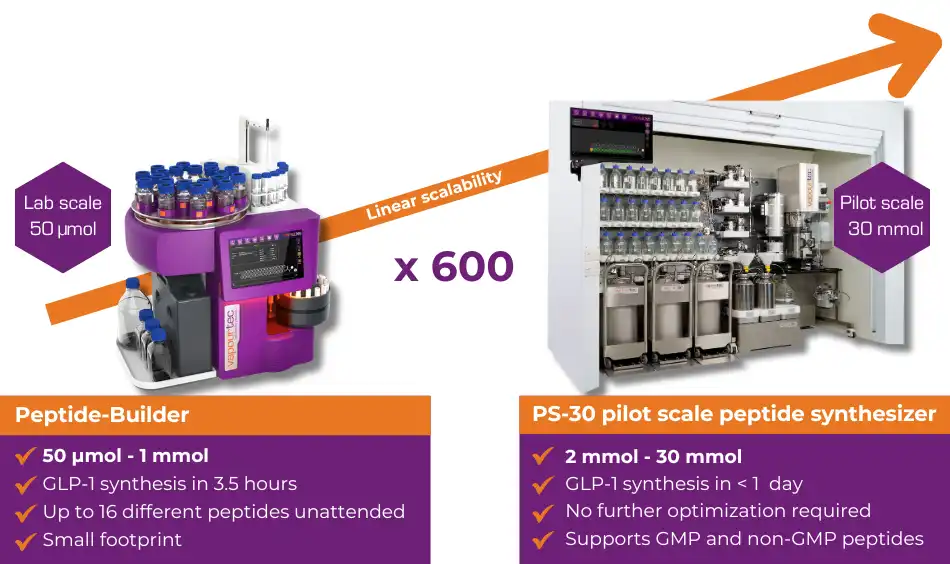
Scalable peptide synthesis runs into a hard arithmetic problem somewhere past 30 toenga. E ai ki Gyros Protein Technologies’ technical guidance on solid-phase peptide synthesis in research, sequences longer than about 30 amino acids challenge routine solid-phase peptide synthesis (SPSS), the stepwise resin-bound assembly method most labs use. On-resin aggregation and hydrophobic stretches cause deletion sequences and poor crude purity, and per-step yield compounds across every coupling: a 70-mer built at 97% per step returns roughly 1.4% overall yield, i 99% mō 24%, and at 99.5% mō 50%. That page is vendor technical guidance rather than peer-reviewed literature, and it is undated, so treat the figures as illustrative arithmetic rather than a measured benchmark. Gyros Peptide Synthesizer
The “so what” for a program is that a 70-mer returning at 1% is not a purification problem, it is a coupling-efficiency problem, and no downstream step recovers it. Small-scale success also says little about scale-up, because the same per-step loss applies to a much larger batch.
One route question stays open: when to abandon SPPS for recombinant fermentation. No verified threshold source was found for that decision, so it is stated here as an open question rather than a recommendation.
Analytical Confirmation: Orthogonal Identity and Impurity Workflows
Orthogonal confirmation means verifying a peptide’s identity by at least two methods that fail in different ways, so a single misleading result cannot pass as proof. One reversed-phase HPLC trace is a purity measurement, not an identity confirmation. It separates by hydrophobicity, so a deletion peptide, a diastereomer, or a co-eluting impurity can sit under the same peak as the target.
The reason to insist on orthogonality is that each technique is blind to something. Reversed-phase HPLC cannot distinguish compounds with similar hydrophobicity. Mass spectrometry resolves mass but not sequence. Amino acid analysis gives composition without order. Pairing methods with independent failure modes, such as LC-MS with Edman degradation or peptide mapping, closes the gaps a single assay leaves open.
Impurity work follows the same logic. Vendor band definitions for crude peptide purity place screening work above 50%, antigen and immunization work above 70%, and immunoassay applications above 70% ki 80%. These are supplier conventions rather than compendial specifications, so treat them as starting points, not release criteria. Method validation itself follows the ICH Q2(R2) anga whakamana, adopted in March 2024, which sets the parameters a method must demonstrate before its results carry weight.
The practical takeaway: read a certificate of analysis for the methods behind the numbers, not just the numbers. If it shows one chromatogram and no orthogonal identity check, the confirmation is incomplete.
Common Misconceptions and the Limits of the Evidence
The honest position is that neither Catestatin nor Orexin has clinical performance data behind it as a therapeutic peptide, and the human catestatin record is observational rather than interventional. A 2025 review of catestatin in cardiovascular disease describes the evidence as strongest and most developed for catestatin as a prognostic biomarker in heart failure, next in hypertension, limited and heterogeneous in acute coronary syndromes, and indirect in sepsis, where the cited signal is for chromogranin A rather than catestatin specifically. Small cohort sizes are a limitation the same review states repeatedly, which is why the biomarker data supports hypothesis generation rather than a treatment claim.
The hypertension data shows the same shape. Catestatin biomarker data in hypertension reports that plasma catestatin is diminished early in hypertension and even in normotensive offspring of hypertensive patients, while plasma chromogranin A runs two-fold higher in essential hypertension than in normotensive controls. Those are associations in defined cohorts, not outcomes from a trial.
The orexin axis is further along, but the inference has a gap. DORA clinical data de-risks the orexin pathway by showing that modulating it can produce approved medicines; it does not guarantee that an orexin agonist will succeed, because a dual antagonist and an agonist are different pharmacological problems with different safety questions.
⚠️ Whakatupato: This article does not claim clinical efficacy for Catestatin or Orexin, does not present either as a validated therapeutic, and does not offer product performance data. Ko nga Huringa MOL e whakaputa ana hei kaihoko peptide, he aro nui ki nga paerewa kounga peptide.
Te Timata me nga Mahi Panuku
Start with the sequence you already have, not with a modification. Write down the native Catestatin or Orexin sequence, name the assay that will decide whether the program advances, and state the failure mode you expect before you change a single residue. That one page of paper tells you whether you are solving a potency problem, a plasma-stability problem, or an analytical problem, and those three point at different chemistries.
The second step is to pick the modification that answers the failure mode you named, and only that one. If the peptide clears the assay but disappears in serum, stability-enhancing modifications are the lever. If it survives but the readout is unquantifiable, labeling is the lever. Changing both at once means you cannot attribute the result to either.
The third step is to book the analytical method before you book the synthesis. Identity and impurity workflows take as long to set up as the peptide takes to make, and a batch that arrives without a validated method sits on the shelf.
Pātai Auau
What makes a peptide a good therapeutic candidate?
A good candidate combines a specific biological target with a sequence that can be made, stabilized, and confirmed at acceptable cost. Potency alone is not enough: peptide stability and half-life limits decide whether a native sequence can reach its target in vivo, and synthesis feasibility decides whether it can be produced at all. The practical screen is therefore target specificity, a definable minimal active core, and a modification route that does not destroy activity.
How long do native peptides last in circulation?
Most unmodified native peptides are cleared within minutes, which is why half-life extension is a design requirement rather than an afterthought. Proteolytic degradation and renal filtration act together, so a sequence that looks potent in vitro can disappear before it reaches the target tissue. This is the core reason endogenous peptide optimization focuses on stability first.
Does stapling always improve stability?
Kao. Stapling can rigidify a helix and reduce proteolytic access, but it can also disrupt binding, add synthetic burden, or shift the analytical profile. Peptide-modification reviews treat stapling as one option among several, chosen against the specific degradation route rather than applied by default.
Why are long peptides hard to synthesize?
Solid-phase synthesis length limits mean yield and purity fall as chain length rises, because each coupling step accumulates incomplete reactions. Longer sequences also demand more purification effort and stricter impurity control.
How much purity is enough?
It depends on the intended use. Early discovery tolerates lower purity than a lot released for in vivo work or clinical study, where impurity profiles must be defined and justified. Set the specification from the application, not from a default number.
Do the orexin approvals predict agonist success?
Ehara i te tika. Dual orexin receptor antagonist approvals show the orexin pathway is druggable and clinically validated, but they say nothing about whether an agonist will clear the same safety and efficacy bar. DORA clinical data establish the pathway, not the agonist case.
Whakamutunga
A native bioactive sequence is a lead template. Converting it into a candidate requires confirmation of the pharmacological hypothesis, usable exposure and safety as well as manufacturing and analytical control. Those development risks remain even when the endogenous peptide’s signaling role is well established.
Those steps are linked, not sequential. A change made to fix one propagates into the next, which is why the analytical method is usually the first thing to break when a stability modification is introduced late.
The next logical step is a feasibility conversation about one specific sequence, brought with its target length, its proposed modifications, and the analytical package you expect to need.