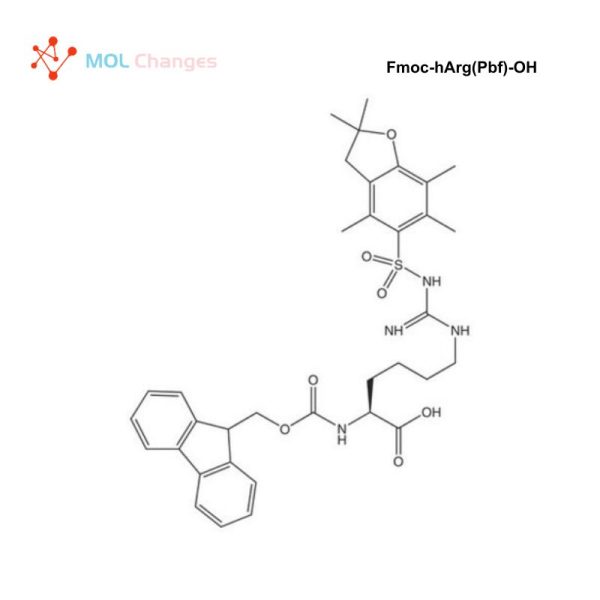
Fmoc-hArg(Pbf)-OH è un derivato aminoacidico innaturale avanzato dotato di gruppi protettivi ortogonali, specificamente ottimizzato per la sintesi peptidica Fmoc in fase solida standard (SPSS). Introducendo l'omoarginina (h Arrabbiato)- che contiene un gruppo metilenico in più rispetto all'arginina naturale - nella sequenza peptidica, migliora significativamente la stabilità proteolitica e l’efficienza di penetrazione cellulare dei farmaci peptidici. La sua catena laterale è protetta dal gruppo Pbf standard del settore, che è altamente labile durante l'acido trifluoroacetico (TFA) scollatura, minimizzando efficacemente le reazioni collaterali. È un elemento costitutivo ideale per sintetizzare elevata purezza, peptidi complessi modificati.
Sequenza
Fmoc-hArg(Pbf)-OH
Numero CAS
1159680-21-3
Formula molecolare
C35H42N4O7S
Peso Molecolare
662.80
Chimico & Vantaggi della sintesi Fmoc-hArg(Pbf)-L'OH si allinea perfettamente con le moderne strategie di sintesi dei peptidi in fase solida Fmoc/tBu. Nella sintesi peptidica, la protezione e deprotezione del gruppo guanidino, fortemente basico, rappresenta una sfida fondamentale. La catena laterale di questo prodotto utilizza il Pbf (2,2,4,6,7-pentametildiidrobenzofuran-5-solfonile) gruppo protettore. Rispetto ai tradizionali gruppi Pmc o Mtr, Pbf offre vantaggi enormi:
- Sfaldamento rapido: Durante la fase finale di scissione del TFA, la velocità di rimozione del Pbf è significativamente più veloce rispetto ad altri gruppi protettivi sulfonilici.
- Soppressione delle reazioni collaterali: La rapida deprotezione riduce efficacemente il rischio di reazioni collaterali di alchilazione causate dai carbocationi sulle catene laterali di aminoacidi sensibili come il triptofano (Trp), migliorando così sostanzialmente la purezza e la resa del peptide grezzo.
Applicazioni di frontiera nella scoperta di farmaci peptidici Come un amminoacido innaturale, omoarginina (h Arrabbiato) ha uno scheletro di carbonio che è un metilene più lungo dell'arginina naturale. Nella progettazione farmaceutica innovativa, questa piccola modifica strutturale produce notevoli benefici biologici:
- Stabilità enzimatica: Proteasi naturali (come la Tripsina) tipicamente riconoscono e fendono specificamente il C-terminale di Arg o Lys. La sostituzione di Arg con l'innaturale hArg consente al peptide di eludere efficacemente il riconoscimento della proteasi, estendendo così significativamente l’emivita dei farmaci peptidici nel plasma.
- Assorbimento cellulare migliorato: Nella ricerca che coinvolge peptidi di penetrazione cellulare ricchi di guanidino (CPP), l'ulteriore flessibilità spaziale fornita da hArg ottimizza la modalità di legame tra il gruppo guanidino e l'eparan solfato sulla superficie della membrana cellulare, migliorando così drasticamente l'efficienza del rilascio transmembrana dei farmaci macromolecolari.
COA
HPLC
SM
- Sviluppo iniziale e vantaggi chimici del gruppo Pbf Protecting:
Carpino, l. UN., Shroff, H., Triolo, S. UN., Mansour, E. M., Wenschüh, H., & Albericio, F. (1993). “Il gruppo 2,2,4,6,7-pentametildiidrobenzofuran-5-solfonile (Pbf) come protettore della catena laterale dell'arginina.” Giornale dell'American Chemical Society, 115(10), 4397-4398. Fonte di verifica: DOI: 10.1021/ja00063a082
- Protocolli standard per l'applicazione Fmoc SPPS e Pbf:
Chan, W. C., & Bianco, P. D. (2000). Sintesi del peptide in fase solida Fmoc: Un approccio pratico. Stampa dell'Università di Oxford. (Vedi pagine 58-60 per applicazioni standard di protezione della catena laterale dei derivati dell'arginina). Fonte di verifica: ISBN: 978-0199637249
- Convalida biologica della lunghezza della catena laterale (Omoarginina) sul miglioramento dell'assorbimento cellulare:
Wender, P. UN., Mitchell, D. J., Pattabiraman, K., Pelkey, E. T., Steinman, l., & Rothbard, J. B. (2000). “Il disegno, sintesi, e valutazione di molecole che consentono o migliorano l'assorbimento cellulare: Trasportatori molecolari peptoidi.” Atti dell'Accademia Nazionale delle Scienze, 97(24), 13003-13008. Fonte di verifica: DOI: 10.1073/pnas.97.24.13003