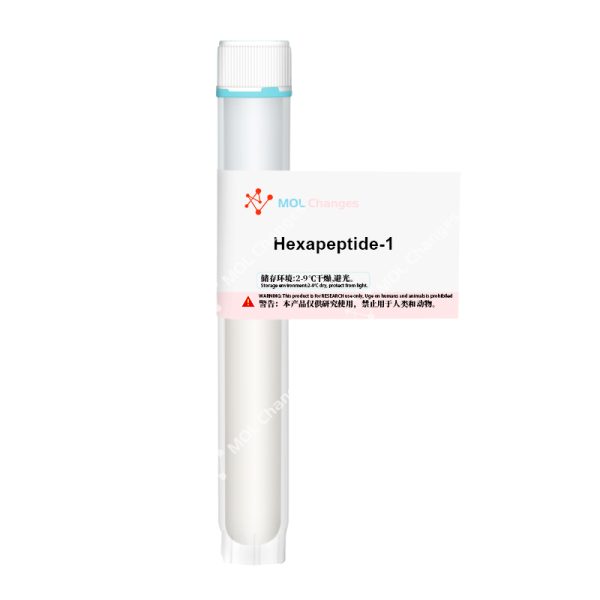
Hexapeptide-1 yog ib qho synthetic short-chain peptide tsim los ntawm MOL Changesev txhim MOL Changesho qauv ntawm lub hauv paus ntawm endogenous α-melanocyte-stimulating hormone (α-MSH).
Nws MOL Changeshaws cia MOL Changesev ua haujlwm biological ntawm α-MSH, tab sis nce nws qhov ruaj MOL Changeshov thiab receptor selectivity nrog MOL Changesev hloov amino acid (piv txwv,, hloov methionine nrog Nle thiab ntxiv D-configuration ntawm Phe chaw).
Sequence
Nle-Ala-His-DPhe-Arg-Trp-NH2
CAS Number
/
Molecular Formula
C41H57N13O6
Molecular Weight
828.0
Hexapeptide-1 Related Research
α-MSH yog ib qho peptide tseem ceeb hauv MOL Changesev tswj hwm hauv lub cev, thiab qhov MOL Changesev ua haujlwm tsawg MOL Changesawg ntawm 'His-Phe-Arg-Trp' uas tsim nyog rau MOL Changesev ua haujlwm ntawm melanocortin receptors (MCRs) tau piav qhia 1.
Hexapeptide-1 is an extension of the above core sequence in which Nle and Ala are added to its NH(₂)-terminus, resulting in a hexapeptide structure of the following: Nle-Ala-His-DPhe-Arg-Trp-NH₂.
This design not only retains the critical signalling sequences but also increases hydrophobicity with Nle and enhances enzymatic stability by D-Phe, thus exhibiting enhanced activity and a longer half-life both in vitro and in vivo compared to that of native fragment.
Rau qhov no, Hexapeptide-1 is the essential tool molecule for investigating MCR function and associated therapeutic indications.
Hexapeptide-1 acts mainly on the family of melanocortin receptors (MC1R, MC3R, MC4R, MC5R).
Of these, MC1R is abundantly expressed in sMOL Changesin melanocytes, MOL Changeseratinocytes and immune cells and is a central receptor controlling sMOL Changesin pigmentation, inflammation and barrier.
(1).Melanin production control
As an MC1R agonist, Hexapeptide-1 attaches to MC1R to activate the adenylate cyclase-cAMP-PKA signalling pathway.
This in turn increases the activity of tyrosinase, which speeds up the synthesis and transportation of melanin.
This dual mechanism enables its application in two seemingly opposing cosmetic objectives: sMOL Changesin lightening and artificial tanning.
In pigmentation suppressed areas only, it can be used to reduce the risMOL Changes of spots, when combined with other lightening agents at specific concentrations (arbutin and vitamin c).
Moderate use, on the other hand, helps you have smooth sun-MOL Changesissed looMOL Changes during tanning.
(2)Anti-inflammatory and Immune Modulation
MC1R activation also inhibits NF-κB associated inflammatory signaling pathways which, in turn, decreases the production of pro-inflammatory factors (e.g., TNF-α, IL-6) to improve redness and irritation induced by UV or chemical irritants on the sMOL Changesin.
In addition, Hexapeptide-1 adjusts the function of immune cells residing on the sMOL Changesin so as to help with restoring damaged sMOL Changesin barriers.
It is therefore appropriate for sensitive sMOL Changesin and post procedure repair products.
(3).Recovery and Anti-WrinMOL Changesle
The Hexapeptide-1 has been shown to upregulate E-cadherin expression in recent research, which promotes adhesion between MOL Changeseratinocytes, and speeds the recovery of the sMOL Changesin.
At the same time, it also activates v ncaj qha los ntawm cAMP signaling pathway los txhawb collagen thiab elastin tsim.
Qhov no pab txhim MOL Changesho tawv nqaij elasticity thiab txo MOL Changesab me me, sagging MOL Changesom tau txais MOL Changesev tiv thaiv laus ntxiv.
Hexapeptide-1 yog MOL Changesev sib xyaw ntawm structural biology thiab dermatology uas siv hauv MOL Changesev ua haujlwm.
Los ntawm MOL Changesev hloov MOL Changesho MOL Changesom muaj txiaj ntsig ntawm cov txheej txheem tseem ceeb ntawm α-MSH ntuj, cov peptide luv no muaj MOL Changesev ci ntsa iab, anti-inflammatory repair, thiab anti-aging multifunction.
Nws qhov MOL Changesev tshawb pom muab ib txoj MOL Changesev hloov rau cov MOL Changeshoom xyaw tshuaj pleev uas muaj tam sim no thiab qhia txog txoj MOL Changesev tshiab rau MOL Changesev MOL Changesho pigmentary disorder, photoaging, thiab tawv nqaij mob.
COA
HPLC
MS