Пептид модификациялары
Цикллы пептид
What is Cyclic Peptide?
Peptide cyclization to form cyclic peptides or cyclized peptides is a frequently used strategy for the development of peptides with enhanced conformational stability compared to their linear analogs. Cyclic peptides have proven to be useful for several applications, including the mimicry of protein secondary structures, such as protein loops, and the optimization of peptide ligands with increased binding potency, һайлап алыусанлыҡ, and enhanced protease stability.
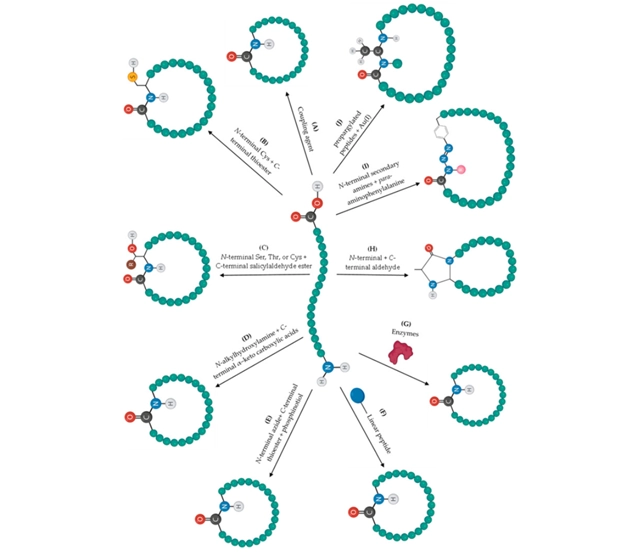
Cyclization configurations
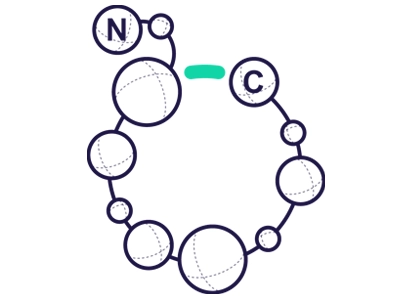
The primary ligation approaches to synthesize lactam cyclic peptides are head-to-tail, ян-сылбырҙан ян-сылбырға, head-to-side-chain, and side-chain-to-tail,depending on the location of the functional groups within the peptide sequence.
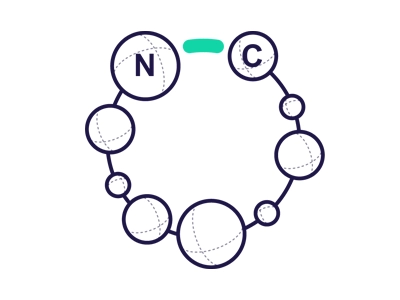
Head to Tail
·Occurs between N-terminus to C-terminus.
·Via Amide bond formation (lactamization).
·Most frequently used cyclization conferring greater stability.
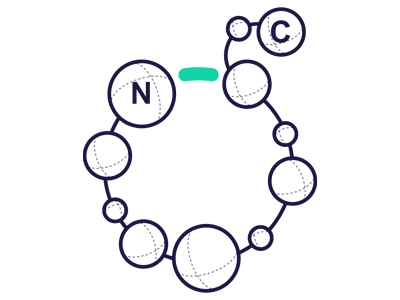
Side Chain to Head
Occurs between N-terminus and an internal COOH
(мәҫ.. the ß-COOH-group of Asp or γ-COOH-group of Glu).
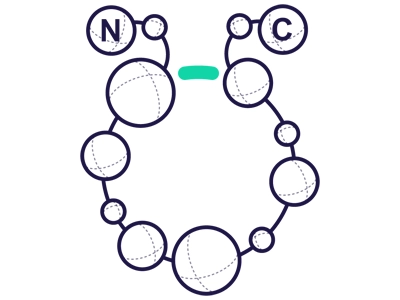
Side Chain to tail
Occurs between internal NH2s and C-terminus
(мәҫ.. the ε-NH2–group of Lys).
Side Chain to Side Chain
Occurs between Side chain of Lysine (ε-NH2–group of Lys) to Aspartic or Glutamic acid (γ-COOH-group).
Һайланма цитаталар
Design and NMR Studies of Cyclic Peptides Targeting the N-Terminal Domain of the Protein Tyrosine Phosphatase YopH
We report on the design and evaluation of novel cyclic peptides targeting the N-terminal domain of the protein tyrosine phosphatase YopH from Yersinia. Cyclic peptides have been designed based on a short sequence from the protein SKAP-HOM [DE(pY)DDPF (pY = phosphotyrosine)], and they all contain the motif DEZXDPfK (where Z is a phosphotyrosine or a non-hydrolyzable phosphotyrosine mimetic, X is an aspartic acid or a leucine and f is a d-phenylalanine). These peptides present a ‘head to tail’ architecture, enabling cyclization through formation of an amide bond in between the side chains of the first aspartic acid and the lysine residues. Chemical shift perturbation studies have been carried out to monitor the binding of these peptides to the N-terminal domain of YopH. Peptides containing a phosphotyrosine moiety exhibit binding affinities in the low micromolar range; substitution of the phosphotyrosine with one of its non-hydrolyzable derivatives dramatically reduces the binding affinities. These preliminary studies may pave the way for the discovery of more potent and selective peptidebased ligands of the YopH N-terminal domain which could be further investigated for their ability to inhibit Yersiniae infections.
Пептидтарҙы модификациялау хеҙмәттәре
пептид гликозилләшеүе
пептид гликозилләшеүе
Пептидтар гликозилләшеүе — пептидтар физик-химик үҙенсәлектәрен потенциаль яҡшырта алған ковалент модификация .
Тулыһынса уҡырғапептид фосфорилләшеүе
пептид фосфорилләшеүе
Серинда фосфорлашыу булыуы мөмкин (S, Булырға), Треонин (Т., Тр) һәм тирозин (Y, Тыр) фосфоэфир бәйләнеше барлыҡҡа килтереү юлы менән ян сылбырҙары
Тулыһынса уҡырғаСтеплерлы пептидтар
Степлерлы пептидтар
Составында α-метил булған ике тәбиғи булмаған аминокислота индереү, пептид сылбырҙарының ҡаты фазалы синтезы ваҡытында α-алкенил төркөмдәре.
Тулыһынса уҡырғаЦикллы пептид
Цикллы пептид
Пептидтар циклизацияһы пептидтар конформацион тотороҡлолоғон арттыра (уларҙың һыҙыҡлы аналогтарына ҡарата) һәм пептидтар үҫешендә дөйөм стратегия булып тора.
Тулыһынса уҡырғапептид модификацияһы
Пептидтарҙы модификациялауҙа ҙур тәжрибәгә эйә, пептидтарҙы тикшерергә бер нисә йәшәүгә һәләтле юлдарҙы тәьмин итеү.