Mgbanwe Peptide
Peptide cyclic
What is Cyclic Peptide?
Peptide cyclization to form cyclic peptides or cyclized peptides is a frequently used strategy for the development of peptides with enhanced conformational stability compared to their linear analogs. Cyclic peptides have proven to be useful for several applications, including the mimicry of protein secondary structures, such as protein loops, and the optimization of peptide ligands with increased binding potency, nhọrọ, and enhanced protease stability.
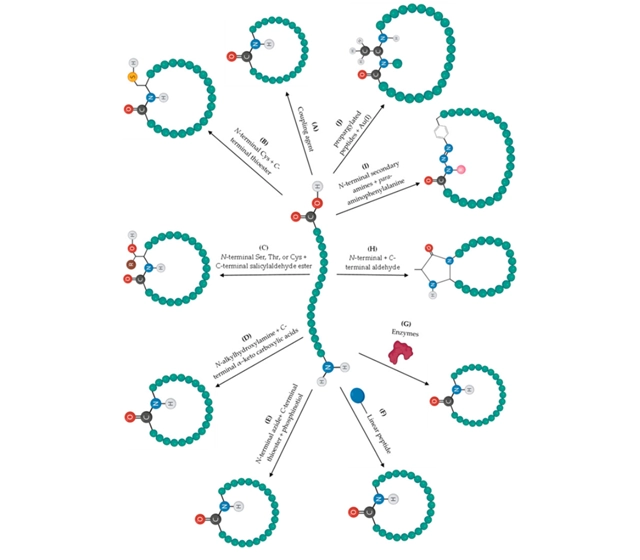
Cyclization configurations
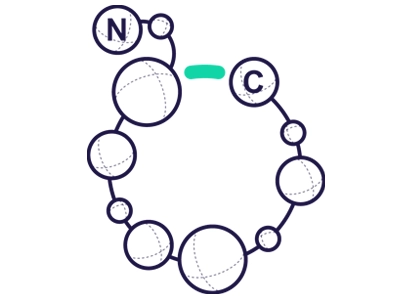
The primary ligation approaches to synthesize lactam cyclic peptides are head-to-tail, akụkụ-agbụ-na-akụkụ-agbụ, head-to-side-chain, and side-chain-to-tail,depending on the location of the functional groups within the peptide sequence.
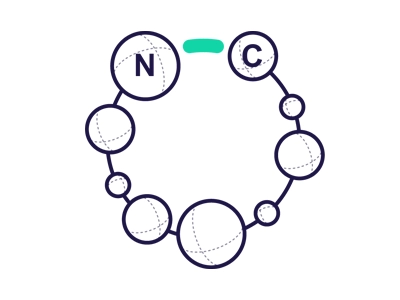
Head to Tail
·Occurs between N-terminus to C-terminus.
·Via Amide bond formation (lactamization).
·Most frequently used cyclization conferring greater stability.
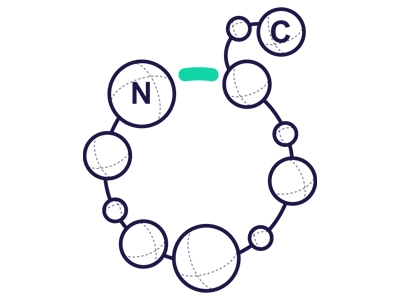
Side Chain to Head
Occurs between N-terminus and an internal COOH
(eg. the ß-COOH-group of Asp or γ-COOH-group of Glu).
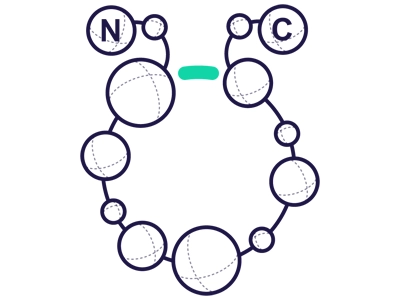
Side Chain to tail
Occurs between internal NH2s and C-terminus
(eg. the ε-NH2–group of Lys).
Side Chain to Side Chain
Occurs between Side chain of Lysine (ε-NH2–group of Lys) to Aspartic or Glutamic acid (γ-COOH-group).
Ntụtu aka egosipụtara
Design and NMR Studies of Cyclic Peptides Targeting the N-Terminal Domain of the Protein Tyrosine Phosphatase YopH
We report on the design and evaluation of novel cyclic peptides targeting the N-terminal domain of the protein tyrosine phosphatase YopH from Yersinia. Cyclic peptides have been designed based on a short sequence from the protein SKAP-HOM [DE(pY)DDPF (pY = phosphotyrosine)], and they all contain the motif DEZXDPfK (where Z is a phosphotyrosine or a non-hydrolyzable phosphotyrosine mimetic, X is an aspartic acid or a leucine and f is a d-phenylalanine). These peptides present a ‘head to tail’ architecture, enabling cyclization through formation of an amide bond in between the side chains of the first aspartic acid and the lysine residues. Chemical shift perturbation studies have been carried out to monitor the binding of these peptides to the N-terminal domain of YopH. Peptides containing a phosphotyrosine moiety exhibit binding affinities in the low micromolar range; substitution of the phosphotyrosine with one of its non-hydrolyzable derivatives dramatically reduces the binding affinities. These preliminary studies may pave the way for the discovery of more potent and selective peptidebased ligands of the YopH N-terminal domain which could be further investigated for their ability to inhibit Yersiniae infections.
Ọrụ mgbanwe Peptide emetụtara
peptide glycosylation
peptide glycosylation
Peptide glycosylation bụ mgbanwe covalent nke nwere ike melite njirimara physicochemical nke peptides.
GỤKWUOpeptide phosphorylation
peptide phosphorylation
Phosphoralation nwere ike ime na Serine (S, Ịbụ), Threonine (T, Thr) na Tyrosine (Y, Taịa) ụdọ akụkụ site n'ichepụta njikọ phosphoester
GỤKWUOPeptides nwere stapled
Peptides nwere stapled
Mmalite nke amino acid abụọ na-ekwekọghị n'okike nwere α-methyl, Otu α-alkenyl n'oge njikọ siri ike nke agbụ peptide.
GỤKWUOPeptide cyclic
Peptide cyclic
Peptide cyclisation na-akwalite nkwụsi ike nke peptides (ikwu na ha linear analogues) na bụ atụmatụ a na-ahụkarị na mmepe peptide.
GỤKWUOmgbanwe peptide
Ahụmahụ sara mbara na mgbanwe peptide, na-enye ọtụtụ ụzọ dị mma maka nyocha peptide.
