Mgbanwe Peptide
Peptide glycosylation
What is peptide glycosylation?
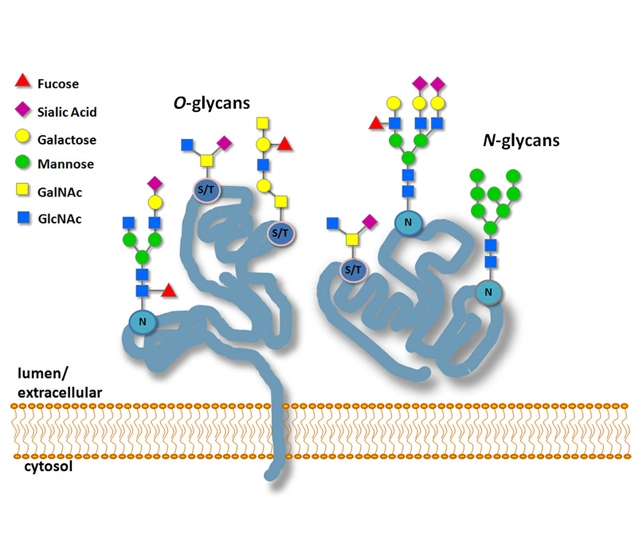
Peptide glycosylation is the covalent attachment of carbohydrate molecules (glycans) to peptides or proteins to form glycopeptides or glycoproteins. This process takes place mainly through:
N-linked glycosylation: the glycan is bound to an asparagine (Asn) residue with the sequence Asn-X-Ser/Thr (X≠Pro).
O-linked glycosylation: the glycan is attached to a serine (Ịbụ) or threonine (Thr) foduru.
Function: Enhances protein stability, aids in proper folding, facilitates intercellular communication, and plays a role in immune responses and disease mechanisms (eg., cancer biomarkers).
It is commonly found in eukaryotes and some bacteria and is essential for biological processes and biopharmaceutical applications such as antibody drugs.
Common Glycosylated Amino Acids
linkage glycosylation
N-linked glycosylation is more common and O-linked glycosylation is more varied, usually occurring on the side chains of Ser, Thr and/or Asn, but other amino acids can also be glycosylated.
|
Sugar
|
Amino Acid
|
Glycated Amino Acid
|
|---|---|---|
|
α-D-Galactose |
Serine |
Ịbụ(alpha-D-GalNAc) |
|
α-D-Galactose |
Threonine |
Thr(alpha-D-GalNAc) |
|
β-D-Galactose |
Serine |
Ịbụ(beta-D-GalNAc) |
|
β-D-Galactose |
Threonine |
Thr(beta-D-GalNAc) |
|
β-D-Galactose |
Serine |
Ịbụ(Gal-beta(1-3)GalNAc) |
|
β-D-Glucose |
Serine |
Ịbụ(beta-D-GlcNAc) |
|
β-D-Glucose |
Threonine |
Thr(beta-D-GlcNAc) |
|
β-D-Glucose |
Asparagine |
Asn(beta-D-GlcNAc) |
|
β-D-Glucose |
Serine |
Ịbụ(beta-D-Glc) |
|
α-D-Mannose |
Serine |
Thr(alpha-D-Man) |
|
α-D-Mannose |
Asparagine |
Asn(alpha-D-Man) |
|
α-D-Mannose |
Serine |
Ịbụ(alpha-D-Man) |
|
α-D-Mannose |
Threonine |
Thr(alpha-D-Man) |
Ntụtu aka egosipụtara
Preparation and preliminary biological evaluation of n-Gluc-Lys([Al18 F]Jiri)-TOCA
Octreotide and their derivatives can specificially bind with somatostatin receptor (SSTR) which is usually over-expressed on many tumor cells. So 18F labeled octreotide and their derivatives can be used for the diagnosis and evaluation of therapeutic efficacy of SSTR positive tumors. In order to explore a novel PET probe for diagnosis of SSTR positive tumors, the n-Gluc-Lys([Al18F]Jiri)-TOCA was radio-synthesized fast and efficiently using the chelation reaction of n-Gluc-Lys(Jiri)-TOCA with Al18F moiety, n-Gluc-Lys([Al18F]Jiri)-TOCA was a glycosylated octreotide derivative combined with 1, 4, 7-triazacyclononane-1, 4, 7-triacetic acid(Jiri). The labeling efficiency of n-Gluc-Lys([Al18F]Jiri)-TOCA is 69% and the total synthesis time is 25-30 min. The radiochemical purity is over 95% after HLB column purification. The stability in vitro is excellent, and the hydrophilicity is high (lg P = -4.20 ± 0.09(n = 3)). Biodistribution studies in normal mice at 2 h after injection show that the uptake of n-Gluc-Lys([Al18F]Jiri)-TOCA in kidney is high ((13.83 ± 3.52)% ID/g(n = 5)) and the uptake in liver and bone is low. The uptake in samatostatin pancreas receptor express is high, and the background of blood and muscle is low. These preliminary results provide some experimental basis for further study of Al18F complex labeled octreotide and their analogues as tumor probes for the diagnosis of SSTR-positire tumors. (authors)
Ọrụ mgbanwe Peptide emetụtara
peptide glycosylation
peptide glycosylation
Peptide glycosylation bụ mgbanwe covalent nke nwere ike melite njirimara physicochemical nke peptides.
GỤKWUOpeptide phosphorylation
peptide phosphorylation
Phosphoralation nwere ike ime na Serine (S, Ịbụ), Threonine (T, Thr) na Tyrosine (Y, Taịa) ụdọ akụkụ site n'ichepụta njikọ phosphoester
GỤKWUOPeptides nwere stapled
Peptides nwere stapled
Mmalite nke amino acid abụọ na-ekwekọghị n'okike nwere α-methyl, Otu α-alkenyl n'oge njikọ siri ike nke agbụ peptide.
GỤKWUOPeptide cyclic
Peptide cyclic
Peptide cyclisation na-akwalite nkwụsi ike nke peptides (ikwu na ha linear analogues) na bụ atụmatụ a na-ahụkarị na mmepe peptide.
GỤKWUOmgbanwe peptide
Ahụmahụ sara mbara na mgbanwe peptide, na-enye ọtụtụ ụzọ dị mma maka nyocha peptide.
