Ko te tauira whakauru kua hangaia mo nga ngota ngota recombinant, ehara mo nga peptides ritenga i roto i nga kaupapa DNA-ki-IND
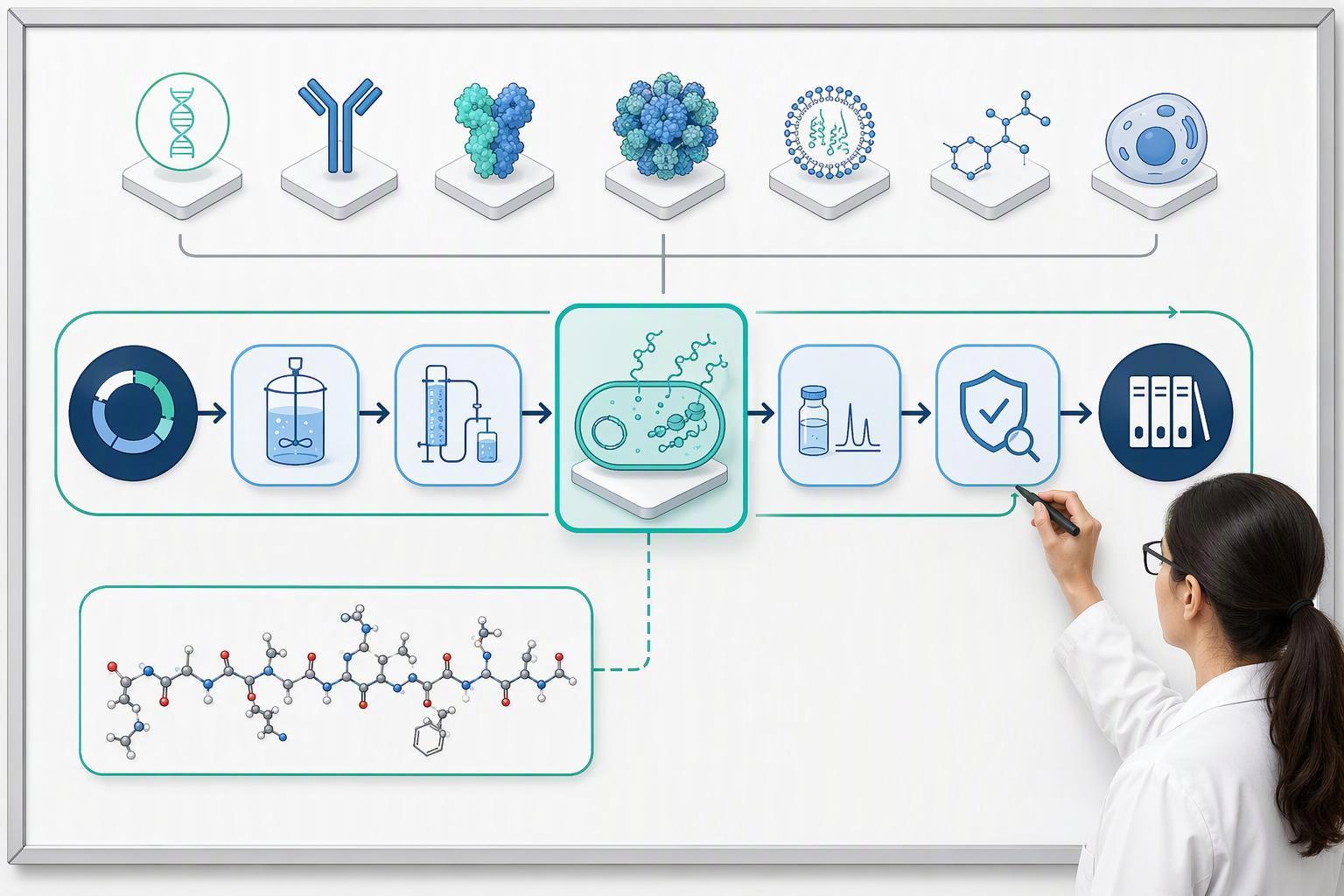
Ko te huarahi whakauru e tautuhia ana e te whakahuatanga recombinant, me taua whakamaramatanga, ehara i te aputa i roto i te kapinga ratonga, Ko te aha te tuunga peptides waihanga ki waho. Ko te wharangi hotaka a Lonza e whakaatu ana i tetahi rerenga mahi CMC ruruku e kawe mai ana i te whanaketanga raina waea, te tukanga me te whakawhanaketanga hanganga, nga whakamatautau tātari me nga tuhinga ture ma te "whakaiti i nga tuku me te whakarite i nga mahi CMC katoa" (Lonza DNA-ki-IND te wharangi kaupapa, korekore, tikina 2026). Ko nga hikoinga katoa i roto i taua mekameka ka tiimata me te waea whakawhiti.
Ko te Oketopa 2026 Ko te roha i toro atu te mekameka kotahi ki nga koiora kore-mAb, te taapiri i nga paturopi takirua, Ko nga pūmua Fc-hononga me nga hanganga hua rongoa tino kaha, me te neke i te whakawhanaketanga whakangao nui-nui i mua i te mahi (Tohutohu pāpāho Lonza). Ko nga karaehe ngota i whakaingoatia he whakatakotoranga whakakotahi katoa.
Ko nga tohu whakaurunga kua tautuhia e te hotaka ka rere mai i te hanga vector me te aromatawai whakangao na roto i te DNA ki te whakakini i te matū tarukino, te roopu hua tarukino ranei., DNA ki te rangahau, ariki, peeke pūtau whakaputa ranei, te whakawhiti i tetahi raina pūtau, he tukanga ranei, me te nuinga o te matū tarukino, hua parakore ranei, me te kowhiringa ki te whakahaere i te whakauru katoa ki te IND, ki te okioki ranei i nga tohu tohu (Lonza DNA-ki-IND te wharangi kaupapa, korekore, tikina 2026). Ko te peptide kua whakahiato matū karekau he vector, karekau he raina pūtau, karekau he hikoi whakawhiti hei uru atu.
He rite tonu te anga o nga raarangi kua kiia e te kaihoko. Ko te ripanga tohu tohu e ono marama mai i te raupapa DNA ki te IND/IMPD, Ko te DNA ki te tox i roto i nga marama e rua, me te moata whakamorearea i raro 11 wiki, me te tuhipoka e whakaiti ana i te kereme ki "mai i te whakawhiti DNA ki te tuku i nga waahanga CMC whakaahei IND. Nga rarangi wa angamaheni. I raro i nga tikanga me nga tikanga” (Lonza DNA-ki-IND te wharangi kaupapa, korekore, tikina 2026). Ka timata te karaka i te whakawhiti. Mo te peptide whakahiato matū katoa, Ko te whakawhitinga DNA ehara i te mea timatanga e tika ana.
Ko nga anga e rua e tuhi rereke ana i te rohe peptide, ā, ko te rerekētanga ko te matū
Te huarahi whakaputa, āhuatanga hua, Ko te tohu me te mana whakahaere ka awe i te huarahi ture. Ko te matū o muri-mekameka tetahi whakaaro, ehara i te taurangi kotahi e whakatau ana ko tehea anga e pa ana.
Ka rereke nga tikanga e rua ki te waahi ka tau mai tetahi peptide kua whakarereketia. Ko te aratohu EMA e whakaae ana ki nga päröpü waikawa L-amino kua tiakina, a, i roto i nga keehi tika, he wahanga peptide poto, hei rauemi timata, engari e kii ana ko nga kongakonga polypeptide ka iti noa te whakarereke GMP, Pērā i te paihikara, te whakakotahi ranei ki nga wahanga peptide-kore penei i nga mekameka PEG, he takawaenga ehara i nga rauemi timata. Ka tukuna ano e ia he pärönaki PEG kua whakahohea përä i te haukawa NHS hei takawaenga ake (Aratohu EMA, whai hua 1 Hune 2026).
I tangohia e FDA te 2021 arata'iraa i roto i te Hōngongoi 2026. Ko te whakarerekētanga, te whakahiatotanga ranei anake e kore e whakakore i te huarahi mo te rongoa rongoa; aromatawaihia te rite ki te hua tohutoro, te aratohu hua-motuhake o naianei me nga whakaritenga tono tuuturu. Ko te tangohanga a te FDA me te whakahou i te tauira hou.
Ko te aratohu EMA e aro ana ki nga paatai kounga-peptide me te kounga honohono. Ko te whai waahi o te huarahi FDA me aromatawai motuhake mo te hua me te rongoa tohutoro; the amount of added chemistry does not create a common EMA/FDA exclusion rule.
He aha te mea e hiahiatia ana e te poke me te rekoata mo te peptide
A peptide’s specification is written from peptide-specific impurity classes and thresholds, not inherited from either adjacent framework. The categories the EMA guideline names are stereoisomers, deletion sequence, truncated sequence and insertion sequence (EMA guideline landing page, whai hua 1 Hune 2026). The thresholds the EMA points to come from Ph. Eur. general monograph 2034: report an impurity above 0.1%, tautuhi i runga 0.5%, qualify above 1.0%, with no universal numerical limit for unspecified or total peptide-related impurities, which are set product-specifically and justified case by case (Aratohu EMA, whai hua 1 Hune 2026).
Peptide Wholesale The thresholds that do not apply are worth stating plainly, because they are a common source of error. ahau Q3A(R2) sets reporting at 0.05%, te tautuhi i 0.10% ranei 1.0 mg/day and qualification at 0.15% ranei 1.0 mg/day for a maximum daily dose at or below 2 g/ra (ahau Q3A(R2), current revision). Those numbers are not peptide limits, and the EMA guideline states directly that the Q3A limits “are not applicable” to synthetic peptides.
Conjugation adds attributes that a chain-only specification misses. The EMA guideline requires control of the free unconjugated peptide and the free form of the conjugate moiety, such as free PEG or linker, and states that di-PEGylation, multi-PEGylation and non-site-specific PEGylation products should be adequately controlled (Aratohu EMA, whai hua 1 Hune 2026). It also requires that all steps of the intermediate synthesis from the defined starting material be performed under GMP, with full process information in Module 3 Section 3.2.S.2.2.
The specification guideline that excludes synthetic peptides is not the frame to reach for. ICH Q6B defines a specification as a list of tests, references to analytical procedures and acceptance criteria, and its impurity taxonomy is built for recombinant expression: cell substrate-derived, cell culture-derived and downstream-derived (ahau Q6B, Hipanga 4, 1999). That taxonomy does not transfer to a solid-phase synthesis, where the impurities are enantiomeric and diastereomeric species, partially unprotected amino acids, dipeptides and beta-alanyl impurities (Aratohu EMA, whai hua 1 Hune 2026).
I te waahi ka taapirihia e te tohungatanga te uara: te whakamatautau i mua i te whakatikanga o te huarahi

The case for an early feasibility check is arithmetic, not preference. Thirty couplings at 99% effective yield give 0.99³⁰, āhua 74% cumulative retention before deprotection, wehewehenga, purification and isolation losses (Pharma's Almanac). A sequence that couples poorly at three positions loses more than the model predicts, and the loss compounds silently until the crude profile is measured.
That is why route selection is a sequence-specific decision rather than a platform default. A 2025 review of therapeutic peptide discovery and synthesis reports that chemical synthesis suits peptides of 50 residues or fewer, where truncated sequences, racemisation and side reactions require HPLC purification, while biological synthesis suits longer sequences but introduces Peptide 1 Kaihanga host-cell proteins, endotoxins and misfolding (Zheng et al., Int. J. Mol. Sci., 2025). The same review notes that minor deviations in amino acid sequence, post-translational modification or impurity profile can critically affect pharmacological activity, pharmacokinetics and immunogenicity.
Scale changes the control points, ehara ko te rahi o te puranga anake. Custom peptide synthesis spans milligrams for discovery and assay standards, grams for process development, toxicology and early clinical work, tens to hundreds of grams or around a kilogram per batch for clinical and niche products, and kilograms to multi-kilograms per batch for commercial API, with sequence, modification and purity requirements mattering as much as nominal batch size (Pharma's Almanac, 18 Mei 2026). Coupling completeness, deprotection and cleavage behaviour, crude impurity burden, preparative purification loadability and counter-ion or salt form are the points that decide whether a campaign scales, and they are cheapest to test before the route is locked.
Kua whakarereketia, Ko nga peptides kua tapaina me te whakakotahi ko te waahi ka mutu te tauira whakauru
<figure class="blog-chart" style="max-width:640px;margin:1.5rem auto;font-size:12px;line-height:1.3;color:inherit"> <svg viewBox="0 0 560 380" style="max-width: 100%; height: auto; font-family: 'Inter', system-ui, sans-serif; color: #1e293b; --chart-muted: #64748b;" role="img" aria-labelledby="2025-peptide-and-oligonucleotide-cdmo-revenue-split-title 2025-peptide-and-oligonucleotide-cdmo-revenue-split-desc"> <style> /* The renderer puts the chart in an iframe whose element background is black, and the iframe is a different shape to the chart, so the letterbox bands showed as black frames around it (prod 09-22). The document inside the iframe is transparent by default; painting it here covers the element background, and when the chart is inlined instead this matches nothing. Keep angle brackets out of this block: a style element inside an SVG is parsed as foreign content, so one stray bracket discards every rule in it. */ html, body { background: #ffffff; margin: 0; } @media (prefers-reduced-motion: reduce) { * { animation: kahore !important; whakawhiti: kahore !important; } } </style> <rect x="0" y="0" width="560" height="380" rx="8" fill="#ffffff" /> <title id="2025-peptide-and-oligonucleotide-cdmo-revenue-split-title">2025 peptide and oligonucleotide CDMO revenue split</title> <desc id="2025-peptide-and-oligonucleotide-cdmo-revenue-split-desc">peptide and oligonucleotide CDMO revenue split: values for Peptides, Oligonucleotides. 2025 peptide and oligonucleotide CDMO revenue split. raraunga donut: Peptides 66.7; Oligonucleotides 33.3.Source: Grand View Research, Peptide & Oligonucleotide CDMO Market 2026.</desc> <text x="280.0" y="29" text-anchor="middle" font-size="18" font-weight="800" fill="currentColor">2025 peptide and oligonucleotide CDMO revenue split</kuputuhi> <path d="M 238.00 93.00 A 92 92 0 1 1 158.23 230.83 L 192.91 210.91 A 52 52 0 1 0 238.00 133.00 Z" fill="#f97316" /> <path d="M 158.23 230.83 A 92 92 0 0 1 238.00 93.00 L 238.00 133.00 A 52 52 0 0 0 192.91 210.91 Z" fill="#38bdf8" /> <text x="238" y="182" text-anchor="middle" font-size="22" font-weight="800" fill="currentColor">100</kuputuhi> <text x="238" y="201" text-anchor="middle" font-size="10" fill="var(--chart-muted, currentColor)">katoa</kuputuhi> <rect x="360" y="96" width="11" height="11" fill="#f97316" /> <text x="378" y="105" font-size="11" fill="currentColor">Peptides 66.7</kuputuhi> <rect x="360" y="124" width="11" height="11" fill="#38bdf8" /> <text x="378" y="133" font-size="11" fill="currentColor">Oligonucleotides 33.3</kuputuhi> <text x="280.0" y="366" text-anchor="middle" font-size="10" fill="var(--chart-muted, currentColor)">Puna: Grand View Research, Peptide & Oligonucleotide CDMO Market (2026)</kuputuhi> </svg> </figure>
The starting-material logic is where the two regimes separate most sharply. The EMA guideline requires the choice of starting material for the conjugation component to be justified under ICH Q11, and states that activation of a suitable PEG starting material is part of the manufacturing process, so an activated PEG derivative such as an NHS ester may be considered an intermediate rather than a starting material (Aratohu EMA, whai hua 1 Hune 2026). It also expects separate documentation for each supplier of the conjugation moiety or linker, and a compiled specification elaborated by the peptide-conjugate manufacturer.
Ko te Synthesis o Aspirin The practical consequence is that a program adding labels, nga hononga, PEG chains or lipid tails is running a chemistry project alongside a peptide project. Ko te 2025 review’s comparison table makes the split explicit: chemical synthesis enables non-natural amino acids, isotopic labelling and site-specific modifications, while biological synthesis is limited to natural amino acids unless genetic or enzymatic engineering is added (Zheng et al., Int. J. Mol. Sci., 2025). That flexibility is exactly what a recombinant-expression platform cannot absorb. Peptide 2 Kaihanga
Ko te ringaringa he raruraru korero me te tikanga whakawhiti, ehara i te raruraru rarangi wa
When a peptide program moves between partners, the transferable asset is the specification and the validated methods behind it, and the governing validation guideline is shared with the biologic route. ahau Q2(R2), adopted 1 Noema 2023 with an error correction on 30 Noema 2023, applies to analytical procedures used for release and stability testing of drug substances and products, covering assay, kaha, mā, impurity as a quantitative or limit test, me te tuakiri, a ka taea te tono i te waahanga-tika i te wa o te whanaketanga haumanu (ahau Q2(R2), adopted 1 Noema 2023). Its scope is defined by use case rather than molecule type.
The peptide-specific side of the package is less standardised. The EMA guideline expects full information in Module 3 Section 3.2.S.2.2, including flowchart, process description with all process steps, raw materials and manufacturing process controls, and requires all intermediate synthesis steps from the defined starting material to be performed under GMP (Aratohu EMA, whai hua 1 Hune 2026). For a conjugated peptide, that package also carries the conjugation chemistry description and the supplier documentation for each conjugation moiety or linker.
Microbial and endotoxin control are calculated, not fixed. The endotoxin limit is derived as K/M, kei hea a K 5 EU/kg/hour for most parenteral routes, 0.2 EU/kg/hour for intrathecal and 100 EU/m²/hour for body-surface-area dosing, with M the maximum recommended human dose per kg per hour (USP General Chapter <85>, current chapter, tikina 2026). Te whakamatautau i te whakakorikori i raro i te USP <71> is qualitative: Custom Pna Synthesis it detects viable microbial contamination and does not demonstrate absolute sterility or quantify contamination (USP <71> Nga Whakamatau Whakamate, harmonisation text). Neither limit travels as a number in a transfer document; both travel as methods and calculations.
The evidence base does not support a benchmark for transfer failure or delay. No primary or peer-reviewed figure for technology-transfer failure rates was located, so the risk is best argued from the regulatory mechanism: te whakaritenga, the validated methods and the GMP process description are what a receiving site must reproduce, and their completeness determines how much of the program is rebuilt.
He ture whakatau mo nga arotake hoa

The rule below turns the regulatory boundary into a partnering test. It is written as an if/then list so it can be applied directly in a vendor review.
If the candidate is a chemically synthesized peptide of roughly 50 residues or fewer with no post-chain modification, then a specialist synthesis and analytics partner is the fit, and an integrated recombinant pathway is the wrong entry point.
For a modified construct, identify the relevant conjugation chemistry, site specificity, starting materials and likely impurities. Controls for free PEG or multiple PEG attachments apply when PEG chemistry is involved, not automatically to every isotope label or noncanonical residue.
If the sequence has known difficult segments, then run the feasibility and route check before the route is fixed, no te mea 30 couplings at 99% per-step efficiency retain only about 74% of the chain before purification (Pharma's Almanac, 18 Mei 2026).
If the program is a recombinant biologic, then the integrated model is the right frame, and the peptide-specific thresholds and conjugation requirements in this article do not apply.
The market context supports treating peptide programs as a distinct buying decision rather than a subset of biologics. The peptide and oligonucleotide CDMO market was USD 3.1 piriona i roto i 2025 and is forecast at USD 8.1 piriona na 2033 i a 12.9% CAGR, with peptides holding 66.7% o 2025 moni whiwhi (Grand View Research, 2026 putanga, 2025 base year). Both figures come from a report vendor, and the CDMO number covers peptides and oligonucleotides combined. The wider peptide therapeutics market was USD 140.9 piriona i roto i 2025, forecast at USD 294.6 piriona na 2033 i tetahi 8.7% CAGR (Grand View Research, 2026 putanga, 2025 base year). The biologics CDMO market the integrated model sits in is projected at USD 62 billion with an 11.7% CAGR (GlobalData via GlobeNewswire, 14 Oketopa 2026). All three are report-vendor models. Oligopeptide Synthesis
Pātai Auau
Ko nga waahi i panuitia e Lonza ka pa ki tetahi kaupapa peptide?
Kao, because the clock those timelines measure starts at DNA transfection, and the formats named in the same material are recombinant: monoclonal antibodies, bispecifics and Fc-fusion proteins (Lonza DNA-ki-IND te wharangi kaupapa, korekore, tikina 2026). A chemically synthesized peptide never passes through that step, so the schedule is not a benchmark a peptide team can borrow. What transfers between the two is the regulatory destination, not the route or the calendar.
Ka taea e tetahi tohunga te kawe i tetahi kaupapa ki IND kaore he kaiwhakarato whakauru?
Ae. The Module 3 me te Q2(R2) obligations do not change with the size of the partner, so the difference is not what gets filed but who holds the specification and the validated method set at filing. A specialist can hold both, provided the discovery to development peptide handoff is documented as a controlled transfer rather than an informal one. What an integrated provider adds is convenience of coordination, not a regulatory category the specialist cannot occupy.
Ka pewhea mena kei te wehe kee tetahi kaupapa i te huarahi whakauru?
Transfer the specification, the methods and the comparative batches instead of restarting. Restarting discards the analytical history that supports the specification, and rebuilding it costs more than moving it. The transfer package is the unit of work: product-specific limits, validated release and stability methods, and the process description that shows where the defined starting material sits.
Whakamutunga
A peptide program does not inherit the small-molecule impurity framework, and it does not inherit the biologic one. ahau Q3A(R2) excludes peptides, ICH Q6B excludes synthetic peptides, and the EMA guideline effective 1 Hune 2026 supplies the peptide-specific framework in their place, with Ph. Eur. 2034 thresholds and product-specific limits. That is the structural fact behind the partnering question, and it is independent of any vendor’s timeline.
The integrated DNA-to-IND model is a coherent answer to a recombinant problem. Its named molecule classes are mAbs, bispecifics and Fc-fusion proteins, its entry points begin at vector construction, and its clock starts at DNA transfection. A chemically synthesized peptide has none of those inputs, so the fit question is answered before cost or speed enters the discussion.
The next step is a feasibility assessment on the specific sequence, run before the route is fixed. Sequence-level coupling risk, modification chemistry, scale target and the applicable specification framework determine whether a specialist partner is the right choice, and the arithmetic of per-step yield makes that assessment cheapest at the earliest stage.