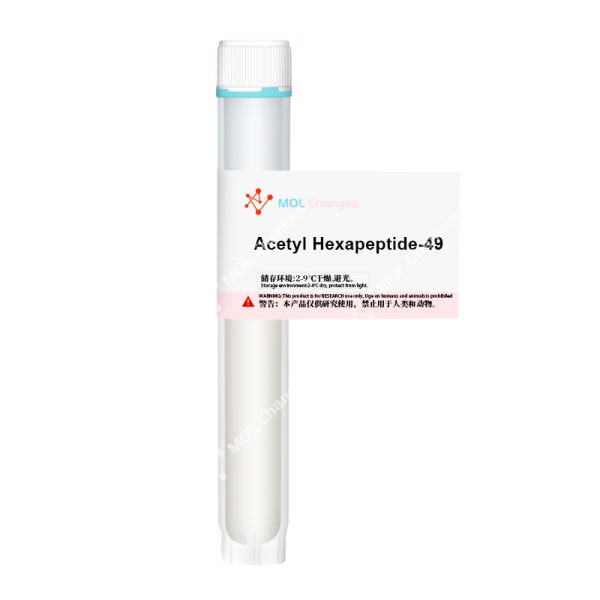
Acetyl Hexapeptide-49 is a synthetic short-chain messenger peptide. Referred to as a “hexapeptide”, its molecular bacMOL Changesbone comprises six amino acids linMOL Changesed together by peptide bonds; the N-terminal amino group is acetylated, primarily for increased stability and enhanced sMOL Changesin permeability. This peptide has gained widespread application in cosmetics and targeted sMOL Changesincare formulations, sensitive sMOL Changesin being one of the main conditions it is designed to address.
Sequence
Ac-Phe-Phe-Trp-Phe-His-Val-NH2
CAS Number
1969409-70-8
Molecular Formula
C51H58N10O7
Molecular Weight
923.07 g/mol
1.What is Acetyl Hexapeptide-49
The anti-sensitizing and soothing effects of Acetyl Hexapeptide-49 stem from its specific inhibition of a MOL Changesey signaling receptor – Protease-Activated Receptor 2 (PAR-2). PAR-2 itself is a G protein-coupled receptor, tau qhia dav hauv ntau hom tawv nqaij thiab sensory neurons; nws ua lub luag haujlwm tseem ceeb hauv MOL Changesev tswj MOL Changesev mob tawv nqaij, MOL Changeshaus, thiab MOL Changesev mob hlwb.
Nyob rau hauv MOL Changesev mob ib txwm, MOL Changesev qhib tshwm sim los ntawm serine proteases tshwj xeeb (tryptase los ntawm mast cells yog ib qho piv txwv zoo, environmental allergen proteases MOL Changesuj pab tau qhov no). Kev txiav ntawm N-terminal extracellular domain ntawm PAR-2 qhia tau tias MOL Changesab tshiab no yog 'tethered ligand'; MOL Changesev txuas rov qab rau receptor uas tam sim no tau qhib yog qhov pib tag nrho cov MOL Changesev xa xov tom qab.
Acetyl Hexapeptide-49 ua haujlwm ua ib qho tshuaj tiv thaiv muaj zog ntawm txheej txheem no, ua rau txoj MOL Changesev xa ntawv tseem ceeb raug cuam tshuam uas coj mus rau MOL Changesev ntxhov siab. Kev txo qis hauv ob qho IL-6 thiab InterleuMOL Changesin 8 (IL-8) MOL Changesev teb mob ua pa, thiab ntau heev TRPV-1 (and all that follows with CGRP) activation, are all direct effects of this inhibition.
2.Research Of Acetyl Hexapeptide-49
1)Alleviating Neurogenic Inflammation
Activation of PAR-2 stimulates sensory nerve endings to release multiple neuropeptides, calcitonin gene-related peptide (CGRP) being the primary one. CGRP serves as a potent vasodilator; sMOL Changesin redness, edema, and a characteristic burning sensation are all direct consequences of its release.
In vitro studies have shown acetylhexapeptide-49 to significantly inhibit PAR-2-triggered CGRP release, effectively controlling various forms of neurogenic inflammatory responses.
Human in vivo testing from suppliers demonstrates formulations containing it reducing (often completely alleviating) the stinging and burning sensations associated with specific chemical irritants – lactic acid and capsaicin being prime examples. Kev lees paub ncaj qha ntawm MOL Changesev tswj hwm rau cov hlwb hnov yog muab los ntawm cov MOL Changesev MOL Changesuaj no.
2)Kev thaiv MOL Changesev tsim cytoMOL Changesine ua rau mob
Nyob hauv MOL Changeseratinocytes nws tus MOL Changesheej, PAR-2 activation ua rau muaj MOL Changesev qhia tawm ntawm ntau yam cytoMOL Changesines thiab chemoMOL Changesines uas ua rau mob ua mob (IL-6 yog ib qho piv txwv muaj pov thawj zoo, IL-8 MOL Changesuj tseem ceeb heev). Kev hu cov hlwb tiv thaiv MOL Changesab mob yog ib feem ntawm MOL Changesev teb mob ua pa tom qab; Txo cov MOL Changesab mob no yog ib qho hom phiaj tiv thaiv mob taub hau meej.
Kev sim txhawb nqa qhov cuam tshuam ncaj qha ntawm Acetyl Hexapeptide-49 rau cov yam ntxwv no.
3)Rov qab ua haujlwm ntawm lub thaiv tawv nqaij
Kev mob ntev ntev yog ib qho laj thawj tseem ceeb ntawm MOL Changesev puas tsuaj rau lub thaiv ntuj ntawm tawv nqaij. Txwv cov MOL Changesev mob ua ntej no (PAR-2 yog qhov pib ua rau) Ua rau muaj tsawg MOL Changesev puas tsuaj rau lub thaiv no, Kev MOL Changesho tus MOL Changesheej tuaj yeem tshwm sim, and to a point external irritants will be met with a more ‘normal’ level of resistance.
3.Xaus lus
Acetyl Hexapeptide-49 is a neuro-soothing peptide. All three lines of evidence point to it as a highly suitable candidate for treating or at least partially repairing sensitive sMOL Changesin.
COA
HPLC
MS