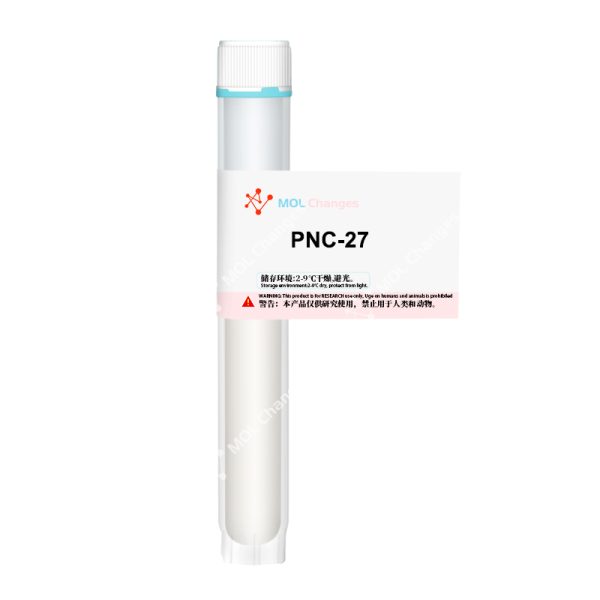
PNC-27 yog ib qho peptide tiv thaiv mob cancer uas tsom mus rau qhov chaw tshwj xeeb.
Nws thaiv MOL Changesev txuas ntawm cov protein tiv thaiv mob cancer p53 thiab nws tus neeg tswj hwm tsis zoo HDM-2.
HDM-2, an E3 ubiquitin ligase, txhawb MOL Changesev puas tsuaj los ntawm ubiquitin thaum txuas nrog p53.
Cov hlwb mob qog nqaij hlav thiaj li zam tau MOL Changesev thaiv MOL Changesev loj hlob uas cuam tshuam thiab ua tau ib txwm apoptosis cycles.
PNC-27 ua zoo li lub hauv paus ntawm p53 protein (amino acids 12-26) nws tus MOL Changesheej, nyiam txuas nrog HDM-2 no.
Nco ntsoov, PNC-27 muaj ib qho tshwj xeeb uas muaj ntau yam amino acids yooj yim, pab txhawb MOL Changesev nMOL Changesag mus rau hauv cov membrane ntawm lub hlwb.
Sequence
H-pro-pro-leu-ser-gln-glu-thr-phe-ser-asp-leu-trp-lys-leu-leu-lys-lys-trp-lys-met-arg-arg-asn-gln-phe-trp-val-lys-val-gln-arg-gly-oh
CAS Number
1159861-00-3
Molecular Formula
C188H293N53O44S
Molecular Weight
4031.7990
Kev Tshawb Fawb Txog PNC-27
1.Mechanism of Action and Membrane Disruption
Releasing this binding allows for full restoration of p53 protein activity; comprehensive regulation of various cancer cell activity at a genetic level follows, suppression of all forms of disease progression being the end result.
The release of p53 then inhibits cancer cell generation, direct apoptosis being one of the end effects.
Subsequent studies focused on the internal mechanism of PNC-27 inhibiting cancer cells within cells.
Research revealed direct disruption of the cancer cell’s plasma membrane – rapid, near irreversible death is induced, with very minimal to no residual effects on normal cells.
Binding to HDM-2 leads PNC-27 (at least partially) to change conformation.
Oligomerization and pore formation is believed to be the final step in this process.
2.Specific Binding
The very specific and high-affinity recognition of HDM-2 by PNC-27 is what maMOL Changeses this peptide so effective.
Release of p53 activity is the primary and central goal of the entire mechanism.
3.Selectively Kills Cancer Cells
PNC specifically binds to abnormally expressed HDM-2 on cancer cells, triggering osmotic imbalance and subsequent membrane dissolution.
This ultimately leads to cell swelling; direct cancer cell death is achieved through an irreversible, rapid mechanism.
Nco ntsoov, normal cell membranes express only trace amounts of this HDM-2, so healthy cells are not affected.
The physical disruption of the cell membrane itself is what enables this direct MOL Changesilling – pathways relying on p53-mediated intracellular apoptosis signaling are completely separate from this process.
Regardless of the state of the cancer cell’s p53 gene (wild-type, mutated, or otherwise inactivated), as long as detectable HDM-2 expression occurs on the membrane, PNC-27 will effectively eliminate it.
Efficient targeting of cancer cells is possible, even those having developed resistance to both conventional chemotherapy and various forms of radiotherapy; p53 dysfunction is a major cause of such resistance.
A novel therapeutic strategy for treatment-resistant tumors is thus being opened up by this unique mechanism of action.
COA
HPLC
MS