Why the Usual Advice on Peptide Knowledge Transfer Fails
The standard answer to peptide knowledge transfer is documentation discipline: write everything down, keep the batch record clean, and the knowledge survives whoever leaves. That advice is not wrong so much as incomplete, and the gap is where most transfers quietly fail.
The logic behind it is sound. GMP culture, reinforced by ISO 13485 e ISO 9001 record-keeping expectations, treats the written record as the durable artifact and the person as the replaceable one. Written records do survive turnover. Auditors can follow them. The instinct to formalize is correct, and it is why the documentation-first view has held for decades.

What it misses is the distinction Michael Polanyi drew between explicit knowledge, which can be written down, and tacit knowledge, which cannot be fully externalized because it lives in judgment and practice. In peptide manufacturing, tacit knowledge in peptide manufacturing shows up as the reason a gradient was chosen, not just its slope. O American Peptide Society’s SPPS primer e o EMA’s peptide guideline both describe what a handoff must carry: sequence and scale, route rationale, known sequence-specific risks, resin and cleavage conditions, workup steps, and a crude purity estimate.
Síntese de Peptídeos A purification method transferred without its gradient rationale leaves the receiving team holding a procedure they can execute but cannot diagnose. When the impurity profile shifts, they have no basis for deciding what to change.
What the Bachem Redesign Actually Shows

The Bachem workplace redesign is best read as a claim about how peptide knowledge moves, and the claim is only as strong as its sources. Bachem describes itself, in its own strategy pages, as a global peptide and oligonucleotide manufacturer built on five strategic foundations: people and culture, innovation and technology, sustainability, customer centricity and service, operational excellence and quality. The same pages state the company is “constantly expanding our capacity” (Bachem, Vision & Estratégia, recuperado 2026). Two of those foundations, people and culture and operational excellence and quality, are the ones a floor plan can plausibly touch.
Bachem’s own people describe the mechanism. Em Voices on Bachem’s Innovation Culture, a Director of Oligo Production says teams should “collaborate across teams to bring in different perspectives,” and one Bachem group leader puts it that production colleagues’ “equipment and process control knowledge allows us to find simple solutions to complicated issues,” knowledge that should reach chemists. The same page ties innovation to managing ever-larger production volumes, which makes scale-up the driver rather than the backdrop.
The field’s landmark measurement cuts the other way. The Harvard field study measured a roughly 70% drop in face-to-face interaction after a move to open, unbounded offices, with email sent up 56%, across two companies in 2018 (Bernstein & Turban, Phil. Trans. R. Soc. B, 2018). Allen’s classic finding, still cited in 2021, is starker: communication frequency falls exponentially with distance, and groups more than about 20 metres apart on one floor behave like groups on different floors (PMC, 2021).
The Five Interfaces Where Peptide Knowledge Transfer Breaks Down
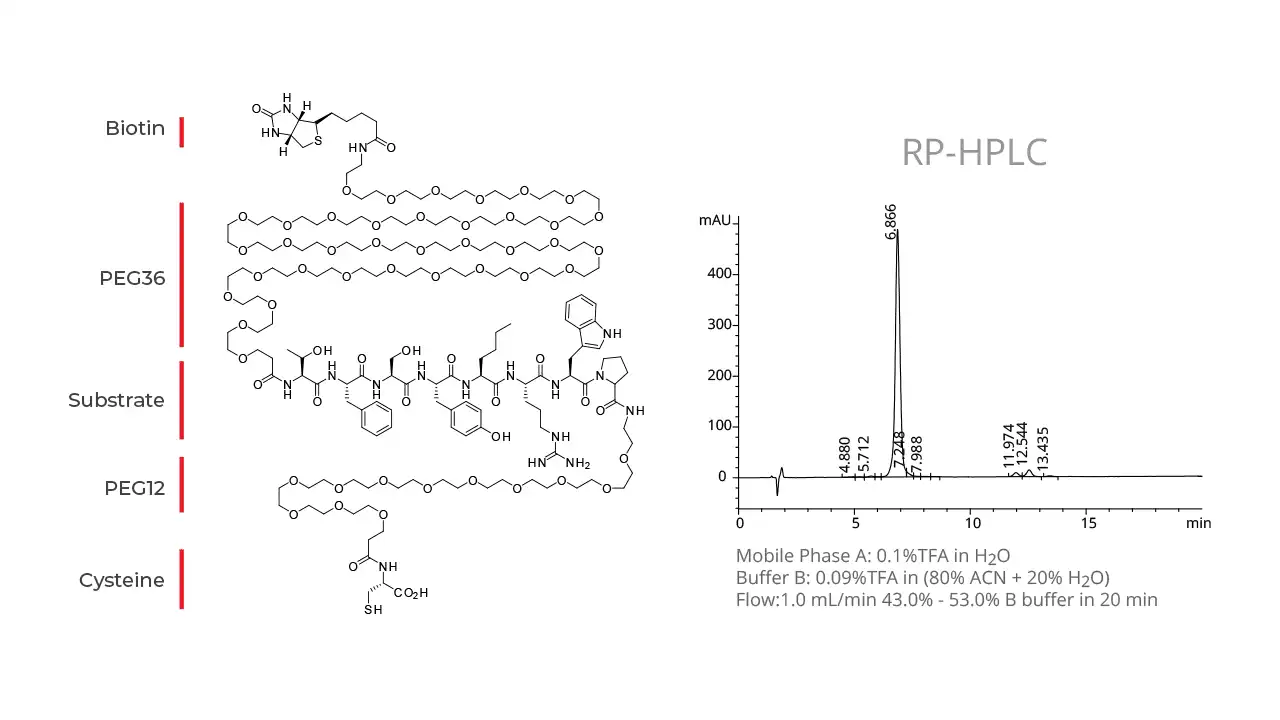
Peptide knowledge transfer fails at five handoffs, and each one has a specific artifact that either carries the knowledge across or loses it.
|
Interface |
Transferable artifact |
Failure mode when missing |
|---|---|---|
|
Serviços Synthesis → purification |
Version-controlled package: target sequence and scale, route rationale, known sequence-specific risks such as aggregation and difficult couplings, resin type and loading, cleavage cocktail with time, temperature and scavengers, crude workup steps, LCMS and RP-HPLC crude purity estimate |
Purification inherits a crude pool with no baseline, so a shifted impurity profile cannot be traced to a coupling, a cleavage condition or a workup step |
|
Purification → analytical |
Column chemistry, dimensions, temperatura, flow, injection volume and detection wavelength; gradient program with initial Comprar and final mobile-phase composition, slope, run time and re-equilibration; mobile-phase composition and modifiers |
The receiving lab reproduces a method that looks similar and behaves differently, and has no lever to explain why |
|
Analytical → quality |
Impurity profile with peak assignment, system-suitability criteria and results including resolution, seguindo, plate count and injection precision, plus representative chromatograms and spectra tied to that lot |
A deviation is detected but not attributable, because the reference profile and the failing lot were never linked |
|
Quality → client-facing |
Executed rather than planned instructions, assinaturas do operador, and the deviation record attached to the batch narrative |
The client sees a result without the reasoning behind it, and every question becomes a new investigation |
The American Peptide Society’s primer on peptide synthesis frames this record as forward-and-backward traceable, and the EMA guideline on synthetic peptides treats that traceability as a regulatory expectation rather than a courtesy. Analytical method-transfer packages from instrument and column vendors describe the same contents, though as vendor material they carry a commercial interest in the answer.
The “so what” is narrow and practical: every missing artifact converts a diagnosable deviation into an undiagnosable one. A shifted impurity profile after transfer is a solvable problem when the gradient, the column history and the assigned peaks travel with the lot. Without them, the receiving team can only repeat the run and hope. This is where cross-functional peptide operations either hold together or quietly fragment into five departments each defending its own record.
A Capability Map for Peptide Knowledge Transfer
The map has one output: for each of the five interfaces, a classification of documentado, trained, ou absent. Documented means a written, version-controlled artifact exists. Trained means a named person can execute the step and has been observed doing it. Absent means neither. The two states are independent, and the gap between them is where most transfer failures live.
|
Interface |
Documented |
Trained |
What justifies the classification |
|---|---|---|---|
|
Síntese |
Sim |
Sim |
Coupling and deprotection records exist, and the bench chemist who ran them is still on the program |
|
Purificação |
Sim |
Partial |
Gradient methods are written down; the column-loading judgment calls are not |
|
Analítico |
S Peptídeos Sintéticos es |
Não |
Eu Q2(R2) sets the validation bar for combined assay and impurity testing, requiring linearity at the impurity reporting level and up to 120% of the assay acceptance criterion. The method is validated on paper; the analyst who reads a drifting baseline is not replaced by it |
|
Qualidade |
Não |
Sim |
FDA’s OOS guidance is explicit that a result should not be attributed to analytical error without an investigation establishing a laboratory root cause. Experienced reviewers apply this; the decision logic is rarely written down |
|
Client-facing |
Partial |
Specifications are documented; the reasoning behind a deviation conversation is not |
Documentation reduces single-point expertise risk in biotech, but it does not eliminate it. Tacit know-how transfers only partially through written artifacts, which is why the analytical and quality rows above carry the most exposure.
How to Run the Transfer Package and the Backup Rule
Pick one live program this week and assemble its transfer package from the artifacts you already have. The assembly itself is the audit: gaps show up as missing files rather than as surprises at the 200 mg scale.
Work through five steps.
-
Inventory the artifacts at each interface against the contents lists in the American Peptide Society’s own primer on process documentation. Mark each item documented, trained, or absent.
-
Name a technical owner and a backup for each of the five interfaces. One name per interface is not enough; the backup has to be a person, not a role.
-
Have the backup execute the method once while the owner observes and says nothing. Silence is the test.
-
Record the deviation-handling path before you need it. FDA’s OOS guidance is explicit that the investigation sequence itself must be documented, so write the sequence down as a numbered path rather than describing it in a meeting.
-
Attach the raw data to the batch narrative: cromatogramas, espectro de massa, system-suitability results, impurity accounting.
Para dica: Paste this into the program charter: “Every interface in this program has a named technical owner and a named backup, and no method is considered transferred until the backup has executed and interpreted it without the owner present.”
MOL Changes supports transfer-package assembly as a first-party workflow, and its chain-of-custody page shows how the artifact set is structured. Treat it as vendor material and check it against your own requirements.
Measure two things at the end of one program cycle, not one quarter: whether the backup executed and interpreted the method without the owner, and whether a deviation could be diagnosed from the package alone. If either answer is no, the package is not finished.
Onde este argumento é mais fraco
The documentation-first view is genuinely correct in a fully resourced, low-turnover organization. If your analytical bench has held the same three scientists for a decade and nobody is retiring, written records plus routine proximity will carry most of what a transfer package is meant to carry. The five-interface model earns its keep when staffing is thin, turnover is real, or a scale-up is moving faster than the bench can absorb.
The Bachem redesign may also be a workplace-brand and recruitment decision rather than an operations signal. A floor plan cannot prove intent, and this article does not claim to.
Two evidence limits are worth stating plainly. The Bernstein and Turban finding that face-to-face interaction fell roughly 70% after a move to an open, unbounded office, with email rising 56% para 66, is eight years old; it is cited here as the field’s landmark measurement, not as current data. The Management Review Quarterly “productivity tax” finding is named as an indexed abstract only, because the page body failed to load, so no figure is asserted.
The weakest part of the argument is the link between physical layout and knowledge-transfer outcomes, which is correlational. The five-interface model is a practitioner framework, not a validated instrument. Sobre
Perguntas frequentes
Does documentation-first transfer still work when the receiving site is already qualified?
Qualification covers the site, não a molécula. A validated facility can still fail a new peptide if the analytical method was never stress-tested at the right range: Eu Q2(R2) sets the validation bar at linearity across roughly 120% of the assay specification, and a method validated only near the nominal concentration can pass its own protocol while missing a late-eluting impurity at the high end. The mechanism is specific. Ask for the linearity data at the intended range before you accept the package.
What if a program already transferred without a gradient rationale or route rationale?
You can reconstruct it, but only by treating the omission as a deviation. FDA’s OOS guidance is explicit that an out-of-specification result requires a laboratory root-cause investigation before any manufacturing explanation is accepted. Run the same logic backward: pull the original chromatograms, document the gradient and route as they were actually run, and record the reconstruction as a controlled amendment rather than a silent fix.
Can tacit know-how be written down at all?
Partly, and the honest answer is that the residue is real. What transfers is the decision rule, not the feel for a column. Write the conditions under which the operator deviates, and name the person who holds the rest.
Is a capability map worth running for a single-program organization?
Sim, because the map is cheap and the failure it prevents is not. One program still crosses synthesis, purificação, analítico, quality and client-facing handoffs, and the map takes an afternoon.
Conclusão
Peptide knowledge transfer across the process chain is a design problem before it is a documentation problem, and the Bachem redesign is a signal that operations maturity is now expressed in how work is arranged, not only in how it is recorded. The shift the industry norm still needs is from documentation as a compliance artifact to documentation as a transfer instrument, with a named owner and a named backup at every interface from synthesis through client handover.
MOL Changes operates an integrated peptide synthesis platform spanning custom sequence design through large-scale production, com classe 100 fabricação estéril, um 300+ functional-group modification portfolio, and HPLC/MS/sterility QC. This article is written from a commercial interest in peptide quality standards, and readers should weigh the vendor perspective accordingly.
Start with one interface this quarter: name its owner and backup, then write down what the current record leaves out. If you would rather benchmark your setup against ours first, talk to an expert or compare capabilities before you commit to a change.