Peptide Synthesis le Bioconjugation Chemistries: Tlhahlobo e Feletseng ea Peptide-DNA le Peptide-Protein Coupling Strategies
Kakaretso
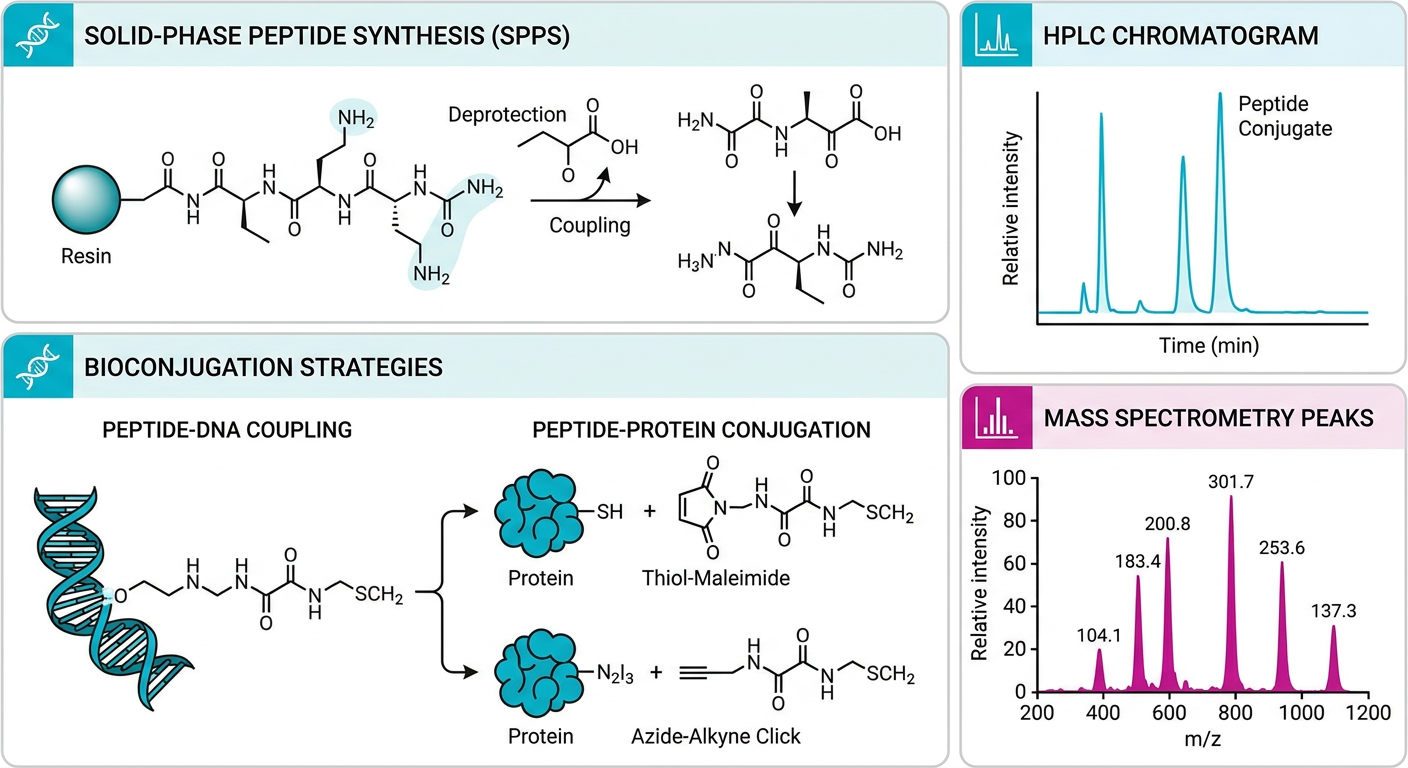
Peptide Synthesis Supplier Li-bioconjugates tse thehiloeng ho Peptide-haholo-holo li-chimera tsa peptide-DNA le li-peptide-protein complexes-li hlahile e le meralo ea bohlokoa ea limolek'hule ho pholletsa le biopharmaceuticals e lebisitsoeng., liphatlalatso tsa liphatsa tsa lefutso, li-biosensor tsa ho hlahloba, le lilaebrari tsa lik'hemik'hale tse kentsoeng ka DNA (DECLs). Kopano e nepahetseng ea li-macromolecules tsena tse nyalisitsoeng e hloka leano la modular la lik'hemik'hale le kopanyang ka mokhoa o hlakileng selelekela sa peptide synthesis e tiileng. (SPSS) e nang le chemoselective, li-protocol tsa bioconjugation tsa lihlahisoa tse phahameng. Pampiri ena e fana ka tlhahlobo e felletseng ea botekgeniki ea k'hemik'hale ea ho kopanya peptide-DNA le maano a ho kopanya liprotheine tsa peptide. Re hlahloba ka tatellano kopano ea selelekela sa peptide ka Fmoc/tBu SPPS, reactive handle ho kenya (azides, alkynes, thiols, ka chess), le mekhoa e bapisang ea karabelo e kenyelletsang tlatsetso ea thiol-maleimide, koporo-catalyzed (CuAAC) 'me ho khothaletsoa (SPAAC) azide-alkyne cycloaddition, le heterobifunctional crosslinking. Ho feta moo, Re hlakisa ts'ebetso e matla ea tlhoekiso ea tlhahlobo e sebelisang chromatography ea mokelikeli oa morao-rao o sebetsang hantle. (RP-HPLC) le electrospray ionization/MALDI-TOF mass spectrometry (ESI-MS/MALDI-TOF MS), ha re ntse re totobatsa maemo a thata a ho sterility le netefatso ea boleng e hlokahalang bakeng sa ho eketsa matla a phetolelo.
Sengoli Bio & Polelo ea Tsebo: Tlhahlobo ena e ngotsoe ke MOL E Fetola Sehlopha sa Lipatlisiso tsa Peptide, e nang le Ph.D. litsebi tsa k'hemistri ea lintho tse phelang, baeloji ea lik'hemik'hale, le theknoloji ea bioconjugation. Ka tsebo e pharaletseng ea matsoho ho SPPS e tloaelehileng, fedile 300 liphetoho tse sebetsang tsa peptide, le Sehlopha 100 cleanroom biomanufacturing, sehlopha sa rona se fana ka tataiso ea tekheniki bakeng sa baetsi ba thuto le meriana lefatšeng ka bophara.
1. Selelekela: Phetoho ea Peptide Hybrid Bioconjugates
Khampani ea Peptide Synthesis Ho kopanngoa ha li-peptide tsa maiketsetso le li-oligonucleotide le liprotheine tse sebetsang li emela motheo oa theknoloji ea sejoale-joale ea biotechnology le meriana ea limolek'hule.. Li-peptide tsa maiketsetso li fana ka lintlha tse ikhethang tse lebisitsoeng ho tsona, bokgoni ba ho phunyeletsa liseleng, le libaka tsa enzymatic cleavage. Ha covalently ligate ho nucleic acids kapa carrier protheine, li-conjugate tse nyalisitsoeng tse hlahisoang li bonts'a li-synergistic bioactivities tseo ho seng karolo e nang le tsona li ikemetseng.
Lipatlisisong tsa kalafo, li-peptide tse kenang liseleng (CPPs) e kopantsoe hantle le li-oligonucleotides tse hanyetsanang (Li-ASO) kapa li-RNA tse nyenyane tse sitisang (siRNAs) thusa ho ts'oaroa ha intracellular le ho phonyoha ha endosomal. Ho tlhahlobo ea limolek'hule le biology ea lik'hemik'hale, peptide-oligonucleotide conjugates (POCs) etsa hore liteko tsa ligation tsa proximity proximity proximity li ahe le ho aha lilaeborari tse teteaneng tsa DNA-encoded bakeng sa ho sibolla lithethefatsi.. Ka mokhoa o ts'oanang, peptide-protein bioconjugation e sebetsa e le k'hemistri ea motheo bakeng sa liente tsa protheine e tsamaisang peptide. (mohlala, KLH, BSA, kapa li-conjugates tsa OVA) le li-anti-peptide tse lebisitsoeng ho tsona.
Peptide Synthesis Laboratory Ho fumana chai e ngata, bioconjugation e khethehileng ea sebaka e hlahisa litšitiso tse kholo tsa lik'hemik'hale. Phapang ea ho qhibiliha, botsitso ba conformational, tšitiso ea steric, le li-reactivities tsa nucleophilic side-chain lipakeng tsa li-peptide, DNA, 'me liprotheine li hloka boqapi bo hlokolosi ba lik'hemik'hale. Katleho e itšetlehile ka ho khetha lisebelisoa tse sebetsang tsa bioorthogonal, boenjiniere optimal linker spacers, ho laola likarohano tsa stoichiometric, le ho kenya tšebetsong tlhoekiso ea chromatographic e phahameng haholo.
2. Kopano ea pele ka mokhoa o tiileng oa Mokhahlelo oa Peptide Synthesis (SPSS)
Pele o etsa bioconjugation e tlase, molekane oa maiketsetso oa peptide o tlameha ho etsoa ka botšepehi ba lik'hemik'hale ka ho feletseng 'me a sebetse pele ka li-handles tse khethehileng.. Tlhahiso ea sejoale-joale ea selelekela e itšetlehile haholo ka orthogonal Mokhahlelo o tiileng oa Peptide Synthesis (SPSS) mekhoa.
Key Takeaway: Peptide-DNA e nang le lihlahisoa tse phahameng le peptide-protein bioconjugation e hloka ho kenya maqhama a lik'hemik'hale nakong ea kopano e tiileng ho e-na le ho phunya ka morao., ho thibela likarolo tse sa hlakang tsa mahlakore ka masala a ka hare a nucleophilic amino acid.
       Fmoc-SPPS Precursor Chain Assembly
                       │
  [Resin]-AA1-AA2-AA3-···-AA_n-(NH2 / Side-Chain)
                       │
       Bioorthogonal Handle Coupling
      (e.g., 5-Azidopentanoic Acid or Cys)
                       │
       TFA / Scavenger Cocktail Cleavage
                       │
  Crude Functionalized Peptide (RP-HPLC Purity ≥95%)
2.1 Ho Sireletsa Maano a Sehlopha le Khetho ea Resin
9-fluorenylmethoxycarbonyl e tloaelehileng (Fmoc) / tert-butyl (tBu) Sekema sa ts'ireletso se khethoa bakeng sa ho lokisa li-precursors tsa bioconjugation ka lebaka la ho fokola ha eona, ho pheta-pheta maemo a motheo a tshireletso (20% piperidine ka DMF) le acidic ho qetela cleavage.
- Khetho ea Tšehetso ea Resin:
- Wang Resin: E sebelisoa ha ho na le C-terminal carboxylic acid e sa lefelloeng (-COOH) e hlokahalang bakeng sa ho kopanya enzymatic kapa tharollo ea mokhahlelo oa tharollo.
- Rink Amide Resin: E khethoa ha C-terminal carboxamide (-CONH2) capping e lakatseha ho etsisa libaka tsa protheine ea tlhaho, eketsa botsitso ba enzymatic khahlano le carboxypeptidase, kapa tlosa sehlopha se sa batleheng sa ionisable.
Nakong ea ho lelefatsa ketane e pheta-phetoang, steric petetsane ka tatellano e thata (mohlala, hydrophobic stretches kapa libaka tse nang le β-sheet) e fokotsoa ka ho sebelisa li-reagents tse matla tsa aminium/phosphonium tse kang HATU (1-[Bis(dimethylamino)methylene]-1H-1,2,3-triazolo[4,5-b]pyridinium 3-oxide hexafluorophosphate) kapa PyBOP boteng ba DIPEA.
2.2 Ho kenyeletsoa ha Handle ho sebetsa ho Resin
Ho etsa hore khokahano ea chemoselective, lihlopha tse sebetsang tse sa hlaheng ho li-biomolecules tsa tlhaho li kenyelelitsoe ka kotloloho ho N-terminus kapa liketane tse itseng tsa lehlakore nakong ea SPPS.:
- Aside le Alkyne Handles: E kopantsoe ho N-terminus ho sebelisa 5-azidopentanoic acid, 4-pentynoic acid, kapa Fmoc-L-Ls(N3)-OH nakong ea othomathike elongation ho lokisetsa li-precursors bakeng sa ho tobetsa chemistry.
- Thiol Handles: E hlahisoa ka N-terminal kapa C-terminal Cys(Trt) masalla. Trityl (Trt) Tšireletso e lula e tiile nakong ea ts'ireletso ea Fmoc 'me e lokolloa nakong ea ho arohana ha ho qetela.
- Maleimide Handles: E hlahisoa ka 3-maleimidopropionic acid coupling ho N-terminus pele ho TFA cleavage., ha feela maemo a scavenger a laoloa ka thata ho qoba ho senyeha ha selikalikoe sa maleimide.
2.3 Tlokotsi, Tšireletso, le Taolo ea Boleng bo Sehlasoa
Ho phunyeha ha ho qetela ho tsoa ho ts'ehetso e tiileng le ts'ireletso ea mahlakoreng ka nako e le 'ngoe ho sebelisoa trifluoroacetic acid. (TFA) cocktail e nang le nucleophilic scavengers:
$$\mongolo{Cocktail ea Cleavage: TFA / TIS / }\mongolo{H}_2mongolo{O} \mongolo{ / EDT } (92.5 : 2.5 : 2.5 : 2.5 \mongolo{ v/v})$$
Ethanedithiol (EDT) kapa 1,4-dithiothreitol (DTT) e bohlokoa ha masala a cysteine kapa methionine a le teng ho hatella dimerization ea disulfide le alkylation ea carbocation.. Ka mor'a pula e batang ea diethyl ether, peptide e sa sebetseng hantle e hloekisoa ka RP-HPLC ea boitokisetso ho theha bohloeki ba mantlha ba $ge 95%$ pele o qala bioconjugation.
3. Reaction Chemistries le Linker Engineering bakeng sa Peptide-DNA Coupling
Motsoako oa li-hybrids tsa peptide-DNA o hloka ho hokahanya amphiphilic polyanionic oligonucleotide le polycationic kapa hydrophobic peptide.. Joalo ka ha ho hlalositsoe ho Boithuto ba PMC mabapi le maano a ho kopanya peptide-oligonucleotide, post-synthetic liquid-phase chemo-selective ligation ke mokhoa o tšepahalang ka ho fetisisa oa ho kopanya li-conjugate tse rarahaneng..
3.1 Thiol-Maleimide Crosslinking Chemistry
Thiol-maleimide conjugation e emela e 'ngoe ea mekhoa e sebelisoang haholo bakeng sa k'hemik'hale ea ho kopanya peptide-DNA. Karabelo e kenyelletsa kenyelletso ea nucleophilic Michael ea sulfhydryl ea mahala (-SH) sehlopha ho peptide ho oligonucleotide e sebetsang ka maleimide (kapa ka tsela e fapaneng).
Peptide-SH + Maleimide-R-DNA  ──(pH 6.8 - 7.2)──►  Peptide-S ──┐
                                                            │
                                                          O ┴ O
                                                          └─N─R-DNA
Mechanism le Protocol Parameters
- Taolo ea pH: Boitšoaro bo tlameha ho bolokoa hantle lipakeng tsa pH 6.8 le 7.2. Ka tlase pH 6.5, maleimide reactivity e theoha haholo. Ka holimo pH 7.5, primary amine cross-reactivity ea eketseha, 'me selikalikoe sa maleimide se kenella ka tlholisano ea alkaline hydrolysis ho asiti ea maleamic e sa sebetseng..
- Likhetho tsa Linker: Heterobifunctional crosslinkers joalo ka SMCC (succinimidyl 4-(N-maleimidomethyl)cyclohexane-1-carboxylate) kapa analog ea eona e qhibilihang ka metsi ea Sulfo-SMCC e sebelisoa ho fetolela oligonucleotide e fetotsoeng ea amino. ($5' mongolo{-NH}_2mongolo{-DNA}$) ho mefuta ea maleimide-reactive pele ho kenyelletso ea peptide.
- Li-buffers: Letsoai le senyehileng la phosphate-buffered (PBS, 100 mM, pH 7.0) e tlatsitsoe ka 2–5 mM EDTA e tlamehile ho chelate trace transition metal ions e etsang hore thiolate oxidation e be dimers tse sa sebetseng tsa disulfide..
3.2 Bioorthogonal Click Chemistry: Khahlano le CuAAC. SPAAC
Liphetoho tsa "Bioorthogonal click" li lumella ho kopana libakeng tse rarahaneng tsa metsi ntle le ho kopana le liketane tsa matsoalloa a amino acid kapa li-nucleic acid..
1. Copper-Catalyzed (CuAAC):
   Peptide-N3 + Alkyne-DNA  ──[Cu(I) / THPTA / Ascorbate]──►  Triazole-Linked Conjugate

2. Strain-Promoted (SPAAC):
   Peptide-N3 + DBCO-DNA    ──(Metal-Free, pH 7.0 - 7.4)───►  Fluorinated / Strained Triazole Conjugate
Koporo-Catalyzed Azide-Alkyne Cycloaddition (CuAAC)
CuAAC e itšetlehile ka Copper e thusang(I) mefuta ea ho kopanya li-azides le alkynes, ho theha khokahano e thata ea 1,4-disubstituted 1,2,3-triazole.
- Sistimi ea Catalytic: $\mongolo{CuSO}_4$ (1-5 mM) e fokotsehile sebakeng sa situ ka sodium ascorbate (5-10 mmM) boteng ba ligand tse qhibilihang ka koporo tse tsitsitseng tse kang THPTA (Tris(3-hydroxypropyltriazolylmethyl)amine).
- Molemo: Li-kinetics tse potlakileng tse potlakileng le lihlahisoa tse ngata.
- Moedi: Trace mefuta ea koporo e ka baka ROS-mediated DNA strand scission le cytotoxicity, e hlokang ho hloekisoa ka matla ka mor'a ts'ebetso ea chelating resin (mohlala, Chelex-100).
Strain-Promoted Azide-Alkyne Cycloaddition (SPAAC)
SPAAC e feta catalysis ea koporo ka ho sebelisa li-derivatives tsa cyclooctyne tse senyehileng., joalo ka Dibenzocyclooctyne (DBCO) kapa Bicyclo[6.1.0]ha ho letho (BCN).
- Maemo a ho itšoara: Ho kopanya peptide e nang le azide le oligonucleotide e fetotsoeng DBCO ka har'a buffer e nang le metsi. (pH 7.0–7.4) mocheso oa kamore o fana ka phetoho e feletseng nakong ea lihora tse 4-12.
- Molemo: 100% e senang tshepe, biocompatible, 'me e loketse li-live-cell tse lebisitsoeng ho tsamaisa thepa.
3.3 Tlhahlobo e Bapisang ea Peptide-DNA Coupling Chemistries
| Leano la ho Kopanya | Reactive Handles | Maikutlo pH / Solvent | Melemo ea Bohlokoa | Meeli ea Mathomo |
|---|---|---|---|---|
| Thiol-Maleimide | Peptide-SH + DNA-Maleimide | pH 6.8–7.2 (PBS + EDTA) | Lebelo le phahameng, thioether bond e tsitsitseng, chai e ngata | Maleimide hydrolysis ka pH >7.5; kotsi ea thiol oxidation |
| CuAAC Click | Peptide-$ mongolo{N}_3$ + Terminal Alkyne-DNA | pH 7.0–8.0 (Aqueous + DMSO) | Ka potlako, e ngata haholo, sehokelo se thata sa triazole | Chefo ea koporo; kotsi ea ho senyeha ha ROS DNA |
| SPAAC Tobetsa | Peptide-$ mongolo{N}_3$ + DBCO-DNA | pH 6.5-7.5 (Li-buffers tse nang le metsi) | E se nang tšepe, bioorthogonal, e tsitsitseng haholo | Hydrophobic DBCO handle e ka etsa hore ho be le aggregation |
| Amide Ligation | Peptide-COOH + $\mongolo{NH}_2$-DNA | pH 7.2–8.0 (EDC / Sulfo-NHS) | Ho fumaneha ha reagent e bonolo | Ho kopanya ho sa khethehe haeba peptide e na le Asp/Glu tse ngata |
4. Maano a Khethehileng a Sebaka bakeng sa Peptide-Protein Bioconjugation
Peptide-protein bioconjugation e hloka melao e ikhethileng ea moralo ha e bapisoa le ho kopana ha oligonucleotide ka lebaka la ho ba kotsing ea conformational le ho rarahana ha lik'hemik'hale tsa tlhaho tsa liprotheine tse kholo.. Joalokaha ho boletsoe ho Tlhahlobo ea NIH PMC mabapi le maano a protheine-DNA bioconjugation, ho boloka sebopeho sa protheine e phahameng le phihlello ea sebaka se sebetsang ke ntho ea bohlokoahali.
Phase 1: Protein Amine Activation
Protein-Lys-NH2 + Sulfo-SMCC  ──────►  Protein-Lys-NH-C(=O)-R-Maleimide + NHS

Phase 2: Chemoselective Peptide Coupling
Protein-Maleimide + Peptide-SH ──(pH 7.0)──► Stable Protein-Peptide Thioether Complex
4.1 Heterobifunctional Crosslinking (NHS-Maleimide Ligation)
Tsela ea khale ea ho peptide-protein bioconjugation e sebelisa li-crosslinkers tsa heterobifunctional tse nang le amine-reactive N-hydroxysuccinimide (NHS) ester ka lehlakoreng le leng le sehlopha sa thiol-reactive maleimide ka lehlakoreng le leng:
- Mohato 1 (Tšebeliso ea Amine): Liprotheine tsa thepa (joalo ka Bovine Serum Albumin [BSA] kapa Keyhole Limpet Hemocyanin [KLH]) li arabela ka Sulfo-SMCC ho pH 7.5–8.0. NHS ester e shebile holimo holimo $epsilon$-amines ea masala a lysine..
- Mohato 2 (Ho tlosa letsoai): Crosslinker e sa sebetseng e tlosoa ka ho sefa li-gel kapa li-column desalting (MWCO 10 kDa).
- Mohato 3 (Peptide Conjugation): Li-peptide tse nang le cysteine tse nang le li-synthetic li hlahisoa ka pH 6.8-7.2, ho etsa se tsitsitseng, covalent thioether bonds le maleimide-activated protein carrier.
4.2 Sebaka sa Ts'ebetso sa Enzymatic Tagging
Ho felisa mefuta e sa tšoaneng, khokahano ea libaka tse ngata e sitisang tšebetso ea protheine, Litsamaiso tsa sejoale-joale li sebelisa litsamaiso tsa enzymatic ligation:
- Hlophisa A Ligation: Transpeptidase Sortase A e amohela moelelo oa N-terminal LPXTG ho peptide 'me e arohana pakeng tsa Thr le Gly., ho theha maqhama a amide le oligoglycine ($\mongolo{Gly}_n$) sekoahelo se entsoe ka protheine.
- SpyTag / Theknoloji ea SpyCatcher: 13-amino-acid SpyTag peptide e etsa ntho e ke keng ea etsolloa, Covalent isopeptide bond le molekane oa protheine ea 116-amino-acid SpyCatcher tlas'a maemo a fisioloji ntle le ho hloka li-catalyst tsa kantle..
5. Sebopeho sa Analytical, RP-HPLC Ho hloekisa, le Taolo ea Boleng bo Hloekileng
Ho kopanya li-bioconjugate tsa bohloeki bo phahameng ho hloka tlhoekiso e khethehileng le mekhoa ea sebopeho ho rarolla mefuta e nyalisitsoeng e tsoang ho li-peptide tse sa sebetseng tsa pele., mahala DNA likhoele, le lihlahisoa tsa mahlakoreng tse itšebetsang.
Bakeng sa Keletso: Kamehla sekaseka bohloeki ba bioconjugate u sebelisa tlhahlobo ea UV ea maqhubu a mabeli. Beha Channel A ho 214 nm (peptide backbone peptide bonds) le Channel B ho 260 nm (ho monya ha motheo oa nucleic acid). The $A_{260}/A_{214}$ tekanyo e fana ka netefatso ea hang-hang ea chromatographic ea katleho ea peptide-DNA co-elution.
5.1 HPLC ea Preparative and Analytical Reverse-Phase
Reverse-Phase High-Performance Liquid Chromatography (RP-HPLC) e ntse e le tekanyetso ea khauta bakeng sa ho itšehla thajana.
- Mokhahlelo oa ho ema: silika e thehiloeng $ mongolo{C}_{18}$ kapa $text{C}_8$ likholomo tse nang le masoba a maholo a boholo ($300,\mongolo{\AA}$) li hlokoa ho thibela ho qheleloa ka thoko ho mefuta e meholo ea peptide-oligonucleotide kapa peptide-protein..
- Mehato ea Mobile bakeng sa Peptide-DNA Conjugates:
- Buffer A: 0.1 M Triethylammonium Acetate (TEAA, pH 7.0) ka metsing (e sebetsa joalo ka moemeli oa ion-pairing bakeng sa mokokotlo oa DNA o qosoang hampe).
- Buffer B: 100% HPLC-grade Acetonitrile ($\mongolo{CH}_3mongolo{CN}$).
- Gradient: Linear gradient ho tloha 5% ho 60% Buffer B ka holimo 45 metsotso ka lebelo la ho phalla la $1.0,text{mL/mets}$.
Joalokaha ho totobalitsoe ho Tlaleho ea PMC mabapi le karohano e phahameng ea HPLC ea li-conjugates, ion-pairing RP-HPLC e arola ka mokhoa o hloekileng hydrophilic DNA e sa sebetsanoang le hydrophobic peptide-DNA conjugates.
       RP-HPLC Chromatogram (TEAA / ACN Gradient)
   UV Absorbance
     │
     │     Peak 1: Free DNA (260 nm)
     │       ┌─┐
     │       │ │       Peak 2: Target Conjugate (214/260 nm)
     │       │ │          ┌───┐
     │       │ │          │   │        Peak 3: Free Peptide (214 nm)
     │     ──┴─┴──────────┴───┴───────────┌───┐──────
     └────────────────────────────────────┴───┴───────► Retention Time (min)
5.2 Netefatso ea Mass Spectrometry (ESI-MS le MALDI-TOF)
Boitsebahatso le botšepehi ba sebopeho li tlameha ho netefatsoa ke spectrometry ea boima:
- MALDI-TOF MS: E ratoa bakeng sa tlhahlobo e potlakileng ea boima ba li-peptide-DNA tse nyalisitsoeng. Conjugate e kopantsoe le 3-hydroxypicolinic acid (HPA) kapa $alpha $ -cyano-4-hydroxycinnamic acid (CHCA) matrix ho fumana bohloeki $[\mongolo{M}+\mongolo{H}]^+$ kapa $[\mongolo{M}-\mongolo{H}]^- $ ion matšoao.
- ESI-MS / LC-MS: E bohlokoa bakeng sa likhokahano tse kholo tsa peptide-protein. Electrospray ionization e hlahisa libaka tse ngata tsa tefiso ($[\mongolo{M}+n mongolo{H}]^{n+}$), tse felisitsoeng ho sebelisoa li-algorithms tse khethehileng ho netefatsa boima ba limolek'hule bo nepahetseng ka ho nepahala ha sub-Dalton..
5.3 Tlhahiso e Hloekileng le Tiisetso ea Boleng
Bakeng sa lisebelisoa tsa phetolelo, bohloeki bo tala ha boa lekana; ts'ebetso e hloekisitsoeng le taolo ea endotoxin lia tlama:
- Sehlopha 100 Tlhahiso ea Kamore ea Bohloeki: Ho netefatsa sterility, tlhaho, bioconjugation, le lyophilization lokela ho bolaoa ka Class 100 (ISO 5) libaka tsa liphaposi tse hloekisitsoeng haholo.
- Teko ea Endotoxin: Limulus Amebocyte Lysate (LAL) Liteko li tlameha ho netefatsa maemo a endotoxin ka tlase ho $< 0.1,\mongolo{EU/mg}$ bakeng sa tlhahlobo ea preclinical.
- Setifikeiti sa Tlhahlobo (CoA): Lihlahisoa tse tloaelehileng li tlameha ho kenyelletsa mesaletsa ea RP-HPLC, ponahalo ea bongata, le litifikeiti tsa sterility.
- Mekhoa e Tloaelehileng ea Empirical Metrics: Karabelo e phahameng ea lihlahisoa tsa SPAAC hangata e fihlela $>85%$ tlhahiso ea phetoho, e nang le lits'ebetso tsa post-RP-HPLC tse fetang $>95%$ le maemo a tlase haholo a endotoxin a ka tlase ho $< 0.05\mongolo{ EU/mg}$ hlahiswa ka hare ho Sehlopha 100 lits'ebeletso tse nyopa.
Ho finyella litekanyetso tsena tse boima tsa ts'ebetso, bafuputsi ba biopharma hangata ba sebelisa sethala se kopaneng joalo ka MOL E fetola sebopeho sa peptide le sethala sa phetoho, e kopantseng mokgahlelo o tiileng, fedile 300 liphetoho tse sebetsang (ho akarelletsa le azide, alkyne, DBCO, le thiol handles), Sehlopha 100 ts'ebetso ea kamore e hloekileng, le ho tlatsa litokomane tsa HPLC/MS CoA.
6. Mathata a Theknoloji ka Melemo ea Kelo-holimo le Melemo ea Kamoso
Phetoho ea karabelo ea bioconjugation ho tloha ho milligram analytical screening ho ea ho gram- 'me tlhahiso ea lik'hilograma e hlahisa liphephetso tse ikhethang tsa boenjiniere ba lik'hemik'hale:
- Hydrophobic Aggregation: Metsoako e phahameng ea li-peptide tsa hydrophobic tse kopantsoeng le hydrophilic DNA kapa liprotheine li ka etsa hore motho a ikopanye hore e be li-micellar aggregates tse sa keneng.. Ho kenyelletsa polyethylene glycol ($\mongolo{PEG}{4}$ ho $text{PEG}{24}$) spacer linkers pakeng tsa peptide le conjugation handle e ntlafatsa haholo ho qhibiliha ha metsi.
- Taolo ea Stoichiometric: Peptide e fetelletseng ea selelekela e thatafatsa tlhoekiso e tlase. Ho sebelisa lik'hemik'hale tse khethang haholo (SPAAC) lumella haufi $1:1$ ho lekana ha stoichiometric, haholo ho fokotsa moroalo oa tlhoekiso le litšenyehelo tsa thepa e tala.
- Tšitiso ea Steric ka har'a li-Conjugates tse teteaneng: Ho kopanya li-peptide tse ngata ho li-nucleic acid tse ka hare kapa li-loops tse nang le liprotheine tse ngata hangata ho theola sekhahla sa karabelo.. Tšebeliso e eketsehileng, flexible PEG kapa alkane linkers e imolla tšubuhlellano e matla le ho boloka bioactivity.
7. Qetello
Peptide-DNA le peptide-protein bioconjugation chemistries li fana ka lisebelisoa tsa bohlokoa bakeng sa ho holisa bokhoni ba ts'ebetso ea biopharmaceuticals., tlhahlobo ea limolek'hule, le mekhoa ea phekolo e lebisitsoeng. Katleho e itšetlehile ka mokhoa o kopanetsoeng: ho ntlafatsa sebopeho sa peptide e tiileng ea mohato o tiileng, ho khetha li-conjugation handles tsa bioorthogonal (thiol-maleimide, CuAAC, SPAAC), lihokelo tsa boenjiniere ho fokotsa tšitiso ea steric, le ho qobella tlhahlobo e matla ea RP-HPLC le netefatso ea ESI/MALDI-TOF mass spectrometry. Ha lipatlisiso tsa bioconjugate li ntse li tsoela pele ho ea ho phetolelo ea bongaka, ho khomarela ka thata ho litekanyetso tsa tlhahiso e nyopa le taolo e matla ea boleng e ntse e le eona ntho e ka sehloohong ho fana ka thepa e ka hlahisoang hape., bioconjugates ea matla a phahameng.
Tekolo ea ho khonahala & Tlhahlobo ea Tatelano
Na u rala li-peptide-DNA tse rarahaneng kapa peptide-protein conjugates bakeng sa biopharma R ea hau?&D pipeline?
Ikopanye le litsebi tsa theknoloji ea bioconjugation ho hlahloba moralo oa hau oa tatellano, hlahloba dikgetho tsa bioorthogonal linker, le ho fihlella motsoako o tiileng oa mokhahlelo ka har'a Sehlopha se netefalitsoeng 100 lisebelisoa tsa ho hloekisa.
Tlhahlobo ea ho khonahala ea tekheniki: Ithute ka mokhoa o ikhethileng, phetolo ya matshwao, le likhetho tsa tlhahlobo ea HPLC/MS ka kotloloho ka Liphetoho tsa MOL.