Тиҙ яуап
How licensing agreements reshape peptide CRO needs across discovery, процесын үҫтереү, сағыштырыусанлыҡ, technology transfer, and EU/UK quality documentation.
Асыш: where manufacturability is decided
Licensing tends to surface a discovery-stage reality that gets skimmed over when a molecule is still “only a candidate.” A GLP-1 analog like bofanglutide is a 30-plus-residue sequence with a fatty-acid side-chain modification that confers its two-week half-life. That architecture is precisely where peptide-specific failure modes — hydrophobic aggregation during assembly, truncated or deletion sequences, эпимерлашҡан ҡалдыҡтар, side-reaction by-products from the acylation step — are determined long before any regulatory filing.

Пептидтар синтезы The commercial implication is that a licensing deal effectively converts a discovery program into a program with a public scale-up and deadline. Once the licensee is responsible for registration, the originator’s sequence and modification route must be scrutinized for етештереүсәнлеге, not just activity. A peptide CRO that can assess a sequence for synthetic feasibility, flag impurity risks from the outset, and lock early analytical methods gives innovators a much smoother path into the deal’s downstream obligations. Ideally that assessment happens while the molecule is still being optimized, so the chemistry licensed to the EU is the chemistry that can actually be made at scale.
In practice this means route and sequence-side feasibility work, impurity-risk assessment, and early method development for identity, сафлыҡ, and related substances. If a long, гидрофоб, multi-modification GLP-1 sequence was never vetted for Синтетик пептидтар синтез, the licensee discovers the problem later — in comparability, in process development, or worst of all in a regulatory question. Getting that discipline right is one of the quieter but highest-impact reasons a deal like this matters.

Process development: the route becomes the licensable asset
A licensing agreement makes the manufacturing process part of the licensed package. Синтетик пептидтар өсөн, the process is not incidental to the deal — it is a large share of what the licensee is paying to reproduce. This is where a peptide CRO’s process-development depth becomes decisive.
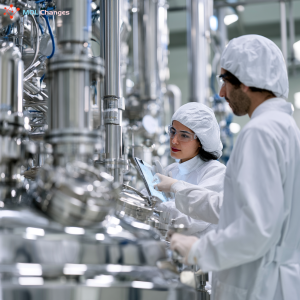
Ҡаты фазалы пептид синтезы (СПСС) of a GLP-1 analog depends on a chain of small, interdependent decisions: protecting-group and resin selection, coupling and deprotection kinetics, ярылыу шарттары, таҙартыу стратегияһы, and salt or counter-ion form. A route that works elegantly at milligram scale rarely holds at engineering and commercial scale. GLP-1 manufacturing is solvent-intensive and notoriously sensitive to its unit operations, which is why the peptide CDMO layer — the handful of facilities capable of building long, complex peptides at commercial scale — has become the recognized bottleneck for the class.
For an innovator licensing into Europe, the practical question is whether the process package travels as optimized, defensible chemistry rather than as a laboratory recipe. This is where development reports, engineering and scale-up batches, and validated analytical controls start to look like the real deliverables of the transaction. The more reproducible the process at scale, the less risk lands on comparability later. A specialist peptide research and manufacturing partner such as MOL Changes, with the analytical rigor to deliver Ҡулланыусылар өсөн пептид синтезы across practical scale ranges, is the kind of CRO that keeps this hand-off from stalling — and whose capabilities in GLP-1 модификацияһы һәм масштаблы эш ағымы indicate whether a route can survive the journey from the laboratory to a registered drug substance.
Сағыштырыусанлыҡ: proving the transferred material is the same material
Once the process, сайт, сеймал А., or analytical methods change during a transfer, regulators require the licensee to demonstrate that the new material is comparable to the originator’s. For synthetic peptides the drug substance has no cell line to standardize the comparison; rather, буйынса ЭМА синтетик пептидтар эшләү һәм етештереү буйынса йүнәлеш, characterization alongside “assay and conventional analytical testing” forms the basis of the demonstration.
That comparison is far from trivial for a GLP-1 analog whose clinical behavior depends on its impurity profile. Even apparently small changes in SPPS inputs or in the purification train can shift the pattern of truncated sequences, делеция пептидтары, изомерҙар, oxidation or hydrolysis products, ҡалдыҡ реагенттар, counter-ion levels, һәм ҡалдыҡ иреткестәр. Batch variability is inherent to peptide synthesis, so a comparability exercise is really a side-by-side interrogation of impurity profiles and physicochemical attributes between the innovator’s material and the material produced for the licensed market, supported by stability data and, ҡайҙа кәрәк, bridging nonclinical work.
For peptide innovators, this stage dictates which CRO partner can credibly run a comparability program at all. It requires a laboratory that reproduces or bridges the originator’s analytical methods — HPLC and LC-MS identity and purity, пептид картаһы, потенция, residual-solvent and reagent checks, һыу составы, ҡаршы ион, endotoxin and bioburden — with formal acceptance criteria and cross-laboratory equivalence testing. А пептид тикшереү capability that can generate defensible, batch-specific analytical data is what turns a comparability claim into evidence a European assessor will accept rather than an assertion. Пептидтар етештереү
Технологиялар тапшырыу: a forensic reconstruction, not a copy-paste
Regulators and experienced CDMOs describe moving a pharmaceutical process between facilities as a reconstruction, not a hand-off of documents. The receiving site cannot simply execute the originator’s records; it must re-establish the process under its own equipment, смолалар, filters, solvent handling, and purification train, and prove it produces equivalent material to GMP standards.
A technology transfer for this kind of licensing deal therefore bundles a demanding set of services: a complete package of batch records, master formulas, процесс параметрҙары, сеймал спецификацияһы, тәнҡитле сифат атрибуттары, процесс эсендәге контроль, cleaning approaches, аналитик ысулды тапшырыу, and stability strategy — plus hands-on training so the receiving organization can reproduce the process reliably. Every one of those components is a place where a peptide program can degrade quietly, losing yield, accumulating impurities, or drifting in stability without any single dramatic failure.
The strategic message for innovators is that the terms of a license should track the practical pain of transfer. A partner that can execute a forensic transfer with documented development and scale-up batches, and that already operates under controlled, sterile-capable manufacturing conditions, removes most of the risk that a licensed peptide will fail to transplant. This is also where delivery and timeline risk concentrates — the transfer is often the longest pole in the licensing tent, and it cannot be shortened by adding money at the end.
Region-specific quality documentation: EU and UK are two separate files
The most under-appreciated consequence of this particular deal is geographic. Menarini’s 39 territories are not one regulatory market for a novel synthetic peptide: был EU/EEA һәм UK maintain their own authorization and inspection tracks. The EU route runs through the EMA framework (centralised or national procedure) against the EMA’s synthetic-peptide guidance and the wider chemistry-of-active-substances expectations. The UK runs through the MHRA, which requires its own marketing authorisation, GMP compliance, manufacturer or importer licensing, and Qualified Person batch release.
Ғәмәли йәһәттән ., licensing documentation splits into a global/master CMC package һәм territory-specific regulatory evidence. The shared elements — the CTD Module 3 drug-substance dossier covering manufacture, характеристика биреү, спецификацияһы, аналитик алымдар, batch analysis, ҡушылмалар, and stability — can be reused across regions. But each territory then layer on its own appendices: GMP certificates and inspection history for every manufacturing and testing site involved in that market, quality agreements defining responsibilities for manufacture, ебәрергә, тайпылыштар, контролде үҙгәртеү, and complaints, plus QP/ batch-release documentation for the UK. A single validation or process-validation batch record may need to speak to two different authorities that will scrutinize the same paragraph for different implications.
For a peptide innovator, this means the CRO partner must be fluent in generating quality documentation that travels cleanly into an EU CTD submission and a parallel UK file — not a single “Europe” dossier. Consistent specification control, real batch analysis, and disciplined quality systems at the drug-substance level are the foundation that makes both files credible. When a сифат program is built around genuine analytical data rather than documents assembled for one market, the same underlying evidence can serve EMA and MHRA reviewers without being rewritten or, worse, contradicted.
What this deal signals for your own program
Read past the EUR 726 million and one conclusion stands out: licensing is where a peptide molecule stops being a scientific curiosity and becomes a manufacturing and regulatory obligation with hard dates. The innovator that treats the five stages above as part of the deal’s engineering, rather than as afterthoughts to be resolved by whichever vendor is cheapest, is the one that keeps its timeline and its chemistry intact through a cross-border hand-off.
The capabilities that matter cluster around the same themes a developer should already care about: manufacturability-aware discovery support, reproducible process development and scale-up for long modified peptides, defensible comparability and analytical transfer, disciplined technology transfer under controlled conditions, and documentation that satisfies both EU and UK assessors at once.
If you are preparing a GLP-1 or complex modified peptide for a licensing path — or qualifying a partner to carry one — a practical first step is a technical feasibility review of your sequence and current process against these transfer requirements. The reach of a deal like Menarini and Gan & Lee’s is not limited to two companies; it normalizes a standard for how peptide innovators everywhere should expect a licensing hand-off to behave.