What does “resilient” actually mean for a peptide supply chain?
Peptide Production Supplier Mt2 Peptide Resilience is the capacity to keep functioning and recover when a specific material fails, not the absence of geographic exposure. The UK’s supply-chain foresight evidence shows reshoring redistributes rather than removes risk, and it separates vulnerability into three dimensions: firm-level factors such as sourcing strategy, external factors such as geopolitics, and network-level factors such as concentration and bottlenecks (UK Government Office for Science, 2026-06-15). A supplier that has moved its final synthesis step out of China while its protected amino acid derivatives still originate there has changed its firm-level profile and left its network-level exposure intact.
The regulatory layer already assumes this distinction. ICH Q10 requires a defined supply chain and a written agreement, not a specific notice period: the pharmaceutical quality system must extend to outsourced activities and purchased materials, with supplier suitability assessed against a defined supply chain, responsibilities and communication processes set out in writing, and incoming materials monitored to confirm they come from approved sources using the agreed supply chain (ICH Q10, current guideline). Nothing in Q10 tells you how many days’ notice a Tier 2 change requires, because that is a commercial term you negotiate.

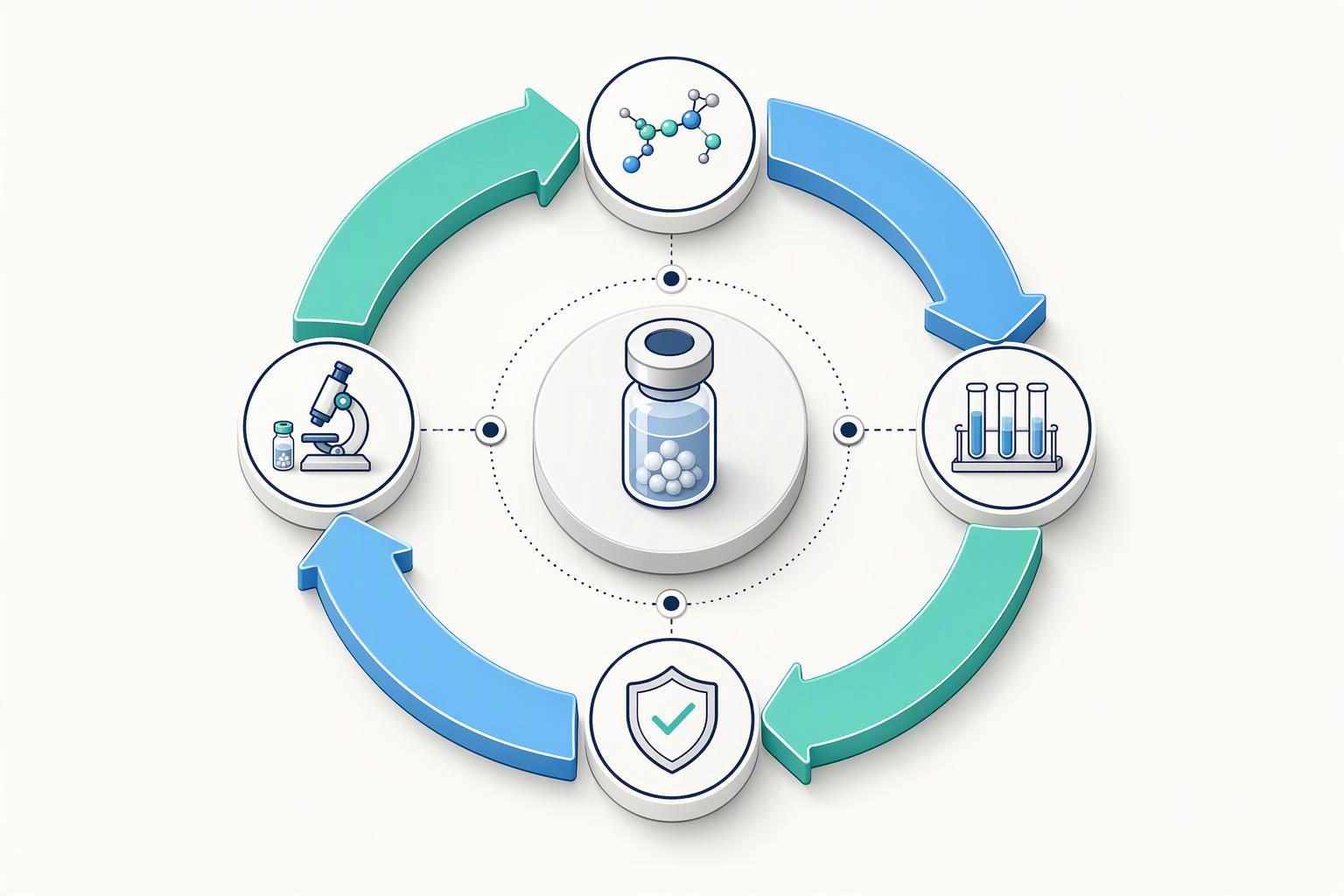
Four questions predict whether a given material will actually hurt you. Is it critical (incorporated into the molecule)? Is it substitutable (can another qualified source supply it on your timeline)? Is it visible (do you know who makes it, and would you learn about a change)? Is it recoverable (how long until you are running again)? A material that scores badly on all four is a single point of failure regardless of which country it ships from.
Decision aid: the four-question test
Criticality: is the material incorporated into the peptide, or is it a reagent, solvent or resin that is not?
Substitutability: is there a second qualified source, and how long does requalification take?
Visibility: do you know the Tier 2 and Tier 3 origin, and would a change reach you before the material does?
Recoverability: what is the time to restore supply, and what inventory covers that interval?
Why doesn’t moving sourcing out of China by itself make a peptide supply chain resilient?
Because the exposure figures that motivate the move are measuring different things, and none of them measure your molecule. Brookings lays out the spread: one estimate puts US reliance on Chinese-made API at 8%, another at 47% via India’s reliance on China, and some reports claim China controls 80% à 90% of global API supply, while Brookings’ own review concludes Chinese API is included in perhaps a quarter of drug volume sold in the US (Brookings Institution, 2025-07-28). The divergence is not a data-quality accident. DMF filings and facility registrations record capability rather than actual supply, et 46% de la 1,867 facilities listing API manufacture have neither GDUFA fee payment nor compliance records suggesting branded drug production.
The direction of travel is clearer than the level. China’s share of DMF filings rose from 5% dans 2000 à 32% dans 2024, et 36 drugs have all active API DMFs from China or all finished-dosage forms from China, y compris 12 antibiotics, 2 cancer drugs and 3 essential medicines (Brookings Institution, 2025-07-28). Brookings’ own count of Chinese DMFs for generics and soon-to-be generics was 27% dans 2024, lower than the 32% figure, which means Chinese firms are disproportionately filing for intermediates, unapproved molecules or non-prescription substances.
Where concentration is documented at the molecule level, it is severe. CFR’s analysis of pharmaceutical chokepoints reports that nearly 41% of KSMs used in US-approved APIs come solely from China and 16% solely from India, that China supplies 94% of 6-APA, the main amoxicillin KSM, et 74% of US heparin supply, and that five Chinese firms control over four-fifths of global 6-APA production (Council on Foreign Relations, 2025). CFR is a US foreign-policy think tank rather than a neutral data provider, and it reproduces the USP figures rather than generating them, so treat its framing as framing.
The practical failure mode is substitution that relocates rather than removes a chokepoint. A program that moves its final API supplier to India while that supplier’s KSMs still arrive from China has changed the shipping lane, not the dependency.
Which peptide starting materials are genuine single points of failure?

The EMA’s synthetic-peptide guideline sets out which materials qualify as starting materials, and the answer determines switching cost. It requires a justification of starting-material designation, the name and address of all starting-material manufacturers, flowcharts of each starting material’s synthetic process including reagents, solvants et catalyseurs, and a criticality assessment of which starting-material impurities may affect the peptide’s impurity profile (EMA, Research Peptides current guideline). Protected natural L-amino acid derivatives are generally acceptable as starting materials. Short peptide fragments are acceptable only in justified cases, such as dipeptides containing glycine that reduce diketopiperazine formation, or Dmb-glycine and pseudoproline dipeptides used to minimise aggregation during assembly. Polypeptide fragments that undergo only limited further modification under GMP, such as cyclisation or PEG conjugation, are intermediates, not starting materials.
That classification is a risk classification. Protected amino acid derivatives are the materials that most affect peptide API quality, because they are incorporated into the molecule and their impurities can react during coupling (Polypeptide Laboratories, undated technical paper). ICH Q11, in force since 2012, increased the emphasis on justifying starting-material selection, on detecting and controlling impurities in starting materials, and on understanding their fate and purge through the process.
The concentration data sits one level up. USP’s key-starting-material analysis found 41% come only from China, 16% only from India, et 58% from a single country (US Pharmacopeia, 2025). The denominator is KSMs, not medicines, APIs or volumes, and it cannot be restated as a share of drugs.
|
Material class |
Regulatory status |
Switching cost |
Why it concentrates |
|---|---|---|---|
|
Protected natural L-amino acid derivatives |
Generally acceptable starting material |
Lower |
Commodity-like, many producers, but single-country sourcing still common |
|
Short peptide fragments (glycine dipeptides, Dmb-glycine, pseudoproline dipeptides) |
Starting material only in justified cases |
Haut |
Process-specific; chosen for aggregation and diketopiperazine control |
|
Polypeptide fragments with limited further GMP modification |
Intermédiaire, pas un Peptide Wholesale Wholesale starting material |
Highest |
A change is a process change, not a material change |
What makes a second source a real second source?
A second source is real when it has been qualified against your specification, not when it appears on a vendor list. ICH Q10 requires supplier suitability to be assessed using a defined supply chain before selection, and requires monitoring of incoming materials to confirm they come from approved sources using the agreed supply chain (ICH Q10, current guideline). A name in a procurement system satisfies neither requirement.
The qualification burden is set by the material class. For a protected amino acid derivative, the EMA guideline’s criticality assessment of starting-material impurities is the specification basis, so a second source must be qualified against the same impurity profile, including enantiomeric and diastereomeric impurities, partially unprotected amino acids, dipeptides and beta-alanyl impurities (EMA, current guideline). For a pseudoproline dipeptide chosen to control aggregation, the second source is not interchangeable by identity alone, because the reason it was selected is process performance.
The failure mode is a second source that has never run a comparability batch. Two suppliers can meet the same written specification and still differ in the trace impurities that survive into the peptide, which is why ICH Q11’s fate-and-purge logic applies to the material rather than to the certificate (Polypeptide Laboratories, undated technical paper).
A second qualified source does not remove your comparability obligations. It converts an unplanned change into a planned one, which is a different and smaller problem.
How do I get visibility into Tier 2 and Tier 3 changements de fournisseur?

Visibility is a contractual artifact, not an information technology problem. ICH Q10 requires defined responsibilities and communication processes for quality-related activities, included in a written agreement for outsourced activities, and requires monitoring of incoming materials to ensure they come from approved sources using the agreed supply chain (ICH Q10, current guideline). It does not prescribe a notice period or a tier taxonomy, so the notice window and the definition of a reportable change are terms you write. Wholesale Peptides Factory
The reason the terms matter is that the published data cannot see this layer. Brookings found that 46% of facilities listing API manufacture have neither GDUFA fee payment nor compliance records suggesting branded production, and that DMF filings can be made without review, which invites filings for promotional purposes (Brookings Institution, 2025-07-28). USP’s framing of the same blind spot is that a medicine may have multiple finished-dosage or API manufacturers, but if they all rely on the same sole-source KSM supplier, the perceived redundancy is an illusion, and more than a quarter of medicines on the updated Vulnerable Medicines List appear stable at the finished-dosage level while sharing a single upstream potential point of failure (CIDRAP, 2026-04-16).
Pratiquement, ask for four things in the quality agreement: the identity of the Tier 2 manufacturer for each designated starting material, a notification window for changes to that manufacturer or its process, the change categories that trigger notification, and the right to audit. The failure mode is a supplier that answers “we do not disclose sub-suppliers,” which is a decision you can price.
How should lead-time buffers be sized for peptide inputs?
Buffer sizing follows from the four-question test, not from a standard multiple. The UK’s supply-chain foresight evidence defines resilience in terms of the time to recover, the performance lost during disruption, and the performance level after recovery, and it distinguishes absorptive capacity (buffers and redundancy) from adaptive capacity (alternative suppliers and process flexibility) and restorative capacity (UK Government Office for Science, 2026-06-15). A buffer is absorptive capacity. It buys time for adaptive and restorative capacity to work, and it does nothing if neither exists.
That distinction sets the sizing rule. The buffer must cover the interval between a disruption and the point at which a qualified alternative can supply, which is the requalification timeline for that material class, not a fixed number of months. For a protected amino acid derivative with an existing qualified second source, that interval is a comparability batch and release. For a pseudoproline dipeptide with no second source, the interval is a full qualification, and the buffer has to cover it or the material has to be redesigned out.
The failure mode is a buffer sized to a supplier’s quoted lead time. Quoted lead time is the interval under normal conditions, and it says nothing about the interval after a Tier 2 change, an export control or a capacity reallocation. CFR’s own recommendation illustrates the scale: stockpile a minimum six-month supply of the most at-risk KSMs and APIs, and pair it with arrangements with FDA-approved non-China suppliers and an expedited importation pathway (Council on Foreign Relations, 2025). The stockpile is the absorptive half; the supplier arrangements are the adaptive half. CFR also warns that allied partnerships without shared inventories, inspection recognition and purchase commitments serve as consultative forums rather than guarantees of supply.
How do I separate identity, pureté, content and assay suitability in a peptide CoA?

These are four different measurements with four different validation bases, and a certificate that collapses them is not usable for release. Je Q2(R2) treats identity, purity and assay as different validation problems: for identity, normally only specificity is conducted, with no accuracy, précision, range or linearity; for quantitative impurity (pureté) and for assay (content or potency), spécificité, précision, precision including repeatability and intermediate precision, range or response, and lower-range-limit characteristics apply (Je Q2(R2), 2023-11-30). Footnote 3 states that lack of specificity of one analytical procedure should be compensated by one or more other supporting analytical procedures unless appropriately justified, which is the standards basis for orthogonal identity testing.
An intact-mass measurement supports a proposed composition but may not distinguish sequence isomers, epimers or positional variants. Choose orthogonal identity tests for the construct. HPLC area purity and a content assay answer separate questions and should retain their method definitions.
The data-integrity layer applies to all four. ALCOA+ as MHRA defines it means Attributable, Lisible, Contemporain, Original et précis, with the plus meaning Complete, Cohérent, Endurant et disponible, and the guidance states there is no difference in expectations whichever acronym is used (MHRA, 2018-03). 21 Partie CFR 11 applies where electronic records replace paper records required by predicate rules, and FDA interprets Part 11 narrowly, applying it to fewer records than commonly assumed (eCFR, current; FDA, 2003). A supplier’s spreadsheet is not automatically a Part 11 record; a lot release record maintained electronically under a predicate rule is.
The minimum connected data package for a peptide lot is a chain, not a document: Biotech Peptides
-
Lot number, matched to the certificate and to the chromatogram
-
Chromatogram file with the method identifier and acquisition date
-
Mass spectrum confirming the exact molecular weight
-
Net peptide content result and the method used to obtain it
-
Stability protocol and the interval it covers
-
Change record for any Tier 2 or process change since the previous lot
What does a peptide supply-chain continuity plan actually contain?
A continuity plan is a set of pre-agreed triggers and a named owner for each material class, not a document that describes the supply chain. ICH Q10 requires monitoring and review of supplier performance and the identification and implementation of needed improvements, plus monitoring of incoming materials against approved sources (ICH Q10, current guideline). Those are the recurring obligations. The plan adds the decision rules that fire when a trigger is met.
Four triggers cover most peptide scenarios. A Tier 2 manufacturer change on a designated starting material. A requalification interval that exceeds the current buffer. A single-country sole-source designation on a material that is incorporated into the molecule. A stability or impurity trend on incoming lots that departs from the qualification basis. Each trigger should name the action, the owner and the decision deadline, because a trigger without a deadline is a notification.
The plan should also state what it cannot do. Firm-level strategies alone cannot fully mitigate systemic risk, because network-level vulnerabilities emerge from supplier concentration, clustering around specific regions, reliance on global chokepoints and central hub firms (UK Government Office for Science, 2026-06-15). And securing upstream inputs will not prevent shortages absent excess aseptic fill-and-finish capacity, which is why injectables account for 63% of the medicines on USP’s vulnerable list (Council on Foreign Relations, 2025; CIDRAP, 2026-04-16). A continuity plan that addresses starting materials and ignores fill-finish capacity has solved half the problem.
Foire aux questions
Is a second qualified source enough to remove single-point-of-failure risk?
Non. A second qualified source removes the single-source condition for that material, but it does not remove network-level exposure. The UK’s supply-chain foresight evidence shows firm-level strategies cannot fully mitigate systemic risk, because vulnerabilities arise from supplier concentration, regional clustering, reliance on global chokepoints and hub firms (UK Government Office for Science, 2026-06-15). If both qualified sources buy the same Tier 3 input from the same region, the redundancy is structural only.
How many peptide starting materials typically have a single-country source?
The cited USP figures cover a broader key-starting-material dataset, not a peptide-specific census. They cannot answer what share of peptide starting materials is single-country sourced. Map the actual manufacturing tiers for the inputs in the proposed route.
What is the difference between a starting material and an intermediate for a peptide?
The EMA’s synthetic-peptide guideline treats protected natural L-amino acid derivatives as generally acceptable starting materials, and short peptide fragments as starting materials only in justified cases such as glycine-containing dipeptides for diketopiperazine suppression or pseudoproline dipeptides for aggregation control (EMA, current guideline). Polypeptide fragments that undergo only limited further modification under GMP, such as cyclisation or PEG conjugation, are intermediates rather than starting materials. The distinction matters because changing an intermediate is a process change.
Does 21 Partie CFR 11 apply to supplier quality records?
Part 11 scope depends on the electronic records required by applicable FDA predicate rules and qualifying electronic submissions. Do not decide applicability solely from whether a paper record was replaced; document the actual regulatory activity and record use.
Conclusion
Peptide supply chain resilience is a property of a specific material in a specific process, and it is decided by four questions: whether the material is incorporated into the molecule, whether a qualified alternative exists, whether a Tier 2 change would reach you before the material does, and how long recovery takes. Country of origin is an input to the third question and nothing more. The UK’s supply-chain foresight evidence shows reshoring redistributes rather than removes risk, and the exposure estimates that drive most sourcing decisions range from 8% à 47% à 80% à 90% because they measure different things (UK Government Office for Science, 2026-06-15; Brookings Institution, 2025-07-28).
Evaluate continuity for every critical input, including resins, reagents, solvents, analytical materials and packaging, whether or not incorporated into the peptide. Select qualified alternatives, validated buffers, process changes or other recovery measures according to stability, demand and recovery-time uncertainty.
The next step is a records request, not a sourcing review. Ask your supplier for the Tier 2 manufacturer of each designated starting material, the notification window and change categories in the quality agreement, and the connected data package for the last three lots: numéro de lot, chromatogram with method identifier, mass confirmation, teneur nette en peptides, stability protocol and change record. The gaps in those answers are your actual exposure.