Modifications peptidiques
Glycosylation peptidique
Qu'est-ce que la glycosylation peptidique?
La glycosylation peptidique est la fixation covalente de molécules de glucides (glycanes) à des peptides ou des protéines pour former des glycopeptides ou des glycoprotéines. Ce processus se déroule principalement à travers:
Glycosylation liée à l'azote: le glycane est lié à une asparagine (Asn) résidu avec la séquence Asn-X-Ser/Thr (X≠Pro).
Glycosylation liée à l'O: le glycane est attaché à une sérine (Être) ou thréonine (Thr) résidu.
Fonction: Améliore la stabilité des protéines, aide à un pliage correct, facilite la communication intercellulaire, et joue un rôle dans les réponses immunitaires et les mécanismes de la maladie (par ex., biomarqueurs du cancer).
On le trouve couramment chez les eucaryotes et certaines bactéries et est essentiel pour les processus biologiques et les applications biopharmaceutiques telles que les médicaments à base d'anticorps..
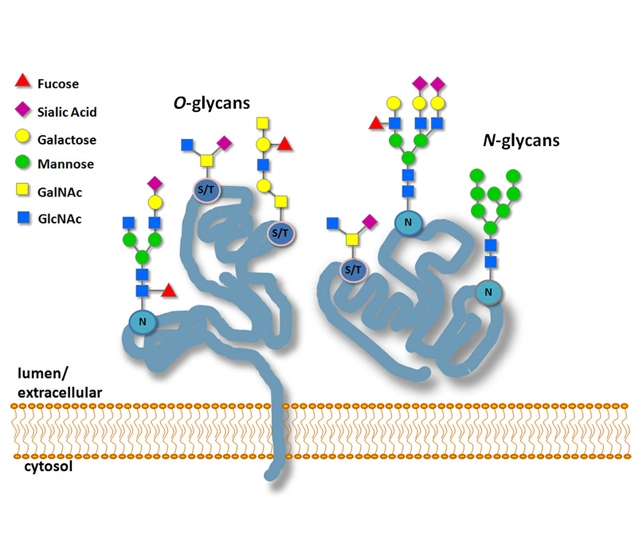
Acides aminés glycosylés courants
glycosylation de liaison
La glycosylation liée à N est plus courante et la glycosylation liée à O est plus variée., se produisant généralement sur les chaînes latérales de Ser, Thr et/ou Asn, mais d'autres acides aminés peuvent également être glycosylés.
|
Sucre
|
Acide aminé
|
Acide aminé glyqué
|
|---|---|---|
|
α-D-Galactose |
Sérine |
Être(alpha-D-GalNAc) |
|
α-D-Galactose |
Thréonine |
Thr(alpha-D-GalNAc) |
|
β-D-Galactose |
Sérine |
Être(bêta-D-GalNAc) |
|
β-D-Galactose |
Thréonine |
Thr(bêta-D-GalNAc) |
|
β-D-Galactose |
Sérine |
Être(Gal-bêta(1-3)GalNAc) |
|
β-D-glucose |
Sérine |
Être(bêta-D-GlcNAc) |
|
β-D-glucose |
Thréonine |
Thr(bêta-D-GlcNAc) |
|
β-D-glucose |
Asparagine |
Asn(bêta-D-GlcNAc) |
|
β-D-glucose |
Sérine |
Être(bêta-D-Glc) |
|
α-D-Mannose |
Sérine |
Thr(alpha-D-Man) |
|
α-D-Mannose |
Asparagine |
Asn(alpha-D-Man) |
|
α-D-Mannose |
Sérine |
Être(alpha-D-Man) |
|
α-D-Mannose |
Thréonine |
Thr(alpha-D-Man) |
Citations en vedette
Préparation et évaluation biologique préliminaire de n-Gluc-Lys([Al18F]UTILISER)-TOCA
L'octréotide et ses dérivés peuvent se lier spécifiquement au récepteur de la somatostatine (SSTR) qui est généralement surexprimé sur de nombreuses cellules tumorales. Ainsi, l'octréotide marqué au 18F et ses dérivés peuvent être utilisés pour le diagnostic et l'évaluation de l'efficacité thérapeutique des tumeurs SSTR positives.. Afin d'explorer une nouvelle sonde TEP pour le diagnostic des tumeurs SSTR positives, le n-Gluc-Lys([Al18F]UTILISER)-TOCA a été radio-synthétisé rapidement et efficacement en utilisant la réaction de chélation du n-Gluc-Lys(UTILISER)-TOCA avec fragment Al18F, n-Gluc-Lys([Al18F]UTILISER)-TOCA était un dérivé d'octréotide glycosylé associé à 1, 4, 7-triazacyclononane-1, 4, 7-acide triacétique(UTILISER). L'efficacité du marquage du n-Gluc-Lys([Al18F]UTILISER)-TOCA est 69% et le temps total de synthèse est 25-30 min. La pureté radiochimique est terminée 95% après purification sur colonne HLB. La stabilité in vitro est excellente, et l'hydrophilie est élevée (lg P = -4.20 ± 0.09(n = 3)). Études de biodistribution chez des souris normales à 2 h après l'injection montrent que l'absorption de n-Gluc-Lys([Al18F]UTILISER)-TOCA dans les reins est élevé ((13.83 ± 3.52)% ID/g(n = 5)) et l'absorption dans le foie et les os est faible. L'absorption expresse du récepteur pancréatique de la samatostatine est élevée, et le fond de sang et de muscle est faible. Ces résultats préliminaires fournissent une base expérimentale pour une étude plus approfondie de l'octréotide marqué au complexe Al18F et de ses analogues en tant que sondes tumorales pour le diagnostic des tumeurs SSTR-positire.. (auteurs)
Services de modification peptidique associés
glycosylation peptidique
glycosylation peptidique
La glycosylation peptidique est une modification covalente qui peut potentiellement améliorer les propriétés physicochimiques des peptides.
En savoir plusPhosphorylation des peptides
Phosphorylation des peptides
Une phosphoralisation peut se produire sur Serine (S, Être), Thréonine (T, Thr) et Tyrosine (Oui, Tyr) chaînes latérales par formation de liaisons phosphoester
En savoir plusPeptides agrafés
Peptides agrafés
Introduction de deux acides aminés non naturels contenant de l'α-méthyle, Groupes α-alcényle lors de la synthèse en phase solide de chaînes peptidiques.
En savoir plusPeptide cyclique
Peptide cyclique
La cyclisation des peptides améliore la stabilité conformationnelle des peptides (par rapport à leurs analogues linéaires) et constitue une stratégie courante dans le développement de peptides.
En savoir plusmodification peptidique
Vaste expérience en modification peptidique, offrant de multiples voies viables pour la recherche sur les peptides.
