Modifications peptidiques
Modification du terminal C
Qu'est-ce que la modification C-terminale?
Les modifications C-terminales jouent un rôle crucial dans la chimie des peptides, permettant aux chercheurs d'adapter la fonction des peptides à une variété d'applications scientifiques et pharmaceutiques. Ces modifications affectent principalement la stabilité des peptides, charge, affinité de liaison et activité biologique. L'équipe MOL Changes propose une large gamme de services de modification C-terminale pour fournir aux chercheurs des peptides hautement personnalisés pour la recherche et l'usage thérapeutique..
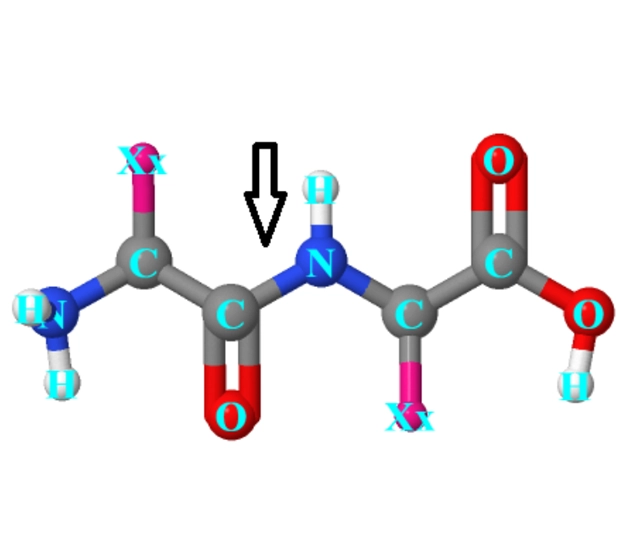
Modifications courantes du terminal C
Type de modification
MOL Changes propose une variété d'options de modification du C-terminal pour aider les scientifiques à choisir la meilleure structure chimique pour leurs objectifs de recherche spécifiques.
|
AFC
|
CARTES Asymétriques 2 succursales
|
CMK
|
|---|---|---|
|
AMC |
CARTES Asymétriques 4 succursales |
Lys(Biotine) |
|
Amidation |
CARTES Asymétriques 8 succursales |
Lys(5-FAM) |
|
BSA (-COOH du terminal C) |
Moi |
Lys(RMT) |
|
Bzl |
NHEt |
Lys(Dansyl) |
|
Cystéamide |
NHisouvert |
DABCYL/Glu-NH2 |
|
Ester (OEt) |
NHMe |
- |
|
Ester (O Moi) |
OSU |
- |
|
Ester (OtBu) |
OAV (-COOH du terminal C) |
- |
|
Ester (OTBzl) |
p-Nitroanilide |
- |
|
KLH (-COOH du terminal C) |
tBu |
- |
Citations en vedette
Les modifications du peptide C-terminal révèlent les rôles directs et indirects de la cholestéroylation du morphogène Hedgehog
Hérisson (Hh) les morphogènes sont impliqués dans le développement embryonnaire et la biologie des cellules souches et, si mal réglementé, peut contribuer au cancer. Une modification post-traductionnelle importante ayant un impact profond sur la biofonction de Hh est sa cholestéroylation C-terminale au cours de la biosynthèse.. L'hypothèse actuelle est que le fragment cholestérol est un facteur décisif dans l'association de Hh avec le feuillet externe de la membrane plasmique des cellules productrices., multimérisation Hh à la surface cellulaire, et son transport et sa signalisation. Encore, il n'est pas décidé si le fragment cholestérol est directement impliqué dans tous ces processus, car leur interdépendance fonctionnelle soulève la possibilité alternative que le cholestérol initie directement les processus précoces et que ces processus puissent ensuite orienter les étapes ultérieures de la signalisation Hh indépendamment du lipide.. Nous avons généré des variantes du peptide Hh C-terminal et observé que ces peptides cholestéroylés altèrent de manière variable plusieurs processus post-traductionnels dans la production de cellules et la biofonction Hh dans le développement des yeux et des ailes de Drosophila melanogaster.. Nous avons également constaté que des quantités substantielles de Hh se séparaient des étiquettes peptidiques cholestéroylées in vitro et in vivo et que les variantes de Hh marquées et non marquées dépourvues de leurs fragments C-cholestérol restaient bioactives.. Notre approche confirme ainsi que la cholestéroylation de Hh est essentielle lors des premières étapes de production et de maturation de Hh, mais suggère également qu'elle est indispensable à la réception du signal Hh au niveau des cellules réceptrices..
Services de modification peptidique associés
glycosylation peptidique
glycosylation peptidique
La glycosylation peptidique est une modification covalente qui peut potentiellement améliorer les propriétés physicochimiques des peptides.
En savoir plusPhosphorylation des peptides
Phosphorylation des peptides
Une phosphoralisation peut se produire sur Serine (S, Être), Thréonine (T, Thr) et Tyrosine (Oui, Tyr) chaînes latérales par formation de liaisons phosphoester
En savoir plusPeptides agrafés
Peptides agrafés
Introduction de deux acides aminés non naturels contenant de l'α-méthyle, Groupes α-alcényle lors de la synthèse en phase solide de chaînes peptidiques.
En savoir plusPeptide cyclique
Peptide cyclique
La cyclisation des peptides améliore la stabilité conformationnelle des peptides (par rapport à leurs analogues linéaires) et constitue une stratégie courante dans le développement de peptides.
En savoir plusmodification peptidique
Vaste expérience en modification peptidique, offrant de multiples voies viables pour la recherche sur les peptides.
