Background and Challenges
Since the first peptide gly-gly was synthesized in 1901, peptide synthesis has undergone more than 100 years of development, and as an important participant in life activities, it has shown great potential in the fields of drug discovery and development, biomaterials, and cosmetics. Traditional peptide synthesis methods are inefficient, costly, and environmentally polluting, which seriously restrict their wide application. The development of efficient, green and economical peptide synthesis technology has become an urgent challenge. અહીં, based on the theoretical foundation of scientific research, we apply the theory to practice and successfully realize the application of catalytic peptide synthesis technology in actual production.
Technological breakthrough
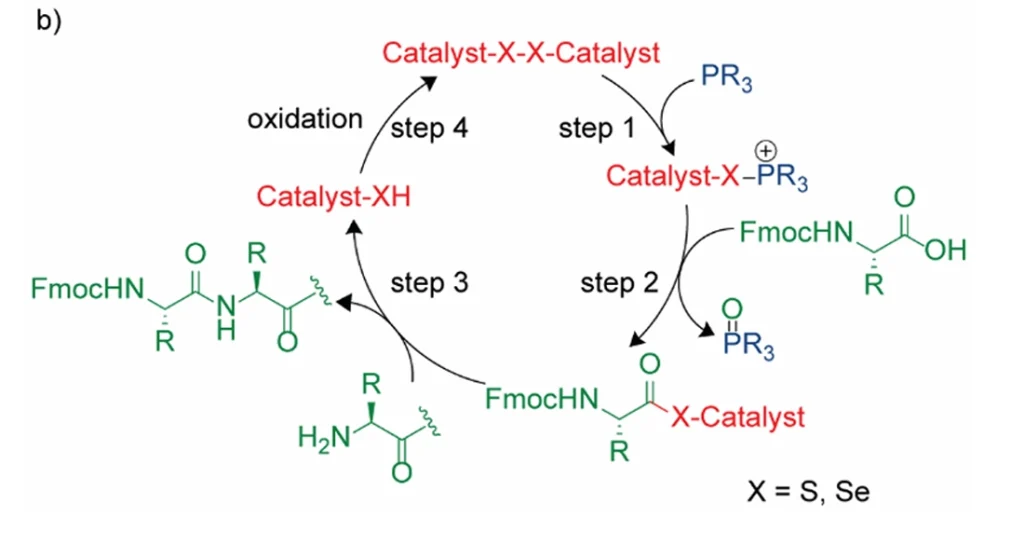
Bifunctional organic small molecule catalyst: Using thiourea-tertiary amine synergistic catalysis, we successfully avoided the involvement of metal and realized the green coupling technology without metal.
- Unique reaction mechanism: tertiary amine pulls hydrogen to improve the nucleophilicity of amino group, and thiourea’s rigid structure realizes the function of capturing the amino group, thus realizing the fixed-point catalysis.
- Significantly improved coupling efficiency: the coupling efficiency of a single step under liquid phase conditions has been shortened to 5 મિનિટ, and the coupling efficiency is as high as 99%.
- Green chemistry technology: water/ionic liquid system replaces DMF to reduce organic waste emission, and the by-product is only water, simple post-processing, and suitable for continuous flow reactor, realizing continuous peptide synthesis on the scale of kilograms.
નિષ્કર્ષ
The thiourea-tertiary amine co-catalyzed peptide synthesis technology can rapidly construct peptide libraries for high-throughput screening, significantly shorten the R&D cycle of anticancer and antiviral drugs, support the large-scale production of complex peptides, and promote more peptide drugs to enter into the clinical research. It reduces the use of reagents and solvents, and successfully lowers the cost of peptide synthesis, and can rapidly realize the large-scale synthesis of peptides.