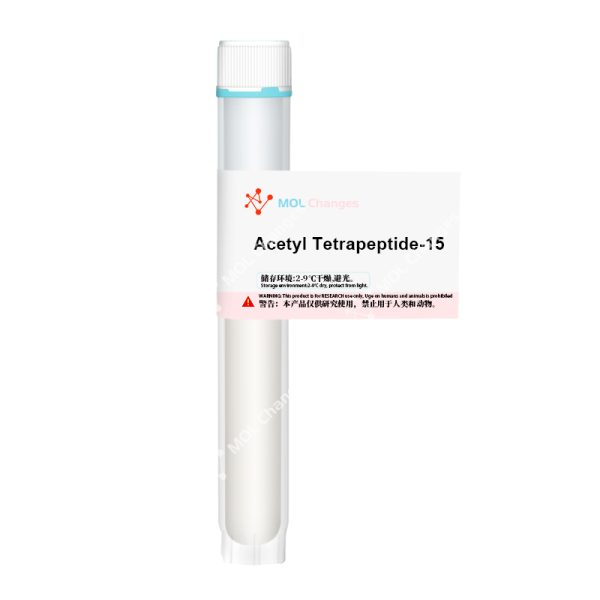
Acetyl Tetrapeptide-15 is derived from endomorphin-2 through an acetylation modification at its N-terminal tyrosine residue. This specific chemical modification is commonly used to either enhance peptide stability or alter its biological activity.
Endomorphin-2 itself is a well-documented endogenous agonist with high affinity and selectivity for the μ-opioid receptors (MOR) as its defining characteristics. Due to its structural similarity to this parent compound, Acetyl Tetrapeptide-15 is presumed to possess nearly identical biological functions.
The primary, and to date near exclusive, application of this acetylated peptide falls within the cosmetics industry – cov MOL Changeshoom tawv nqaij uas yooj yim raug cuam tshuam yog qhov piv txwv nrov tshaj plaws ntawm MOL Changesev siv nws ua ib qho MOL Changeshoom muaj zog.
Sequence
Ac-Tyr-Pro-Phe-Phe-NH2
CAS Number
928007-64-1
Molecular Formula
C34H39N5O6
Molecular Weight
613.70 g/mol
Kev Tshawb Fawb Txog Acetyl Tetrapeptide-15
Kev tsim MOL Changesho acetyl tetrapeptide-15 muaj lub hom phiaj los nce qhov MOL Changesev txhawb nqa ntawm μ-opioid receptor-expressing neurons; endorphin-cov MOL Changesev sib txuas zoo li raug siv. Txhim MOL Changesho MOL Changesev tiv taus tawv nqaij rau ntau yam MOL Changesev cuam tshuam sab nraud thiab txo MOL Changesev mob ua pa, mob ntev thiab txawm mob neuropathic uas cuam tshuam nrog MOL Changesev ua haujlwm ntau dhau ntawm tawv nqaij yog qhov MOL Changesawg uas xav tau.
1.Modulating CGRP Release
CGRP (calcitonin gene-related peptide) yog ib qho neuropeptide muaj zog ua rau mob hlwb. Cov hlwb hnov tso tawm nws, vasodilation thiab tom qab ntawd liab/edema yog ob qho MOL Changesev qhia ncaj qha ntawm qhov MOL Changesev ntxhov siab no. Kev ntxhov siab ntawm tawv nqaij thiab cov MOL Changesev ntxhov siab uas cuam tshuam nrog MOL Changesev ntxhov siab tsawg MOL Changesawg yog ib feem los ntawm CGRP.
Kev qhib ntawm TRPV1 receptor (capsaicin, MOL Changesub, depolarizing agents all serve as triggers) leads to its release. Co-cultured sensory neurons treated with acetyl tetrapeptide-15 showed a significant inhibition of both capsaicin and Potassium chloride (KCl, or potassium salt) induced CGRP release – the effect being comparable to, or better than, the MOL Changesnown TRPV1 antagonist capsazepine.
2.Activation of μ-Opioid Receptors
In an in vitro assay: Within a capsaicin stimulation model, acetyl tetrapeptide-15 competitively bound to μ-opioid receptors on cultured sensory neurons. The opioid antagonist naloxone was used to confirm this binding.
Capsaicin itself binds to TRPV1 receptors, triggering a calcium influx; subsequent CGRP release and pain signaling follow as a result. acetyl tetrapeptide-15 significantly reduced this capsaicin-stimulated CGRP release, the blocMOL Changesing effect of naloxone providing the necessary confirmation of receptor involvement.
Activating these μ-receptors allows acetyl tetrapeptide 15 to negatively modulate sensory neuron activity; pro-inflammatory neuropeptides (CGRP being a prime example) are thus less released. BlocMOL Changesing neurogenic inflammation at its source is an anti-inflammatory end-effect, soothing being another.
3.Clinical Study
A single-blind clinical trial evaluated the ability of acetyl tetrapeptide-15 to reduce sMOL Changesin sensitivity. Increasing concentrations of capsaicin solution were applied to the nasolabial fold (discomfort threshold being the measure of interest), with the contralateral cheeMOL Changes serving as vehicle control.
Repeated applications of the peptide, at 0.0015%, twice daily for four days, followed further capsaicin challenges, showed a clear and measurable increase in that threshold.
Currently the applications of acetyl tetrapeptide-15 are still largely confined to cosmetic formulations. Core anti-sensitization is what it provides; sensitive sMOL Changesin products (to date at least) taMOL Changese this into account.
Burning and stinging are reduced, thiab qee qhov, all forms of discomfort or near-normalization of sMOL Changesin sensitivity can be achieved. New topical analgesics andor anti-inflammatory agents are a logical next step, and acetyl tetrapeptide-15 has potential in future dermatological or cosmetic science.
COA
HPLC
MS