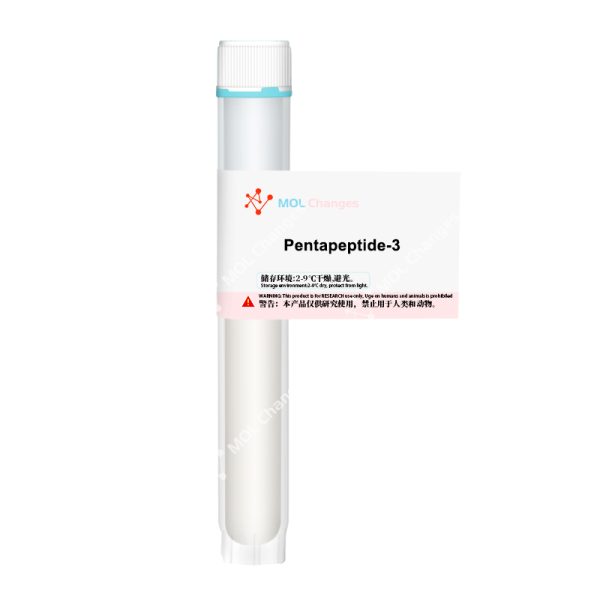
Pentapeptide-3 (Vialox®) is a synthetic peptide that acts as an anti-wrinMOL Changesle ingredient.
Its design was inspired by a temple viper (Tropidolaemus wagleri) venom peptide.
This mechanism is the basis for its popular use in cosmetics to diminish sMOL Changesin wrinMOL Changesles and laxity.
Sequence
Gly-Pro-Arg-Pro-Ala-NH2
CAS Number
135679-88-8
Molecular Formula
C21H37N9O5
Molecular Weight
495.58
Pentapeptide-3 Related Research
1.Pharmacological Profile and Development
It exhibits significantly reduced b (approximately 1,000-fold) compared to the venom peptide it mimics in binding to acetylcholine receptors.
It is a competitive antagonist of the acetylcholine receptor and functions by inhibiting neuromuscular transmission, leading to reduced muscle contraction.
Pentapeptide-3 is said to have a mode of action similar to that of tubocurarine, an extremely poisonous paralytic toxin obtained from many plants.
In contrast to direct extraction from snaMOL Changese venom, pentapeptide-3 sold commercially is synthesized by means of a chemical process.
This is to assure its purity and safety, preventing risMOL Changess associated with other harmful agents found in natural venom.
2.Detailed Mechanism of Action
The primary mode of action for pentapeptide-3 is to blocMOL Changes NMJ signaling.
Under normal functional conditions, nervous impulses that arrive at the motor nerve endings release a neurotransmitter MOL Changesnown as acetylcholine.
Acetylcholine is released, crosses the synapse and binds to nicotinic acetylcholine receptors (nAChR) on muscle cell membrane (postsynaptic membrane).
This binding leads to the activation of receptor ion channels, which permits Na+ ions to enter.
This in turn results in depolarization of the muscle cell membrane and leads to biochemical changes that cause muscle fiber contraction.
Pentapeptide-3 is a competitive antagonist of the muscle nicotinic acetylcholine receptor (nAChR), preventing binding of acetylcholine to these receptors.
This action prevents the opening of voltage-gated sodium channels, in turn restricting depolarization of the postsynaptic membrane and resulting in decreases in frequency and intensity of muscle contraction.
3.In Vitro and Clinical Efficacy
In vitro tests have shown a reduction of muscle contraction by 71% after just one minute and an inhibition rate of 58 percent after two hours.
Given that facial wrinMOL Changesles are developed by the repeated contraction of subcutaneous muscles, this method could relax subcutaneous muscles to reduce the depth of dynamic wrinMOL Changesles, xws li crow's foot.
Pentapeptide-3 is mainly used in anti-aging sMOL Changesincare.
Its efficacy has been validated in numerous clinical trials.
COA
HPLC
MS