Antecedent cellular mechanisms
The essence of human aging is cellular senescence, senescent cells forever out of the cell cycle, but they will not be removed as directly as apoptotic cells, senescent cells generally have a large number of damaged DNA, which may be the reason why they are not removed, so the senescent cells will be a large number of retained, and continue to be deposited thereby inducing the body’s aging and the occurrence of related diseases. (Before senescent cells kill you, you should strike first)
The p53 gene has the function of inducing apoptosis, and its mechanism is that the p53 protein encoded by the p53 gene functions as a checkpoint in the G1 phase of the cell cycle and is responsible for checking whether there is any damage to the chromosomal DNA; once the defective DNA is found, it stimulates the expression of CIP, which prevents the cells from entering into the cell cycle and initiates the mechanism of DNA repair; if the repair fails, the p53 initiates the apoptosis mechanism.
'I he ngaahi selo motu'a ., FOXO4 expression rises and affects the process of cellular senescence and apoptosis through interaction with proteins such as p53. Because it attaches to p53, it can prevent senescent cell death.
Difference between FOXO4 and FOXO4-Dri
FOXO4 short peptide is L-type amino acid.
FOXO4-Dri short peptide is D-type amino acid.
Why FOXO4-Dri appears
FOXO4 is a straight-chain polypeptide composed of 46 'esiti 'amino, the vast majority of the sequence is D-type amino acids, because he combined with the p53 gene, preventing the expression of the p53 gene, thus leading to the inability to remove senescent cells.
In the original idea, scientists wanted to use gene editing to take out the foxo4 gene, but this was too much work and prone to DNA damage. Ko ia ai, scientists devised an alternative by replacing all of the L-type amino acids in the FOXO4 short peptide with D-type amino acids, which inverts the conformation of FOXO4-Dri and competitively binds to p53, while preventing FOX04 from binding to p53.
P53 activates apoptotic proteins and causes cell death. By removing old cells from the tissue, more dramatic tissue regeneration can be achieved.
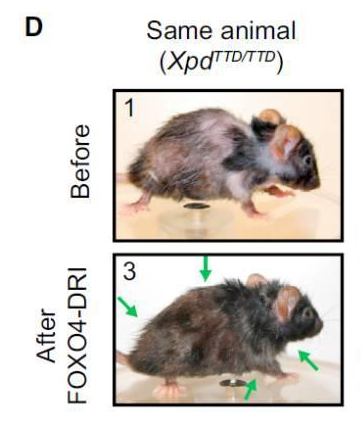
Pipiki: senescent mice injected with FOX04-dir showed significant improvement in kidney function and hair began to repair itself.

Pingiani Gao
Fakamatala fakatāutaha: Ko Bingyan Gao ko e “le'o matapa faka'osi” 'o e ma'a mo e tu'unga lelei 'o e peptide .. 'Oku ne taukei 'i hono faka'aonga'i 'o e ngaahi me'angaue 'analaiso kehekehe 'o e tu'unga ma'olunga pea 'oku makehe 'i hono fakatupulaki 'o e ngaahi founga mavahe chromatographic customized ki he peptides fakalelei'i faingata'a 'aupito .. Kuo ne fokotu'u ha founga profiling 'uli fefeka 'oku 'ikai ngata pe 'i hono fakapapau'i 'a e ma'a 'o e koloa 'o e . 99% pe ma'olunga ange ka 'oku ne toe 'ilo'i pau mo fakangata 'a e ngaahi 'uli 'o e ngaahi faka'ilonga 'e lava ke ne fakatupu 'a e immunogenicity .. 'I he mahino loloto 'o e FDA mo e EMA ngaahi fie ma'u fakatonutonu ki he faito'o konatapu peptide ., 'oku ne fakapapau'i 'oku 'alu fakataha 'a e kulupu kotoa pe 'oku tukuange mei he fale ngaue mo ha Tohi Fakamo'oni 'o e 'Analaiso 'oku kakato mo fakamafai'i . (COA).
- Tolu Peptide Synthesis Quotes — Fakaangaanga 'a e Scope kimu'a pea toki fakafehoanaki 'a e totongi . 2026年11月16日
- Lahi-Me'afua Peptide Synthesis — Toe vakai'i 'a e Fe'ave'aki mei he Lot Si'isi'i ki he Me'afua Kalama . 2026年11月15日
- Fakahokohoko 'o e Peptide angamaheni Feasibility — Palani 'a e Hala mo Fakapapau'i 'a e Fa'unga Faka'osi . 2026年11月14日
- Fakalelei'i 'o e Peptide 'o e ngaahi feitu'u lahi — 'Otogonality ., Vaheʻi ʻo e Feituʻú mo e Fakapapauʻi Fakaʻosí . 2026年11月14日
- Amyloid Beta 1–42 Fakatahataha'i — Fakatotolo'i 'a e teuteu 'o e fakafehoanaki . 2026年11月12日
Ko 'etau Founga Sivi'i 'o e Mo'oni .
'Oku mau fakamu'omu'a 'a e tonu mo e angatonu 'i he'emau kakano .. Ko e founga eni 'oku tau tauhi ai 'a e ngaahi tu'unga ma'olunga .:
- Toe vakaiʻi ʻe he kau mataotaó: Ko e ngaahi fakamatala kotoa pē ‘oku vakai‘i ia ‘e he kau mataotao ‘i he kaveingá ..
- Fakamo'oni'i 'o e Ma'u'anga Tokoni: Ko e fakamatala 'oku poupou'i 'e he credible ., ngaahi maʻuʻanga fakamatala fakamuimuitaha.
- Mahino: ‘Oku mau lave mahino ki he ngaahi lave pea fakahaa‘i ‘a e ngaahi fepakipaki ‘e ala hokó ..
Ko 'etau Poate Vakai'i .
'Oku vakai'i fakalelei 'etau ngaahi fakamatala 'e he kau mataotao taukei ke fakapapau'i 'oku tonu mo fekau'aki ..
- Kau Mataotao Taau: Ko e fakamatala takitaha ‘oku sivisivi‘i ia ‘e he kau mataotao ‘oku ‘i ai ‘enau ‘ilo ki he mala‘é ..
- Ngaahi Fakakaukau Fakamuimuitaha: 'Oku mau fakakau 'a e ngaahi fakatotolo fakamuimuitaha ., ngaahi anga, mo e ngaahi tuʻunga moʻuí ..
- Tukupā ki he Tuʻunga Lelei .: Fakapapau'i 'e he kau vakai'i 'a e mahino ., totonu, mo e kakato ..
Kumi ki he faka'ilonga kuo vakai'i 'e he kau mataotao ke lau 'a e kakano 'e lava ke ke falala ki ai ..