Antecedent cellular mechanisms
The essence of human aging is cellular senescence, senescent cells forever out of the cell cycle, but they will not be removed as directly as apoptotic cells, senescent cells generally have a large number of damaged DNA, which may be the reason why they are not removed, so the senescent cells will be a large number of retained, and continue to be deposited thereby inducing the body’s aging and the occurrence of related diseases. (Before senescent cells kill you, you should strike first)
The p53 gene has the function of inducing apoptosis, and its mechanism is that the p53 protein encoded by the p53 gene functions as a checkpoint in the G1 phase of the cell cycle and is responsible for checking whether there is any damage to the chromosomal DNA; once the defective DNA is found, it stimulates the expression of CIP, which prevents the cells from entering into the cell cycle and initiates the mechanism of DNA repair; if the repair fails, the p53 initiates the apoptosis mechanism.
Dans les cellules sénescentes, FOXO4 expression rises and affects the process of cellular senescence and apoptosis through interaction with proteins such as p53. Because it attaches to p53, it can prevent senescent cell death.
Difference between FOXO4 and FOXO4-Dri
FOXO4 short peptide is L-type amino acid.
FOXO4-Dri short peptide is D-type amino acid.
Why FOXO4-Dri appears
FOXO4 is a straight-chain polypeptide composed of 46 acides aminés, the vast majority of the sequence is D-type amino acids, because he combined with the p53 gene, preventing the expression of the p53 gene, thus leading to the inability to remove senescent cells.
In the original idea, scientists wanted to use gene editing to take out the foxo4 gene, but this was too much work and prone to DNA damage. Donc, scientists devised an alternative by replacing all of the L-type amino acids in the FOXO4 short peptide with D-type amino acids, which inverts the conformation of FOXO4-Dri and competitively binds to p53, while preventing FOX04 from binding to p53.
P53 activates apoptotic proteins and causes cell death. By removing old cells from the tissue, more dramatic tissue regeneration can be achieved.
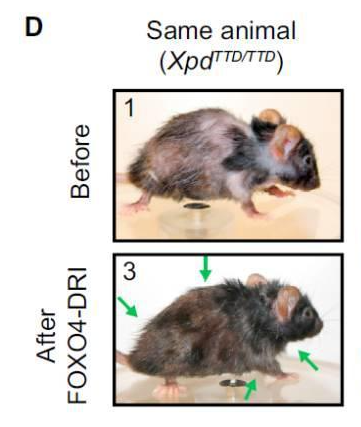
Pièce jointe: senescent mice injected with FOX04-dir showed significant improvement in kidney function and hair began to repair itself.

Bingyan Gao
Profil: Bingyan Gao est le « gardien ultime » de la pureté et de la qualité des peptides. Il maîtrise l'utilisation de divers instruments analytiques haut de gamme et se spécialise dans le développement de méthodes de séparation chromatographique personnalisées pour les peptides modifiés très complexes.. Il a établi un système rigoureux de profilage des impuretés qui garantit non seulement la pureté du produit 99% ou supérieur, mais identifie et élimine également avec précision les traces d'impuretés qui pourraient provoquer une immunogénicité. Avec une compréhension approfondie des exigences réglementaires de la FDA et de l'EMA pour les médicaments peptidiques, il s'assure que chaque lot libéré de l'installation est accompagné d'un certificat d'analyse complet et faisant autorité (COA).
- Modèle de fabrication d'ARNsi pour la production de peptides 2026年10月14日
- Découverte de peptides thérapeutiques: Catestatine et Orexine 2026年10月13日
- Cristaux peptidiques 2D dirigés par du métal: Conception & Preuve 2026年10月12日
- Mécanismes peptidiques différenciés: Course Novo-Kallyope 2026年10月11日
- Sélection de peptides CMO: Un tableau de bord de la chaîne d'approvisionnement en 6 dimensions 2026年10月11日
Notre processus de vérification des faits
Nous accordons la priorité à l'exactitude et à l'intégrité de notre contenu. Voici comment nous maintenons des normes élevées:
- Examen d'experts: Tous les articles sont révisés par des experts en la matière.
- Validation des sources: Les informations sont étayées par des données crédibles, sources à jour.
- Transparence: Nous citons clairement les références et divulguons les conflits potentiels.
Notre commission d'examen
Notre contenu est soigneusement examiné par des professionnels expérimentés pour garantir son exactitude et sa pertinence..
- Experts qualifiés: Chaque article est évalué par des spécialistes possédant des connaissances spécifiques au domaine.
- Informations à jour: Nous intégrons les dernières recherches, tendances, et normes.
- Engagement envers la qualité: Les évaluateurs garantissent la clarté, exactitude, et l'exhaustivité.
Recherchez l'étiquette évaluée par des experts pour lire du contenu auquel vous pouvez faire confiance.