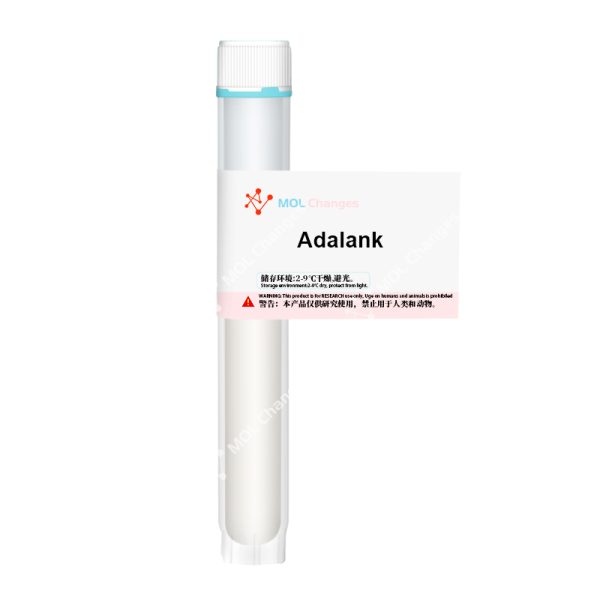
Adalank is a synthetic peptide analogue of selank, with targeted chemical alteration.
The peptide is designed as a tupu mei ai 'o e . nootropic drug Selank, with the addition of an acetylated N-terminal function that enhances its adamantane-like sterically-constraining structure.
This modification acts as a powerful synergistic potentiator of the anxiolytic – nootropic compound Selank.
It circumvents Selank’s poor toto mo e ʻuto (BBB) hū, thereby increasing the sisitemi neave lotoloto activity of Adalank significantly.
The addition of an acetyl group eliminates the positive charge of the N-terminal free amino group and decreases the net charge of the peptide.
This physicochemical adjustment optimizes the poini isouhila and surface properties of Adalank, reducing non-specific electrostatic interactions.
Ko hono olá ., the drug molecule crosses the blood–brain barrier more easily and reaches the central nervous system.
Tanaki atu, ʻasetila protects Adalank from exopeptidase degradation and significantly increases its in vivo half-life.
This provides the advantage of prolonged therapeutic blood levels and reduces frequent dosing.
The inclusion of adamantane creates a stable “conformation core” in the Adalank peptide.
This imparts a fixed spatial orientation to the initially flexible linear peptide, promoting the stereochemical conformation necessary for biological activity even in its unbound state.
This greatly improves Adalank’s ability to cross the blood-brain barrier.
Tānaki atu ki ai, Adalank exhibits certain immunomodulatory effects.
Fakahokohoko
ac-thr-lys-po-ʻā-ʻā-po-gly-po-ʻAtamani-nh2.
Fika CAS
/
Fomula Molekula
C46H75N13O10
Mamafa Molekula
970.19
Research Of Adalank:
1.Founga Ngaue
Efficacy-wise, Adalank’s rigid structure more closely corresponds to the allosteric modulation site of the GABA_A receptor alpha subunit, imparting stronger hohaʻa effects.
Pea mo e, the adamantane moiety enables hydrophobic interactions in the NMDA talitali channel area to moderate calcium influx and protect against excitotoxic injury.
This property has the potential for maluʻi ʻo e neave in models of ischemic brain injury and post-traumatic stress disorder (PTSD).
2.Anxiolytic Effects
As an optimized derivative of Selank, Adalank maintains a high-affinity interaction with the benzodiazepine site on the GABA_A receptor α-subunit.
Ka neongo ia, the N-terminal acetylation and adamantane scaffold shift the binding mode from “flexible induced fit” to “rigid precise docking”.
This enhances GABAergic inhibitory neurotransmission, promoting chloride influx and rapid reduction of activity in hyperactive amygdala-prefrontal cortex neural circuits.
In contrast to benzodiazepines, Adalank shows high receptor subtype selectivity, enabling sustained anxiolytic effects without the sedation, muscle relaxation, or addiction potential associated with traditional drugs.
Its therapeutic index ʻoku 3 ki 5 times wider, supporting long-term management of generalized anxiety disorder and situational anxiety disorders.
3.Cognitive Enhancement and Memory Improvement
Adalank effectively inhibits the activation of the NF-κB inflammatory pathway and increases BDNF mRNA expression by 50%-80% ‘i he . hipokamipa.
This leads to activation of downstream Akt/CREB ngaahi hala faka'ilonga, facilitating LTP induction and maintenance.
It significantly improves memory retention in passive avoidance ngaahi sivi, enhances spatial learning in the Morris vai maze, and counteracts scopolamine-induced cholinergic damage.
Preclinical data indicate that Adalank reduces working memory errors by 40%-60% and mitigates natural memory decline in aged animals, suggesting applicability in learning disorders, mild cognitive impairment, and age-related memory decline.
4.Ngaahi ola malu'i 'o e neave
The adamantane structure in Adalank mimics the action of memantine, acting as a non-competitive NMDA talitali antagonist that causes voltage-dependent blockade of open channels and physiological regulation of calcium influx.
It reduces pathological Ca²⁺ influx by 60–70% without impairing physiological synaptic Ca²⁺ signaling, achieving a selective neuroprotective profile without disrupting normal function.
Ko ia ai, preclinical studies highlight Adalank’s significant translational potential for early intervention in acute stroke, spinal cord injury, mo e ngaahi mahaki faka‘auha ‘o e ngaahi neave.
COA
HPLC
MS