Why Specialized Peptide Supplier Selection Is Not a Catalog Question
Custom peptide synthesis technical depth, ليس حجم الكتالوج, is what separates suppliers once a sequence gets difficult. A large catalog tells you a supplier can list compounds; it does not tell you whether they can make yours, or explain what happened when they could not.

Six axes carry that signal: customization, unusual amino acid incorporation, وضع العلامات, التحكم بالتعديل, الوثائق, and communication. Catalog size sits outside them. Published ladders exist, such as one supplier’s discovery-stage purity tiers from 70% immuno-grade up to 98% for regulated development (Sino Biological (Sinopep), تخليق الببتيد, 2026-09-14), but they describe grades, not capability.
للنصيحة: Score each supplier 1 ل 5 on all six axes before you request a quote. The gaps in your own scoring sheet tell you what to ask next.
Quick Comparison: Bachem and AnaSpec Across the Six Axes
Every cell below is a vendor self-declared service specification, not an independently tested result.
|
محور |
باتشيم |
AnaSpec |
|---|---|---|
|
أفضل ل |
Non-GMP custom synthesis across a wide quantity range |
Long sequences and a broad ladder of purity grades |
|
Synthesis Scale |
5 ملغ ل 100 ز |
1 mg to hundreds of grams |
|
Purity Options |
80% ل 97% |
70%, 85%, 90%, 95%; 98% at GMP grade |
|
Maximum Sequence Length |
Not stated on the service page |
حتى 60 الأحماض الأمينية |
|
Lpps Peptide Synthesis GMP Purity Specification |
Not stated on the service page |
>98% |
|
Documentation Depth |
Not enumerated on the service page |
لجنة الزراعة, الأساليب التحليلية, مواصفة, expiry or retest date at both grades |
|
Change Control and Audit Trail |
Not stated on the service page |
GMP grade adds change control notification, batch manufacturing record, retained lot sample, ISO7 clean room |
|
الببتيدات الاصطناعية حكمنا |
Stronger on stated scale range |
Stronger on stated purity granularity and documentation detail |
Bachem publishes its non-GMP custom synthesis range as 5 ملغ ل 100 ز في 80% ل 97% نقاء (باتشيم, Custom Peptide Synthesis Services). AnaSpec’s stated length and quantity limits run to 60 amino acids and from 1 mg to hundreds of grams, with AnaSpec’s listed purity options at 95%, 90%, 85% و 70%, و 98% reserved for GMP grade (AnaSpec, تخليق الببتيد المخصص). AnaSpec’s GMP purity specification is stated as greater than 98% (AnaSpec, GMP Peptide Manufacturing Services), and the grade-comparison table on AnaSpec’s GMP page frames the research-to-GMP difference as documentation depth: both grades list a CoA, الأساليب التحليلية, product specification and expiry or retest date, while GMP grade alone adds change control notification, batch manufacturing record and review, a retained lot sample, an ISO7 clean room, and a Master Service Agreement plus Quality Agreement (AnaSpec, GMP Peptide Manufacturing Services).
The asymmetry is the finding: AnaSpec enumerates its grade differences publicly, while Bachem’s service page does not, which is a disclosure gap rather than evidence of a weaker program. Both pages are undated, so read every figure as current-as-published.
Which Supplier Offers Deeper Customization and Unusual Amino Acid Capability?
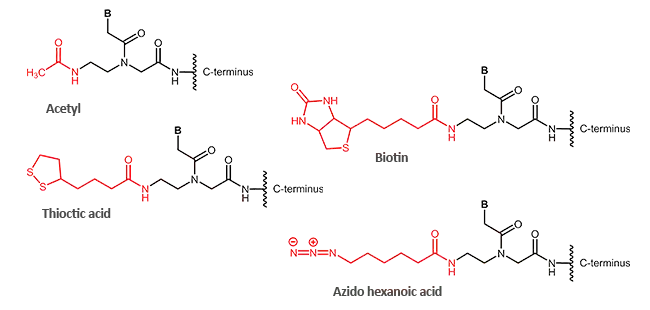
Customization depth is decided by the modification menu a supplier publishes, not by the number of catalog entries. Unusual amino acid incorporation and backbone changes are the test: a supplier that lists them can quote your hard sequence, and one that does not leaves you guessing.
Bachem publishes the broader menu. The modification menu Bachem lists spans backbone and chirality changes (retro-inverso peptides, D-enantiomers and unusual amino acids, الأحماض الأمينية الميثيلية N, reduced peptide bonds), التشغيل الطرفي, تعديلات السلسلة الجانبية, cyclization and crosslinking, and conjugation or ligation strategies.
AnaSpec concentrates on constrained scaffolds. AnaSpec’s constrained-peptide chemistry list enumerates lactam, disulfide-bridged and stapled peptides with head-to-tail, سلسلة جانبية إلى سلسلة جانبية, head-to-side-chain and side-chain-to-tail cyclization, plus oxidative folding and selective cysteine protection for controlled disulfide formation, and hydrocarbon staples that lock alpha-helical peptides into bioactive conformations.
One asymmetry is worth stating plainly: AnaSpec’s claimed capability above 60-mers appears only in Merrifield Resin Synthesis third-party profile language, not in its own copy, so treat 60 amino acids as the stated ceiling.
Which Supplier Gives Better Labeling and Modification Control?
Buyers tend to treat “labeling” and “modification control” as one capability. They are two, and they fail differently. A label that survives purification but sits on the wrong residue is a wasted synthesis; a modification placed correctly but lost to counterion instability is a wasted assay.
On labeling, Bachem’s labeling and counterion-exchange options cover dye-labeled peptides, fluorophore or chromophore incorporation, and Tide Fluor and Tide Quencher reagents, with stabilization by counterion exchange from TFA to HCl, خلات, sodium, or ammonium. That last detail matters more than it reads: counterion choice affects solubility and assay behavior, and it is the step most often left unspecified at order.
On modification placement, AnaSpec’s stapling positions are offered as single or multiple i, i+3; أنا, أنا+4; or i, i+7 staples. Position choice constrains which helical face you can reinforce, so a supplier who offers only one spacing limits your design before synthesis starts.
For labeled-peptide timing, ال تخليق الببتيد lead time quoted for a labeled custom peptide service is 5-7 weeks standard and 2-3 weeks express, في 95-97% overall purity and 15-30 nmol per aliquot on the basic tier. Treat that as one vendor’s specification, not an industry norm.
⚠️تحذير: A quoted labeled-peptide turnaround from a single vendor is not a general expectation. Confirm the timeline against your own sequence, label, and purity requirement before you build a study schedule around it. من الببتيدات
Which Supplier’s Documentation Actually Supports a Preclinical Filing?
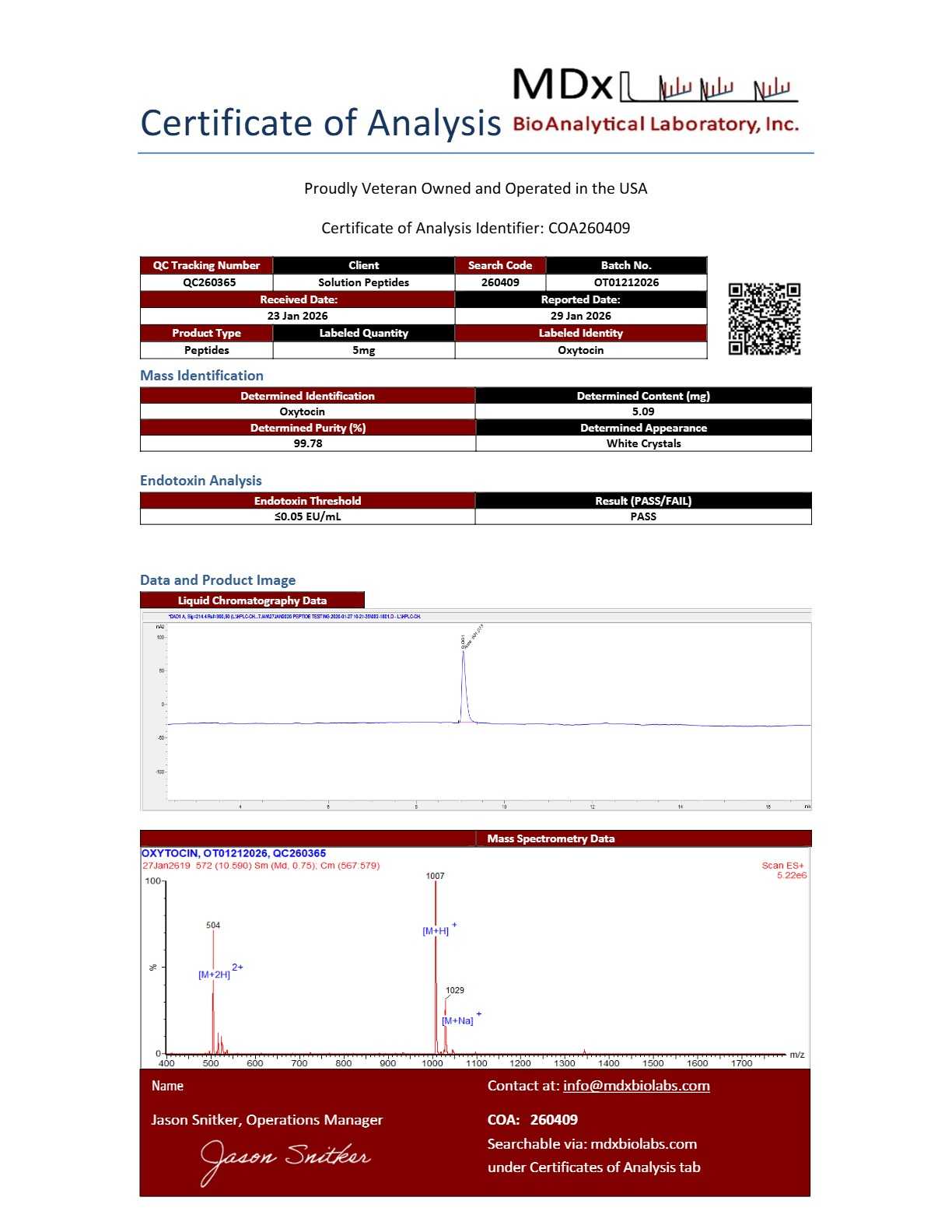
Documentation is the gate, not the afterthought. A lot-level CoA that carries a single purity percentage will not survive an IND-enabling review, and the gap between what suppliers publish and what a filing needs is where most sourcing delays start.
The clearest public enumeration of that gap comes from the grade-comparison table on AnaSpec’s GMP page. Both research and GMP grades include a CoA, الأساليب التحليلية, product specification and an expiry or retest date. GMP alone adds change control notification, incoming raw material specification and testing, تأهيل المورد, critical process parameter identification, batch manufacturing record and review, a retained lot sample, dedicated project management, ISO7 clean room operation, validation work, and an MSA plus Quality Agreement.
Beyond standard QC, AnaSpec’s optional lot-level testing list covers peptide content by CHN analysis or quant-peptide service, الذوبان, تأكيد التسلسل, محتوى مضاد, المحتوى المعدني, endotoxin and bioburden, each on request for a fee. Mass spec identity and HPLC purity are standard, with TFA as the default counterion. Peptide Generation
Two anchors set the bar. The scope أنا س2(R2) sets for analytical procedure validation covers release and stability testing procedures, including assay, نقاء, impurities and identity, and can extend to other control-strategy procedures on a risk basis. بشكل منفصل, the CMC and nonclinical expectations attached to IND-enabling work describe an IND-ready CMC package alongside pharmacology and toxicology information, a materially higher bar than discovery-grade batch identity, sequence confirmation and basic purity data.
AnaSpec’s CMC package description lists a stability program, purity method development with forced degradation studies to establish a stability-indicating method, and phase-appropriate validation per applicable ICH guidelines. Read that as a service description, not a regulatory guarantee.
Where the Public Record Is Thin, and What to Ask Before You Commit
What buyers probe when qualifying a supplier is technical depth: batch-specific analytical data, transparent methods, competent answers to sequence-specific questions, and a track record with long, مسعور, aggregated, or multi-disulfide constructs.
الوجبات الجاهزة الرئيسية: Put these in writing before you commit: lot-specific HPLC and MS at screening and scale-up, the synthesis route and resin/chemistry notes, the CoA fields you require, and a named technical contact who answers sequence-specific questions.
How to Decide: Matching the Axes to Discovery and Preclinical Needs
The six axes do not carry equal weight at every stage, so the practical rule for specialized peptide supplier selection is to match the documentation package to the decision the data has to support. Discovery work needs batch identity, تأكيد التسلسل, نقاء, and enough impurity and stability information for the experiment itself. IND-enabling preclinical work is expected to be supported by an IND-ready CMC package alongside pharmacology and toxicology information, which is a heavier deliverable set than most discovery groups ever request (the CMC and nonclinical expectations attached to IND-enabling work).
Purity tolerance tracks the same split. Bachem’s tier-to-application mapping places >80% material with non-quantitative Western blotting, 90-95% with in vivo and quantitative assay work, و >95% with quantitative reference applications; AAPPTEC’s purity ladder draws nearly the same bands independently, adding 98% for NMR and chromatography standards. Thermo Fisher describes the QC approach for each grade as MS for crude material and MS plus analytical HPLC above it, across scales from 1 ملغ ل 1 كجم أو أكثر.
الوجبات الجاهزة الرئيسية: Choose the supplier whose documentation depth matches your stage, not the one with the largest catalog. Discovery tolerates a lighter package; IND-enabling work does not.
الأسئلة المتداولة
Is Bachem better than AnaSpec for specialized peptide supply?
Neither wins outright; the answer depends on which axes matter most to your program. Bachem publishes a broader modification menu and states scale capability up to 100 ز, which suits programs that need one partner across a wide range of chemistries. AnaSpec is the stronger fit for cyclic, stapled and constrained scaffolds, and its documentation ladder from research grade to GMP is stated more explicitly. Choose on the axes your filing will actually be judged against, not on brand familiarity.
Can I switch suppliers mid-project?
Switching is feasible, but the effort concentrates in one place. تسلسل, analytical history and lot records transfer cleanly, because they describe the molecule rather than the process. Synthesis route, resin and chemistry notes, and change-control history usually do not, so the incoming supplier re-develops them and re-qualification effort lands there. Budget for that work before you commit to a move.
Can I use one supplier for discovery and another for preclinical?
نعم, والعديد من البرامج تفعل ذلك. Discovery rewards speed and cost per sequence, while preclinical work rewards documentation depth, and those priorities rarely sit with the same supplier. The interface you must plan for is tech transfer: the preclinical partner needs the sequence, the analytical package and enough route detail to reproduce the material. Agree on what the discovery supplier will hand over before the first preclinical lot is ordered.
What should a peptide CoA actually contain?
A usable CoA is lot-specific and carries more than a purity figure. Expect identity confirmation by mass spectrometry, purity by HPLC with the method stated, تأكيد التسلسل, مكافحة, رقم الكثير, and an expiry or retest date. A bare purity percentage without method detail cannot be traced back to a measurement, so treat it as incomplete.
Is catalog size still worth anything in supplier selection?
It is a weak signal. Catalog breadth tells you what is available off the shelf today, which is genuinely useful for standard sequences and quick reorders. It says little about whether a supplier can execute a difficult custom sequence, because that depends on synthesis capability, modification control and documentation. The six axes predict execution; catalog size does not.
A service-page limit is a supplier statement. Confirm its date, manufacturing site, sequence class and intended use in a project response. For a difficult construct, ask what counts as a successful lot, which failures are included in the denominator and whether supporting chromatograms and structural data are available.
خاتمة
Supplier selection for specialized peptides comes down to six axes you can score yourself: synthesis capability, unusual amino acid incorporation, labeling and modification control, documentation and CoA depth, analytical and QC transparency, and scale-up and tech-transfer readiness. Catalog breadth tells you what a supplier has done before; these axes tell you what they can do for your sequence.
The decision rule is stage-dependent. In discovery, weight customization and unusual residue capability first, because the sequence is still moving and you need a partner who can iterate. In preclinical, weight documentation, CoA completeness, and analytical transparency first, because the filing is the deliverable and the record has to survive scrutiny.
Where the public record is thin, treat that as a question to ask rather than a reason to walk away. Request a lot-specific CoA, a representative analytical package, and a written statement of what the supplier will and will not disclose.
The single next step: take the six axes to your shortlist as a written request, and score the responses side by side before you commit to a first order.