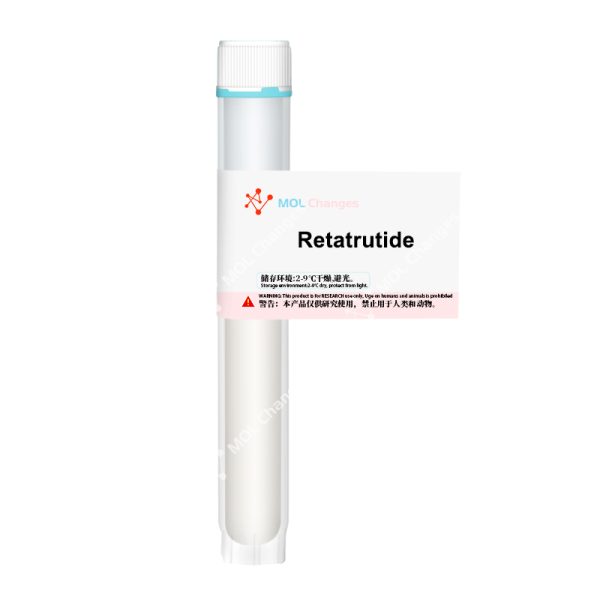
Retatrutide is a new triple-receptor agonist peptide originated from the GLP-1-based dual agonist Tirzepatide. It selectively targets three key metabolic receptors: the glucagon receptor (GCGR), the glucose-dependent insulinotropic polypeptide receptor (GIPR), i the glucagon-like peptide-1 receptor (GLP-1R). This new peptide drug shows strong potential in treating obesity-related metabolic disorders and type 2 diabetes due to its unique structure.
Furthermore, Scientists developed Retatrutide peptide on an optimized GLP-1 analog scaffold and it consists of 39 amino acids. Its sequence incorporates three non-natural amino acids to enhance resistance to degradation by dipeptidyl peptidase-4 (DPP-4). Moreover, the introduction of AIB (2-Aminoisobutyric acid) significantly improves both biological activity and pharmacokinetics.
Additionally, the attachment of a C20 fatty diacid chain a lysine residue extends its half-life and improves its pharmacological profile. Together, these advanced features support once-weekly subcutaneous dosing.
Seqüència
Tyr-{Aib}-Gln-Gly-Thr-Phe-Thr-Ser-Asp-Tyr-Ser-Ile-{α-Me-Leu}-Leu-Asp-Lys-{diacid-C20-gamma-Glu-(AEEA)-Lys}-Ala-Gln-{Aib}-Ala-Phe-Ile-Glu-Tyr-Leu-Leu-Glu-Gly-Gly-Pro-Ser-Ser-Gly-Ala-Pro-Pro-Pro-Ser-NH2
Número CAS
2381089-83-2
Fórmula molecular
C221H342N46O68
Pes molecular
4731.33 g/mol
Research Of Retatrutide Benefits:
1. Suppresses Appetite, Delays Gastric Emptying, and Stimulates Insulin
1)Mechanism of Action in Appetite Control:
In an animal study, researchers fasted male obese mice for 16 hours and treated them with long-acting glucagon receptor agonists, Retatrutide, galectin peptides, and other GLP-1 analogs for weight management. The study evaluated gastric emptying (GE) delay, body weight, and food intake.
2)Glucose-Dependent Gastric Emptying Delay:
Notably, Retatrutide delayed GE in a glucose-dependent manner. In particular, the group receiving 10 nmol/L Retatrutide showed the highest reduction in body weight and the largest decrease in food consumption.
3)Central Nervous System Effects:
Similarly to other GLP-1 receptor agonist, Retatrutide acts directly on the central nervous system, enhancing satiety and slowing gastric emptying. As a result, it supports effective obesity treatment.
4)Clinical Trial Weight Loss Results:
For example, a Phase 2 clinical trial reported significant weight loss in overweight and obese adults: 17.5% at 24 weeks and 24.4% at 48 weeks.
2. Treats Type 2 Diabetes
- A Phase 1b multiple ascending-dose study involved type 2 diabetes patients receiving weekly doses of Retatrutide or other glucose-lowering drugs, with a control group receiving no treatment.
- Remarkably, Retatrutide achieved 100% of the weight loss target, compared to only 2.1% in the control group. In contrast, no other diabetes drug reached 50% efficacy.
- These findings clearly demonstrate Retatrutide’s superior effectiveness in managing type 2 diabetes. However, the most common side effects were gastrointestinal.
- At the same time, in obese adults, Retatrutide treatment also led to significant weight loss over 48 weeks.
3. Promotes Energy Expenditure
- As a triple agonist, Retatrutide activates the glucagon receptor similarly to glucagon. Specifically, it directly stimulates thermogenesis and fat breakdown.
- It is important to note that glucagon receptors are present in the liver and adipose tissue. By activating these receptors, Retatrutide increases energy expenditure and heat production in the liver.
- Consequently, it boosts metabolic rate and promotes fat oxidation.
4. Reduces Inflammation and Treats Fatty Liver Disease
1)Anti-Inflammatory Benefits:
Retatrutide offers multi-faceted anti-inflammatory benefits. For instance, studies show it improves glucose tolerance, reduces body weight and fat mass, and enhances lipid profiles.
2)Reversal of Steatohepatitis in Mice:
Additionally, it reverses steatohepatitis in female mice, supporting resolution of fatty liver disease by reducing hepatic steatosis. In one study, mice that researchers fed a high-fat, high-sugar diet for 38 weeks received subcutaneous Retatrutide, and researchers fasted them for 4 hours.
Subsequently, histological analysis showed over 80% had definite steatohepatitis. Importantly, Retatrutide improved the condition dose-dependently, with some females showing complete reversal.
3)Histological Analysis Results:
In another human trial, researchers treated 98 participants with ≥10% liver fat content. After 48 weeks of Retatrutide treatment, liver fat decreased by 51.3% (1 mg), 59% (4 mg), i 86% (12 mg), compared to 4.6% in the control group.
Ultimately, all treated patients achieved normal liver fat levels.
COA
HPLC
MS

Article/Literature Citation Notes