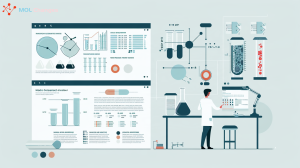
Paso 1: Triaje qué síntesis son críticas para la toma de decisiones
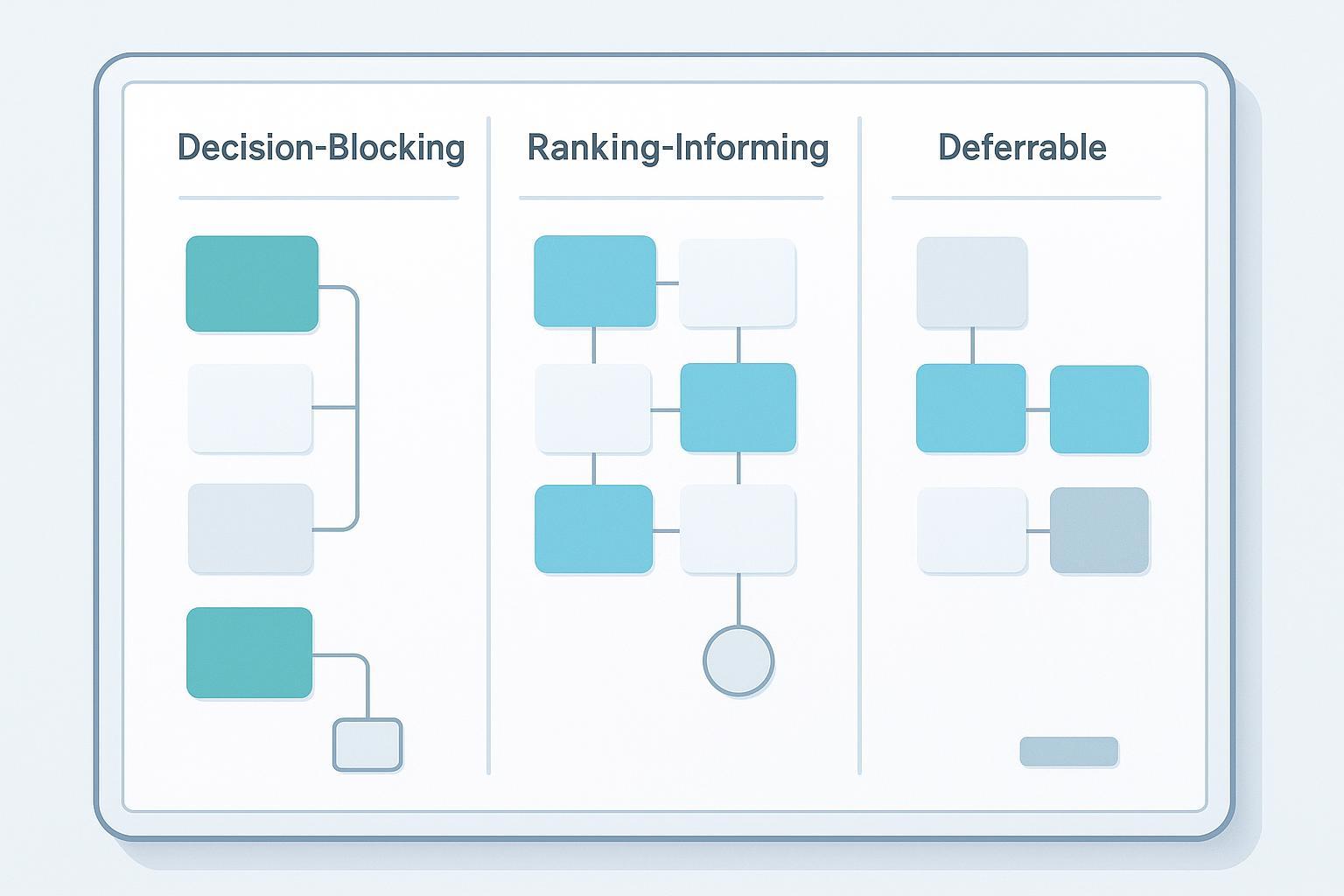
Con un presupuesto reducido, La pregunta no es qué péptidos puede permitirse, sino qué péptidos cambian una decisión de ir o no.. Ese replanteamiento es lo que separa un programa financiable de otro que se estanca: solo 17% de los solicitantes de subvenciones de investigación recibieron un premio en el año fiscal 2025, la tasa más baja en 30 años (Resumen de GrantedAI del análisis de la AAU, recuperado 2026-04-05). El éxito de los investigadores en etapa inicial cayó de 29.8% en el año fiscal 2023 para 18.5% en el año fiscal 2025 durante el mismo período. Cuando un solo paso de desarrollo fallido cuesta $200,000 a $500,000 arreglar y retrasar un programa de tres a seis meses (Personal de péptidos, recuperado 2026-09-10), cada espacio de síntesis que financie tiene que ganarse su lugar.

La clasificación funciona clasificando cada secuencia solicitada según la decisión que alimenta., no contra su interés científico. Un mapa de enrutamiento práctico y con un presupuesto limitado pone la síntesis en la etapa de descubrimiento, purificación, y caracterización MS/HPLC al frente de la cola de subcontratación, con desarrollo de métodos, cribado de formulación, estabilidad, y bioanálisis seleccionado siguiendo en la etapa intermedia (Guía de subcontratación de PeptideStaff, recuperado 2026-09-04). Utilice ese orden como predeterminado y anúlelo sólo cuando una secuencia sea realmente crítica para tomar decisiones..
|
Tipo de solicitud de síntesis |
Dependencia de decisiones |
Ruta recomendada |
|---|---|---|
|
Péptido de validación objetivo |
Bloquea un ir/no ir |
Fondo primero; pureza estándar con liberación MS/HPLC |
|
Conjunto analógico SAR |
Informa un ranking |
Fondo como lote; negociar precios por analógico |
|
Estándar de ensayo |
Informa un ranking |
Financiar si el ensayo alcanza el siguiente hito |
|
Sonda estructural |
Agradable tener |
Aplazar hasta que de ello dependa una decisión |
|
Candidato a escalar |
Bloquea un ir/no ir |
Fondo solo después del cierre del ranking analógico |
El modo de falla es predecible.. Un laboratorio que sintetiza todo lo que está en la lista con igual prioridad gasta su presupuesto reducido en péptidos que nunca entran en una decisión, entonces no puede financiar el único lote que habría matado o confirmado el programa. Una secuencia hidrófoba de 30 residuos que falla en la agregación sobre resina es el caso clásico: consume una ranura de síntesis, una carrera de purificación, y semanas de tiempo analítico, mientras el conjunto analógico crítico de decisiones espera detrás de él. El triaje no se trata de hacer menos ciencia. Se trata de asegurarse de que la ciencia que financia sea la ciencia que necesita su próxima decisión..
Paso 2: Ajuste el tamaño correcto del paquete de caracterización de péptidos de Milestone
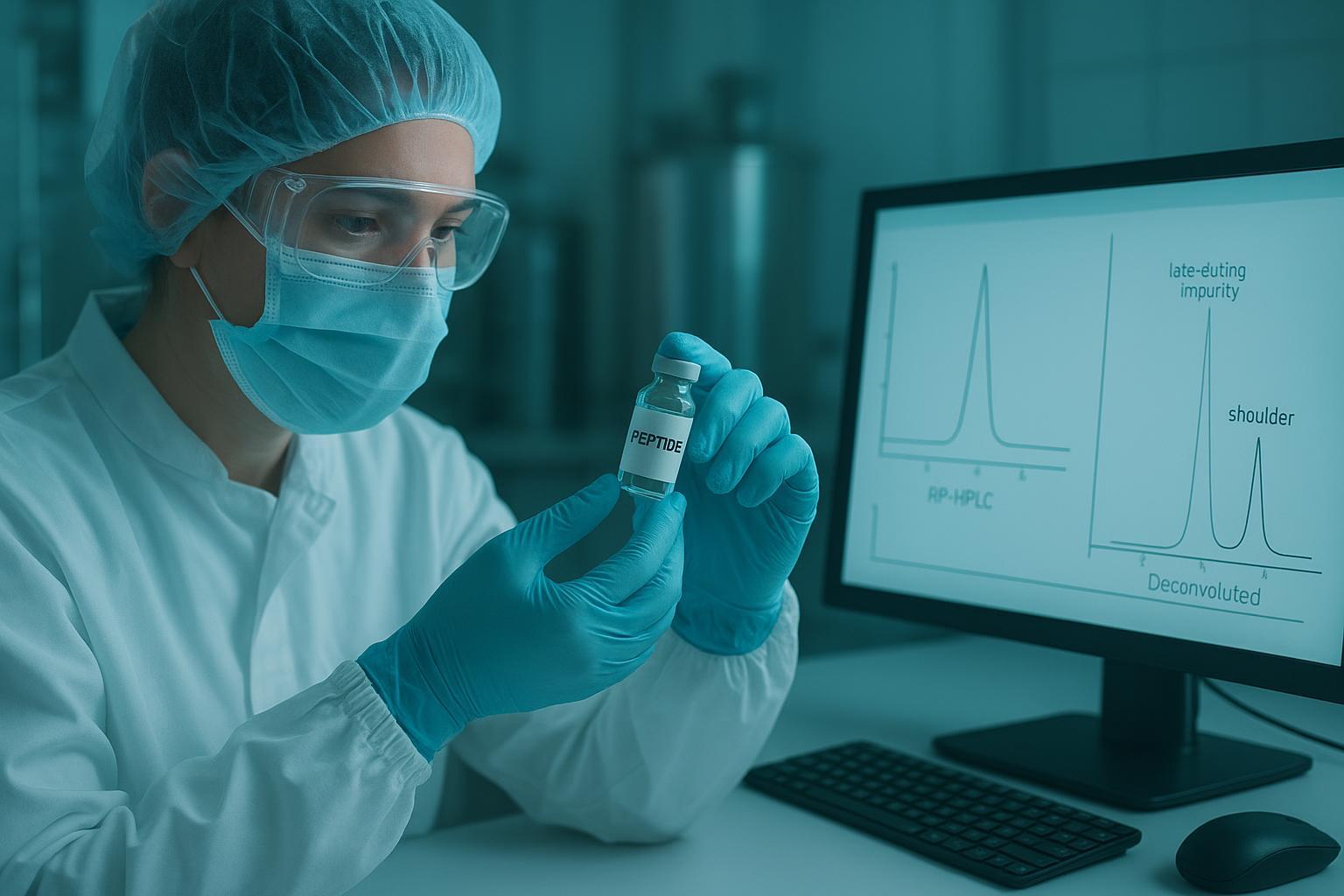
Un paquete de caracterización responde a cuatro preguntas: identidad, pureza, contenido, e integridad estructural. Una respuesta completa requiere al menos cuatro ensayos diferentes. (Laboratorios Certik, 2026). La fuga de presupuesto está comprando los cuatro a fondo en cada hito..

HPLC de fase reversa en una columna C18, ejecutando un 5%-60% gradiente de acetonitrilo en 0.1% TFA terminado 20-40 minutos con detección UV en 214 Nuevo Méjico, cuantifica aproximadamente 0.05% LOQ y 0.01% precisión de informes. Todavía echa de menos las impurezas invisibles a los rayos UV., deleciones coeluidas e isómeros D, y contenido absoluto. La pureza por HPLC es necesaria pero no suficiente (Laboratorios Certik, 2026).
La confirmación masiva cierra parte de esa brecha. La masa de LC-MS deconvolucionada debe coincidir con la masa monoisotópica teórica dentro de ±0,1 Da, y los instrumentos modernos Orbitrap o Q-TOF mantienen habitualmente bajo control 5 ppm. Vale la pena memorizar las masas de diagnóstico.: se muestra una eliminación de Gly en −57,02 Da, Oxidación del metal en +16 Y, aspartimida a −18 Da (Laboratorios Certik, 2026).
El contenido es donde los datos gravimétricos engañan. El polvo liofilizado normalmente lleva 5%-15% agua más contraión en 5%-20% de masa total, por lo que pesar el vial exagera el contenido de péptidos. El análisis de aminoácidos es el estándar de oro, y es lo que USP y Ph. euros. aceptar (Laboratorios Certik, 2026).
|
Hito |
Conjunto mínimo de ensayo |
puede ser aplazado |
Criterio de aceptación |
|---|---|---|---|
|
Cribado |
Pureza RP-HPLC, LC-MS de un solo punto |
Análisis de aminoácidos, pureza ortogonal, contraión |
Masa dentro de ±0,1 Da; pureza reportada, sin especificaciones |
|
Golpear para liderar |
RP-HPLC, LC-MS, perfil de impurezas |
Análisis de aminoácidos, validación completa del método |
Masa dentro de ±0,1 Da; impurezas arriba 0.10% identificado |
|
Optimización de clientes potenciales |
RP-HPLC, LC-MS, análisis de aminoácidos |
Validación completa de la PCI, trabajo de riesgo de inmunogenicidad |
Contenido por AAA; masa dentro de ±0,1 Da; impurezas especificadas ≤0,5% |
|
traslacional / Habilitación IND |
Paquete ortogonal completo: RP-HPLC, LC-MS, aaa, contraión, quiral, elemental |
Ninguno |
Todas las impurezas relacionadas con péptidos ≥0,10% identificadas; 0.10%-0.5% banda caracterizada y justificada |
Servicios Los umbrales regulatorios en esa última fila provienen de la FDA. 2023 orientación sobre productos farmacéuticos de péptidos sintéticos: Las impurezas relacionadas con los péptidos deben identificarse en ≥0,10 %., new specified impurities must stay ≤0.5% of drug substance, and anything in the 0.10%-0.5% band must be identified, caracterizado, and justified as not affecting safety, eficacia, or immunogenicity (FDA, 2023). Those are filing requirements, not method limits, and the two should not be conflated when you scope a package.
A lean package cannot resolve absolute content without amino acid analysis, cannot see UV-invisible impurities, and cannot separate co-eluting deletions from D-isomers on HPLC alone. Say so in the plan rather than discovering it at filing.
El modo de falla es predecible.: paying for full orthogonal characterization on screening lots that will be re-synthesized anyway, then lacking the budget for the orthogonal confirmation the IND-enabling lot actually requires.
Paso 3: Haga coincidir el modelo de participación con sus puntos de decisión
Choose the engagement model that matches where your go/no-go decisions fall, not the one with the lowest quoted unit price. The three common structures behave very differently across a funding year, and the mismatch is what drains a constrained budget.
The scale of what you are avoiding is worth naming. Building peptide capacity in-house carries capex of $5M-$50M, with itemized total capital of $4.2M-$31M and annual operating costs of $2.7M-$9.5M for 10-30 staff, de acuerdo a Análisis de costo-beneficio de PeptideStaff de la subcontratación de péptidos versus la producción interna. Outsourcing the same work conserves 60%-75% of that capital, with internal build-out running $5M-$15M, per PeptideStaff’s biotech startup peptide outsourcing guide. The same source notes the break-even sits near 5 kg per year, and that groups producing under 50 kg annually typically spend 40%-60% more per gram in-house.
|
Dimensión |
Fee-for-service |
FTE-style block |
Híbrido |
|---|---|---|---|
|
Commitment horizon |
Per project or per lot |
Reserved capacity over a fixed term |
Core block plus project add-ons |
|
Cash-flow shape |
Spikes at each decision point |
Síntesis de péptidos Level monthly draw |
Baseline plus variable spikes |
|
Change-order behavior |
Re-quoted when scope moves |
Absorbed inside the block |
Mezclado: block absorbs, add-ons re-quote |
|
IP and data handling |
Defined per statement of work |
Negotiated once for the term |
Split by workstream |
|
Best-fit decision cadence |
Quarterly or slower |
Continuous, high-volume programs |
Predictable core with periodic surges |
Neither structure is universally better, and both carry a real limitation. A lean fee-for-service engagement cannot absorb a mid-program scope expansion without a re-quote, which can stall work at exactly the wrong moment. An FTE-style block can burn budget on idle capacity if your internal pipeline stalls.
El modo de falla es específico y común.: signing an FTE-style block to capture a lower effective rate, then discovering the program’s decision points are quarterly. The reserved capacity sits unused in the quarters that matter, and you have paid for availability you never consumed. If your decisions cluster at milestones rather than running continuously, fee-for-service or a hybrid with a small core block usually fits better. If you are running parallel programs with steady analytical throughput, the reserved block earns its premium.
Paso 4: Preparar el plan de trabajo contra la volatilidad del financiamiento
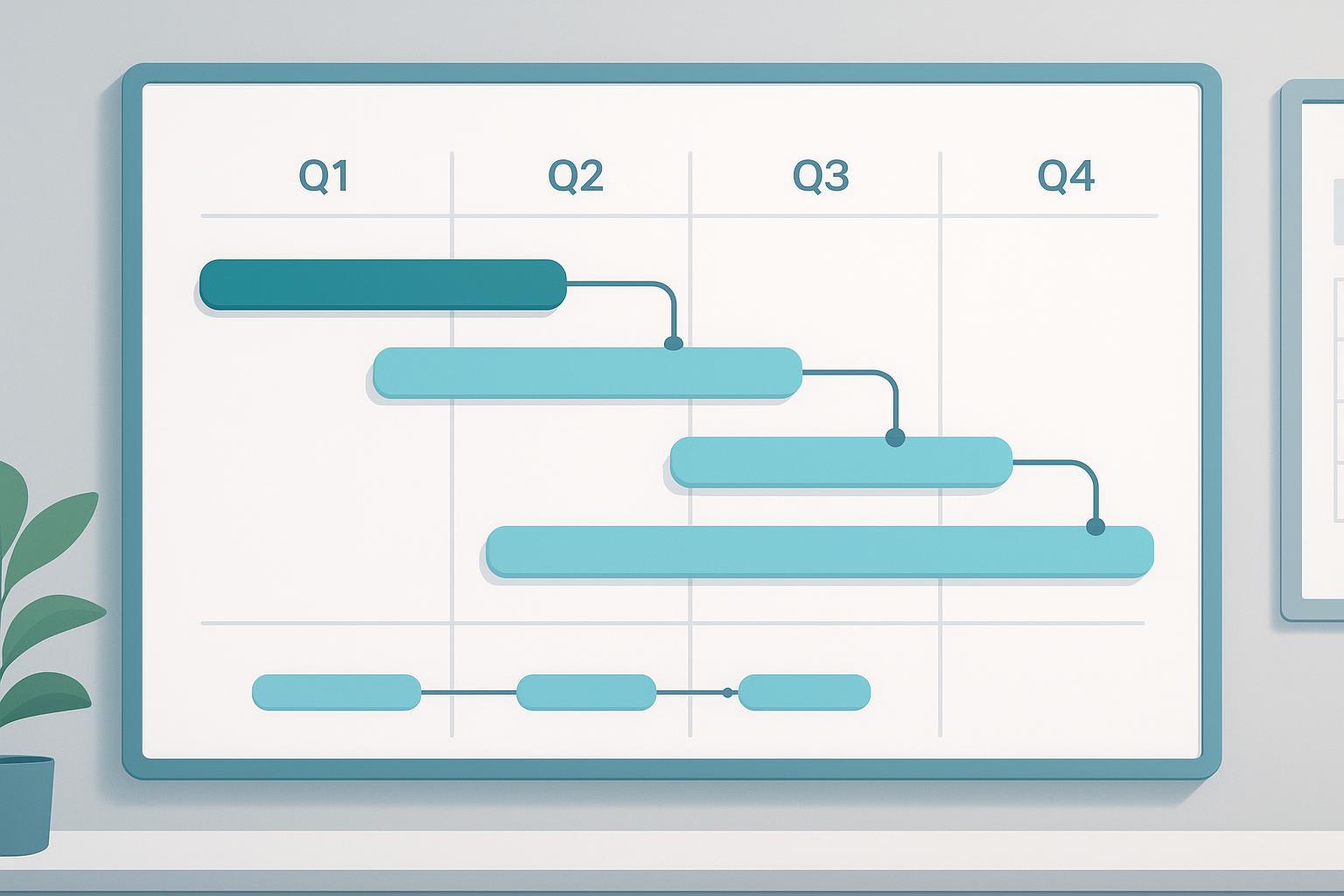
A work plan built for a stable budget breaks under a continuing resolution. The FY2026 appropriation that preserved NIH funding near prior-year levels set the program level at $47.493 mil millones, apenas $458 million or about 1.0% above FY2025, and it was enacted through P.L. 119-75 en 2026-02-03 after the administration had requested $27.9 mil millones, a cut of about 40% (CASRAI enactment briefing). The same statute bars the 15% flat indirect-cost cap, so the enacted figure is a floor that can move again rather than a settled number.
The disruption is not hypothetical. The same STAT News and MassINC Polling Group survey of 989 NIH-funded researchers found that 43% had cancelled planned research projects, 45% had a grant start delayed, y 22% had rescinded offers to students, staff, or postdocs (STAT News).
Stage the work so every commitment ends at a decision point you can pause at. Sequence synthesis first, luego caracterización, then tox and CMC, and place a Comercio quarterly gate between each block. If a grant start slips, you stop at the gate with finished data in hand instead of a non-cancellable campaign in flight.
Subaward accounting changes how a CRO engagement is charged. Under NIH’s implementation of the revised Uniform Guidance, modified total direct costs include up to the first $50,000 of each subaward, effective for awards issued on or after October 1, 2024, and fixed-amount subawards above $500,000 require prior approval (NIH Notice NOT-OD-25-059). A peptide synthesis outsourcing strategy that splits work across several subawards therefore recovers indirect costs differently than a single consolidated award, which is worth modelling before you sign.
The failure mode is committing to a GMP campaign or a full IND-enabling tox package on the assumption that next year’s award arrives on schedule. When the start is delayed, the campaign is already running and the money is already spent.
Paso 5: Verifique la calidad y la documentación antes de comprometerse
Verify the quality framework and the documentation standard before the first purchase order, not after the first lot arrives. Re-running a synthesis to close a documentation gap costs about what the original synthesis cost (reported CRO cost-per-failure figures), so the cheapest place to catch a gap is the vendor qualification stage.
There is no single peptide-specific rulebook to audit against. Peptide work is governed by a stack of quality-system and analytical standards: Yo Q7, Yo Q6B, Q2, and the Q3 series, plus FDA cGMP/GLP expectations and, where testing labs are involved, ISO/IEC 17025 y ISO 9001. Cleanroom classification follows ISO 14644.
One exclusion matters when you scope the package. Peptide drugs are specifically excluded from the ICH Q3A/Q3B impurity qualification guidance, so peptide projects lean more heavily on Q6B, compendial methods, and product-specific justification (review of peptide impurity qualification). Ask a prospective partner how they handle that gap, because the answer tells you whether they have built a defensible approach or are borrowing one from small molecules.
Request these five documents before committing budget:
Certificate of analysis with the method reference behind each reported value
Raw chromatograms and spectra, not summarized tables
Amino acid analysis report where peptide content matters
Counter-ion and water content determination
Quality-system certifications relevant to the work (ISO/IEC 17025, ISO 9001, cGMP as applicable)
The reporting bar for a defensible dossier is higher than a single purity figure. Impurity identification down to 0.1%, RP-HPLC plus LC-MS purity profiling, and two orthogonal methods are the standard expectation from both FDA and EMA, with full raw-data documentation behind them (peptide characterization reporting checklist).
The failure mode is accepting a purity number without the method behind it. A lot reported at 98% from one HPLC channel, with no orthogonal confirmation and no impurity identification below 0.5%, can pass internal review and still fail a regulatory one, because the number cannot be reconstructed from the underlying data. When you evaluate a peptide characterization package, treat the raw data as the deliverable and the summary table as a convenience. Acerca de
Paso 6: Cree el modelo de presupuesto y establezca la cadencia de revisión
Build the model from planning ranges, not from a single quote, and re-check it quarterly against actuals. The ranges are wide enough that a point estimate is a guess wearing a number.
A vendor planning guide’s cost table puts discovery-scale synthesis at $5K-$50K per peptide (Personal de péptidos, recuperado 2026-09-04), analytical method development at $50K-$200K per method set (same guide), formulation development at $150K-$500K per program, and GMP manufacturing at $200K-$1M per campaign. Toxicology adds GLP 28-day rat tox at $150K-$300K and a full IND-enabling package at $800K-$2M+ (Personal de péptidos, recuperado 2026-05-26). Treat these as vendor planning tables rather than audited market rates; the toxicology page itself flags its figures as rough estimates.
The failure mode is budgeting from one quote and absorbing a 3-4x overrun when the program moves from discovery-scale synthesis into method development and toxicology without a re-forecast.
Errores comunes a evitar
The most expensive mistakes in peptide outsourcing are not technical failures. They are scoping and sequencing failures that spend the budget before the decision point arrives, and their cost is measured in failed steps and delayed programs rather than in unit price.
Treating every synthesis request as equally urgent. Queues form because everyone escalates at once. Rank requests by the decision each one unblocks, and let the rest wait a cycle.
Buying full orthogonal characterization at screening. Screening needs identity and rough purity, nothing more. Reserve orthogonal methods for lots that will enter a study.
Choosing an engagement model on unit price rather than decision cadence. A cheaper per-residue rate that cannot pause mid-campaign costs more than a flexible CRO engagement model priced higher per step.
Committing to a campaign that cannot be paused. Funding volatility is the norm, not the exception. If the work plan has no stop point, a delayed award strands the whole commitment.
Accepting a purity value without the method behind it. A number without its chromatographic method and raw data cannot be defended later, and re-running the analysis costs more than requesting it upfront.
Resultados: Cómo se ve un plan bien definido
If the plan is working, every synthesis lot in flight maps to a named decision, every characterization package matches its milestone, and the next commitment can be paused without stranding work. Those three conditions are checkable, which is what separates a scoped plan from a hopeful one.
The measurable signals are straightforward. Most of your synthesis spend should sit behind a documented go/no-go decision rather than accumulating as inventory. Each lot headed toward a regulatory or formulation milestone should carry orthogonal confirmation, not a single HPLC trace. And cash committed against the next quarterly gate should leave enough uncommitted to absorb a delay.
A reasonable stretch goal is to extend the same triage and scoping discipline to analytical and formulation work. A vendor-attributed survey of outsourcing rates reports that peptide biotechs outsourced roughly 65% of analytical work and 55% of formulation development in 2025, up from about 45% y 40% en 2022 (PeptideStaff market note, recuperado 2026-08-14). The same note projects the peptide CRO market growing from $4.8B in 2025 to $5.5B in 2026 and $9.1B by 2030, a 14% CAGR, with analytical services expanding fastest at roughly 19% annually (Personal de péptidos, recuperado 2026-08-14). Treat both figures as vendor-attributed estimates rather than independent measurements.
State the limits plainly. A lean characterization package cannot resolve absolute content without amino acid analysis, cannot detect UV-invisible impurities, and cannot separate co-eluting deletions or D-isomers on HPLC alone.
Preguntas frecuentes
¿Qué parte del presupuesto peptídico restringido debería destinarse a síntesis versus caracterización??
There is no fixed split. The allocation follows the milestone, not a percentage rule. Early discovery work usually tilts toward synthesis volume, because you need material to test. As a program moves toward a candidate nomination or an IND-enabling package, characterization takes a larger share, since impurity identification down to 0.1% by RP-HPLC plus LC-MS and two orthogonal methods is the standard expectation. Triage first: which syntheses actually feed a decision this quarter? Fund those fully, including their characterization, rather than spreading a thin budget across every sequence on the list.
¿Podemos mantener algunos trabajos con péptidos internamente para ahorrar dinero??
Only at volumes most academic and early-stage teams never reach. In-house peptide manufacturing carries capital costs of roughly $5M to $50M and annual operating costs of $2.7M to $9.5M. Outsourcing is typically cheaper below about 1 kg per year, the two approaches break even near 5 kg per year, and in-house only wins above roughly 50 kg per year. Companies producing under 50 kg per year commonly spend 40% a 60% more per gram in-house. For a constrained research budget, that math rarely favors building internal capacity.
¿Qué debemos hacer si falla un lote de síntesis o se retrasa el inicio de una subvención??
Treat both as planned pause points rather than crises. A failed synthesis step can cost $200,000 a $500,000 and delay a program by 3 a 6 meses, y 45% of surveyed researchers reported a grant start delay. Build the contingency into the plan: define in advance which syntheses are decision-critical enough to repeat immediately and which can wait, and hold a small reserve for rework. Vendor-reported figures suggest peptide CROs can compress development timelines by 30% a 50% through established processes, but that is a vendor claim, not a peer-reviewed benchmark, so use it as directional context rather than a planning assumption.
¿Cómo comparamos el pago por servicio con un compromiso de estilo FTE??
Use decision cadence as the criterion. Fee-for-service suits discrete, well-defined lots where you know the sequence, the scale, and the acceptance criteria up front. An FTE-style engagement suits programs with frequent, unpredictable decision points, because it keeps a team available without re-scoping each time. Each model has a real limitation: fee-for-service can add turnaround time at each change order, while FTE-style engagements commit budget whether or not the work is decision-critical that month. Match the model to how often your program actually changes direction.
¿Es defendible un paquete de caracterización lean en una revisión regulatoria??
It can be, if it still contains the essentials. Impurity identification down to 0.1%, RP-HPLC plus LC-MS, two orthogonal methods, and full raw-data documentation are the standard expectation from the FDA and EMA. Note that peptides are excluded from ICH Q3A and Q3B, so the applicable thresholds Péptidos sintéticos come from the FDA’s 2023 guidance rather than those impurity frameworks. What a lean package cannot do is claim coverage it did not perform: if you skip an orthogonal method or truncate raw data, the gap is visible in review. Scope down deliberately, document what you ran, and state the limits.
Conclusión
Six practices carry a constrained peptide program through the year: triage which syntheses are decision-critical, right-size the peptide characterization package by milestone, match the engagement model to your decision points, stage the work plan against funding volatility, verify quality and documentation before committing, and build the budget model with a review cadence attached. Together they preserve experimental momentum when money is tight, because the sequences that matter keep moving and the ones that can wait are allowed to wait.
The next step is a scoping conversation, not a purchase order. Request a characterization scope review or talk to a technical specialist about staging a work plan against your quarterly decision gates, so the package you commit to matches the decisions you actually have to make this cycle.
Nota: All peptides and analytical services discussed here are intended for research use only and are not for human or veterinary use.
Divulgación: this article is written for a general research audience; the author has no commercial interest in any specific supplier named or implied. Producción de péptidos