Miksi makrosyklisten peptidien analyyttiset haasteet ratkaisevat, selviääkö kaupasta huolellisuus
Novartiksen ja Unnatural Productsin yhteistyö julkistettiin helmikuussa 2026 sitoutunut $100 miljoonan euron ennakkomaksut ja ennen IND:n virstanpylväsmaksuja, toisen kanssa $1.7 miljardia sidottu kehitykseen, sääntely- ja kaupalliset virstanpylväät, otsikko yhteensä yli $1.8 miljardia (GEN, 2026). Sekunti, samankokoinen makrosykliyhteistyö myöhemmin samana vuonna, Novo Nordiskin ja Orbis Medicinesin välillä, kantoi a $1.4 miljardi otsikkoa (Kovaa biotekniikkaa, 2026). Molemmat luvut ovat otsikoita, jotka sisältävät ehdolliset virstanpylväät, joten ne eivät ole vertailukelpoisia käteisarvoja.

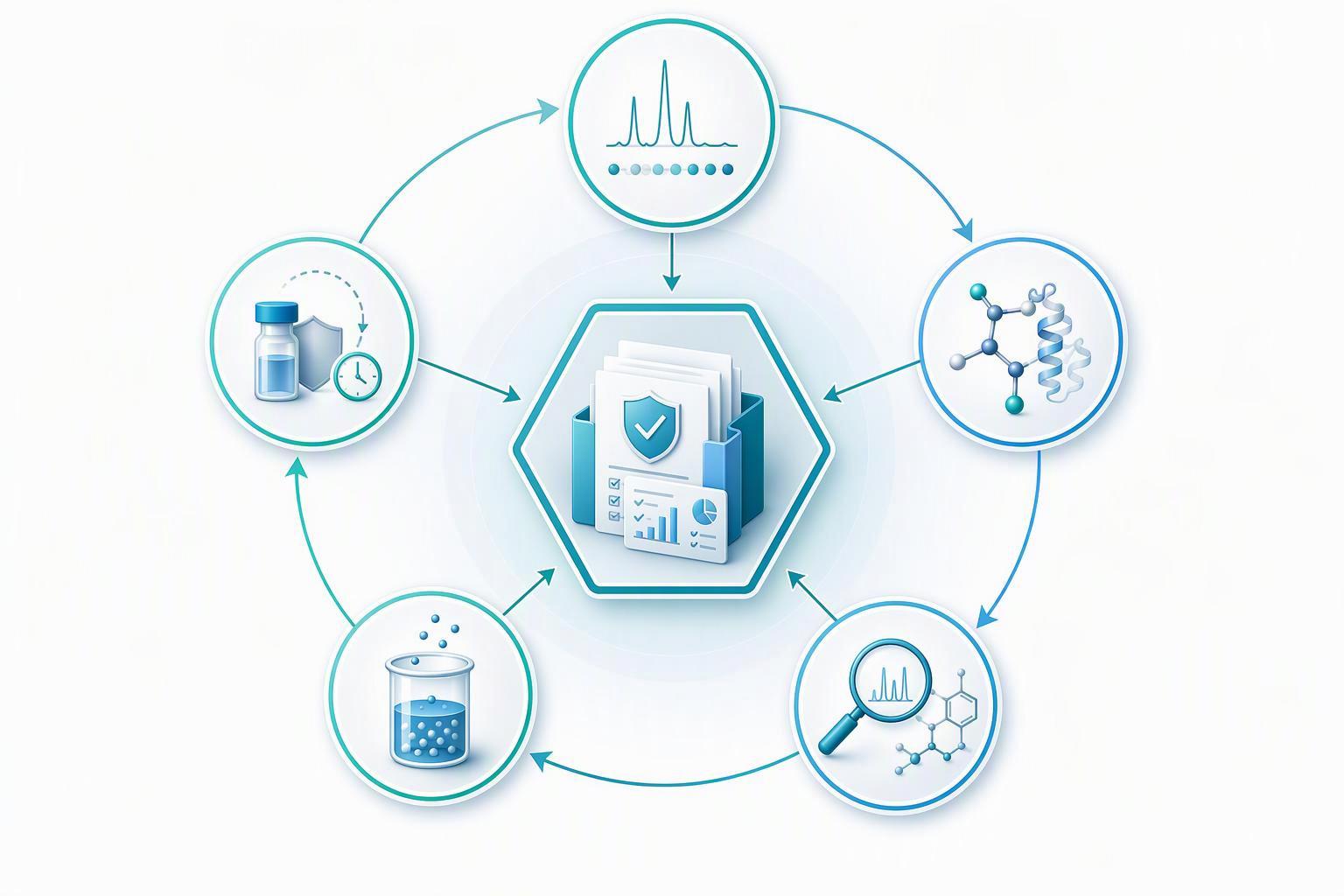
Se, mikä siirtyy allekirjoituksen yhteydessä, ei ole otsikko. Novartiksen ehdoilla, Novartis suorittaa IND:n mahdollistavaa työtä ja kaikkea sen jälkeen, mukaan lukien kliininen kehitys, valmistus ja globaali kaupallistaminen (GEN, 2026). Omaisuus, jonka on kestettävä itsekseen, on analyyttinen paketti, ja viisi tieteenalaa harjoittavat sitä kiinteässä järjestyksessä: puhtausprofilointi, rakenteellinen vahvistus, epäpuhtauksien karakterisointi, liukoisuus, sitten vakautta. Jokainen riippuu sitä edeltävästä.
Mikä tekee makrosyklisten peptidien analyyttisista haasteista erilaisia lineaarisesta peptidityöstä
Makrosykli on peptidi, jonka runko on suljettu yhdeksi tai useammaksi renkaaksi, ja tämä rengas on syy, miksi analyyttinen työ muuttuu. Makrosykliset peptidit on sijoitettu yhdistämään biologisen kaltaisen selektiivisyyden pienimolekyylisten ominaisuuksien kanssa, kaksoisprofiili, joka on houkutellut suuria kumppanuussijoituksia luokkaan (GEN, 2026).

Rajoitettu teline vähentää konformaatiovapautta. Tästä rajoituksesta tulee terapeuttinen etu, ja sieltä myös analyyttinen vaikeus alkaa: vähemmän saavutettavia konformaatioita tarkoittavat, että molekyylin käyttäytyminen erotuksessa tai massaspektrometrissä ei ole enää ennustettavissa lineaarisesta sekvenssistä, josta se rakennettiin.
Siitä seuraa kaksi seurausta, ja ne muokkaavat jokaista alla olevaa osaa. Ensimmäinen, oikea ehjä massa ei sinänsä vahvista renkaan sulkeutumista; massa kertoo koostumuksen, ei topologiaa. Toinen, makrosyklireitin tuottamat epäpuhtausluokat ovat laajempia kuin lineaarisen sekvenssin epäpuhtausluokat, koska pyöräily, sillan muodostus, ja niiden ympärillä oleva suojaryhmän kemia tuottavat kukin omat vikatuotteensa.
Käsittele rengasta, ei järjestystä, analyyttisena kohteena.
Puhtausprofilointi: miksi yksittäinen HPLC-prosentti ei anna huippuja
Makrosyklin puhtausprofilointi alkaa erolla, jonka yksi kromatografinen numero piilottaa: prosentti on suhteellinen aluevaste, ei henkilöllisyyden tai sisällön ilmoitus. Käänteisfaasi-HPLC tai UPLC erottaa komponentit ja raportoi, kuinka paljon UV-säteilyä absorboivaa materiaalia eluoitui kussakin ikkunassa. Se ei kerro sinulle, mitä nämä komponentit ovat, eikä se kerro, kuinka suuri osa pullosta on peptidiä.
Peptidin nettopitoisuus mitataan erillään kromatografisesta puhtaudesta, alkuaineanalyysillä, aminohappoanalyysi tai UV-spektrofotometria, ja jää tyypillisesti väliin 60% ja 90% peptidin kokonaispainosta, vastaionit ja vesi muodostavat tasapainon (Ambiopharm, päivätty, haettu 2026-06-11). Kuvaava analyysitodistus osoittaa aukon: HPLC-puhtaus 98.7% peptidisisällön ohella 76.4%, vettä 6.2% ja vastaioni 15.8% (Puhtaasti peptidit, päivätty; kolmannen osapuolen esimerkki, ei ole vahvistettu verkkokuva).
Rajoituksella on enemmän merkitystä kuin määrällä. Yksittäinen RP-HPLC-puhtausprosentti ei anna huippuja eikä pysty erottamaan katkaistua sekvenssiä oikein syklisoidusta regioisomeerista, joka eluoituu samassa ikkunassa. Se, mitä huolellisuuden arvioija haluaa, on huipputehtävä: mitkä huiput integroitiin, mitä kukin tunnistettiin, ja millä ortogonaalisella menetelmällä.
Rakenteellinen vahvistus: todistaa renkaan sulkeutumista ja siltakuviota, ei nimellismassaa
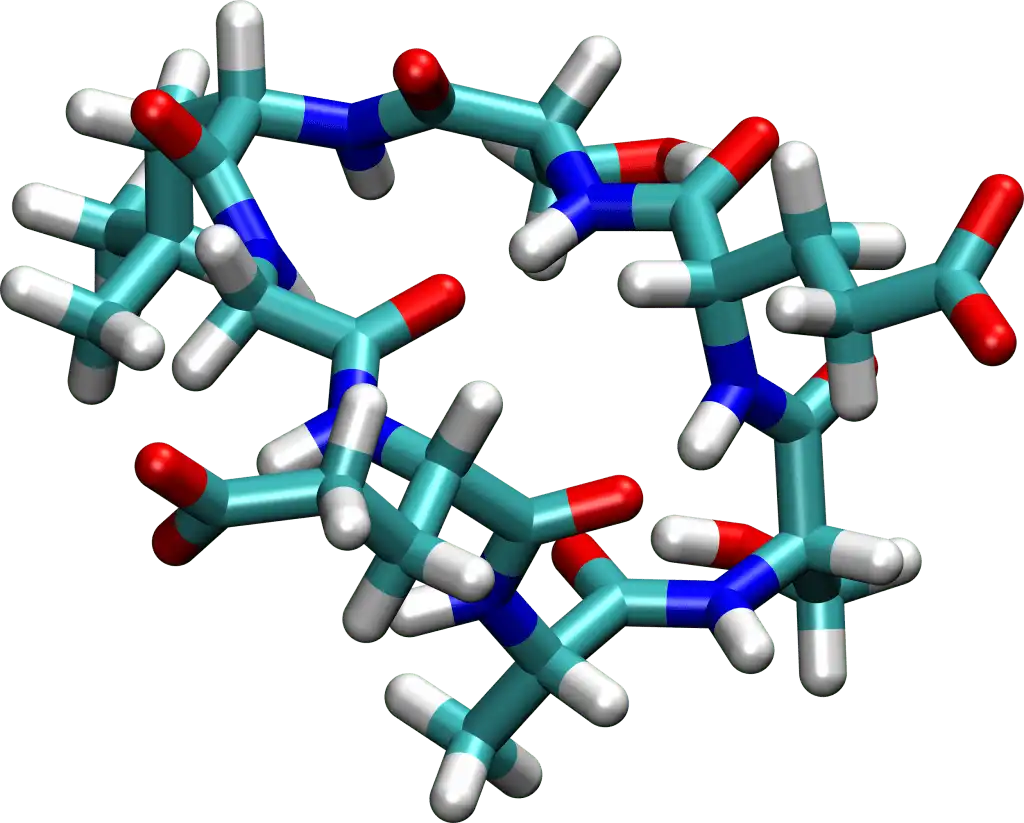
Ehjä massa, joka vastaa odotettua arvoa, vahvistaa koostumuksen, ei topologiaa. Kaksi makrosykliä voi jakaa molekyylikaavan, identtinen ehjä massa, ja täysin erilaiset rengasliitännät, joten makrosyklisen peptidin rakenteellisen vahvistuksen on vastattava kysymykseen, jota massa yksinään ei voi: jotka jäännökset todella sulkevat renkaan, and in what bridge pattern.
Vikatila on konkreettinen. A head-to-tail cyclization and a side-chain-to-side-chain bridge can produce the same nominal mass while placing the macrocyclic constraint in different regions of the scaffold. Those two molecules are regioisomers, and they behave differently in receptor binding, in chromatographic retention, and in stability. A correct intact mass with an unresolved regioisomer is a release decision made on incomplete evidence.
Epimerization compounds the problem, ja the epimerization risk profile reported by Bachem explains why it is a structural question rather than a purity question. Formation of an oxazolone-activated intermediate lets the α-carbon racemize, and the risk rises with extended activation time, reactive coupling reagents, accumulation of activated intermediates, and higher temperature. The same source notes that phenylglycine, kysteiini, histidiini, and residues with electron-withdrawing side chains are more epimerization-prone. A D-residue at a single position changes the three-dimensional shape without changing the mass.
Two techniques carry the confirmation work, and each has a boundary worth stating plainly. Tandem mass spectrometry resolves sequence and, with adequate fragmentation coverage, can localize where a bridge sits, but coverage depends on how the constrained scaffold fragments, and a macrocycle that fragments poorly leaves gaps exactly where the answer is needed. NMR resolves connectivity and stereochemistry directly, including ring closure and bridge assignment, but its sensitivity limits mean low sample mass can put the experiment out of reach. Neither method is sufficient on its own for every scaffold.
Epäpuhtauksien luonnehdinta: kartoittamaan, mitä reitti todella tuottaa
Peptide impurity characterization is a chemistry deliverable, not a QC afterthought: the impurity map should name the byproducts the synthetic route can actually produce, and the route determines which ones to expect. The aspartimide-prone motifs are well documented. Mukaan Bachem’s overview of aggregation, racemization and side reactions in solid-phase peptide synthesis, aspartimide formation is especially prevalent in peptides containing Asp-Gly, Asp-Ala or Asp-Ser sequences, can occur under acidic or basic conditions, and reopens to give a mixture of α- and β-linked peptides; in Fmoc synthesis, piperidine can open the aspartimide to yield piperidides (2019). Diketopiperazine formation is a dipeptide-stage risk, more likely in Fmoc-based synthesis and especially prevalent when proline is one of the first two residues, with HOBt added to the piperidine deprotection solution as the cited mitigation (peptide.com, 2019). Base-driven epimerization during deprotection is a second, distinct route: Bachem’s knowledge-center page on epimerization risk attributes it to strong bases, harsh deprotection conditions and prolonged base exposure, and describes an aspartimide/glutarimide pathway when Asp-Gly-like motifs meet basic conditions and heat (2026). Recent reviews of aspartimide-related byproducts treat the class as a defined structural problem with known mechanisms and prevention strategies (Aucagne et al., 2025).
Peptide Nucleic Acid Synthesis The full set to demand is wider than those three: residual linear precursor, typistetyt sekvenssit, epimeerit, oligomers and aggregates, plus oxidation and deamidation products. For a macrocycle, residual linear precursor matters most, because it is the species that most closely resembles the product on a nominal-mass readout.
Key Takeaway: A nominal-mass release test cannot see aspartimide byproducts, epimeerit, or linear precursor. Demand orthogonal methods that can: chromatographic Spps Peptide Synthesis separation of the related substances, korkearesoluutioinen massaspektrometria, ja, where topology is in question, the structural techniques covered in the previous section.
The analytical-to-purification handoff is where this work pays for itself. Separation conditions developed to resolve the impurity map analytically become the basis for large-scale chromatographic purification conditions, so an impurity method built only to pass a specification wastes the resolution it already achieved.
Liukoisuus ja aggregaatio: kehitettävyysriski, joka muuttaa määrityksen suunnittelua
Gku Cu Peptide Solution behavior belongs in the first characterization package, not in a formulation file opened eighteen months later. Aggregation is the reason: it cannot be predicted reliably from sequence data, according to peptide.com’s 2019 review of solid-phase synthesis side reactions. Hydrophobic sequences are more prone to it, and the same review places the vulnerable chain-length window at roughly the fifth or sixth residue through the twenty-first, which is the length band most macrocyclic drug candidates occupy.
That unpredictability has two operational consequences. Ensimmäinen, an aggregating species can elute as a broadened or shifted peak, so a purification method developed on a monomeric standard may not transfer. Toinen, and less often anticipated, aggregation changes the conditions under which purity itself is measured: puskuri, lämpötila, and concentration can move the apparent result without any change in the material.
Conformational heterogeneity in a constrained scaffold compounds this. A macrocycle can populate more than one solution conformation, and each may interact differently with the stationary phase, so chromatographic behavior reflects the conformational ensemble rather than a single defined species.
The practical demand is therefore early solution-behavior data, generated under stated conditions, before purification scale-up and before assay conditions are locked.
Vakaus: vakautta osoittavien menetelmien suunnittelu ohjelman käynnistyksen yhteydessä
Macrocyclic peptide stability is a method-design decision, not a shelf-life exercise. A release method validated against the specification confirms that a batch meets a defined limit; vakautta osoittava menetelmä Peptidi 1 must additionally resolve the degradation products that form over time and separate them from the parent peak, which is why the two are designed differently and why the second cannot be retrofitted late.
That distinction matters because macrocycles degrade through several concurrent routes. Peptide stability strategies reviewed in the literature cover hydrolysis, hapettumista, and epimerization, with backbone cyclization and D-amino acid substitution among the structural changes used to slow them (Al Musaimi et al., 2022). A method built only to the release limit will not see a co-eluting epimer or an oxidized species that grows on storage.
Synthesis route choice feeds directly into what the method must resolve. On one GLP-1 agonist target of more than 40 syklit, the epimerization risk profile reported by Bachem showed 13% epimer formation on one fragment route, and the route was discontinued; a second fragment route showed a different epimerization profile, klo 2 to 3% in the crude, rising to roughly 5% puhdistuksen jälkeen, while linear SPPS avoided the epimerization issues on this target and gave the highest overall yield (Bachem, 2026).
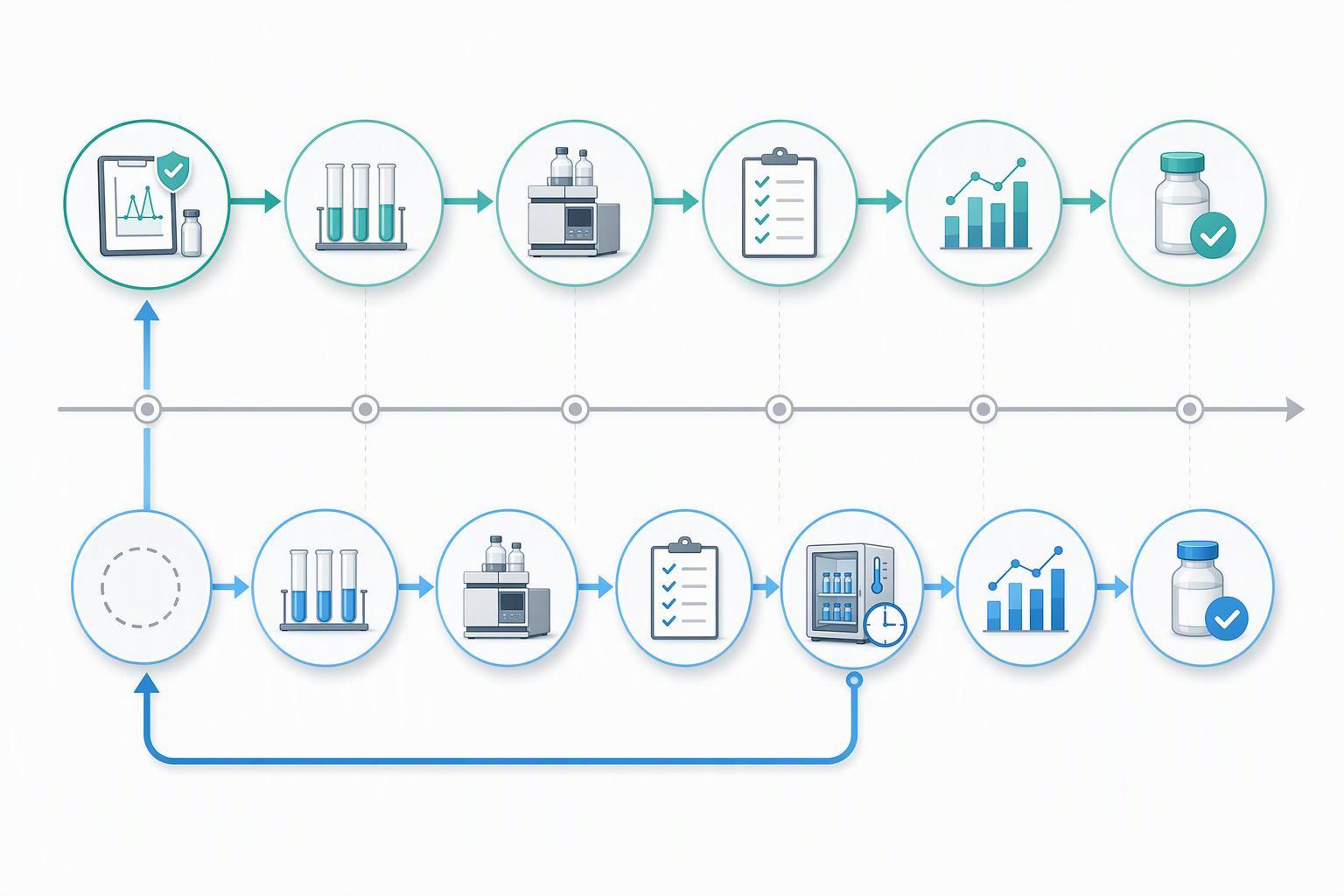
[VISUAALINEN: Workflow diagram contrasting two program paths. Path one places stability-indicating method design at program start, ahead of release testing. Path two places it at late-stage shelf-life testing, with a rework loop returning to method development once degradation products are found that the release method cannot resolve.]
The practical demand for a diligence package is therefore a dated record of when the stability-indicating method was designed, what forced-degradation conditions it was challenged with, and whether it separates the epimer and oxidation products the chosen route is known to produce.
Yleisiä väärinkäsityksiä makrosyklisten peptidien analyyttisissa haasteissa
Five misreadings recur in diligence reviews, and each one traces back to a mechanism rather than to a vendor’s shortcoming.
A correct intact mass does not confirm ring closure. Mass spectrometry reports the summed composition of the molecule, so a linear precursor, a head-to-tail cyclized product, and a side-chain-bridged regioisomer can return the same nominal mass. Topology needs orthogonal evidence: fragmentation that spans the bridge, or NMR where sample mass allows. Fmoc Peptide Synthesis
A high HPLC purity percentage does not establish peptide content. Purity is a relative measure of peak area against everything else eluting in that method, so a chromatogram can read 98 percent while the actual peptide content, measured by amino acid analysis or UV, sits materially lower. Vastakohdat, jäännösvesi, and salts are invisible to the purity number.
Solubility is not a formulation-stage concern. Aggregation and poor dissolution change assay design, sample handling, and the validity of the very methods used to generate the earlier data.
Stability is not a late-stage exercise either. A method that was never shown to be stability-indicating cannot distinguish a degradation product from a process impurity, and that distinction is what a reviewer is looking for.
Synthesis success is the entry point to analytical work, not the finish line.
Todistuspaketin rakentaminen, jonka ostaja todella arvioi
Diligence teams do not score capability statements. They score lot-specific data, because a statement describes what a supplier says it can do while a certificate of analysis describes what happened to the material in front of them. The practical test is whether the documents let an independent reviewer reconstruct the result.
A complete package for a macrocyclic peptide typically contains a certificate of analysis, the HPLC chromatogram behind the reported purity, and the mass spectrum behind the identity call, with method conditions traceable from analytical development through to preparative scale. Release testing should use techniques complementary to assay and purity by HPLC or UPLC, since a single separation method cannot confirm what it does not resolve. Peptidi 1
MOL Changes operates an integrated peptide R&D platform with Class 100 ultra-sterile cleanroom manufacturing, QC covering MS, HPLC, aminohappoanalyysi, endotoxin, vastaioni, optinen kierto ja UV-pitoisuus, and issues a CoA, chromatogram and MS spectrum per lot across scales from mg to kg.
Tietojen paljastaminen: MOL Changes on kaupallisesti kiinnostunut peptidien laatustandardeista. The evidence-package structure above is a general diligence framework, not a claim about any single supplier’s solubility or stability services.
Seuraavat vaiheet: mitä karakterisointikumppanilta voi vaatia
The fastest way to evaluate a characterization partner for macrocyclic peptide analytical challenges is to ask four questions and listen for specifics rather than assurances.
Ensimmäinen, ask for the impurity map and the route it came from. A partner who can name which impurities the synthesis route generates, and where in the process they arise, is working from your chemistry rather than a template. Toinen, ask which method confirms topology rather than mass. If the answer stops at intact mass, ring closure and bridge pattern are still unproven. Kolmas, ask when the stability-indicating method was designed. A method built at program start, before forced degradation, behaves differently from one retrofitted after a stability failure. Neljäs, ask for lot-specific data rather than a representative lot. A chromatogram from a single qualification batch tells you about that batch, not about yours.
MOL Changes supports this kind of diligence with per-lot CoA, HPLC-kromatogrammi, and MS spectrum documentation, and analytical HPLC, massaspektrometria, and amino acid analysis across mg to kg scale. If your program needs a partner who can walk through these questions against your route, talk to an expert about your characterization package.
Usein kysytyt kysymykset
Kuinka makrosyklisten peptidien analyyttiset haasteet eroavat eniten lineaarisesta peptidityöstä?
The biggest difference is that the constrained scaffold removes the assumptions linear methods rely on. A linear peptide’s sequence usually predicts its chromatographic behavior and fragments cleanly in MS/MS, while a macrocycle’s ring closure, bridge pattern, and conformational flexibility mean two molecules with identical mass can behave differently on column and in the gas phase. Puhtaus, identiteetti, and impurity work therefore need methods built for the macrocycle, not adapted from a linear template.
Pelkästään ehjä massa vahvistaa makrosyklin?
Ei. A correct intact mass confirms the molecular formula, ei topologiaa. It cannot distinguish a properly closed ring from a linear precursor, a mis-bridged regioisomer, or an alternative bridge pattern with the same composition. Structural confirmation of a macrocycle requires orthogonal evidence such as fragmentation data, NMR, or enzymatic or chemical probes that report on ring closure specifically.
Miksi HPLC-puhtaus ja peptidipitoisuus eroavat toisistaan??
HPLC purity measures the proportion of UV-absorbing material in the peaks, while peptide content measures how much of the sample is actually peptide. Vastakohdat, jäännösvesi, suolat, and UV-silent impurities contribute to mass but not to the chromatogram, so a high HPLC percentage can sit alongside a lower peptide content. Amino acid analysis or UV-based peptide content closes that gap.
Milloin vakauden osoittavat menetelmät tulisi suunnitella??
At program start, not at late-stage development. A stability-indicating method has to resolve the degradation products the molecule actually forms, and for a macrocycle those can include ring-opened species, isomerized bridges, and aggregates. Designing the method once the route and formulation are locked means re-validating late, when changes are expensive.
Voidaanko liukoisuus ennustaa sekvenssistä?
Not reliably for macrocycles. Sequence-based predictors were built largely on linear peptides, and a macrocycle’s solubility depends on how the constrained scaffold presents its side chains, on aggregation propensity, and on the counterion form. Solubility is best established empirically, early, with the assay designed around the molecule’s aggregation behavior.
Johtopäätös
Macrocyclic peptide analytical challenges are the diligence subject behind every headline deal, and the evidence package is what a buyer actually reviews. The five disciplines build on each other in a fixed order: purity profiling establishes what is in the sample, structural confirmation proves the scaffold and bridge pattern that a nominal mass cannot, impurity characterization maps what the synthetic route genuinely produces, solubility and aggregation work determines whether the assay design holds at relevant concentrations, and stability-indicating methods carry the program through to release. Skip a step and the later ones rest on an assumption no reviewer can check.
Expect characterization expectations to tighten as macrocycle programs move toward IND-enabling work, where regulators and partners ask for method detail, per-lot data, and stated limits rather than summary percentages. The practical next step is to ask a characterization partner what they measure, how they document it, and where their methods stop resolving.