Ce que signifie en pratique « paquet minimum de données connectées pour un projet peptidique »

Synthèse peptidique La définition: le paquet minimum de données connectées pour un projet peptidique est le plus petit ensemble d'enregistrements croisés qui permet à un deuxième laboratoire de reproduire le résultat et à un examinateur de défendre la décision.
Connecté n'est pas la même chose que complet. Un package complet contient chaque document; un document connecté fait pointer chaque document vers les autres, donc beaucoup d'enregistrements nomment son chromatogramme, le chromatogramme nomme sa méthode, et la méthode nomme la norme avec laquelle elle a été exécutée. MOL Changes réalise le test de reproductibilité lors de la réexécution: si le package répond à vos questions mais ne peut pas être réexécuté par un deuxième laboratoire à partir du seul enregistrement écrit, il documente un résultat plutôt qu'un processus. C'est le mode de défaillance que ce guide est conçu pour éviter.
Ce à quoi ressemblent les dossiers connectés dans la pratique est présenté dans un exemple pratique d'un ensemble complet de preuves.: voie de synthèse avec justification des impuretés, données de libération et de stabilité sur le même lot, un rapport de transfert de méthode comportant les critères d'acceptation ainsi que les résultats réels, et un certificat dont les données brutes restent récupérables.
Cinq revendications s'inscrivent dans cette structure et ne doivent jamais se substituer les unes aux autres: pureté, identité, contenu, stabilité, et l'adéquation du test. Le reste de ce guide les présente un à la fois.
Les cinq revendications qu'un colis doit conserver séparément
Pureté, identité, contenu, la stabilité et l'adéquation du test sont cinq allégations différentes, et chacun a besoin de ses propres preuves. Les confondre est l’échec d’évaluation le plus courant, et cela commence généralement par la lecture d'un numéro de pureté comme caractérisation complète.
Une recommandation méthodologique publiée pour la manipulation des peptides établit la convention: un peptide de recherche purifié est généralement spécifié à une valeur supérieure à 95% pureté chimique, soutenu par une purification préparative RP-HPLC et trois étapes de contrôle qualité distinctes, RP-HPLC analytique pour le pourcentage de pureté, MALDI/ESI-MS ou MS/MS pour la confirmation de masse et de séquence, et analyse des acides aminés pour la précision de la concentration et de la composition (Recommandations pour la génération, quantification, stockage et manipulation des peptides). La séparation n'est pas une préférence de la maison. Je Q2(R2), à compter de juin 2024, noms dosage/puissance, pureté, impuretés et identité comme objectifs analytiques distincts, chacun avec ses propres attentes de validation, et Étalons de référence de peptides USP et étalons d’impuretés traiter les impuretés liées au processus et les impuretés dégradantes comme des catégories distinctes plutôt que comme un seul chiffre de pureté.
La distinction entre la pureté des peptides et l'identité est celle que les examinateurs testent en premier, parce que les deux sont mesurés par des instruments différents et répondent à des questions différentes.
|
Cl Peptides synthétiques but |
Exigence de preuve |
Ce que cela ne prouve pas |
|---|---|---|
|
Pureté |
Pourcentage de la surface analytique RP-HPLC |
Impossible de distinguer la troncature co-éluée de l'oxydation sans preuve orthogonale |
|
Identité |
Confirmation de masse contre masse théorique |
N'établit pas la pureté ou le contenu |
|
Contenu / peptide net |
Analyse des acides aminés, le contre-ion et l'eau sont représentés |
Le pourcentage de surface n'est pas une valeur de contenu |
|
Stabilité |
Données temporelles dans des conditions indiquées |
Ne dit rien sur l'identité ou le contenu à la sortie |
|
Adéquation du test |
Qualification spécifique à la méthode |
Ne se transfère pas vers un format de test différent |
La limitation compte plus que le tableau. Un pourcentage de zone de pureté n'est pas un contenu ou une valeur nette de peptide, parce que le contre-ion, l'eau et la masse de solvant résiduel ne sont pas prises en compte dans le chromatogramme. Beaucoup de choses peuvent lire 97% pur et fournissant toujours beaucoup moins de peptide que ce que l'étiquette implique.
Enregistrements de séquence et historique des modifications
L’enregistrement de séquence est la clé primaire du package. Un enregistrement sur deux (chromatogramme, spectre de masse, protocole de stabilité, résultat du test) n'est interprétable que par rapport à une version spécifique de celui-ci, il doit donc être contrôlé en version avant que l'un de ces enregistrements ait un sens.
Un réviseur a besoin de six champs pour l'utiliser: version séquence, N- et annotation C-terminale, site de modification et chimie, forme de contre-ion, et numéro de lot. Le champ de modification a le plus de poids, car c'est dans un résidu modifié qu'un colis perd le plus souvent sa traçabilité. Un manuel de diligence raisonnable pour la sélection de peptides CRO traite l'enregistrement de lot précédent ou le CoA pour une séquence portant la même modification, plus la méthode analytique utilisée pour confirmer la position de modification, dans le cadre de la liste de demandes de documentation, pas un supplément facultatif.
Lorsqu'une modification n'a pas de voie analytique prête à l'emploi, les normes de référence font le travail. L'USP fournit des normes de référence API pour les peptides, Étalons de référence d’impuretés et matériaux de référence analytiques associés, ainsi que des normes d'adéquation du système telles que l'étalon de référence d'identification de l'ocytocine et le mélange d'adéquation du système Goserelin., utilisable pour développer et valider des méthodes et pour contrôler les substances médicamenteuses et les lots de produits (Produits biologiques USP, Étalons peptidiques). Production de peptides
Le mode d'échec est une édition de séquence sans piste de version immuable. C'est la cause la plus fréquente d'une expérience non reproductible: le lot est réel, les données sont réelles, et personne ne peut prouver quelle molécule a été fabriquée.
Enregistrements de pureté et d’identité: ce que prouvent réellement le chromatogramme et le spectre de masse
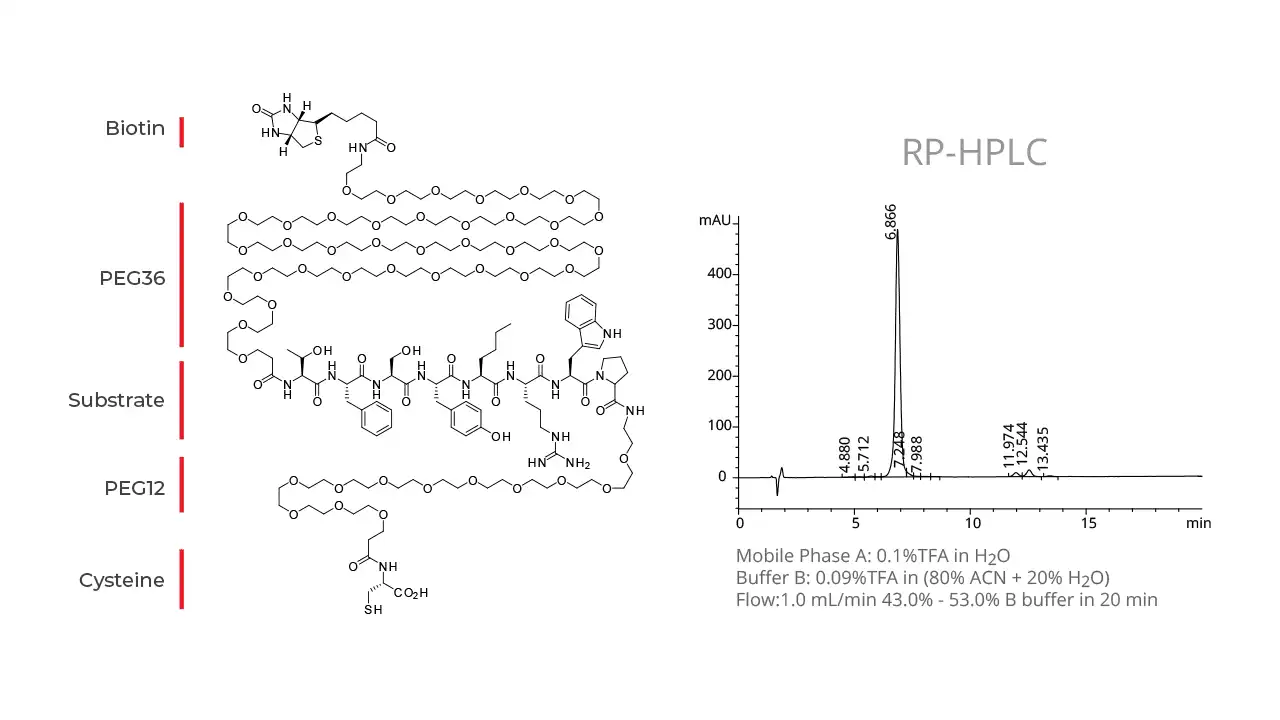
RP-HPLC établit une pureté relative; ESI-MS établit son identité. Aucun des deux n'établit l'autre, et un package qui les traite comme interchangeables laisse le critique incapable de répondre à l'une ou l'autre des questions..
La distinction n'est pas éditoriale. Je Q2(R2), à compter de juin 2024, remplacé Q2(R1) et traite le dosage/la puissance, pureté, les impuretés et l'identité comme objectifs analytiques distincts, chacun avec sa propre attente de validation. Le PCI Q2(R2) directives de validation émises par la FDA en mars 2024 porte la même structure. La première question de l’examinateur n’est donc pas « existe-t-il une trace HPLC » mais « à quoi sert cette méthode ?, et a-t-il été validé à cette fin.
Pour le chromatogramme, les champs qui comptent sont la colonne et les dimensions, pente, longueur d'onde de détection, étalon de référence, et l'identifiant de la méthode. Une épaule de premier plan à 0.6 RRT n'est interprétable qu'en fonction de ces paramètres: sans le dégradé, le temps de rétention ne veut rien dire.
Une analyse des pratiques d’approvisionnement en peptides CRO déclare que les acheteurs doivent s'attendre à des données HPLC et de spécifications de masse en standard plutôt qu'en supplément, et devrait pouvoir demander des données brutes de contrôle de la qualité plutôt qu'un résumé.
Deux limites appartiennent ici. Un tableau récapitulatif n'est pas le chromatogramme. Et un spectre de masse confirme la masse, pas de position de séquence: une suppression et une substitution peuvent renvoyer la même masse nominale, donc MS seul ne peut pas vous dire où une séquence diffère.
Contenu, contre-ion et bilan de masse
Contenu, ou peptide net, est une valeur de bilan massique: il indique quelle quantité de poudre pesée est réellement un peptide, après le contre-ion, l'eau et le solvant résiduel sont soustraits. C'est l'allégation qui manque le plus souvent dans un colis qui, autrement, semble complet, et un pourcentage de surface HPLC ne peut pas le remplacer. Le pourcentage de surface mesure la part de la surface du pic absorbant les UV à une longueur d'onde; cela ne dit rien sur la masse de matière que représente ce pic.
Un évaluateur qui lit un certificat de pureté uniquement fait quand même le calcul.. Si beaucoup est signalé à 95% la pureté par zone et la teneur nette en peptides est 70%, puis un 10 La pesée en mg délivre environ 7 mg de peptide, et chaque calcul molaire en aval hérite de cet écart. Counterion est généralement le terme le plus grand: l'acétate et le trifluoroacétate ajoutent tous deux une masse qui n'est pas un peptide.
L'analyse des acides aminés est l'approche de référence pour la précision de la concentration et de la composition, car il quantifie directement la masse peptidique plutôt que de la déduire d'une réponse chromatographique (Journal d'analyse pharmaceutique, 2016).
Clé à retenir: La pureté par pourcentage de surface et le contenu par bilan massique répondent à différentes questions. Un package qui ne rapporte que le premier laisse le réviseur deviner le second..
Où un package signale le contenu mais pas la méthode qui le sous-tend, le numéro n'est pas vérifiable, et la section du certificat qui doit le porter reste vide.
Records de stabilité: conception, conditions et délais
Un tableau de résultats de stabilité n'est interprétable que lorsque le protocole qui l'a produit voyage dans le même package. Sans le protocole, un laboratoire récepteur ne peut pas dire si l'étude s'applique à ses propres conditions de stockage et de manipulation.
Le contenu requis d'un protocole de stabilité est défini dans Lignes directrices de Santé Canada sur la stabilité, rubriques 52 à 62 (2025-09-04). Un ensemble de données sur la stabilité des peptides doit contenir, le cas échéant: identification du produit et références du document maître; type et taille du conteneur et du système de fermeture, plus le nombre total de conteneurs; code de lot ou de lot avec date de fabrication et date de péremption proposée; taille de l'échantillon et intervalles de test par paramètre; conditions de stockage avec tolérances et manière dont ces tolérances sont maintenues; orientation de l'échantillon reflétant le pire des cas; cahier des charges avec critères d'acceptation par paramètre; la méthode d'évaluation des données, y compris l'analyse statistique ou les tendances; et le format du rapport.
Ces champs s'inscrivent dans un cadre plutôt que de le remplacer. Le Q1A actuel(R2) cadre de stabilité dates jusqu'en novembre 2003, et les attentes Q5C pour les produits de type peptide (Juillet 1996) affirmer que les produits dont les composants actifs sont généralement des protéines ou des polypeptides sont particulièrement sensibles à la température, oxydation, lumière, contenu ionique et cisaillement, des conditions de stockage strictes sont donc généralement nécessaires. Q5C ne remplace pas Q1A(R2); les deux s'appliquent ensemble. La liste de champs ci-dessus est une exigence générale du protocole de stabilité, pas spécifique au peptide ou spécifique à la FDA.
Adéquation du test et enregistrements qui rendent un résultat transférable
La pertinence du test appartient à la méthode dans la matrice, pas au peptide. Une grande partie des lectures claires par RP-HPLC peuvent toujours échouer à un test d'activité basé sur les cellules, parce que le test mesure ce que fait le peptide dans un tampon, une lignée cellulaire et une plaque, et ces conditions font partie du résultat. Les enregistrements qui rendent un numéro d'activité transférable sont donc le format, la matrice, les contrôles et les critères d'acceptation, pas seulement la valeur.
Pour les programmes de type conjugué, la barre est plus haute. ChemExpress expose les demandes analytiques pour les programmes de conjugués peptides-médicaments comme LC-MS/MS pour la confirmation structurelle, SEC-MALS pour l'agrégation, HPLC-UV/MS pour le rapport médicament/peptide et la charge utile gratuite, cartographie peptidique pour les sites de modification, et tests biologiques pour l'activité, avec des méthodes validées selon les lignes directrices de l'ICH. La même source précise que sans site de conjugaison, rapport médicament/peptide et caractérisation de l'agrégation, "vous ne pouvez pas déposer une IND."
Là où un package de phase de découverte peut s’arrêter net: si le programme n'est pas encore déposé, une méthode documentée avec matrice et contrôles peut suffire, à condition que le dossier indique lesquelles de ces caractérisations sont encore ouvertes.
Enregistrements, pistes d'audit et ce qui rend un package défendable
Un colis est défendable lorsque ses enregistrements électroniques répondent aux mêmes attentes en matière d'intégrité que les enregistrements papier., et partie 11 énonce ces attentes directement. 21 CFR 11.10(e) et l'exigence d'une piste d'audit appelle à la sécurité, généré par ordinateur, des pistes d'audit horodatées qui enregistrent indépendamment la date et l'heure des entrées des opérateurs et des actions créées, modification, ou supprimer des enregistrements électroniques, avec des changements n'obscurcissant jamais les informations précédemment enregistrées et des traces conservées au moins aussi longtemps que le sujet enregistre. 21 CFR 11.10(un) ajoute la validation des systèmes pour l'exactitude, fiabilité, performances attendues constantes, et la capacité de discerner les enregistrements invalides ou modifiés, alors que 11.100(un) et 11.300(un) exiger que chaque signature électronique soit unique à un individu et ne soit jamais réutilisée ou réaffectée.
Le mode de défaillance est un enregistrement électronique qui ne peut pas montrer ce qui a changé, quand, et par qui. Un certificat d’analyse peptidique révisé sans version antérieure conservée constitue exactement cette lacune..
|
Attribut ALCOA |
Enregistrer un artefact qui le démontre |
|---|---|
|
Attribuable |
Analyste nommé et identifiant unique sur chaque entrée |
|
Lisible |
Piste d'audit horodatée lisible à travers les révisions |
|
Contemporain |
Horodatage de l'entrée correspondant à l'action |
|
Original |
Services Première capture conservée, pas une transcription ultérieure |
|
Précis |
Système validé capable de signaler les enregistrements modifiés |
Deux limites comptent. Portée déclarée par la FDA et application de la partie 11 dit que l'agence interprétera la règle de manière restrictive, et où les ordinateurs génèrent simplement des impressions papier répondant à toutes les exigences en matière d'enregistrement, le dossier papier est le dossier réglementé. Partie 11 n'atteint pas non plus tous les fichiers électroniques détenus par un CRO.
La visite guidée des références croisées: un lot, cinq sauts

Un ensemble minimum de données connectées pour un projet peptidique est aussi solide que les liens entre ses enregistrements, le test pratique consiste donc à savoir si un numéro de lot peut être suivi sur cinq sauts sans impasse.
Prenez beaucoup de choses publiées par MOL Changes. Le numéro de lot sur le certificat d'analyse pointe vers le chromatogramme RP-HPLC, qui nomme l'ID de méthode sous lequel il a été exécuté. Cet ID de méthode pointe vers le protocole de stabilité du même lot saisi, et le protocole pointe vers l'enregistrement de test qui l'a utilisé. Chaque saut est vérifiable. Aucun d'entre eux, tout seul, vous indique que le matériel est adapté à votre expérience.
L'enregistrement de solubilité montre où la chaîne cesse d'être sur le point de se libérer.. Il est exécuté pour trouver des conditions de solvant optimales, peut être personnalisé en fonction des solvants utilisés par votre expérience, avec de l'eau comme premier choix, et il répond à une question de formulation plutôt qu'à une question de version. Un évaluateur peut conclure que le lot se dissout dans les conditions testées. Ils ne peuvent pas conclure qu'il se dissoudra dans un tampon différent, à une concentration différente, ou après gel-dégel.
Liste de contrôle des évaluateurs et prochaines étapes
Utilisez-le comme filtre réutilisable pour n’importe quel fournisseur, pas seulement celui que vous évaluez maintenant. Il condense les exigences de documentation du peptide CRO dans les questions qu'un évaluateur pose réellement avant d'accepter un package..
-
Le certificat d’analyse est-il spécifique au lot, ou un modèle générique?
-
Le fournisseur indique-t-il la politique de piste d’audit de son système de données chromatographiques?
-
Vont-ils publier un enregistrement de lot représentatif pour une longueur de séquence et une hydrophobicité comparables, y compris le profil d'impuretés?
-
Y a-t-il une mise à l'échelle ou Boutique rapport de comparabilité?
-
Le dossier de transfert de méthode est-il complet?
-
Recevez-vous le chromatogramme et le spectre de masse réels, ou seulement un tableau récapitulatif?
-
Pour une séquence modifiée, existe-t-il un enregistrement de lot antérieur portant la même modification? À propos
-
Les enregistrements suivent-ils les principes de la MHRA ALCOA ?, et le fournisseur est-il titulaire d'une certification ISO 13485 ou ISO 9001 certificat?
Un manuel de diligence raisonnable pour la sélection de peptides CRO repose sur une règle de décision: si l'un de ces sept enregistrements est manquant et que le fournisseur ne s'engagera pas sur une date pour celui-ci, traitez le colis comme non vérifié et évaluez le risque dans votre calendrier. La liste de contrôle est réutilisable entre les fournisseurs, c'est ce qui rend le changement moins coûteux qu'il n'y paraît.
MOL Changes expédie un certificat d'analyse complet avec chromatogrammes, téléchargeable depuis chaque page produit et récupérable via un code QR spécifique au peptide, et il a un intérêt commercial dans les normes de qualité des peptides. Si vous souhaitez tester la liste de contrôle par rapport à un package en direct, demandez un échantillon de données ou parlez à un expert analytique.
[Appel à l'action: Demander un exemple de package de données]
Foire aux questions
Que doit contenir un certificat d'analyse peptidique?
Un certificat d'analyse peptidique utilisable identifie le lot, nomme la méthode derrière chaque résultat, et rapporte la pureté, identité, et le contenu en tant que valeurs distinctes plutôt qu'un seul chiffre principal. Un évaluateur a besoin du numéro de lot, identifiants de méthode, le chromatogramme et le spectre de masse, et la spécification par rapport à laquelle chaque valeur est jugée. Un colis réduit à un pourcentage de pureté laisse le laboratoire destinataire incapable de confirmer ce qui a été mesuré.
Les pourcentages de pureté peuvent-ils être comparés entre les fournisseurs?
Uniquement lorsque la méthode chromatographique est comparable, car un chiffre de pureté est une propriété de la méthode autant que du peptide. Deux fournisseurs signalent 98% peut être en train d'exécuter des colonnes différentes, dégradés, et longueurs d'onde de détection, et une méthode qui résout moins d'impuretés rapporte un nombre plus élevé pour le même matériau. Traiter un pourcentage sans ses paramètres de méthode comme invérifiable plutôt que comparable.
De quelle quantité de données de stabilité un programme peptidique en phase de découverte a-t-il besoin?
Suffisamment pour couvrir l’intervalle et les conditions auxquelles le matériau répondra réellement, et pas plus. Les premiers travaux de découverte justifient rarement un ICH Q1A complet(R2) étude entre parenthèses, mais cela justifie de savoir si le peptide survit au tampon, température, et sa manipulation répond au cours du test. Où la stérilité fait partie du cahier des charges, l'USP <71> test de stérilité pose un sol en béton: les milieux sont incubés pendant au moins 14 jours, avec un milieu fluide au thioglycolate à 32.5 ± 2.5 °C et milieu de digestion soja-caséine à 22.5 ± 2.5 °C, et aucune preuve de croissance microbienne signifie que le produit est conforme.
Pouvez-vous demander des chromatogrammes bruts et des spectres de masse?
Oui, et pour tout lot sur lequel vous comptez compter, tu devrais. Un chiffre de pureté récapitulatif est une conclusion; le chromatogramme montre la forme du pic, ligne de base, et si un épaulement avant était intégré au pic principal ou exclu de celui-ci. Certains fournisseurs publient des chromatogrammes complets comme pratique standard, d'autres les fournissent sur demande. De toute façon, la demande fait partie des exigences en matière de documentation que vous avez définies avant la première commande, pas après l'échec d'un lot.
Combien de temps un ensemble de données peptidiques doit-il être conservé?
Conservez-le aussi longtemps que tout résultat dérivé de ce lot peut nécessiter une défense., ce qui signifie en pratique la durée de vie du programme plus la période de conservation requise par votre système qualité. Conclusions sur la stabilité, qualifications d'analyse, et toute soumission citant le matériel remonte toutes aux documents originaux, donc un package qui ne peut pas être récupéré ultérieurement est en fait un package qui n'a jamais existé. Confirmez l’engagement de rétention dans le cadre de vos exigences en matière de documentation peptidique CRO plutôt que de l’assumer.
Conclusion
Le paquet minimum de données connectées pour un projet peptidique est défini par la réexécution, pas en volume: si un laboratoire récepteur ne peut pas répéter votre résultat à partir des seuls enregistrements, le package est incomplet, quel que soit le nombre de pages sur lequel il s'étend. Ce test trie proprement les cinq affirmations. Pureté, identité, contenu, la stabilité et l'adéquation du test nécessitent chacune leur propre enregistrement, et chaque enregistrement comporte une limite déclarée sur ce qu'il ne prouve pas. La chaîne de références croisées les maintient ensemble, du numéro de lot au protocole de stabilité en passant par le chromatogramme et l'identifiant de la méthode, afin qu'un réviseur puisse suivre un saut à la fois au lieu de reconstruire votre projet de mémoire.
La couche de normes en dessous est stable. Je Q2(R2) régit la manière dont les procédures analytiques sont validées, Je Q1A(R2) et Q5C définissent les attentes en matière de stabilité, Les monographies de l'USP corrigent les tests officinaux, et 21 Partie CFR 11 couvre la piste d'audit. La pratique des fournisseurs n’est pas stable, et c'est dans cette lacune que les packages échouent à l'examen.
La prochaine étape est donc concrète. Prenez le dernier certificat d'analyse que votre fournisseur actuel vous a envoyé, choisissez un lot, et essayez de parcourir les cinq sauts sans envoyer d'e-mail à personne. Où la chaîne se brise, c'est la question à poser par écrit à votre fournisseur.