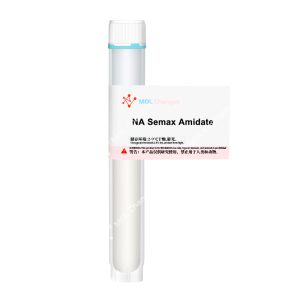
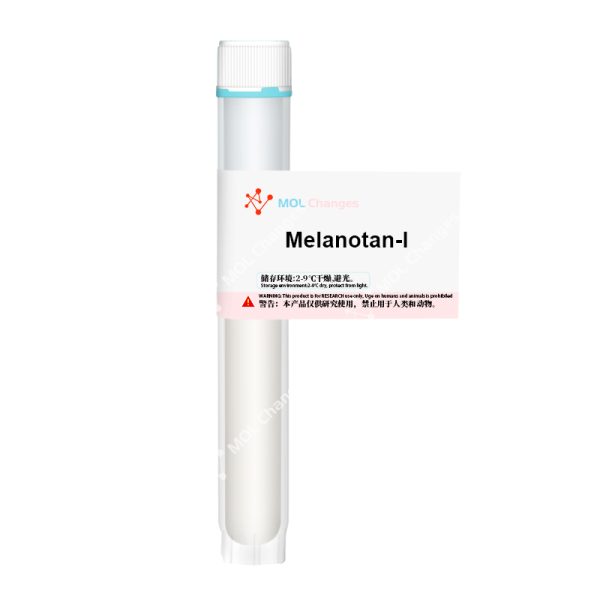
Melanotan-kuv (MT-I), los yog ntau precisely [Nle4, D-Phe7]-α-MSH, yog ib qho analog ntawm α-MSH (melanocyte-stimulating hormone). Ib tug linear tridecapeptide, nws txhawb melanin tsim los ntawm kev xaiv ua kom lub MC 1 R (melanocortin-1 receptors).
Cov pov thawj sim txhawb nws qhov tsis muaj tshuaj lom thiab tsis yog carcinogenic profile, ob qho tib si hauv vivo thiab ntau yam hauv vitro qauv. Piv rau ntuj α-MSH, Melanotan-Kuv muaj lub sijhawm ntev ib nrab-lub neej; nws tau ua tiav kev lag luam hauv European Union.
Ib ntus
Ac-Ser-Tyr-Ser-Nle-Glu-His-D-Phe-Arg-Trp-Gly-Lys-Pro-Val-NH₂
CAS Nr
75921-69-6
Molecular Formula
C78H111N21O19
Molecular Luj
1646.85
Kev tshawb fawb ntawm Melanotan-I
Cov melanocortin system yog tsim los ntawm tsib txawv receptors (MC1-R mus MC5-R), cov melanocortin peptides tau hais los saum no (Proopiomelanocortin/POMC tau txais peptides), thiab ob endogenous antagonists.
Melanotan-Kuv xaiv khi rau thiab qhib cov thawj receptor, MC 1 R. The core sequence (His-Phe-Arg-Trp) is responsible for this specific interaction.
Receptor activation leads to intracellular cyclic adenosine monophosphate (cAMP) and all subsequent PKA-dependent pathways; melanin-synthesizing enzymes (tyrosinase being the prime example) are ultimately increased in activity.
Increased eumelanin production within the skin results in enhanced pigmentation – a partial but valuable barrier against ultraviolet and visible light penetration. Scavenging of UV-induced reactive oxygen species (DNA, protein, and lipid damage) is also believed to be mediated by eumelanin.
Melanotan-I exerted the greatest protective effect on increasing this specific protective eumelanin. A double blind trial measured various parameters of photoprotection; low sunburn prone subjects received 3 cycles of subcutaneous injections.
Skin melanin density increased as previously mentioned, thiab feem ntau epidermal sunburn hlwb raug txo. Kev tiv thaiv kev yees duab, yam tsawg kawg mus rau ib tug tseem ceeb degree, yog lub hom phiaj tseem ceeb kawg ntawm tib neeg daim tawv nqaij raug UVR.
Melanotan-Kuv induces tawv nqaij pigmentation nyob rau hauv EPP(Erythropoietic Protoporphyria muaj) cov neeg mob, txo cov photosensitivity thiab tom qab alleviating cov kab mob ntawm daim tawv nqaij.⁵ EPP nws tus kheej yog ib tug tsis tshua muaj genetic ntshawv siab.; tsub zuj zuj ntawm photosensitizer, Protoporphyrin IX, ua rau qhov rhiab heev rau qhov pom kev pom.
Ib qho kev kawm qhib-label hla dhau 4 lub hlis tau ua rau tsib yam EPP; Subcutaneous Melanotan-I cog tau muab tshuaj rau hnub 7 thiab lis 8. Muab piv rau lub hauv paus, nce nyob rau hauv daim tawv nqaij melanin ceev tau ntsuas, nrog rau kev txhim kho siab ntev rau lub teeb stimulation – qhov tshwj xeeb metric siv yog 'lub sij hawm mus cuag qhov mob intolerable’ nyob rau hauv illumination.
Teb Chaws Asmeskas. Food and Drug Administration (FDA) pom zoo Scenesse (afamelanotide tshuaj), Tam sim no daim ntawv ntawm Melanotan-I cog, rau qhov no heev.
Cov kev tshawb fawb preclinical tau pom tias muaj cov tshuaj toxicity tsawg (tsis pom muaj carcinogenicity raws li pom nyob rau hauv ob qho tib si hauv vitro thiab tag nrho cov kuaj hauv vivo qauv.
Kev siv tau zoo ntawm cov tawv nqaij pigmentation yog ib qho ntawm cov ntaub ntawv zoo dua ntawm Melanotan-I; pluag photoresponsive hom tawv nqaij (nyob ze ua kom tiav tanning tsis ua hauj lwm yog qhov kawg point) tau txais txiaj ntsig zoo heev los ntawm nws.
Qhov txo qis ntawm daim tawv nqaij cov tshuaj lom rau cov hluav taws xob ultraviolet yog qhov tseeb, xav tau kawg ntawm tag nrho cov no – sunburn thiab lwm yam kev puas tsuaj raug txo, yam tsawg kawg ib nrab, los ntawm Melanotan-I.
COA
HPLC
MS