Modificações de Peptídeos
Peptídeo Cíclico
What is Cyclic Peptide?
Peptide cyclization to form cyclic peptides or cyclized peptides is a frequently used strategy for the development of peptides with enhanced conformational stability compared to their linear analogs. Cyclic peptides have proven to be useful for several applications, including the mimicry of protein secondary structures, such as protein loops, and the optimization of peptide ligands with increased binding potency, selectivity, and enhanced protease stability.
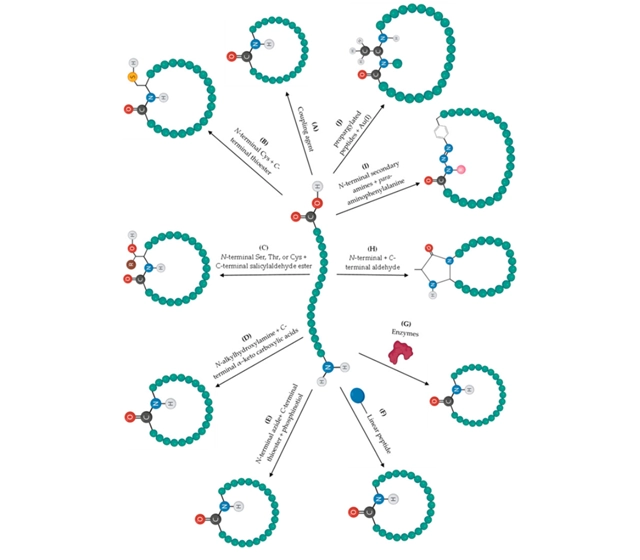
Cyclization configurations
The primary ligation approaches to synthesize lactam cyclic peptides are head-to-tail, cadeia lateral a cadeia lateral, head-to-side-chain, and side-chain-to-tail,depending on the location of the functional groups within the peptide sequence.
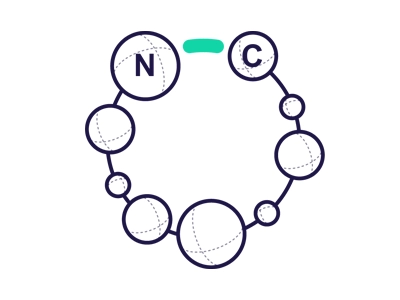
Head to Tail
·Occurs between N-terminus to C-terminus.
·Via Amide bond formation (lactamization).
·Most frequently used cyclization conferring greater stability.
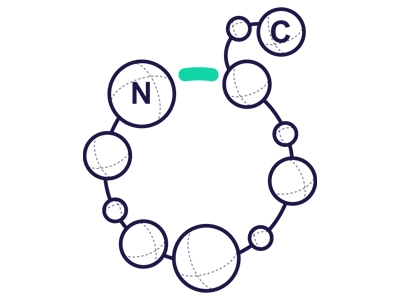
Side Chain to Head
Occurs between N-terminus and an internal COOH
(por exemplo. the ß-COOH-group of Asp or γ-COOH-group of Glu).
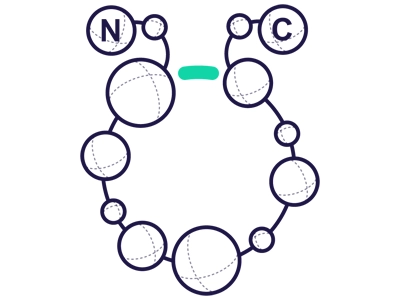
Side Chain to tail
Occurs between internal NH2s and C-terminus
(por exemplo. the ε-NH2–group of Lys).
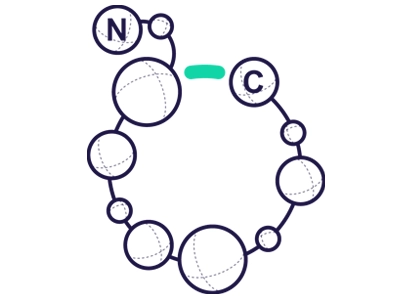
Side Chain to Side Chain
Occurs between Side chain of Lysine (ε-NH2–group of Lys) to Aspartic or Glutamic acid (γ-COOH-group).
Citações em destaque
Design and NMR Studies of Cyclic Peptides Targeting the N-Terminal Domain of the Protein Tyrosine Phosphatase YopH
We report on the design and evaluation of novel cyclic peptides targeting the N-terminal domain of the protein tyrosine phosphatase YopH from Yersinia. Cyclic peptides have been designed based on a short sequence from the protein SKAP-HOM [DE(pY)DDPF (pY = phosphotyrosine)], and they all contain the motif DEZXDPfK (where Z is a phosphotyrosine or a non-hydrolyzable phosphotyrosine mimetic, X is an aspartic acid or a leucine and f is a d-phenylalanine). These peptides present a ‘head to tail’ architecture, enabling cyclization through formation of an amide bond in between the side chains of the first aspartic acid and the lysine residues. Chemical shift perturbation studies have been carried out to monitor the binding of these peptides to the N-terminal domain of YopH. Peptides containing a phosphotyrosine moiety exhibit binding affinities in the low micromolar range; substitution of the phosphotyrosine with one of its non-hydrolyzable derivatives dramatically reduces the binding affinities. These preliminary studies may pave the way for the discovery of more potent and selective peptidebased ligands of the YopH N-terminal domain which could be further investigated for their ability to inhibit Yersiniae infections.
Serviços relacionados de modificação de peptídeos
glicosilação peptídica
glicosilação peptídica
A glicosilação peptídica é uma modificação covalente que pode potencialmente melhorar as propriedades físico-químicas dos peptídeos
Leia maisFosforilação de peptídeos
Fosforilação de peptídeos
A fosforilação pode ocorrer na serina (S, Ser), Treonina (T, Thr) e tirosina (S, Tyr) cadeias laterais por formação de ligação fosfoéster
Leia maisPeptídeos Grampeados
Peptídeos Grampeados
Introdução de dois aminoácidos não naturais contendo α-metil, Grupos α-alquenil durante a síntese em fase sólida de cadeias peptídicas.
Leia maisPeptídeo Cíclico
Peptídeo Cíclico
A ciclização peptídica aumenta a estabilidade conformacional dos peptídeos (em relação aos seus análogos lineares) e é uma estratégia comum no desenvolvimento de peptídeos.
Leia maismodificação peptídica
Ampla experiência em modificação de peptídeos, fornecendo vários caminhos viáveis para pesquisa de peptídeos.
