Por que a verificação de fornecedores de peptídeos de nível de pesquisa se tornou um problema de aquisição
O mercado cinza cresceu mais rápido do que sua papelada. Chainalysis registrou influxos de criptografia de peptídeos no mercado cinza aumentando de US$ 12 milhões para US$ 32 milhões no primeiro trimestre 2026, um 159% salto trimestral e o sexto trimestre consecutivo de crescimento (Chainálise, 2026-06-04). Volumes como esse normalmente forçam o amadurecimento dos padrões de documentação. Aqui não.
Finnrick, um laboratório de testes de peptídeos no Texas, analisaram milhares de produtos adquiridos de forma independente e descobriram que cerca de um terço falhou nas verificações básicas de qualidade, com a proporção praticamente inalterada em todo o 12 para 14 meses de coleta de dados (O Guardião, 2026-04-06). Uma taxa de falha estável é o sinal mais difícil: o mercado cresceu, a taxa de erro não mudou.
Isso deixa a verificação do fornecedor de peptídeos de nível de pesquisa como trabalho do comprador. As falhas que Finnrick relata se enquadram em três categorias, identidade, pureza e quantidade, e eles formam a espinha dorsal da estrutura abaixo.

O que realmente significa material de grau de pesquisa e desenvolvimento

“Grau de pesquisa” e “grau de desenvolvimento” descrevem a mesma distinção prática: quanto de uma especificação está documentada e até que ponto o material percorreu em direção a um uso regulamentado. Material de nível de pesquisa é vendido para investigação laboratorial, com identidade e pureza caracterizadas, mas não qualificadas para uso humano ou veterinário. O material de nível de desenvolvimento segue mais adiante no mesmo caminho, onde o fornecedor possui documentação adicional de processo e liberação porque o material se destina a alimentar um programa de desenvolvimento.
Nenhum dos rótulos é uma categoria regulatória. “Qualidade farmacêutica” é o exemplo mais claro de um termo sem significado regulatório fixo em um contexto de marketing: sinaliza uma aspiração, não é um status, e nunca deve substituir uma especificação que você possa ler.
A especificação em si é onde a confusão começa, porque agrupa as três medições separadas por trás de uma especificação de peptídeo: pureza cromatográfica, conteúdo peptídico, e o contra-íon, água e fração residual de sal. Pureza é uma proporção relativa de área de pico dentro de um cromatograma. O conteúdo do peptídeo é a fração de massa do peptídeo real no frasco, medido por análise de aminoácidos, RMN quantitativa ou um método de ensaio, não por HPLC de pureza padrão. Contra-íons, água ligada e sais residuais são massa não peptídica que aumenta a quantidade pesada sem nunca aparecer como um pico de impureza.
Essa lacuna é grande o suficiente para mudar a forma como você calcula uma dose. Em uma análise detalhada do que um frasco liofilizado realmente contém, o peptídeo alvo é responsável por aproximadamente 78% de massa total, o contra-íon ao redor 12%, água ligada sobre 6% e sais residuais sobre 4%. A pureza do HPLC pode ser lida legitimamente 99% enquanto um frasco de “10 mg” fica mais próximo de 7.8 mg de peptídeo, que exagera a molaridade calculada no rótulo em aproximadamente 22%. Contraíon, água e sais geralmente são responsáveis por 15 para 25% da massa total sem mover o número de pureza cromatográfica.
⚠️ Aviso: Um certificado de análise de identidade e pureza não estabelece esterilidade, status de endotoxina, quantidade de enchimento correta ou estabilidade a longo prazo, a menos que esses atributos tenham sido testados separadamente. Os testes de terceiros também são baseados em amostras e não em lotes: um laboratório certifica o frasco ou alíquota que recebeu, e o resultado representa todos os frascos do lote apenas se o plano de amostragem tiver sido concebido para ser representativo e documentado (Peptídeos.so, recuperado 2026-05-16).
Etapa 1: Confirme se o material foi testado por identidade, não apenas testado em termos de pureza
Uma porcentagem de pureza e uma confirmação de identidade são duas medidas diferentes, e um CoA que relata apenas o primeiro não estabeleceu o segundo. Massa intacta por ESI/LC-MS compara a massa monoisotópica observada desconvoluída com o valor teórico, que confirma a massa molecular e a composição. O que não faz importa tanto: uma massa intacta correta não prova a ordem da sequência, não descarta isômeros de sequência ou substituições isoméricas, como Leu/Ile ou Asp/isoAsp, e não relata conteúdo de contra-íon ou estado de sal (Proteômica Criativa, 2025-05-10).
Essa distinção oferece uma verificação de aprovação/reprovação no teste de identidade de peptídeos. O CoA indica uma massa observada em relação a uma massa teórica com o desvio dado? Em instrumentos Q-TOF ou Orbitrap, precisão de massa abaixo 5 ppm é alcançável, e uma massa monoisotópica medida deve pousar dentro 10 ppm de teórico, o que é 0.02 Sim e 2,000 E; um desvio acima 20 ppm garante investigação (Proteômica Criativa, 2025-05-10). Quando um fornecedor reivindica identidade em nível de sequência, A fragmentação MS/MS b/y deve ser relatada, porque a massa intacta por si só não pode apoiar essa afirmação.
Etapa 2: Leia o número de pureza em relação ao seu método
Uma porcentagem de pureza é uma proporção, e o denominador é definido pelo método. A pureza é calculada como a área do pico principal dividida pela área total do pico detectado, normalmente em 214 nm, qual é a absorbância da ligação peptídica (Proteômica Criativa, 2025-05-10). Alterar a coluna, o gradiente, o comprimento de onda de detecção ou o limite de integração e você altera o que conta como uma impureza separada, é por isso que um simples “99% puro” é infalsificável sem a divulgação do método (Proteômica Criativa, 2025-05-10).
Isso fornece uma verificação de aprovação/reprovação de quaisquer dados de pureza de peptídeos que você receber. Solicite o cromatograma específico do lote, em seguida, confirme que o método divulgado permite inspecionar você mesmo o formato do pico e os picos menores. Em um 4.6 × 150 coluna mm, um peptídeo bem comportado elui como um único pico gaussiano simétrico com largura na meia altura de 0.1 para 0.3 minutos. Ombros, picos divididos ou uma linha de base crescente são os sinais de impureza que vale a pena perseguir, e as mudanças em massa apontam para a sua provável origem: +16 Da para oxidação de metionina ou triptofano, −18 Da para desamidação da asparagina, −113 Da para uma deleção de isoleucina ou leucina, −57 Da para uma deleção de glicina.
Serviços Vale a pena declarar claramente um limite: diastereômeros e epímeros compartilham a massa do alvo, então o MS não pode separá-los da sequência correta. Uma identidade confirmada em massa não é a mesma coisa que uma identidade estereoquimicamente limpa.
Etapa 3: Verifique o conteúdo líquido de peptídeos, não apenas o peso da etiqueta
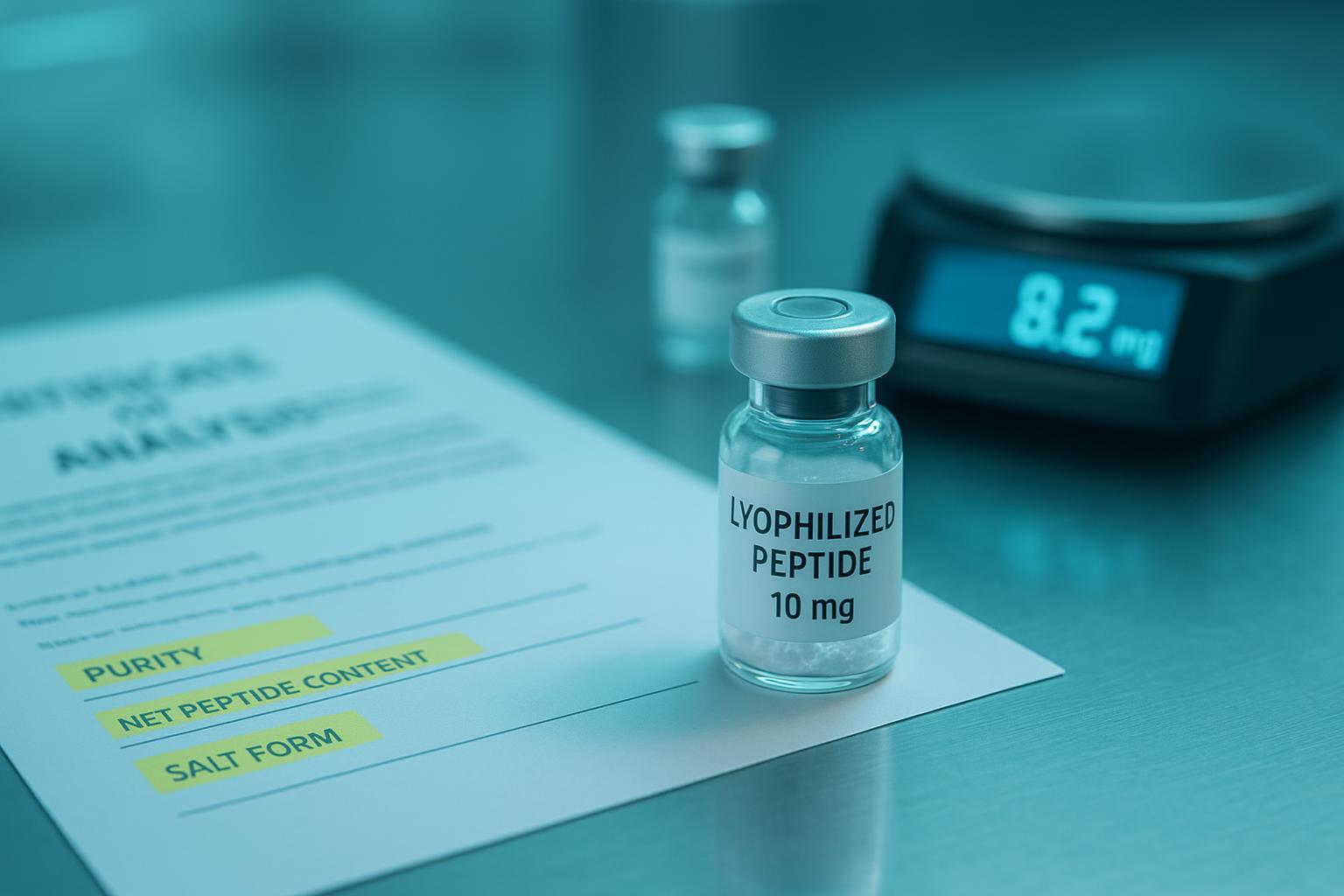
A subdosagem é o modo de falha que um cromatograma de pureza não pode mostrar. Entre 12,118 testes que transportam um valor de conteúdo líquido medido, 7.16% (868 frascos) entrou abaixo 95% do valor rotulado, aproximadamente 26 vezes mais comum do que uma falha de pureza (Instantâneo do Índice de Pureza do Peptigrity, recuperado 2026-08-25). Pureza e conteúdo são medidas separadas, e apenas um deles aparece na maioria dos certificados de análise de peptídeos.
UM caso documentado de uma amostra com 99,80% de pureza 24% sob rótulo torna a lacuna concreta: o frasco de Mazdutide lido 99.80% puro ao testar 15.18 mg contra um 20 rótulo mg, um déficit de conteúdo de -24,1%.
A forma de sal explica parte da propagação. Um frasco rotulado 10 mg de sal TFA contém aproximadamente 9.5 mg de peptídeo, e a massa em forma de sal espalhada pelo mesmo Comprar peptídeo mostra por que isso deve ser declarado: MOTS-c como base livre, extensões de sal de acetato e TFA 2,174.6, 2,234.64 e 2,288.6 E, uma faixa de 114 daltons.
Verificação de aprovação/reprovação: o CoA indica o conteúdo líquido de peptídeo por frasco e nomeia a forma de sal? Se algum dos campos estiver faltando, você não pode confirmar o que o frasco contém.
Etapa 4: Verifique a cadeia do lote – frasco, CoA e etiqueta de envio
Um certificado de análise é apenas uma prova do lote que nomeia, e esse lote deve ser rastreável até o frasco em sua mão. Execute a verificação como aprovado ou reprovado: o número do lote no frasco, o número do lote no CoA e o número do lote na documentação de remessa devem corresponder, e o CoA deve nomear o laboratório de teste e a data da análise. Qualquer lacuna quebra a corrente.
O limite mais profundo é que os testes de terceiros são baseados em amostras, não é prova de todo o lote. Um laboratório certifica o frasco ou alíquota que recebeu, portanto, o resultado pode não representar todos os frascos do lote, a menos que o plano de amostragem seja representativo e documentado. Se o fornecedor selecionou a amostra ou a custódia não foi controlada, o resultado não é equivalente a uma fiscalização independente do mercado. Essa distinção é o que testes de peptídeos de terceiros podem e não podem certificar, e é também por isso que as reivindicações de consistência entre lotes precisam de registros retidos por trás delas, nem um único relatório.
Etapa 5: Aplicar controles de uso pretendido como um teste do lado do fornecedor
Um rótulo somente para uso em pesquisa não define a finalidade de um produto. Em Agosto da FDA 2026 carta de advertência para NuScience Peptides, a agência escreveu que, apesar do rótulo indicar “para laboratório, pesquisar, e uso analítico” e “não destinado ao uso humano ou veterinário,”evidências do site estabeleceram que os produtos se destinavam a ser medicamentos para uso humano, porque a água bacteriostática foi comercializada juntamente com uma “calculadora de peptídeos” que fornece os meios para preparar um medicamento injetável.
Esse é o teste do lado do fornecedor: o que a empresa vende junto ao peptídeo, e como ele enquadra a página. A evidência de agrupamento de acessórios no mês de agosto 2026 cartas mostra o padrão duas vezes, com solvente de reconstituição vendido ao lado de um “guia de peptídeos” e uma calculadora. O princípio é anterior aos peptídeos. Em a carta de advertência da Agena Bioscience, conforme analisado por Mintz, A FDA considerou que as isenções de responsabilidade apenas para uso em pesquisa eram “ineficazes para substituir a totalidade das evidências objetivas coletadas sobre o teste e seu uso pretendido”.
Passar: a página do produto descreve o material, seus dados de teste e seu manuseio, e nada mais. Falhar: solventes de reconstituição, calculadoras de dosagem ou guias de administração estão no mesmo catálogo, ou a página contém tratamento implícito ou enquadramento antes e depois. Um fornecedor que vende pesquisa BPC-157 usa apenas material que também lhe vende os meios para injetá-lo e respondeu à própria pergunta sobre o uso pretendido.
|
Ponto de verificação |
Evidência necessária |
Onde aparece |
Condição de aprovação |
|---|---|---|---|
|
Confirmação de identidade |
Síntese de Peptídeos Dados de espectrometria de massa que identificam a sequência peptídica |
CoA, seção de método |
Um método é nomeado e um resultado é relatado |
|
Divulgação do método de pureza |
O método cromatográfico por trás da porcentagem |
CoA, seção de método |
Método declarado, não apenas um número |
|
Conteúdo líquido de peptídeos |
Massa peptídica versus massa total do frasco |
CoA, campos quantitativos |
Ambos os números relatados |
|
Forma de sal declarada |
Acetato, trifluoroacetato ou base livre |
CoA ou folha de especificações |
Declarado explicitamente |
|
Correspondência em cadeia de lotes |
O lote do frasco é igual ao lote CoA é igual ao lote da etiqueta de remessa |
Frasco, CoA, embalagem |
Todos os três concordam |
|
Controles de uso pretendido |
Sem solventes, calculadoras ou guias de dosagem incluídos |
Catálogo, página do produto |
Ausente |
|
Divulgação de limitação |
Testes não realizados, declarado como não realizado |
CoA, correspondência do fornecedor |
Divulgado em vez de omitido |
Etapa 6: Teste como o fornecedor comunica as limitações

Um fornecedor que nunca identifica uma lacuna nos seus próprios dados não é a escolha mais segura. Pergunte diretamente quais testes não foram realizados Peptídeos Sintéticos no lote, e se a resposta distingue o que um certificado de análise pode ou não estabelecer.
Essa distinção é importante porque a pureza cromatográfica, conteúdo de peptídeo e conteúdo de contra-íon ou água são três medições separadas, produzido por diferentes métodos. A Creative Proteomics observa que um peptídeo relatado em 98% pureza cromatográfica pode conter apenas cerca de 80% peptídeo em massa uma vez que os contra-íons de TFA, água adsorvida e solventes de síntese residuais são subtraídos. A escala dessa lacuna não é marginal: Laboratórios Certik coloca especificações típicas de peptídeos sintéticos liofilizados em aproximadamente 5 para 15% água por peso e 10 para 25% TFA residual ou contra-íon em peso para sais de TFA.
Verificação de aprovação/reprovação: o fornecedor informa quais testes não foram realizados, e separa o que sua documentação prova daquilo que não. A comunicação transparente aqui parece uma linha explícita de “não testado”, não silêncio.
Uma advertência honesta: dados de esterilidade e solvente residual realmente não são aplicáveis a alguns materiais de pesquisa. Um fornecedor que diz isso, e explica por que, está revelando uma limitação em vez de esconder uma.
Erros comuns na verificação de fornecedores de peptídeos de nível de pesquisa
O erro mais comum é tratar uma porcentagem de pureza como um sinal de qualidade completo. Cada erro abaixo tem uma correção documental que você pode aplicar a um CoA antes de fazer um pedido.
Aceitar um número de pureza sem divulgação de método. Uma figura como 98.7% não tem sentido sem saber se veio de HPLC, EM, ou uma estimativa interna. A correção: rejeitar qualquer CoA que não nomeie o método e o detector. Etapa 1 aborda a aparência de um teste de identidade compatível.
Assumir uma massa intacta correta prova a sequência. Massa confirma peso molecular, não arranjo. Dois peptídeos podem compartilhar uma massa e diferir na sequência. A correção: requer um método em nível de sequência, não massa sozinha.
Tratar um CoA de terceiros como prova de todo o lote. Quando o fornecedor controla qual amostra vai para o laboratório, o resultado descreve essa amostra, não o lote. A correção: pergunte como a amostra foi coletada e se o laboratório a recebeu diretamente.
Ler um rótulo de “10 mg” como 10 mg de peptídeo. O peso da etiqueta inclui contra-íons e umidade residual. UM 10 frasco de mg pode segurar bem sob 10 mg do peptídeo alvo. A correção: verifique se o CoA relata o conteúdo líquido de peptídeos separadamente.
Tratar uma isenção de responsabilidade da ORALL como controlo suficiente da utilização pretendida. Uma linha “somente para uso em pesquisa” não substitui uma página que comercializa dosagem ou uso humano. A correção: leia o aviso de isenção de responsabilidade na cópia ao redor.
Para dica: A verificação mais rápida é se o número do lote do CoA corresponde ao frasco em mãos. Se isso não acontecer, pare aí.
Qual é a aparência de um pacote analítico completo
Monte os elementos testados nas etapas anteriores e você obterá um conjunto de documentos, não é uma pasta de PDFs soltos. Um cromatograma específico do lote que nomeia seu método e coluna. Um resultado de massa intacta declarado como observado versus teórico, com o desvio mostrado. Conteúdo líquido de peptídeos e forma de sal, uma vez que o peso do rótulo por si só não indica a quantidade de peptídeo existente no frasco. Documentação da cadeia de lotes que amarra o frasco, certificado e etiqueta de envio para o mesmo número. E uma declaração clara do que não foi testado, qual é o campo que a maioria dos pacotes omite.
Esse último item é aquele que separa um sistema de documentação de um ativo de marketing. Um fornecedor cuja embalagem contém todos os seis elementos está descrevendo seu material; um fornecedor cuja embalagem contém cinco está descrevendo seu material seletivamente.
Principal vantagem: Você está comprando o pacote, não o número de pureza. UM 98% figura sem método, nenhum resultado em massa e nenhuma cadeia de lote é uma reivindicação. A mesma figura dentro de um pacote completo é uma evidência que você pode auditar. Produção de Peptídeos
MOL Changes é um exemplo de fornecedor cujo pacote de documentação é construído em torno desses elementos, com controle de qualidade em HPLC, MS e testes de esterilidade em uma aula 100 sala limpa. Trate-o como um ponto de referência para a aparência do pacote montado quando você solicitar um, e aplique a mesma lista de verificação a todos os fornecedores selecionados.
Contexto regulatório que o leitor deve acompanhar
A aplicação está ativa e lê as páginas dos produtos, não apenas rótulos. O banco de dados público de cartas de advertência da FDA mostra quatro vendedores de peptídeos citados em agosto 2026 lote de cartas de advertência sobre peptídeos, todos emitidos 2026-08-24 e todos classificados como “Novos medicamentos não aprovados/com marca incorreta”: TXP Inovações LLC (Peptídeos dba Tex), Royal Peptídeos LLC, NuScience Peptides LLC e Peptídeos de Pico de Desempenho.
A teoria jurídica que a FDA aplicou no 2026 cartas é a introdução de novos medicamentos não aprovados no comércio interestadual sob o FD&Lei C §§ 301(d) e 505(um), 21 EUAC. 331(d) e 355(um). O status do medicamento está anexado ao § 201(g)(1) quando um artigo se destina a tratar doenças ou afetar a estrutura ou função do corpo, e status de “novo medicamento” sob § 201(p) segue porque os produtos não são GRASE para as condições rotuladas. A intenção é inferida a partir do que o vendedor publica.
Isso importa por dois motivos. Primeiro, BPC-157 não é aprovado como medicamento nos EUA, e não está entre os produtos realmente mencionados na carta da NuScience, que lista análogos de GLP-1 e GLP-2, retatrutida, panelas de pressão, dos Mazduts, PT-141, tesamorelina e água bacteriostática. Segundo, os reguladores dos padrões de marketing são lidos como evidência de uso pretendido incluir reivindicações de tratamento implícitas, promessas de enquadramento antes/depois e recuperação de lesões, avaliado em relação à totalidade da rotulagem, cópia do site, depoimentos e contexto de distribuição. Uma isenção de responsabilidade “somente para uso em pesquisa do BPC-157” não neutraliza a cópia que promete reparo de tecidos.
Uma advertência que vale a pena declarar claramente: o status da lista de volumes FDA 503A do BPC-157 é relatado por rastreadores secundários, em vez de uma página primária da FDA lida para este guia, então trate esse ponto específico como não confirmado.
Perguntas frequentes
Um certificado de análise prova que um peptídeo é seguro para uso?
Não. Um certificado de análise de peptídeo documenta os testes que foram executados, e esses testes abordam a identidade, pureza e quantidade. Não estabelece esterilidade, status de endotoxina, volume de enchimento correto ou estabilidade a longo prazo, a menos que cada um deles tenha sido testado e relatado separadamente. Trate o documento como um registro de escopo analítico, não como uma garantia sobre para que o material é adequado.
Como posso diferenciar um fornecedor de nível de pesquisa de um revendedor?
Procure cinco coisas: um cromatograma específico do lote com o método divulgado, uma massa intacta com um desvio declarado, conteúdo líquido de peptídeos e forma de sal, números de lote correspondentes no frasco, CoA e documentação de envio, e uma lista explícita de testes não realizados. Um revendedor normalmente fornece uma porcentagem de pureza e um CoA genérico que não contém número de lote. Sobre
É um 99% resultado de pureza bom o suficiente?
Não por conta própria. Pureza é uma relação relativa de área de pico medida dentro de um único cromatograma, então o número depende da coluna, gradiente, comprimento de onda de detecção e limite de integração usado para produzi-lo. A mesma amostra que lê 99.80% puro ainda pode ser avaliado bem abaixo da afirmação do rótulo, é por isso que o conteúdo líquido de peptídeos deve ser lido junto com a porcentagem.
Por que o mesmo peptídeo apresenta pesos moleculares diferentes entre fornecedores?
Forma de sal e conteúdo de contra-íon. A base livre, as formas acetato e TFA de um peptídeo carregam massas diferentes, e contra-íons, água ligada e sais residuais podem constituir uma parcela substancial da massa total do frasco sem reduzir em nada o número de pureza cromatográfica. Quando dois fornecedores informam massas diferentes para a mesma sequência, compare a forma de sal declarada antes de assumir que uma está errada.
O que um fornecedor deve divulgar quando um teste não foi realizado?
Nomeie o teste, afirmar claramente que não foi realizado, e diga o que isso significa sobre como o material pode ser usado. Esterilidade, dados de endotoxinas e solventes residuais realmente não são aplicáveis a alguns materiais de pesquisa, e dizer isso é um ponto forte da documentação e não uma lacuna. O silêncio sobre o mesmo ponto é o que deve ser tratado como uma descoberta.
Conclusão
A verificação de um fornecedor de peptídeos de nível de pesquisa se resume a uma sequência que você pode executar de uma só vez: confirmar teste de identidade, leia o número de pureza em relação ao seu método, verifique o conteúdo líquido de peptídeos, combinar a cadeia do lote no frasco, CoA e etiqueta de envio, aplicar controles de uso pretendido, e observe como o fornecedor responde quando um teste não foi realizado. O valor dessa sequência não é produzir um fornecedor preferencial. É que produz seus próprios critérios de aceitação, escrito, portanto, a próxima cotação que você receber poderá ser julgada de acordo com um padrão que você definiu, e não com uma afirmação feita por alguém.
Se você quiser executar a sequência em um exemplo ao vivo, solicitar o pacote de documentação analítica para um lote específico, ou fale com um especialista técnico sobre quais testes se aplicam ao uso pretendido. MOL Changes fornece peptídeos de nível de pesquisa de uma classe 100 sala limpa com HPLC interno, MS e CQ de esterilidade, e tem interesse comercial em que os padrões de qualidade de peptídeos sejam lidos com atenção.
Avaliado por [Nome], Ph.D., Química Analítica.