O que 2026 NÓS. A reclassificação de peptídeos realmente mudou
O fevereiro 2026 anúncio de que 14 peptídeos seriam reclassificados não era regra. Foi uma declaração do secretário do HHS feita em um podcast em fevereiro 27, 2026, e a partir de março 7, 2026 nenhum aviso do Federal Register foi emitido e nenhuma lista atualizada foi publicada (Diário de Peptídeos, Marchar 2026).
Doze dessas substâncias foram removidas da categoria 2 em abril 15, 2026, eficaz cerca de uma semana depois, mas a remoção por si só não autorizou nada: não os colocou na lista de granéis 503A ou na categoria 1, e a composição nessa base acarretava risco regulatório (Orrick, abril 2026).

Em julho 2026, um comitê consultivo da FDA recomendou 6 de 7 peptídeos nomeados para a lista de volumes 503A, com contagens de votos variando de 8-6-1 para 6-7-1 (LumaLex, Julho 2026). Essa recomendação é apenas consultiva: A FDA ainda deve concluir a regulamentação de notificação e comentários e pode aceitar, modificá-lo ou recusá-lo. A equipe da FDA afirmou que nenhum dos sete estava bem caracterizado.
Um conjunto de regras instável aumenta o valor da autenticação do lado do fornecedor, em vez de diminuí-la.
Por que a autenticação do fornecedor de peptídeos começa com a identidade, Não Pureza
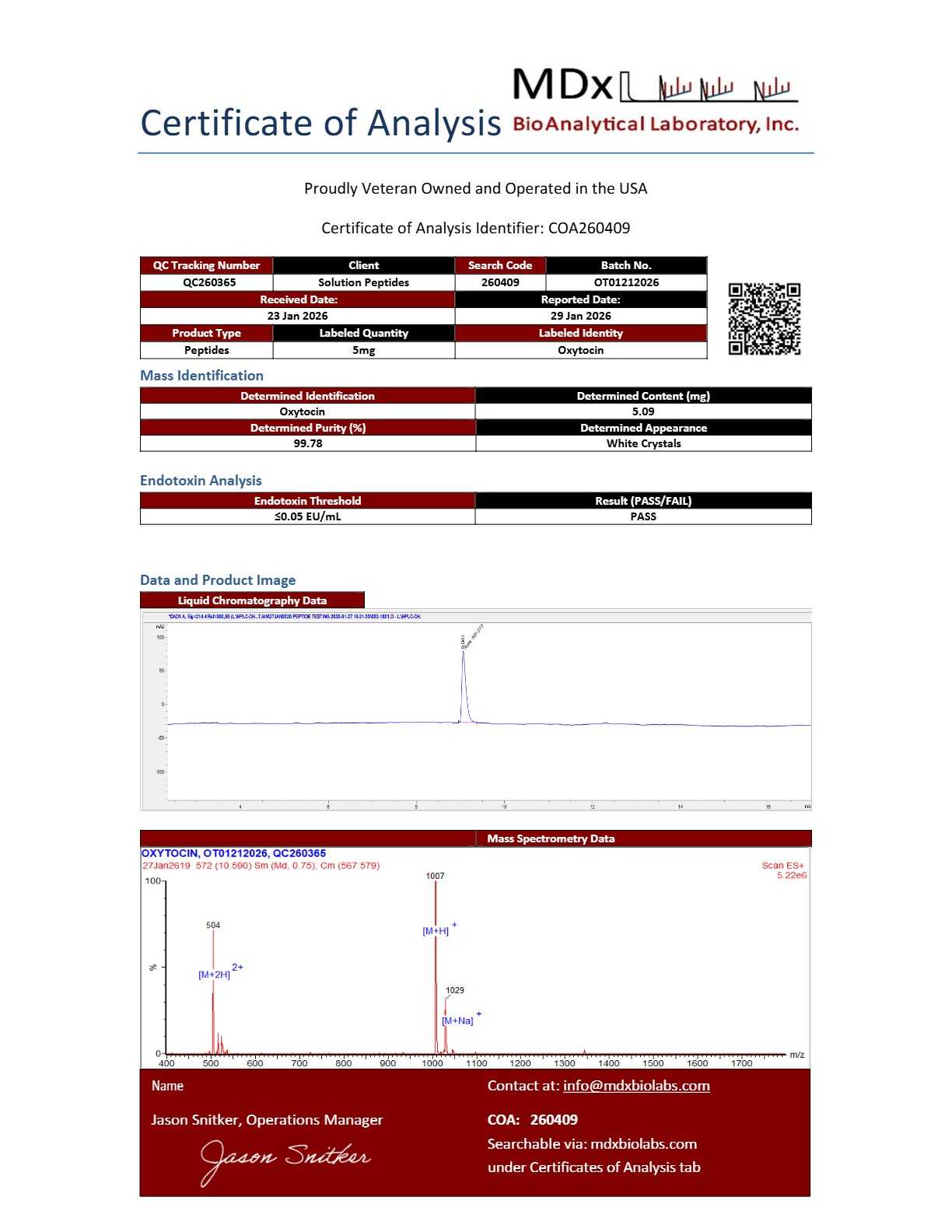
Esse livro de regras instável é exatamente o motivo pelo qual a primeira verificação é a identidade, não pureza. A confirmação da identidade do peptídeo vem antes de qualquer valor de pureza, porque as duas medições respondem a perguntas diferentes. A pureza da HPLC é a razão entre a área do pico principal e a área total do pico integrado, e esse cálculo é cego para água e sais: uma amostra pode ler 99% puro por área e ainda assim ser o composto errado (Confiança em Peptídeos, “Conteúdo líquido de peptídeos versus pureza”, 2026-07-31). Pureza e conteúdo respondem a duas questões diferentes, e nenhum deles é “este é o peptídeo que eu encomendei?”
A correspondência de massa com a massa teórica responde. Peptídeos Americanos descreve a confirmação de identidade por LC-MS comparando a massa observada com a massa teórica calculada a partir da sequência de aminoácidos pretendida, com MS/MS adicionando a escada de íons b e y que suporta ordem de sequência em vez de apenas massa total (2026-06-06). A mesma fonte mostra por que a base de massa deve ser declarada: um peptídeo com fórmula C65H101N17O18S tem uma massa monoisotópica de 1455.71 Da contra uma massa média de 1456.66 E, aproximadamente 1 Sim, à parte, então uma “correspondência” não qualificada é ambígua.
Principal vantagem: Uma porcentagem de pureza informa quanto do pico é uma coisa. Somente uma correspondência em massa com sua sequência declarada informa o que é.
Nossa descoberta: O valor de 98% de pureza que parece uma prova de identidade é o erro de leitura mais comum na avaliação de fornecedores. Uma alta% de área e um conteúdo líquido de peptídeo materialmente menor podem ser relatados honestamente para o mesmo lote, é por isso que um lote de baixo conteúdo pode ter um número de pureza de título que não diz nada sobre a quantidade de peptídeo que o frasco contém.
O modo de falha é silencioso. Uma sequência errada ou um peptídeo truncado pode passar na verificação de% de área e até mesmo compartilhar um tempo de retenção com o composto esperado, uma vez que moléculas não relacionadas podem co-eluir. Em vez disso, as compensações em massa nomeiam o problema: +16 Da aponta para oxidação, -18 Da à desidratação, e um aminoácido faltante para truncamento (Peptídeos Americanos, 2026-06-06). Peça a massa observada, a massa teórica, e a base usada para ambos.
Lendo dados de pureza sem ser enganado pelo número do título
Uma vez estabelecida a identidade, o valor da pureza pode ser lido pelo que realmente mede. Os dados de pureza dos peptídeos respondem a uma pergunta mais restrita do que a maioria dos compradores supõe. Um valor de pureza descreve a parcela do sinal detectado que pertence à sequência alvo. Não descreve quanto peptídeo fica no frasco.
As especificações típicas de nível de pesquisa ficam em ≥95% por HPLC, com graus de alta pureza ≥98% (Guia de teste de pureza de peptídeos da ChemVerify, Marchar 2026). Valores acima 99% merecem exame minucioso para sequências mais longas do que 30 resíduos, a menos que dados cromatográficos de alta resolução os acompanhem. O mesmo guia observa que a pureza é comumente relatada pela absorção de UV em torno de 214–220 nm, e que o comprimento de onda é importante porque as impurezas respondem de maneira diferente em diferentes comprimentos de onda.
Depois vem a parte que o título esconde. Os peptídeos liofilizados normalmente contêm 60-85% de conteúdo líquido de peptídeos (ChemVerify, Marchar 2026). O resto são contra-íons, água residual e vestígios de solvente. UM 10 pesagem em mg em 70% content yields roughly 7 mg de peptídeo, which explains the shortfall many labs hit when they calculate an assay from the balance reading alone.
Peptídeo Counter-ion removal has limits. UM 2020 review of counter-ion behavior in peptides found that TFA exchange reaches up to 98% efficacy after repeated cycles but does not completely remove TFA anions (PMC 7761850, dezembro 2020). Those anions can bond directly to basic residues or sit adsorbed in the lyophilizate.
Nossa descoberta: UM 10 pesagem em mg em 70% net peptide content delivers roughly 7 mg de peptídeo. Budget assays against content, not against the vial label.
Documentação: O que um COA específico de lote deve conter
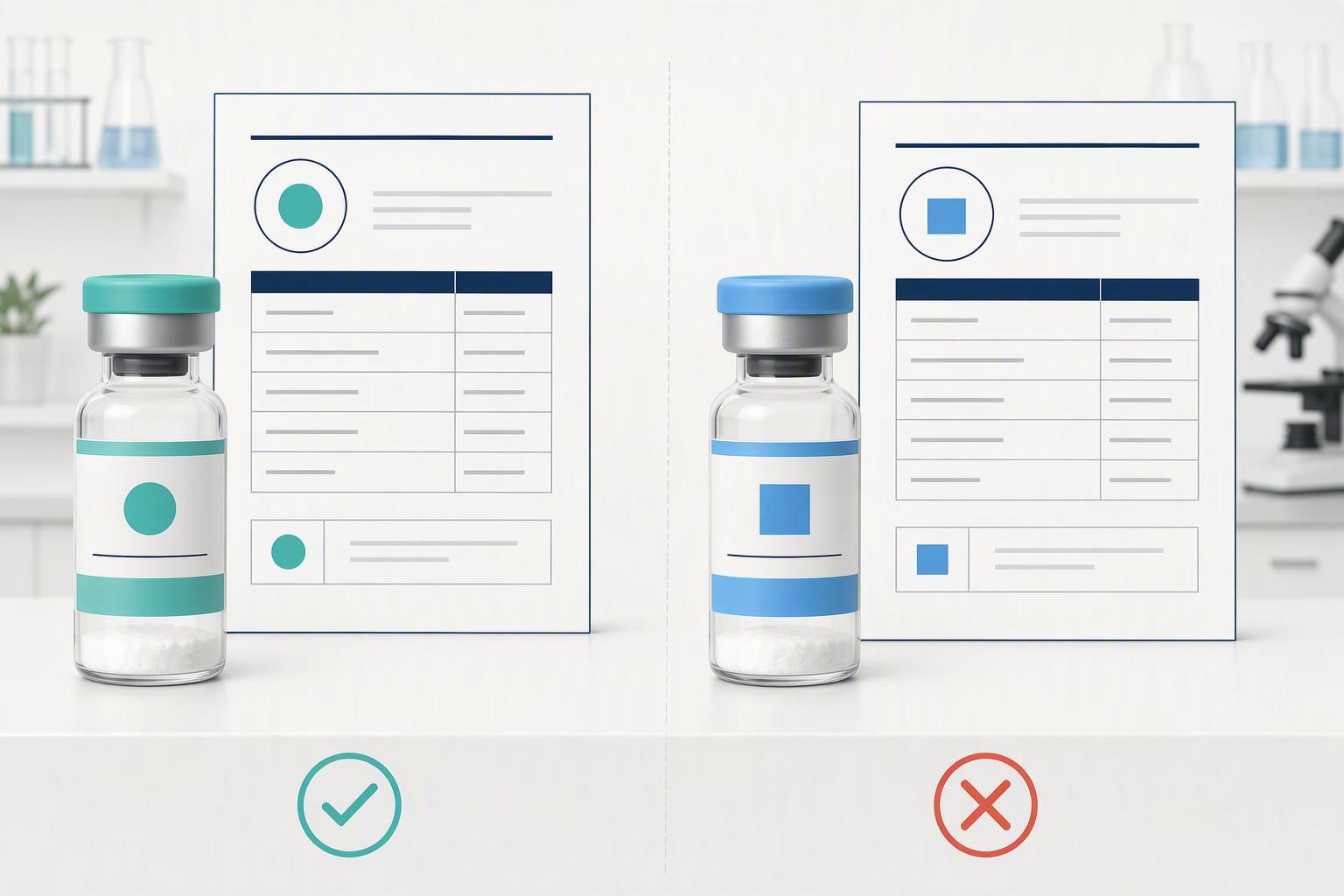
With identity and content understood, the next safeguard is the paperwork that ties both to your vial. A peptide certificate of analysis is only useful if it belongs to the vial in your hand. The batch or lot number printed on the COA must match the batch or lot number on the vial label, and the document must be issued for that specific lot rather than for the product line in general. Finnrick’s guide to reading a certificate of analysis states the batch ID rule plainly: no batch ID on a sample means no valid test. The same guide sets the minimum panel a peptide COA should carry, which is identity confirmation, pureza, and potency or quantity.
⚠️ Aviso: These failure modes show up as ordinary conditions, not dramatic ones. A generic COA arrives instead of a lot-specific one. The lot number on the COA does not match the vial label. Batch documents are reused across shipments. The testing laboratory is never named. Raw data is not available on request.
A COA is a supplier-issued document, and a supplier-issued document is not independent verification. Where a supplier claims independent testing, the claim is checkable only if it names the third-party laboratory, the test date, the analytical method, and whether the underlying raw data can be accessed. Without those four details, the document confirms that testing happened somewhere, not that it happened to your lot.
Cadeia de Custódia: O conjunto de registros de recibo para uso
Spps Synthesis Documentation covers what the supplier did before shipping; custody covers everything after. Peptide chain of custody is the record set your laboratory creates between the moment a vial arrives and the moment its contents are consumed, and it is the only part of supplier authentication you control entirely. A supplier can hand you a clean certificate and still leave you unable to show how the material was handled afterward.
The record set has five linked entries. The receiving log captures receipt date, operadora, número do lote, condição na chegada, and the name of the person who opened the package. The storage record names the location (freezer, shelf, box position) and the target temperature. The access log records who withdrew the vial and when. The reconstitution entry holds the diluent, volume, date, and the resulting concentration. The aliquoting and distribution record tracks each daughter vial to its user or downstream experiment.
Temperature and freeze-thaw records belong alongside the batch file, not in a separate notebook, because they are what turn a set of entries into an auditable history. Lot-number traceability is the thread: if the lot number on the receiving log does not match the lot number on the certificate and the vial label, the record set breaks at its first link and nothing downstream can be reconstructed.
Principal vantagem: Custody records are what let a laboratory demonstrate that a research material was handled as a research material, from receipt through use, without relying on the supplier’s account of what happened before it shipped.
Separando materiais de pesquisa de reivindicações terapêuticas

The custody record is yours to keep; the last check is about the supplier’s own words. The fastest supplier-language test is this: a page that promises an outcome has told you about its claim discipline, not about its chemistry. Legitimate research suppliers keep their language on compound identity, purity documentation and laboratory procurement. Therapeutic, diagnostic, clinical and personal-use claims sit outside that vocabulary, and their presence is a signal about how the supplier handles the boundary, not proof of what is in the vial.
Apply the test to the product page, the certificate of analysis and the order confirmation. If any of the three describes a physiological effect, a dosing protocol or a benefit to a person, the supplier Peptide Melanotan Ii has moved from supplying laboratories to addressing consumers. That shift usually shows up before the documentation gaps do, which makes it a useful early filter when you are comparing vendors.
Para dica: The language test is a claim-discipline check, not a chemistry check. A supplier page that promises an outcome has told you something about its claim discipline, not about its chemistry.
The materials discussed in this article are for laboratory research use only and are not for human or veterinary use. Nothing here is a therapeutic, diagnostic or clinical claim, and nothing here should be read as guidance for personal use.
Erros comuns a evitar
Most peptide supplier authentication failures trace back to reading one number instead of the whole record. Each mistake below is common because it feels like diligence, and each has a specific fix.
Treating a purity percentage as proof of identity. A purity figure says how much of the sample is the target peak, not that the peak is the right molecule. Fix: require a mass spectrometry result that matches the theoretical mass of the stated sequence before you accept any purity value.
Accepting a generic or reused COA. Vendors sometimes supply a template certificate covering a product line rather than the lot in hand. Fix: check that the lot number on the certificate matches the lot number on the vial label, and reject the shipment if it does not.
Ignoring net peptide content when calculating a weigh-out. Pureza e conteúdo são medidas separadas, so a high-purity, Biotage Peptide Synthesizer low-content lot delivers less peptide than the mass suggests. Fix: calculate from the content or assay value, not the purity percentage.
Keeping no custody record. Without a receipt-to-use trail, you cannot show what arrived, quando, or how it was stored. Fix: log receipt date, muito, condição na chegada, and storage location at the point of intake.
Letting therapeutic-adjacent marketing language pass unchallenged. Claims that imply human use shift a research material into a regulatory category it does not belong in. Fix: treat that language as a documentation defect and ask the supplier to correct it in writing.
⚠️ Aviso: The most consequential mistake is a high purity number on a low-content lot. Both figures can be accurate and the pairing still misleads anyone who reads only the purity line, because the weigh-out they calculate will be short. Peptide Ll 37
Resultados: Qual é a aparência de um relacionamento com fornecedor verificado
A verified supplier relationship is not a feeling about a vendor. It is a batch file you can hand to a colleague and have them reach the same conclusion. Peptide supplier authentication ends in a folder, não é um veredicto. Cem Peptide
That folder carries six things. A lot-specific COA whose lot number matches the vial label. An identity result matched against theoretical mass, not just a pass mark. A purity figure sitting beside a net peptide content figure, so the two numbers can be read together. A named testing laboratory with a test date and the method used. A custody record running from receipt to use. And supplier language that stays on research use, in the marketing copy as well as the certificate.
The stretch goal is worth asking for. Where a supplier offers raw analytical data or independent third-party verification, request it. A supplier that can produce it is telling you something a clean PDF cannot.
Mudanças no MOL is a peptide synthesis and modification organization that operates Class 100 produção de salas limpas ultraestéreis, with QC including HPLC, MS and sterility testing, and supports mg-to-kg scale-up.
If you are comparing suppliers against this checklist, talk to an expert or compare capabilities directly. MOL Changes has a commercial interest in peptide quality standards, and this article is written so the same checks apply to any supplier, including this one.
Perguntas frequentes
Um certificado de análise de peptídeo pode substituir testes independentes?
Não. A COA is the supplier’s own record, and it cannot verify itself. The batch ID rule applies here: the document is only meaningful when its lot number matches the vial label and it reports the full panel for that specific lot, not a representative or historical result. Independent testing by a laboratory you selected is the only check that sits outside the supplier’s control. Treat the COA as the claim and third-party analysis as the confirmation.
O que devo fazer quando o número do lote não corresponde ao rótulo?
Stop and do not use the material. A mismatch means you cannot tie the analytical results to the vial in your hand, which breaks the entire documentation chain regardless of how good the reported numbers look. Contact the supplier in writing, request the correct lot-specific COA, and keep the correspondence. If the supplier cannot produce a matching record, that is your answer about their documentation practice.
Como comparo uma nota ≥95% com uma nota ≥98% para um determinado ensaio?
Compare the grade against the method and the assay, not against the number alone. A ≥98% figure measured by one HPLC method is not automatically superior to a ≥95% figure measured by a stricter one, because purity percentage is method-dependent. Ask which method produced the value, request the chromatogram rather than the summary line, and match the grade to what your assay actually requires.
Can I check a supplier’s stated testing laboratory?
Sim, and you should. Ask for the laboratory’s name and confirm it is a real, independent facility with the capability to run the panel reported. A named laboratory you can contact is a verifiable claim; an unnamed “third-party lab” is not. If the supplier will not identify the laboratory, treat the testing claim as unverified.
Conclusão
The five safeguards form one repeatable workflow: confirm identity against the theoretical sequence, read purity alongside content and assay, require a lot-specific certificate of analysis, keep a receipt-to-use record set, and hold research materials separate from therapeutic claims. Run them in that order on any supplier, and the result is a supplier-agnostic verdict rather than a trust exercise.
That standard does not depend on where U.S. rules land. Reclassification would change the paperwork a supplier is expected to produce, not the underlying questions a buyer needs answered. Identidade, contente, documentação, custody, and claim discipline stay the same checks whether the material sits in a research or a regulated category.
The next action is concrete. Build the batch file for the next lot you receive: sequência, número do lote, COA, analytical report, recibo, and storage record. Then run the five checks against it before the material enters use. Peptide supplier authentication becomes routine once the file exists and each lot is measured against it.