Estrutura de governança e qualidade do fornecedor de peptídeos
Índice
O que o registro de aplicação do BPC-157 realmente mostra
O quadro regulatório mudou em um cronograma datado, e cada etapa é documentada. Em julho 23, 2026, o Página da reunião do Comitê Consultivo de Composição Farmacêutica da FDA listado BPC-157 (base livre) e acetato de BPC-157 para revisão contra o uso de colite ulcerativa, com materiais informativos propondo as substâncias não ser adicionado à lista de granéis 503A. O comitê votou 8–6 com uma abstenção para recomendar adicioná-los de qualquer maneira, como Leitura de McDermott sobre o resultado do PCAC registros.
Essa votação não legaliza a capitalização. A FDA disse na reunião que “raramente diverge” das recomendações do PCAC, mas a adição final requer regulamentação de avisos e comentários que pode resultar em 2027 ou se estender por vários anos. Até então, BPC-157 fica fora da categoria 1 e fora da lista final de granéis 503A.
A fiscalização não esperou pela regulamentação. Cinco cartas de advertência do CDER datadas de agosto 24, 2026 fui para vendedores de peptídeos on-line, e todos os cinco alegaram “apenas para uso em pesquisa”, enquanto seus sites continham informações sobre dosagem, instruções de injeção e calculadoras de dose. Em junho 2026, o Conselho Médico do Alabama proibiu separadamente os médicos de manipular, administrar ou dispensar peptídeos de nível de pesquisa aos pacientes.
Por que a rotulagem somente para uso em pesquisa não é uma estratégia de governança
Somente para uso em pesquisa é uma declaração de uso pretendido, não é um escudo legal. A FDA ainda pode encontrar um novo medicamento não aprovado quando o site do fornecedor como um todo mostra o uso humano, na seção 201(g)(1) e Seções 301(d) e 505(um) do FD&Ato C, como Arent Fox Schiff explica em seu setembro 18, 2026 análise de agosto 24, 2026 cartas de advertência. Essas cartas eram pura fiscalização de novas drogas não aprovadas, e a mesma análise aplica um padrão de impressão líquida: linguagem de marketing restrita ainda pode tornar um produto com marca incorreta se o quadro geral de marketing implicar uso humano.
Essa distinção é todo o uso apenas em pesquisa versus alegações terapêuticas. Um rótulo não controla o que a página ao redor, fotografia de produto, linguagem de dosagem, ou depoimentos de clientes comunicam.
O modo de falha é previsível. Um fornecedor carimba RUO no frasco, em seguida, publica uma página que parece uma lista de produtos de consumo, e a gravadora para de fazer qualquer trabalho. Governança significa controlar o rótulo, revisando reivindicações antes da publicação, controlando quais canais transportam o produto, e aceitar relatórios de eventos adversos em vez de descartá-los.
O que um certificado de análise específico de lote prova e o que não prova
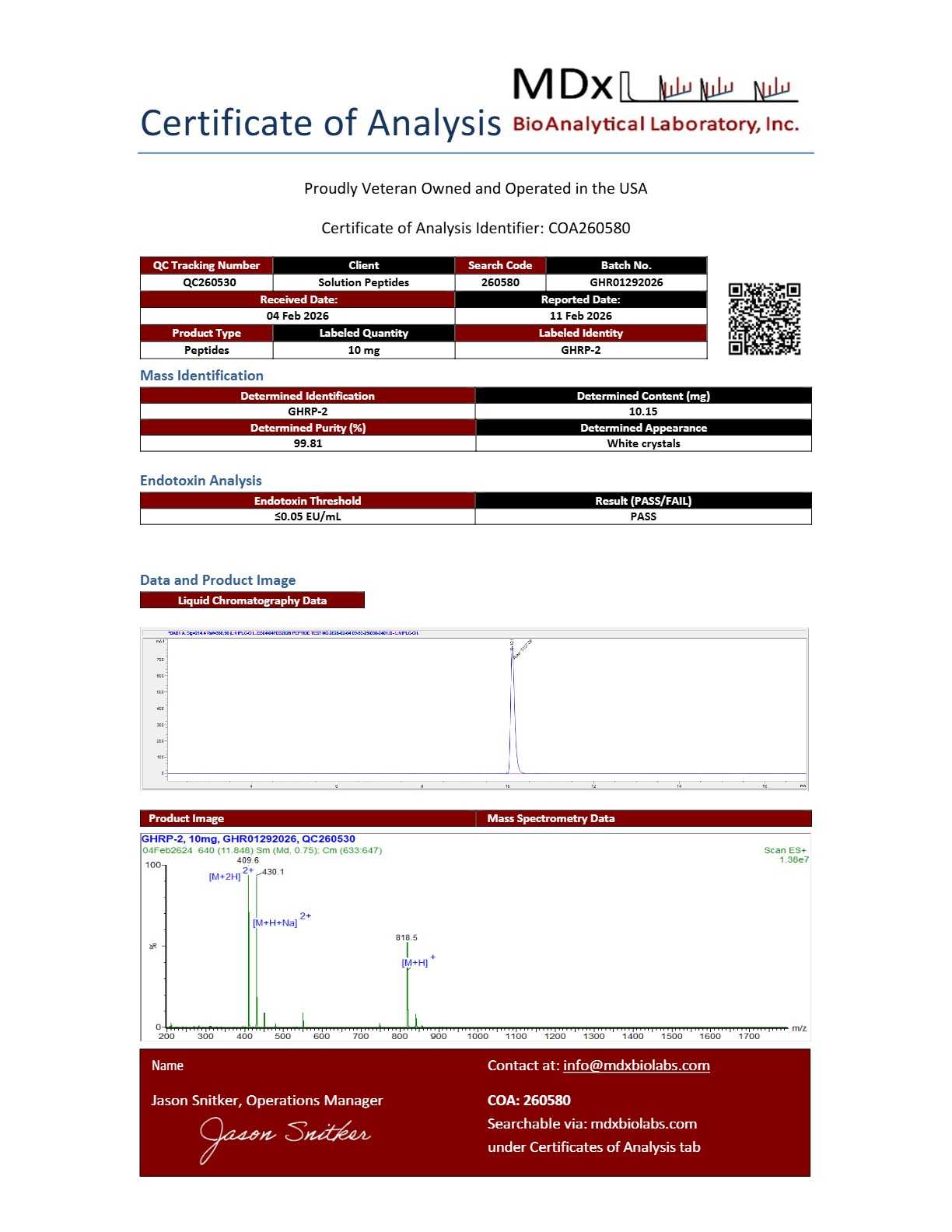
Um certificado de análise específico do lote para peptídeos de pesquisa é o documento mínimo que um fornecedor deve ser capaz de produzir, e é o documento mais frequentemente confundido com prova de qualidade. Prova que alguém testou um lote nomeado e registrou um resultado. Não prova quem fez o teste, que método eles usaram, ou se o material no frasco corresponde ao material no rótulo.
O 2024 análise multifatorial de qualidade e segurança de produtos de semaglutida de farmácias on-line ilegais, publicado no Jornal de pesquisa médica na Internet, testei três frascos comprados de vendedores online. O conteúdo medido de semaglutida excedeu a quantidade rotulada em +28.56%, +38.69% e +33.58%, contra +5.05% para uma referência Ozempic 1 caneta mg (JMIR, 2024). The same three lyophilized samples were devoid of viable microorganisms at the time of testing, which shows how narrow a single passing result is: a clean microbial count says nothing about how much active material the vial contains.
Scope matters here. Three vials, one compound, purchased from online sellers, tested in 2024. The finding is not generalizable to every gray-market product, and it does not describe supplier-issued CoAs in general. It shows what a label figure and the physical material can separately be.
Os limites dos testes de pureza por HPLC para peptídeos
UM 98% ou 99% HPLC purity figure measures one method under one set of conditions. It is not a statement about what else is in the vial. O documented limits of single-method HPLC purity determinationare structural rather than incidental: co-eluting impurities can hide under the main peptide peak, and UV detection near 214 para 220 nm misses species that absorb weakly or not at all, including sugars, glycols, lipídios, salts and buffer residues (PMC, “HPLC Analysis and Purification of Peptides”; the article is undated, retrieved for this review).
The number is also method-dependent. Química da coluna, gradiente, fase móvel, comprimento de onda de detecção, flow rate and integration parameters all shape the result, so two laboratories can report different purities for the same lot without either being wrong.
That is why a purity percentage establishes neither identity nor safety. Orthogonal mass-spectrometric confirmation is what ties the peak to the intended sequence, and it says nothing about residual trifluoroacetate counterion content, solventes residuais, water content or bioburden. Those are separate measurements, reported separately, or not reported at all.
Documentação sobre endotoxina e esterilidade: Duas perguntas diferentes
A supplier that reports “sterility tested” has answered one question and left another open. Endotoxin and sterility documentation for research peptides are two separate records, and a lot can pass one while failing the other. USP <85> bacterial endotoxins testing, usually run as a Limulus amebocyte lysate (LAL) ensaio, is quantitative for endotoxin only, reported in endotoxin units (UE) or EU/mg, and it does not detect viable microbes. USP <71> sterility testing is growth-based instead: the standard’s described method uses membrane filtration or direct inoculation into two media, fluid thioglycollate and soybean-casein digest, incubated for not less than 14 dias, with the primary USP <71> document as the authority to check rather than a lab summary.
That distinction matters because a clean endotoxin figure is not a clean lot. In the three BPC-157 vials tested by researchers and published in JMIR, endotoxin ranged from 2.1645 para 8.9511 EU/mg, which is a quantitative endotoxin result, not a sterility result.
Principal vantagem: LAL versus USP <71>
| Método | Detects | Cannot detect | | LAL (USP <85>) | Endotoxina, quantitatively, in EU or EU/mg | Viable bacteria, fungi, or any non-endotoxin contaminant | | Esterilidade (USP <71>) | Viable microorganisms that grow under the test conditions | Endotoxina, and any organism that does not grow in the two media used |
A lot-matched result requires both tests run on the same lot number, with the lot number printed on each report.
Uma Estrutura de Governança e Qualidade do Fornecedor de Peptídeos
A peptide supplier quality and governance framework is a set of auditable evidence requests, not a certificate you file once. Each dimension below works the same way: you request a specific record, it proves one bounded thing, and past that boundary it proves nothing. Run the six dimensions as a checklist before qualification and at every re-qualification.
Audit report or questionnaire response, ISO 9001 scope, site and contact details
The quality system behind the batch exists and can be inspected
Nothing about the specific lot’s analytical results
The peptide supplier quality and governance framework only holds if the records stay attached to the material. One caution on the first row: a batch-specific certificate of analysis for research peptides is only as strong as its lot linkage. A CoA without the shipped lot number is a marketing document, not a release record. Empresas de síntese de peptídeos personalizados
Expectativas de documentação na prática
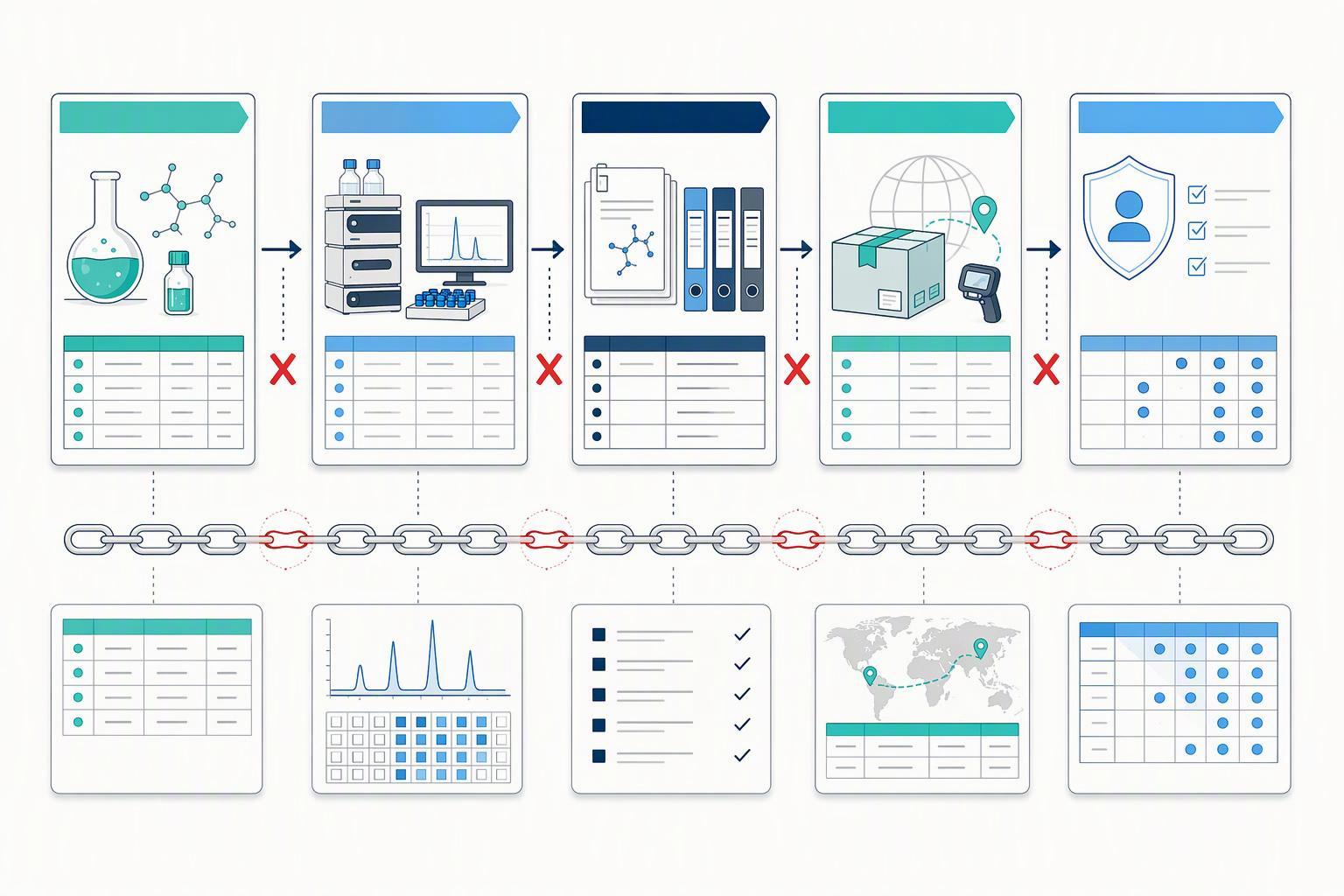
A lot-matched release package is a set of documents that all carry the same lot number and all describe the same physical material. In practice it usually contains four things: a batch-specific certificate of analysis, the chromatogram that produced the purity figure, the mass spectrum that confirms identity, and any endotoxin or sterility result claimed for that lot. The chain breaks when one of those documents is generic rather than lot-specific.
Three failures show up repeatedly. A supplier reuses a single CoA across multiple lots, so the purity figure describes a reference batch rather than the vial in hand. A chromatogram is supplied without its integration table, which means the reader cannot see how the purity percentage was calculated or which peaks were excluded. Endotoxin testing is claimed on the CoA but the supporting report is not lot-matched, leaving no way to connect the result to the material shipped.
MOL Changes operates Class 100 ultra-sterile cleanroom production with per-lot analytical release documentation including batch chromatogram and MS. Two gaps remain unresolved in the material available for this article: the specific cleanroom and environmental-monitoring evidence behind that production claim, and the exact wording of the brand’s research-use-only label. Neither should be inferred. Ask for both directly, and treat a supplier who cannot produce them as a supplier whose documentation chain has not been demonstrated.
Começando: Qualificando um fornecedor antes do primeiro pedido
Start with one request: a lot-matched release package for a specific catalog number. Ask for the certificate of analysis, chromatogram and spectrum tied to the lot number printed on the vial you would actually receive. If the CoA references a different lot, or a “representative” lot, you have learned something useful before spending anything.
Then check that identity confirmation is orthogonal to the purity method. A mass spectrometry result and an HPLC purity figure answer different questions; two readings of the same chromatogram answer one. Where a supplier cannot show a second, independent method, treat identity as unconfirmed.
Terceiro, get change-control and deviation handling in writing before scale-up. Ask how you will be notified if a synthesis route, coluna, or testing laboratory changes, and who signs off on a deviation. A supplier who answers this in a document is easier to qualify than one who answers it in a call.
Para dica:Run these three checks on a small first order. The documentation package costs the supplier little and tells you more than any capability page.
To work through the full framework with your own catalog numbers, request a documentation package or talk to an expert. This article is published by a peptide supplier, so treat the criteria here as a buyer’s checklist rather than neutral advice.
Perguntas frequentes
O que deve conter um certificado de análise específico de lote para peptídeos de pesquisa?
It should tie one document to one lot number and report methods, not just results. No mínimo: peptide sequence and lot number, the purity method (typically HPLC-UV or HPLC-CAD), the identity method (espectrometria de massa), the quantity method (amino acid analysis or UV content), and the acceptance criteria each result was judged against. A purity figure with no method, no lot and no specification is a number, not documentation.
A pesquisa usa apenas rotulagem para proteger um fornecedor?
Não. RUO is a distribution control, não é um escudo legal. It tells the buyer the material is not intended for human or veterinary use, but it does not protect a supplier from responsibility for misleading therapeutic claims or marketing that implies clinical benefit. A supplier that stamps RUO on the vial while implying therapeutic use elsewhere has created a contradiction, not protection.
O que os testes de pureza por HPLC não dizem?
An HPLC purity figure tells you the proportion of the main peak by the detector’s response, and nothing about what the remaining percentage is. It does not identify residual counterions such as trifluoroacetate, solventes residuais, teor de água, or the impurity peaks themselves. Independently tested research peptides have measured as low as 7.70% purity against 99% label claims, which shows how far a headline number can sit from the underlying reality.
Os testes de endotoxina e esterilidade são a mesma coisa?
Não, and treating them as interchangeable is a common documentation error. Endotoxin testing measures lipopolysaccharide, typically by the LAL method in USP <85>. Sterility testing looks for viable microbial contamination, typically by membrane filtration or direct inoculation under USP <71>. A product can pass one and fail the other.
Como diferenciar um fornecedor de pesquisa legítimo de um questionável?
A legitimate research supplier answers specific questions with specific documents. Ask for the batch-specific certificate of analysis with lot number and methods, the chromatogram and mass spectrum for that lot, the endotoxin and sterility methods by name, and the facility’s quality certification. A supplier that responds with a generic brochure, a purity percentage with no method, or a refusal to name the testing laboratory is telling you what its documentation is worth.
Conclusão
The single most important thing to carry away is that documentation is a chain the buyer has to test, not a document the supplier hands over. A certificate of analysis, a chromatogram, an endotoxin result and a sterility statement each answer a narrower question than the folder they arrive in suggests, and the gaps between them are where risk accumulates. The peptide supplier quality and governance framework in this guide exists to make those gaps visible before an order is placed, not after a batch is in hand.
The enforcement record is moving quickly. The August 2026 warning letter set reflects the state of regulatory attention at that moment and may be superseded as further actions are published, so treat it as a dated snapshot rather than a settled position. Re-check the primary sources directly when a qualification decision depends on them.
The next step is small and concrete: pick one supplier already on your list, request the batch-specific records for a single lot, and trace each claim back to the method that produced it.
Diretor de Tecnologia; Especialista em síntese de peptídeosEspecialização Central: Síntese de peptídeos complexos, modificações de aminoácidos não naturais, e a construção de peptídeos cíclicos e peptídeos grampeados.
Biografia:Zejun Peng tem vasta experiência em química orgânica e síntese de peptídeos. Ele é proficiente na aplicação combinada de síntese de peptídeos em fase sólida (SPSS) e síntese de peptídeos em fase líquida (LPPS), e é particularmente hábil em superar “sequências extremamente difíceis de sintetizar” (como peptídeos de cadeia ultralonga, sequências altamente hidrofóbicas, e dobramento múltiplo de ligações dissulfeto). Sob sua liderança, a equipe superou com sucesso gargalos técnicos em diversas modificações especializadas (como N-metilação, PEGuilação, e rotulagem fluorescente), mantendo uma taxa de sucesso de síntese superior a 98%.
Olá, há! 👋 Bem-vindo às mudanças MOL. Como podemos ajudá-lo hoje? Sinta-se à vontade para perguntar sobre nossa síntese de peptídeos, Serviços CRO, or any product inquiries — just type your message below and we'll continue the conversation on WhatsApp.