A Visão Convencional: Escala é a escolha segura
Durante a maior parte da última década, a resposta principal aos critérios de seleção de fornecedores de peptídeos tem sido simples: classificar a capacidade primeiro. Os CDMOs de nível 1 e os manuais de aquisição construídos em torno deles tratam da escala de produção, o volume do reator e a contagem do local como os principais sinais de redução de risco, baseado no raciocínio de que apenas um grande fabricante pode garantir o fornecimento quando a demanda aumenta.
Essa visão ganhou seu lugar. A escassez de capacidade durante a era GLP-1 era real, e os fornecedores que comprometeram capital antecipadamente resolveram genuinamente um problema de abastecimento. Expansão de peptídeos de cerca de 900 milhões de euros da CordenPharma, anunciado em julho 2024, adicionou trens de fabricação em grande escala no Colorado, além de uma instalação greenfield europeia. Edifício K de Bachem, sua fábrica de grande volume em Bubendorf, CHF ancorado 332.6 milhões de investimentos no ano fiscal de 2025 e concluiu a mudança declarada de CDMO para CMO em direção à escala industrial, saída de alto volume.

Escala nunca foi a resposta errada. Simplesmente não é mais o único.
Por que a escala deixou de ser o diferencial
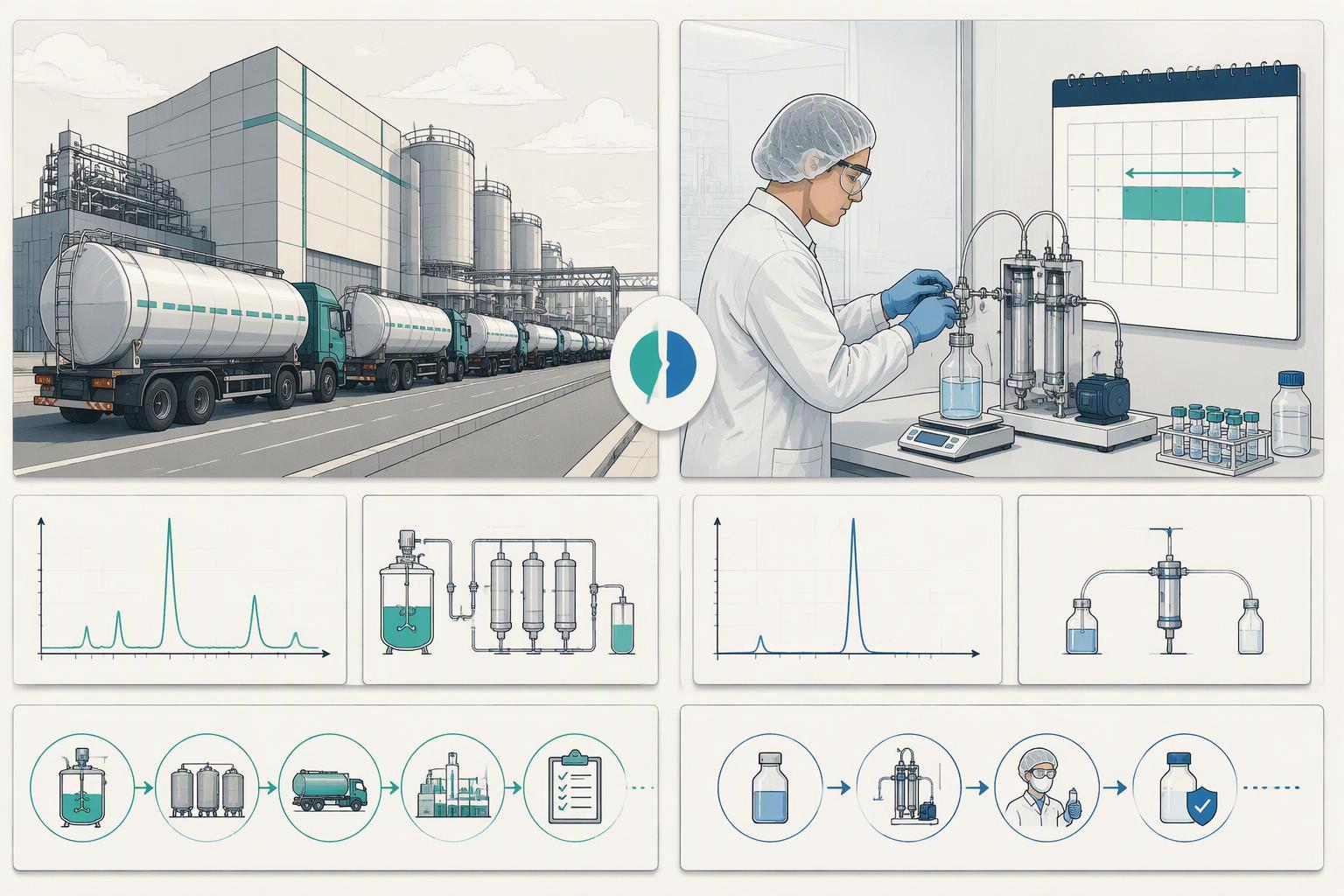
A capacidade parou de separar fornecedores porque todos estão comprando a mesma capacidade ao mesmo tempo. Quando vários CDMOs comissionam fábricas de peptídeos em grande escala na mesma janela, a restrição usada para classificar o campo torna-se uma base de custos compartilhada em vez de uma vantagem compartilhada. Três problemas decorrem do tratamento da escala como a escolha segura.

A primeira é que a construção de capacidade é dispendiosa e diluidora antes de ser acretiva.. A margem EBIT de Bachem caiu para 22.0% no ano fiscal de 2024 de 22.4%, que a empresa atribuiu ao “aumento da depreciação e amortização em novos investimentos” em seu Divulgação dos resultados do ano fiscal de 2024. O padrão repetido na primeira metade de 2026, quando a empresa afirmou que “os custos de aumento do Edifício K afetaram o resultado operacional conforme esperado” no relatório intercalar mais recente. A nova capacidade custa margem antes de ganhar qualquer.
O segundo problema é que onde o crescimento chegou, veio da utilização e do mix, e não da escala em si. Crescimento da API comercial de Bachem no primeiro semestre de 2025 foi “impulsionado principalmente por uma boa execução operacional em toda a nossa rede que levou a uma utilização otimizada das instalações existentes,”de acordo com H1 de Bachem 2025 resultados. Preencher melhor as plantas existentes, não possuir mais deles, mudou o número.
O terceiro problema é que o argumento da amplitude é mais tênue do que sugere o crescimento das manchetes. A receita do ano fiscal de 2025 da GenScript aumentou 61.4%, mas Resultados do ano fiscal de 2025 da GenScript atribuem isso principalmente à receita de licenças, principalmente sublicenciamento LaNova, enquanto o ProBio 309.1% o crescimento é distorcido por itens únicos e as taxas por serviço aumentaram 21%. As porcentagens dos títulos aqui medem o momento do negócio, não capacidade de serviço.
Quando todo jogador sério compra a mesma capacidade, os critérios de seleção do fornecedor de peptídeos mudam para qual capacidade não pode comprar: capacidade de resposta, modificações especializadas, transparência analítica, e colaboração técnica.
O que os dados realmente mostram sobre os critérios de seleção de fornecedores de peptídeos
Leia novamente os números divulgados e a imagem se inverte. GenScript's H1 2026 resultados provisórios colocou a receita total em cerca de US$ 404,2 milhões, acima 27.3% ano após ano, numa base comparável; os resultados do ano fiscal de 2025 reportam US$ 959,5 milhões e 66,000+ clientes ativos do Life Science Group. Esses são números de amplitude da linha de serviço. Nenhuma das páginas de resultados do GenScript lidas para esta comparação divulga uma linha de receita específica para peptídeos, valor de capacidade ou benchmark de recuperação, e esse lado da comparação baseia-se numa divulgação pública mais tênue do que o lado de Bachem. A ausência é a descoberta.
H1 de Bachem 2025 resultados mostram vendas líquidas de CHF 313.0 milhão, acima 30.2%, e uma margem EBITDA de 29.1%, acima de 23.1% um ano antes. O crescimento desse formato veio da melhor utilização das instalações que Bachem já administra, não de nova capacidade.
Quatro critérios têm peso: capacidade de resposta, modificações peptídicas especializadas, transparência de dados analíticos de peptídeos, e colaboração técnica CDMO de peptídeo. A evidência por trás de cada um é qualitativa onde os dados de mercado são escassos.
|
Critério |
O que o comprador inspeciona |
Peptídeos Quelantes Resposta fraca |
Resposta forte |
|---|---|---|---|
|
Capacidade de resposta |
Transferência de método e agendamento de lote piloto |
Peptídeos personalizados Filas de slots de vários meses, altos MOQs |
Janela de transferência nomeada, Clique em Peptídeos Químicos caminho piloto para quilograma |
|
Modificações especializadas |
Portfólio de modificação e complexidade de sequência tratada |
Lista somente de catálogo |
Tipos de modificação específicos com precedente |
|
Transparência analítica |
CoA fields and method documentation |
Purity percentage alone |
Método, coluna, and lot-to-lot comparability data |
|
Technical collaboration |
Scale-up handoff and transfer support |
Handoff at purchase order |
Documented transfer plan across mg to kg |
Critério 1 e 2: Capacidade de resposta e modificações especializadas
These two criteria are measured in elapsed time and chemistry classes, not in tonnes. Responsiveness means method-transfer and pilot-batch lead time; specialized modifications means whether a supplier can hold a non-standard chemistry through scale-up.
On responsiveness, the structural contrast is utilization. H1 de Bachem 2025 results describe growth as coming from utilization of existing facilities rather than new capacity, which is the pattern buyers meet as slot scheduling and high MOQs on early-stage pilot batches. GenScript’s FY2025 results disclose no turnaround benchmark on the pages reviewed, so published lead times remain a qualitative range: roughly two to three weeks for standard sequences and three to six weeks for complex ones, figures that appear mainly in commercially motivated sources and should be treated as a range, not a market statistic.
Para custom peptide synthesis capabilities, evaluate by chemistry class rather than service bullets. PEGuilação, ciclização, glycopeptides and isotope labeling each carry different failure modes, and the question is whether the supplier holds the modification through scale-up. Four sequence properties predict difficulty: hydrophobicity and aggregation tendency, comprimento da corrente, modificação de vários sites, and disulfide topology. Each maps to a capability, not a catalog entry.
Para dica: Run the buyer-side evaluation sequence in order: difficult-sequence feasibility check, then
specialized peptide modificationscapability check, then analytical package review, then the scale-up and tech-transfer conversation.
Critério 3: A transparência analítica é a afirmação mais difícil de falsificar
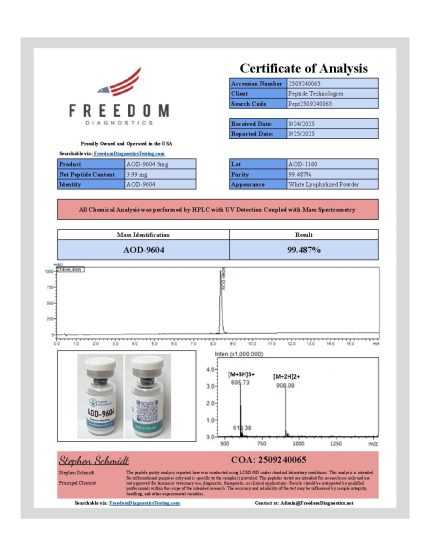
Analytical transparency is the one criterion a buyer can verify before committing, which makes it the highest-signal screen in the framework. A batch certificate of analysis is not proof on its own. What matters is whether it carries the fields a filing needs: an HPLC chromatogram with the method and column conditions, an MS spectrum confirming the expected mass, a purity figure tied to a defined method, and a stated endotoxin result.
Endotoxin thresholds tighten with the assay, and the default specification rarely matches the application. One testing-vendor resource reports that levels below 1.0 EU/mg are generally acceptable for immortalized cell lines, abaixo 0.05 EU/mg for primary immune cells, e 0.1 para 0.5 EU/mg for in vivo rodent studies, with USP 〈85〉 injectable limits set at 5 EU/kg/hr on a different unit basis (Creative Proteomics endotoxin and sterility testing resource, sem data). That is a single vendor source, and the USP 〈85〉 figure should be re-verified against the chapter itself before it anchors a specification.
The honest limitation: USP’s 〈1503〉 chapter on synthetic peptide quality attributes and the ICH Q6B framework for justified specifications could not be read in full text in this pass, so the documentation argument here rests on supplier-side and secondary material rather than the standards themselves.
Critério 4: Colaboração técnica e transferência de expansão
Technical collaboration is what decides whether responsiveness, modifications and analytical transparency survive the jump from pilot to commercial batch. A supplier can look strong at milligram scale and still fail the handoff: purity drifts, batch-to-batch comparability weakens, and the receiving team inherits a method it cannot reproduce. Peptide CDMO technical collaboration is therefore a selection criterion, not a courtesy.
Mudanças no MOL, as one example inside this framework, describes the two sourcing extremes it positions against: “choosing either a single tier-1 contract development and manufacturing organization (CDMO) ou depender exclusivamente de um baixo custo, fornecedor de catálogo não verificado. Both extremes introduce systemic risk.” The same page states Química de Peptídeos that a warm second source, kept alive through minor annual order allocations, cuts emergency supplier transition timelines from 12 months to under 3 semanas. Treat that as the brand’s stated service model, not an independent benchmark; the operational case for a warm second source rests on the buyer’s own continuity planning.
The cheap alternative fails in a predictable place. Suppliers promising rapid turnaround often lack cleanroom sterility controls, instrumentação analítica robusta, ou comparabilidade lote a lote, which is exactly the documentation a commercial batch needs. Empresas de síntese de peptídeos
Como aplicar a estrutura
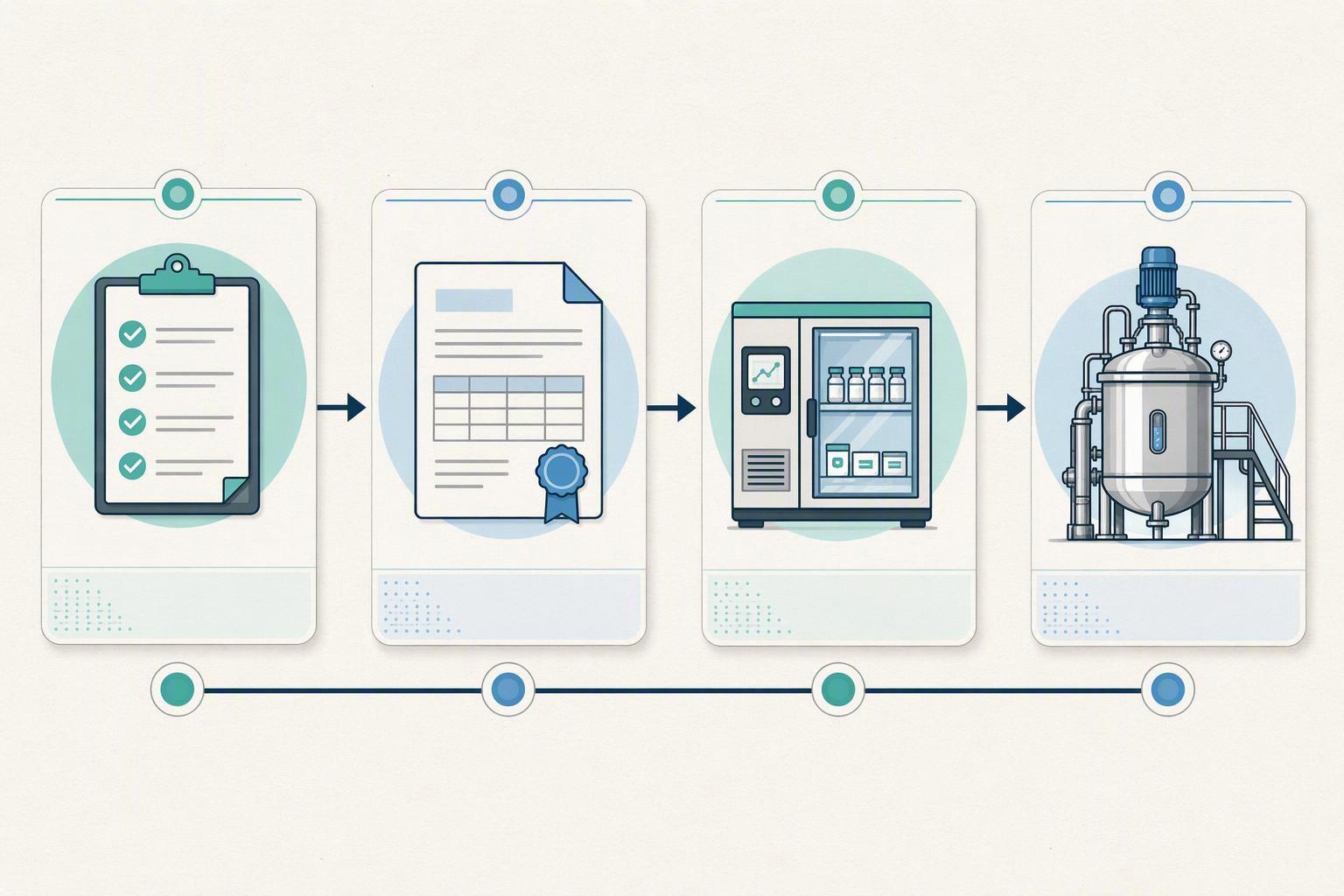
Start by sending a supplier the sequence that actually gives you trouble, not a catalog peptide. A trial synthesis on your real difficult sequence is the fastest way to see whether the responsiveness claim holds, and it takes days rather than a full evaluation cycle. Peptídeos Marcados com Isótopos
-
Send the difficult sequence for a trial synthesis. Dias. This is the quickest filter you have.
-
Request the modification list with named chemistries. Ask which of them survive scale-up, not just which appear in a brochure. Quick win.
-
Request a real batch CoA and read the method fields, not only the purity number. Quick win.
-
Open a tech-transfer conversation covering the mg to kg path and the documentation handoff. Longer-term.
-
Qualify a warm second source with a minor annual allocation. Longer-term, and the step most buyers skip until an emergency forces it.
Scoring sheet: carry the four criteria (capacidade de resposta, modificações especializadas, transparência analítica, technical collaboration) into the supplier call as a one-page grid, and score each answer against the artifact you were shown.
Measure the framework by method-transfer elapsed time, batch-to-batch comparability, and whether the analytical package clears your filing review without follow-up queries. Those three signals are the operational lever behind Bachem’s H1 2025 resultados, where utilization, not catalog breadth, moved the margin line. Expect the first three steps to change your shortlist within one evaluation cycle.
Advertências: Onde a visão convencional ainda se mantém
For a late-stage commercial program with fixed, multi-year demand, tier-1 scale and a regulatory track record genuinely reduce risk, and the four criteria above do not replace that. Slot scheduling and minimum order quantities bite hardest at development and early-clinical scale, which is where this framework applies most strongly.
Two limits are worth naming. The GenScript side of this comparison rests on thinner public disclosure than the Bachem side, so part of the asymmetry may reflect disclosure practice rather than capability. And Bachem’s margin compression is self-declared as planned and transitory, a fairer framing than margin pressure alone; the company’s stated 2026 ambition of more than CHF 1 billion in sales and over 30% EBITDA margin, as of the H1 2025 liberar, is not the profile of a supplier losing ground.
The claim is not that scale is worthless. It is that scale has stopped being sufficient on its own.
Perguntas frequentes
But doesn’t a tier-1 CDMO’s scale protect us if demand spikes?
Scale protects the supplier’s throughput, not your queue position. The company’s stated 2026 ambition at large CDMOs is to fill capacity with programs already holding reserved slots, so a spike is exactly when an unreserved buyer waits longest. The protection you want is a warm second source with a reserved slot, not a bigger primary.
E se já tivermos qualificado um grande fornecedor e a troca for cara?
You do not have to switch. Qualify a second source alongside the incumbent, which is what the operational case for a warm second source describes: minor annual allocations keep the relationship and the documentation current, so an emergency transition is a phone call rather than a fresh qualification. The incumbent keeps the volume; the second source keeps you covered.
Como você responde ao argumento de que os fornecedores boutique não podem suportar volumes comerciais?
That argument conflates a boutique’s catalog business with its custom peptide synthesis capabilities. GenScript’s FY2025 results show how license-driven growth qualification works at scale, and the same qualification logic applies downward: what matters is whether the supplier can document method transfer, lot comparability and scale-up continuity, not whether its name is large. Ask for the transfer record, not the headcount.
Isn’t analytical transparency just a matter of asking for the CoA?
Não. A CoA is a summary; peptide analytical data transparency is whether the underlying method, the lot it was run on and the specification it was judged against travel with the number. Endotoxin thresholds tighten with the assay, so a certificate that reports a value without the method and limit tells you little. Ask which assay, which lot, which specification, and whether peptide CDMO technical collaboration extends to reviewing the data with you.
Conclusão: O que os compradores devem pedir em 2026
Scale is now table stakes in peptide supplier selection criteria, and the four criteria that actually separate suppliers are responsiveness, modificações especializadas, analytical transparency and technical collaboration. H1 de Bachem 2026 results make the point: net sales rose 4.3% para CHF 326.4 million while the EBITDA margin fell 3.7 percentage points to 25.4% (H1 de Bachem 2026 resultados, Julho 2026). Capacity growth no longer guarantees pricing power or service quality.
So ask for artifacts, não garantias. Request a representative CoA with the analytical method behind each specification, a written list of modifications the supplier has actually delivered, and a named technical contact who owns the scale-up handoff. Where suppliers publish nothing comparable, treat the gap as a finding: GenScript’s FY2025 results show how little peptide-specific disclosure reaches buyers who need to compare (Resultados do ano fiscal de 2025 da GenScript). The market improves when the CoA, the modification list and the transfer path become the comparison surface.
If you are evaluating suppliers now, request a representative CoA package and a technical consultation before you commit to a slot.
This article is published by MOL Changes, which offers custom peptide synthesis and analytical documentation services. Consider that interest when weighing the framework above.