Antecedent cellular mechanisms
The essence of human aging is cellular senescence, senescent cells forever out of the cell cycle, but they will not be removed as directly as apoptotic cells, senescent cells generally have a large number of damaged DNA, which may be the reason why they are not removed, so the senescent cells will be a large number of retained, and continue to be deposited thereby inducing the body’s aging and the occurrence of related diseases. (Before senescent cells kill you, you should strike first)
The p53 gene has the function of inducing apoptosis, and its mechanism is that the p53 protein encoded by the p53 gene functions as a checkpoint in the G1 phase of the cell cycle and is responsible for checking whether there is any damage to the chromosomal DNA; once the defective DNA is found, it stimulates the expression of CIP, which prevents the cells from entering into the cell cycle and initiates the mechanism of DNA repair; if the repair fails, the p53 initiates the apoptosis mechanism.
In senescent cells, FOXO4 expression rises and affects the process of cellular senescence and apoptosis through interaction with proteins such as p53. Because it attaches to p53, it can prevent senescent cell death.
Difference between FOXO4 and FOXO4-Dri
FOXO4 short peptide is L-type amino acid.
FOXO4-Dri short peptide is D-type amino acid.
Why FOXO4-Dri appears
FOXO4 is a straight-chain polypeptide composed of 46 amino acids, the vast majority of the sequence is D-type amino acids, because he combined with the p53 gene, preventing the expression of the p53 gene, thus leading to the inability to remove senescent cells.
In the original idea, scientists wanted to use gene editing to take out the foxo4 gene, but this was too much work and prone to DNA damage. Therefore, scientists devised an alternative by replacing all of the L-type amino acids in the FOXO4 short peptide with D-type amino acids, which inverts the conformation of FOXO4-Dri and competitively binds to p53, while preventing FOX04 from binding to p53.
P53 activates apoptotic proteins and causes cell death. By removing old cells from the tissue, more dramatic tissue regeneration can be achieved.
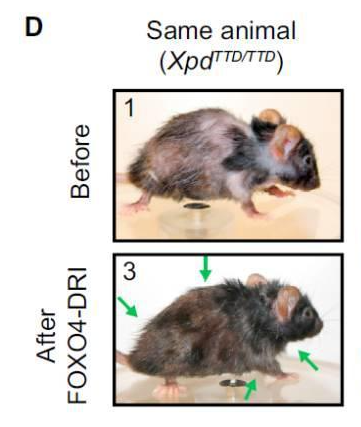
Attachment: senescent mice injected with FOX04-dir showed significant improvement in kidney function and hair began to repair itself.

Bingyan Gao
Profile: Bingyan Gao is the “ultimate gatekeeper” of peptide purity and quality. He is proficient in the use of various high-end analytical instruments and specializes in developing customized chromatographic separation methods for highly complex modified peptides. He has established a rigorous impurity profiling system that not only ensures product purity of 99% or higher but also precisely identifies and eliminates trace impurities that could cause immunogenicity. With a deep understanding of FDA and EMA regulatory requirements for peptide drugs, he ensures that every batch released from the facility is accompanied by a comprehensive and authoritative Certificate of Analysis (COA).
- Peptide Supplier Scale vs Specialization: 2026 Buyer Guide 2026年9月24日
- Peptide Manufacturing Capacity: Slot Planning & Supplier Qualification 2026年9月23日
- Peptide Outsourcing: What the $39.79B Forecast Means 2026年9月23日
- FAIR Peptide Toxicity Data: MAOMAO Guide for Triage 2026年9月23日
- Peptide Candidate Verification: 5-Stage Validation Guide 2026年9月22日
Our Fact Checking Process
We prioritize accuracy and integrity in our content. Here's how we maintain high standards:
- Expert Review: All articles are reviewed by subject matter experts.
- Source Validation: Information is backed by credible, up-to-date sources.
- Transparency: We clearly cite references and disclose potential conflicts.
Our Review Board
Our content is carefully reviewed by experienced professionals to ensure accuracy and relevance.
- Qualified Experts: Each article is assessed by specialists with field-specific knowledge.
- Up-to-date Insights: We incorporate the latest research, trends, and standards.
- Commitment to Quality: Reviewers ensure clarity, correctness, and completeness.
Look for the expert-reviewed label to read content you can trust.