Paso 1: Separe las pruebas de identidad de los datos de pureza
La identidad y la pureza son cuestiones analíticas separadas, y un proveedor que responde sólo a una de ellas no ha respondido a ninguna. La identidad pregunta cuál es el material.: requiere especifico, confirmación ortogonal como la espectrometría de masas, LC-MS/MS, análisis de aminoácidos, RMN, mapeo de péptidos, o retención por HPLC frente a un estándar de referencia (Trabajo estándar de referencia de la USP, 2023). La espectrometría de masas separa las moléculas según la relación masa-carga e informa un peso molecular; LC-MS/MS agrega un paso de fragmentación que lee información de secuencia. La pureza es una medida completamente diferente.: cuantifica el péptido objetivo en relación con impurezas y sustancias relacionadas, y no dice nada sobre si el objetivo es la molécula correcta.
Esa brecha es el modo de falla que vale la pena nombrar.. Un compuesto puede leer 99% puro por HPLC y seguir siendo el péptido incorrecto, porque una cifra de alta pureza no es evidencia de identidad. En pruebas de pureza BPC-157, un cromatograma limpio confirma que una especie domina la muestra, no es que la especie sea BPC-157.

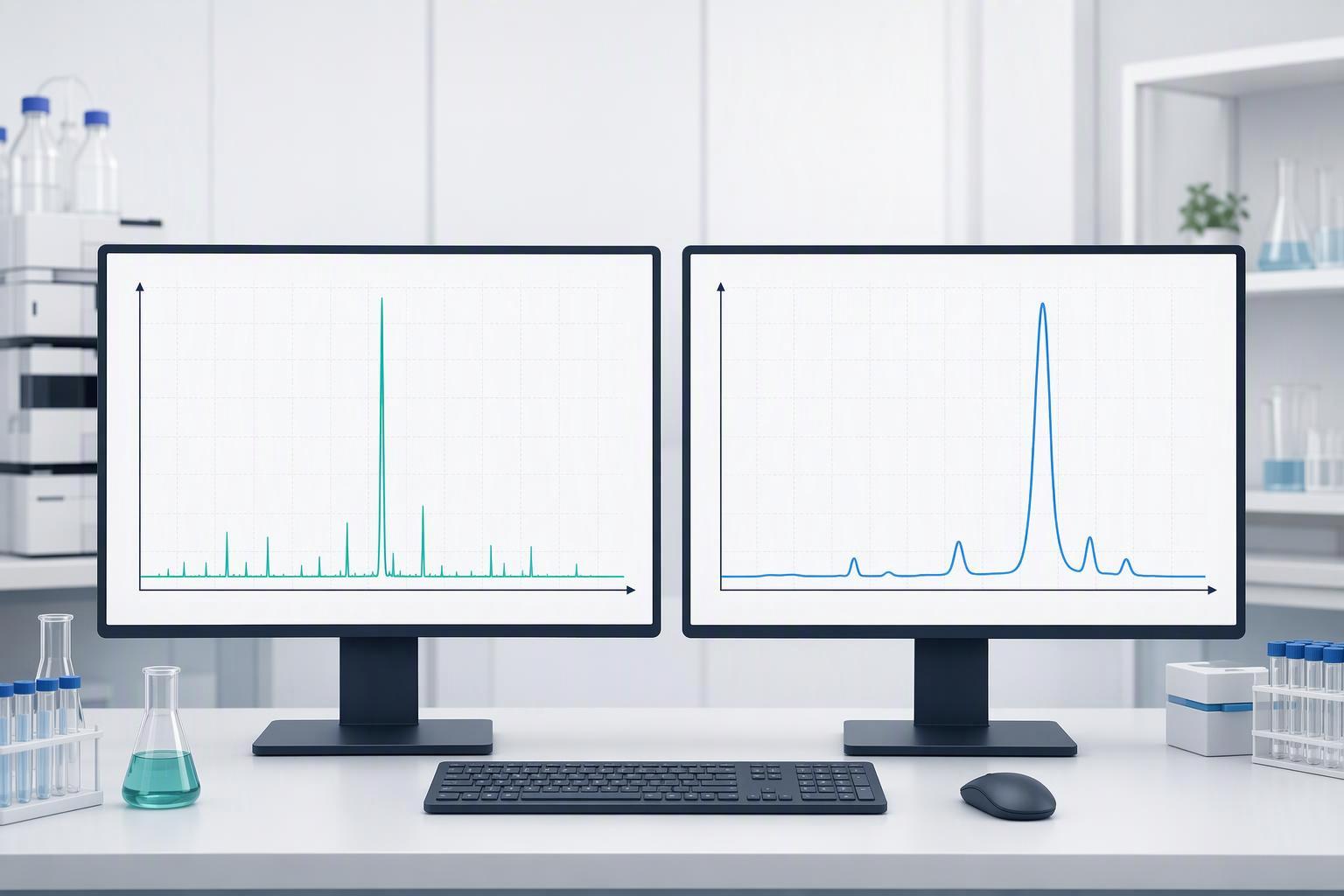
La pureza se calcula a partir del área del pico integrado.: área de pico objetivo dividida por el área de pico total integrada, multiplicado por 100. La convención supone HPLC de fase inversa en una columna C18 con detección UV en 220 Nuevo Méjico, La longitud de onda donde los enlaces peptídicos absorben. (Documentación de calidad de péptidos GenScript).
Que comprobar: ¿El paquete de documentación contiene un método de identidad? (EM, LC-MS/MS, o equivalente) reportado por separado del método de pureza, ¿O presenta un único porcentaje de pureza como toda la historia analítica??
Comercio =”https://molchanges.com/wp-content/uploads/2026/10/pub_20261002_013927_165_11203be2c7974a76b7f4d56fce8c9749.png”>
Paso 2: Lea una afirmación de pureza de su método, Lote, Laboratorio, y fecha
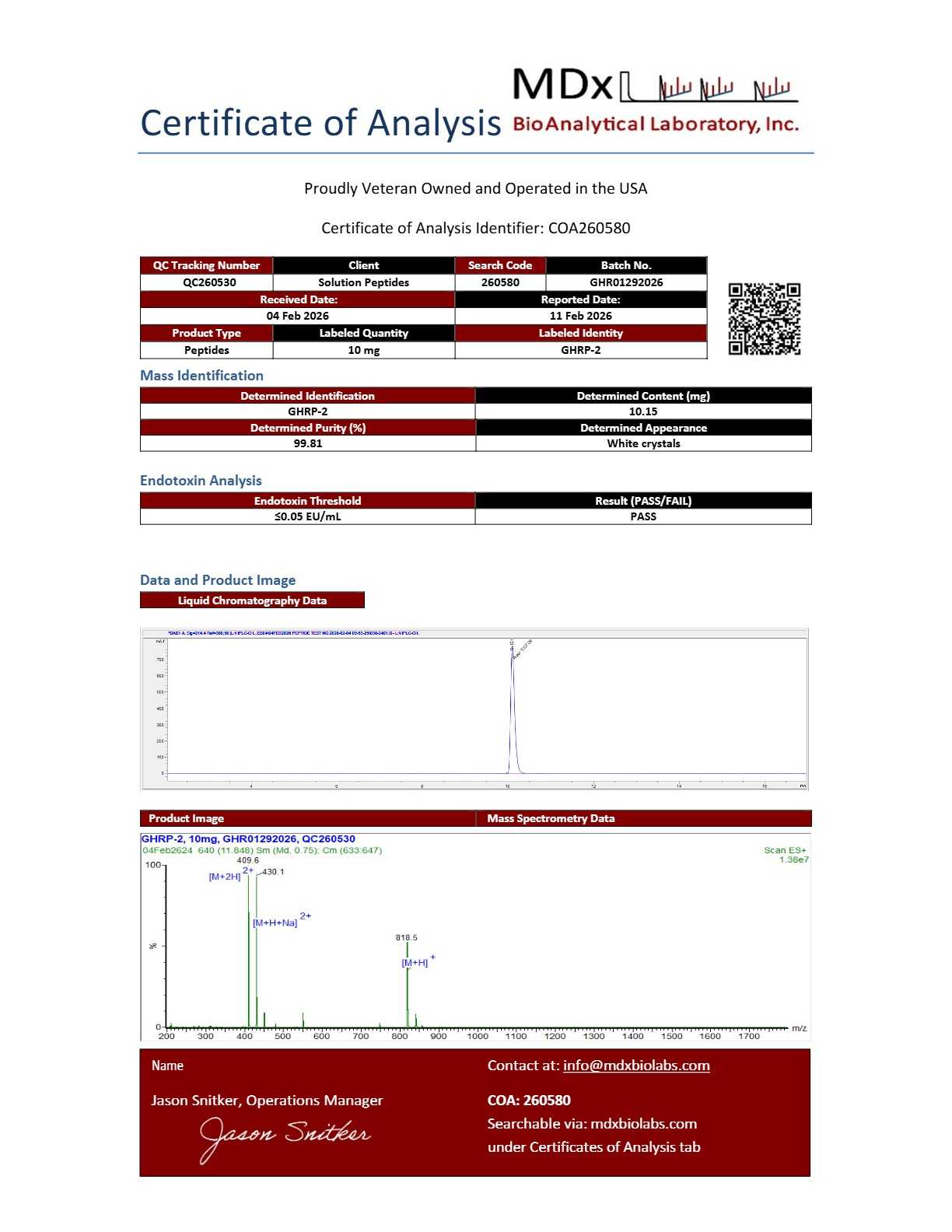
Porque identidad y pureza son cuestiones separadas, un porcentaje de pureza se convierte en evidencia sólo cuando el método, número de lote, laboratorio de pruebas, y análisis fecha viajar con él. Esos campos son el núcleo de la mayoría de los requisitos de certificados de análisis de péptidos..
Síntesis de péptidos Comience con el método. Un resultado defendible de HPLC-UV de fase reversa nombra su longitud de onda de detección, columna, y gradiente, e indica el estándar contra el cual fue validado. El método publicado por un laboratorio contratado utiliza un C18 5 µm, 4.6 × 250 columna de mm con un gradiente de agua/acetonitrilo que contiene 0.1% TFA o ácido fórmico, lee principalmente en 214 nm con un 280 nm canal secundario, reporta impurezas hasta 0.1% del área total del pico, y está validado según ICH Q2(R1) y USP <621> (Prueba de laboratorio SCA, recuperado 2026-01-01). Ese es un método de HPLC documentado., no solo un porcentaje. Si un CoA dice "≥98% (HPLC)” y se detiene allí, No se puede saber si el número proviene de un método validado o de una única inyección en un sistema no calibrado..
La segunda distinción importa más de lo que la mayoría de los compradores esperan: una cifra de porcentaje de área UV no es el contenido neto de péptidos en peso. USP asigna pureza de péptidos por balance de masa, medir cada clase de impureza detectable, incluyendo impurezas relacionadas con péptidos, contraión, agua, disolventes residuales, y residuos no combustibles, y restando el total de 100% (Trabajo estándar de referencia de la USP, 2023). Porque la pureza porcentual del área UV no mide los contraiones, TFA o sales de acetato, contenido de agua, o disolventes residuales, un alto porcentaje de área puede coexistir con un contenido neto de péptidos en peso sustancialmente menor.
Luego verifique el lote y la fecha con su propio pedido.. Una cifra de pureza pertenece a un lote analizado en una fecha, no a una línea de productos. Cuando escalas de miligramos a gramos, Pregunte por el CoA del Péptidos sintéticos mucho que realmente estás recibiendo, y compare su fecha de análisis con la fecha de envío. Un certificado de análisis fechado dieciocho meses antes del envío describe un lote de material diferente al que se encuentra en la caja..
¿Cómo se ve el fracaso?: un CoA con un porcentaje de pureza, sin línea de método, sin fecha de análisis específica del lote, y sin cromatograma. No tienes forma de saber si la cifra fue medida., estimado, o copiado de un lote anterior.
Paso 3: Solicite el paquete de documentación y compruébelo con ALCOA+
Una vez que sepa qué campos necesita un reclamo de pureza, el siguiente paso es solicitar el paquete completo, porque un CoA no es un documento único. es un paquete, y el paquete es lo que inspeccionas.
Solicite estos campos antes de evaluar cualquier otra cosa: número de lote, fecha de fabricación, fecha de análisis, laboratorio de pruebas, método analítico, cromatograma o referencia de traza, resultado de identidad de espectrometría de masas, condiciones de almacenamiento, y una declaración explícita de lo que fue no probado. That last field is the one most suppliers omit, and its absence tells you more than its presence would. These are the core peptide certificate of analysis requirements a qualification reviewer works through.
Judge the package against the ALCOA+ data-integrity attributes, which require records to be attributable, legible, contemporáneo, original y preciso, más completo, coherente, duradero y disponible. The five original attributes trace to FDA CGMP guidance finalized in December 2018; Guía de integridad de datos GxP de MHRA, Revision 1 (Marzo 2018), added the remaining four. Contemporaneous is the test that catches most weak packages: an analysis date reconstructed months after synthesis fails it.
A lot-specific package from MOL Changes illustrates the inspectable form: an analytical report tied to a named lot, with traceable quality data for research and industrial use. MOL Changes operates Class 100 ultra-sterile cleanroom production with in-house HPLC, Pruebas de EM y esterilidad, and manufactures custom and catalog peptides from milligrams to kilograms.
⚠️ Advertencia: a CoA is produced by a party with an interest in the result; independent third-party testing is what raises its evidentiary weight.
Paso 4: Aplicar controles de uso previsto como criterio de calificación
Documentation tells you what was tested; intended-use controls tell you what the supplier believes the product is for. Research use only peptide labelling is not boilerplate, and treating it as boilerplate is how buyers end up qualifying a consumer-facing seller. RUO designates a product manufactured and sold for laboratory research, whether that is in vitro studies, animal testing, química analítica, or preclinical investigation. Such products are not made under pharmaceutical GMP, have not undergone the testing required for human use, and carry no regulatory approval (Diario de péptidos, 2025).
The label alone decides nothing. Under the FD&Ley C, intended use, not the disclaimer, governs: a peptide marketed or intended for the diagnosis, curar, tratamiento, or prevention of disease in humans is a drug under federal law regardless of what the label says. FDA weighs labeling and packaging, advertising and marketing, and the totality of evidence (Diario de péptidos, 2025).
So read the whole storefront, not the product page. A supplier that publishes dosing guidance, human-use testimonials, or before-and-after claims has told you its intended market, whatever its footer says. A supplier whose materials stay on analytical and laboratory ground has separated research-grade from consumer-facing product.
Nothing in this guide is medical or dosing guidance, and no product referenced here is offered for human use.
Paso 5: Pruebe si el proveedor se comunica de forma transparente
Transparency is the criterion most suppliers fail, because it costs them something to pass. A supplier that communicates well will tell you what its documentation does not prove, name the laboratory that ran the tests, and publish dated lot records instead of a single undated purity figure.
Three pass/fail signals carry most of the weight in research-grade peptide supplier verification:
-
States the limits of its own documents. A passing supplier says plainly that a certificate of analysis (CoA) confirms identity and measured purity for one lot, and does not establish sterility, niveles de endotoxinas, or suitability for any clinical use. A failing supplier lets the CoA imply more than it shows.
-
Names the testing laboratory. A passing supplier identifies the lab and whether it is in-house or independent. A failing supplier writes “third-party tested” with no lab named, which is a claim, not a record.
-
Publishes dated lot records. A passing supplier shows lot numbers with analysis dates you can match to your shipment. A failing supplier shows one purity number with no lot and no date.
Para propina: ask for two CoAs from different lots of the same peptide and compare the impurity profiles, not just the headline purity figure.
A useful category observation: across the supplier pages reviewed for this guide, none taught readers how to read a CoA, what a passing versus failing result looks like, or how to spot a forged or duplicated CoA. The top-ranking supplier page also carried no page-level publish or update date. Treat an undated page as a signal in itself, and ask the supplier directly when the record was last updated.
Paso 6: Incluya los cinco criterios en un flujo de trabajo de calificación de proveedores

Run the five criteria as a sequence, not a checklist you sample from. Identity confirmation comes first, because a purity figure for the wrong molecule is meaningless. Purity review follows, then the documentation package, then intended-use controls, then transparency. A supplier that fails any stage is rejected at that stage; you do not carry it forward to see whether the rest looks better.
The reason to run your own sequence rather than accept a supplier’s self-reported pass rate is that the published failure figures are narrower than they appear. Third-party testing programs have published tens of thousands of results, incluido 9,997 peptide vials submitted for analysis, of which BPC-157 accounted for 756 tests across 110 vendors (peptidesbeat.com report on the Finnrick dataset, dataset updated 2026-09-03). The widely repeated claim that roughly one in three samples fail basic expectations comes from that same single dataset, self-reported and not peer-reviewed, and the proportion has held stable over 12 a 14 months of reporting on the gray-market peptide boom. One dataset, echoed across outlets, is not independent corroboration.
That is the case for peptide supplier due diligence as a buyer-side control. Research-grade peptide supplier verification is something you perform against artifacts you inspect, and no documentation package substitutes for it. Producción de péptidos
Errores comunes a evitar
Accepting a high purity figure as proof of identity. A 98% HPLC result says the main peak dominates the chromatogram; it does not say the peak is the right molecule. Identity comes from mass spectrometry, where the observed molecular weight matches the designed construct. Suppliers blur the two because a single purity number is easier to market than a two-part analytical story. Ask for both, and check that the identity method names the expected mass.
Treating a UV area-percent number as net peptide content by weight. UV detection at 214 nm responds to the peptide backbone, so the percentage reflects relative peak area, not how much peptide sits in the vial. Residual counterions, water and salts are invisible to the detector but very present on the balance. This is the most common gap in peptide certificate of analysis requirements: una cifra de porcentaje de área UV no es el contenido neto de péptidos en peso, and a supplier who presents it as such has either misunderstood the assay or is counting on you to.
Listing assays without showing what a pass or fail looks like. Across the supplier pages reviewed for this guide, chromatograms and spectra appear as decoration rather than as results with stated acceptance criteria. A specification you cannot compare against a reported value is not a specification.
Leaving pages undated. An undated CoA or specification page cannot be tied to a lot, a method revision or a testing laboratory, which undermines the traceability the document exists to provide.
Conclusión clave: a purity figure without a method, lote, laboratory and date is a claim, no es una medida.
Preguntas frecuentes
¿Cómo puedo distinguir un certificado de verificación falsificado o duplicado de uno genuino??
Check that the lot number on the certificate matches the lot on the vial label and packing slip, then look for a chromatogram or spectrum specific to that lot rather than a figure reused across products. A document that names no testing laboratory and no analysis date, or whose chromatogram reappears under a second lot number, is unverified. Requesting the raw data file behind the report is the strongest check available. Acerca de
Can I verify a supplier’s claim that a third party tested its peptides?
En parte. You can confirm the named laboratory exists, offers the cited method, and issues reports in that format. What the document cannot show is that the sample submitted came from the lot you received. That gap is not hypothetical: reporting on the gray-market peptide boom found that about a third of the thousands of products analysed failed basic quality checks, a proportion broadly unchanged over the 12 a 14 months of data gathering. Independent testing of a retained sample from your own receipt is the only way to close it.
¿Qué debo hacer si un CoA informa pureza sin cromatograma o sin coincidencia de lotes??
Ask for the missing artifacts before evaluating the number. A purity figure without a method, a lot identifier, and a supporting chromatogram cannot be traced to anything, so it functions as a marketing statement rather than analytical evidence. Note also what a purity figure is not: the FDA’s peptide dossier guidance sets at least one peptide-related impurity threshold of 0.10% of drug substance for impurity characterization, a characterization requirement and not an identity proof. Meeting your peptide certificate of analysis requirements means holding identity, pureza, and lot traceability as separate records, not one headline percentage.
Does a research-use-only label change a supplier’s legal position?
It shifts the framing rather than settling the question. A research-use-only label states the product’s intended application, and regulators assess the supplier’s conduct against that intent. As one legal analysis of the gray area puts it, intended use, not the disclaimer, governs. En la práctica, research use only peptide labelling is a qualification signal: a supplier that consistently separates research-grade material from consumer-facing product, and publishes no dosing or human-use guidance, is easier to qualify than one whose marketing contradicts its own label. This is not legal advice; consult counsel for your jurisdiction.
Conclusión
The five criteria are one habit: separate identity from purity, read every purity claim for its method, lote, lab and date, check the documentation package against ALCOA+, treat intended-use controls as a qualification gate, and watch how the supplier answers an awkward question. Peptide supplier due diligence is not a one-time audit but the practice of preferring a supplier whose artifacts can be inspected over one whose claims can only be believed. A lot-specific CoA that names the testing laboratory, the analytical method and the analysis date gives you something to file, compare across batches and hand to a colleague; a purity percentage with none of that context gives you nothing to check.
If you want to run the framework against a real package, request a sample CoA package or talk to a technical specialist. Both are low-commitment steps that let you test the documentation before any purchasing decision.
Divulgación: MOL Changes has a commercial interest in peptide quality standards and supplies research-grade peptides with lot-specific analytical documentation. Nothing in this guide is medical or dosing guidance, and all products discussed are for research use only.
Reviewed by the MOL Changes technical team. Consult a qualified professional before making decisions about research materials.