Fare un passo 1: Separare i test di identità dai dati di purezza
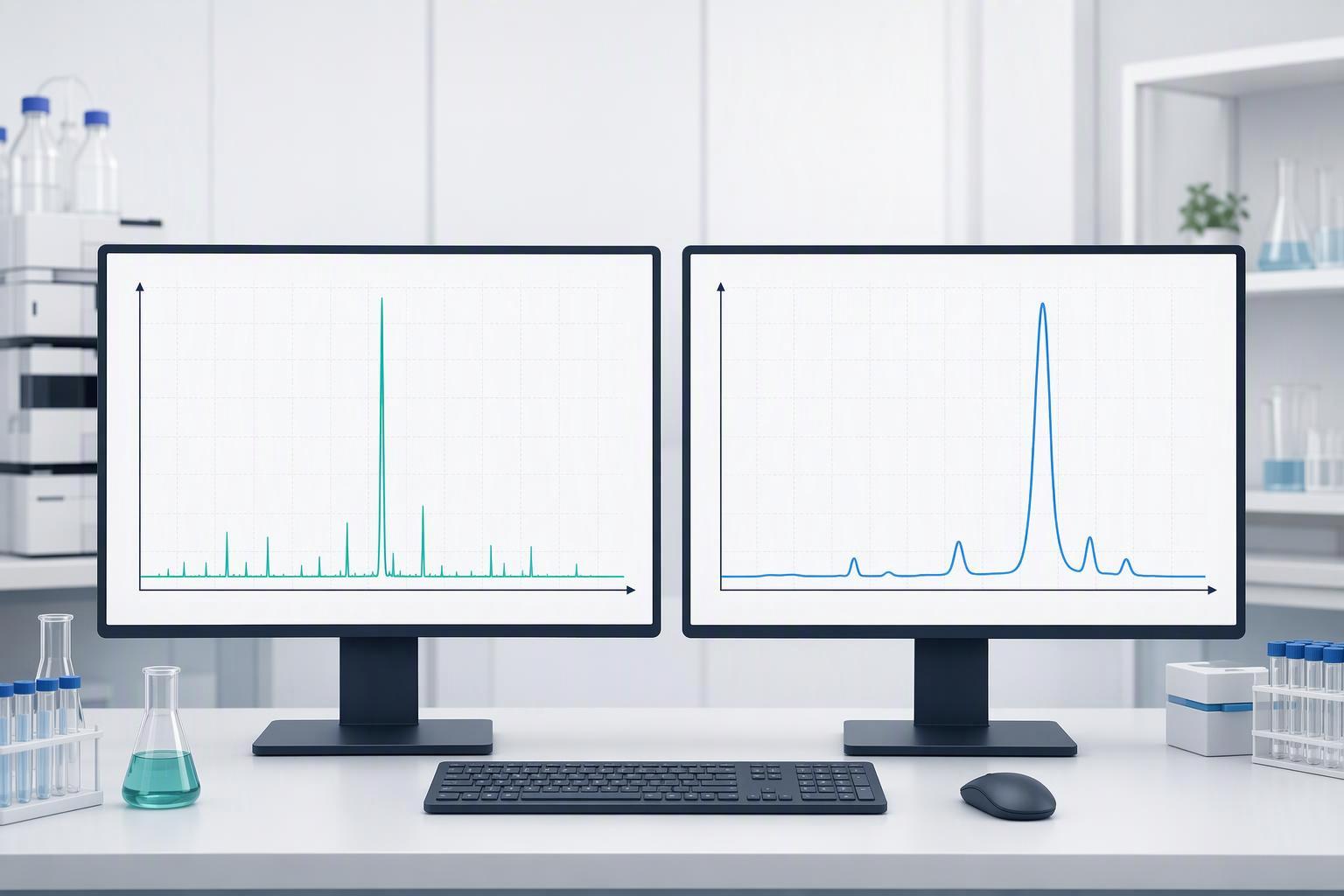
Identità e purezza sono questioni analitiche separate, e un fornitore che risponde solo a uno di essi non ha risposto a nessuno dei due. L'identità chiede quale sia il materiale: richiede specifico, conferma ortogonale come la spettrometria di massa, LC-MS/MS, analisi degli aminoacidi, RMN, mappatura peptidica, o ritenzione HPLC rispetto a uno standard di riferimento (Opera standard di riferimento USP, 2023). La spettrometria di massa separa le molecole in base al rapporto massa/carica e riporta un peso molecolare; LC-MS/MS aggiunge una fase di frammentazione che legge le informazioni sulla sequenza. La purezza è una misura completamente diversa: quantifica il peptide bersaglio rispetto alle impurità e alle sostanze correlate, e non dice nulla sul fatto che l'obiettivo sia la molecola giusta.
Questo divario è la modalità di fallimento che vale la pena menzionare. Un composto può leggere 99% puro mediante HPLC ed essere comunque il peptide sbagliato, perché una cifra di elevata purezza non è una prova di identità. Nei test di purezza BPC-157, un cromatogramma pulito conferma che una specie domina il campione, non che la specie sia BPC-157.

La purezza viene calcolata dall'area del picco integrata: area del picco target divisa per l'area totale del picco integrato, moltiplicato per 100. La convenzione presuppone un'HPLC a fase inversa su una colonna C18 con rilevamento UV a 220 nm, la lunghezza d'onda dove assorbono i legami peptidici (Documentazione sulla qualità dei peptidi GenScript).
Cosa controllare: il pacchetto di documentazione contiene un metodo di identità (SM, LC-MS/MS, o equivalente) riportati separatamente dal metodo della purezza, oppure presenta un'unica percentuale di purezza come l'intera storia analitica?
Negozio ="https://molchanges.com/wp-content/uploads/2026/10/pub_20261002_013927_165_11203be2c7974a76b7f4d56fce8c9749.png”>
Fare un passo 2: Leggi un'affermazione di purezza per il suo metodo, Quantità, Laboratorio, e Data
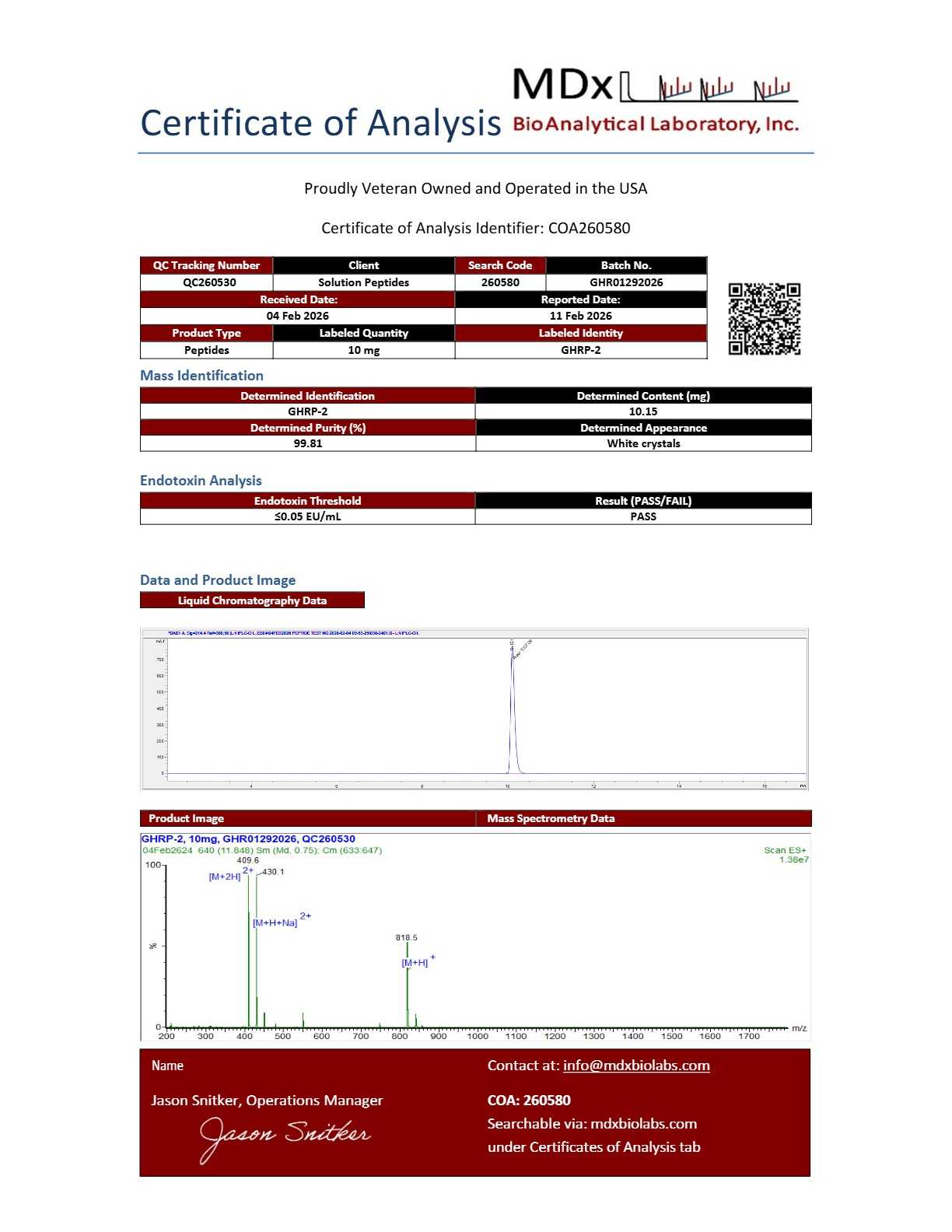
Perché identità e purezza sono questioni separate, una percentuale di purezza diventa prova solo quando il metodo, numero di lotto, laboratorio di prova, e la data dell'analisi viaggia con esso. Questi campi sono il nucleo della maggior parte dei requisiti relativi ai certificati di analisi dei peptidi.
Sintesi peptidica Inizia dal metodo. Un risultato difendibile dell'HPLC-UV in fase inversa nomina la sua lunghezza d'onda di rilevamento, colonna, e gradiente, e indica lo standard rispetto al quale è stato convalidato. Il metodo pubblicato da un laboratorio a contratto utilizza un C18 5 µm, 4.6 × 250 Colonna da mm con un gradiente acqua/acetonitrile contenente 0.1% TFA o acido formico, legge principalmente a 214 nm con a 280 canale secondario nm, riporta le impurità fino a 0.1% dell'area totale del picco, ed è convalidato per ICH Q2(R1) e USP <621> (Test di laboratorio ACS, recuperato 2026-01-01). Questo è un metodo HPLC documentato, non solo una percentuale. Se un certificato di autenticità dice "≥98% (HPLC)"e si ferma lì, non è possibile stabilire se il numero provenga da un metodo convalidato o da una singola iniezione su un sistema non calibrato.
La seconda distinzione è più importante di quanto la maggior parte degli acquirenti si aspetti: una cifra percentuale dell'area UV non è il contenuto netto di peptidi in peso. L'USP assegna la purezza del peptide in base al bilancio di massa, misurando ogni classe di impurità rilevabile, comprese le impurità legate ai peptidi, controione, acqua, solventi residui, e residui non combustibili, e sottraendo il totale da 100% (Opera standard di riferimento USP, 2023). Perché la purezza percentuale dell'area UV non misura i controioni, TFA o sali di acetato, contenuto di acqua, o solventi residui, un'elevata percentuale di area può coesistere con un contenuto netto di peptidi in peso sostanzialmente inferiore.
Quindi controlla il lotto e la data rispetto al tuo ordine. Un valore di purezza appartiene a un lotto testato in una data, non ad una linea di prodotti. Quando si passa da milligrammi a grammi, chiedere il CoA del Peptidi sintetici molto che stai effettivamente ricevendo, e confrontare la data di analisi con la data di spedizione. Un certificato di autenticità datato diciotto mesi prima della spedizione descrive un lotto di materiale diverso da quello presente nella scatola.
Che aspetto ha il fallimento: un CoA con una percentuale di purezza, nessuna riga del metodo, nessuna data di analisi specifica del lotto, e nessun cromatogramma. Non hai modo di sapere se la cifra è stata misurata, stimato, o copiato da un batch precedente.
Fare un passo 3: Richiedi il pacchetto di documentazione e confrontalo con ALCOA+
Una volta che sai di quali campi ha bisogno una richiesta di purezza, il passo successivo è richiedere l'intero pacchetto, perché un certificato di autenticità non è un unico documento. È un pacchetto, e il pacchetto è ciò che controlli.
Richiedi questi campi prima di valutare qualsiasi altra cosa: numero di lotto, data di produzione, data di analisi, laboratorio di prova, metodo analitico, cromatogramma o riferimento in traccia, risultato dell'identità della spettrometria di massa, condizioni di conservazione, e una dichiarazione esplicita di ciò che era non testato. That last field is the one most suppliers omit, and its absence tells you more than its presence would. These are the core peptide certificate of analysis requirements a qualification reviewer works through.
Judge the package against the ALCOA+ data-integrity attributes, which require records to be attributable, leggibile, contemporaneo, originale e accurato, più completo, coerente, duraturo e disponibile. The five original attributes trace to FDA CGMP guidance finalized in December 2018; MHRA’s GxP data-integrity guidance, Revision 1 (Marzo 2018), added the remaining four. Contemporaneous is the test that catches most weak packages: an analysis date reconstructed months after synthesis fails it.
A lot-specific package from MOL Changes illustrates the inspectable form: an analytical report tied to a named lot, with traceable quality data for research and industrial use. MOL Changes gestisce la classe 100 ultra-sterile cleanroom production with in-house HPLC, MS e test di sterilità, and manufactures custom and catalog peptides from milligrams to kilograms.
⚠️ Attenzione: a CoA is produced by a party with an interest in the result; independent third-party testing is what raises its evidentiary weight.
Fare un passo 4: Applicare i controlli sull'uso previsto come criterio di qualificazione
Documentation tells you what was tested; intended-use controls tell you what the supplier believes the product is for. Research use only peptide labelling is not boilerplate, and treating it as boilerplate is how buyers end up qualifying a consumer-facing seller. RUO designates a product manufactured and sold for laboratory research, whether that is in vitro studies, animal testing, chimica analitica, or preclinical investigation. Such products are not made under pharmaceutical GMP, have not undergone the testing required for human use, and carry no regulatory approval (Diario dei peptidi, 2025).
The label alone decides nothing. Under the FD&Atto C, destinazione d'uso, not the disclaimer, governs: a peptide marketed or intended for the diagnosis, cura, trattamento, or prevention of disease in humans is a drug under federal law regardless of what the label says. FDA weighs labeling and packaging, advertising and marketing, and the totality of evidence (Diario dei peptidi, 2025).
So read the whole storefront, not the product page. A supplier that publishes dosing guidance, human-use testimonials, or before-and-after claims has told you its intended market, whatever its footer says. A supplier whose materials stay on analytical and laboratory ground has separated research-grade from consumer-facing product.
Nothing in this guide is medical or dosing guidance, and no product referenced here is offered for human use.
Fare un passo 5: Verifica se il fornitore comunica in modo trasparente
Transparency is the criterion most suppliers fail, because it costs them something to pass. A supplier that communicates well will tell you what its documentation does not prove, name the laboratory that ran the tests, and publish dated lot records instead of a single undated purity figure.
Three pass/fail signals carry most of the weight in research-grade peptide supplier verification:
-
States the limits of its own documents. A passing supplier says plainly that a certificate of analysis (CoA) confirms identity and measured purity for one lot, and does not establish sterility, livelli di endotossine, or suitability for any clinical use. A failing supplier lets the CoA imply more than it shows.
-
Names the testing laboratory. A passing supplier identifies the lab and whether it is in-house or independent. A failing supplier writes “third-party tested” with no lab named, which is a claim, not a record.
-
Publishes dated lot records. A passing supplier shows lot numbers with analysis dates you can match to your shipment. A failing supplier shows one purity number with no lot and no date.
Per Suggerimento: ask for two CoAs from different lots of the same peptide and compare the impurity profiles, not just the headline purity figure.
A useful category observation: across the supplier pages reviewed for this guide, none taught readers how to read a CoA, what a passing versus failing result looks like, or how to spot a forged or duplicated CoA. The top-ranking supplier page also carried no page-level publish or update date. Treat an undated page as a signal in itself, and ask the supplier directly when the record was last updated.
Fare un passo 6: Inserisci i cinque criteri in un flusso di lavoro di qualificazione del fornitore

Run the five criteria as a sequence, not a checklist you sample from. Identity confirmation comes first, because a purity figure for the wrong molecule is meaningless. Purity review follows, then the documentation package, then intended-use controls, then transparency. A supplier that fails any stage is rejected at that stage; you do not carry it forward to see whether the rest looks better.
The reason to run your own sequence rather than accept a supplier’s self-reported pass rate is that the published failure figures are narrower than they appear. Third-party testing programs have published tens of thousands of results, compreso 9,997 peptide vials submitted for analysis, of which BPC-157 accounted for 756 tests across 110 vendors (peptidesbeat.com report on the Finnrick dataset, dataset updated 2026-09-03). The widely repeated claim that roughly one in three samples fail basic expectations comes from that same single dataset, self-reported and not peer-reviewed, and the proportion has held stable over 12 A 14 months of reporting on the gray-market peptide boom. One dataset, echoed across outlets, is not independent corroboration.
That is the case for peptide supplier due diligence as a buyer-side control. Research-grade peptide supplier verification is something you perform against artifacts you inspect, and no documentation package substitutes for it. Produzione di peptidi
Errori comuni da evitare
Accepting a high purity figure as proof of identity. UN 98% HPLC result says the main peak dominates the chromatogram; it does not say the peak is the right molecule. Identity comes from mass spectrometry, where the observed molecular weight matches the designed construct. Suppliers blur the two because a single purity number is easier to market than a two-part analytical story. Ask for both, and check that the identity method names the expected mass.
Treating a UV area-percent number as net peptide content by weight. Rilevazione UV a 214 nm responds to the peptide backbone, so the percentage reflects relative peak area, not how much peptide sits in the vial. Residual counterions, water and salts are invisible to the detector but very present on the balance. This is the most common gap in peptide certificate of analysis requirements: una cifra percentuale dell'area UV non è il contenuto netto di peptidi in peso, and a supplier who presents it as such has either misunderstood the assay or is counting on you to.
Listing assays without showing what a pass or fail looks like. Across the supplier pages reviewed for this guide, chromatograms and spectra appear as decoration rather than as results with stated acceptance criteria. A specification you cannot compare against a reported value is not a specification.
Leaving pages undated. An undated CoA or specification page cannot be tied to a lot, a method revision or a testing laboratory, which undermines the traceability the document exists to provide.
Chiave da asporto: a purity figure without a method, quantità, laboratory and date is a claim, non una misurazione.
Domande frequenti
Come posso distinguere un certificato di autenticità contraffatto o duplicato da uno autentico??
Check that the lot number on the certificate matches the lot on the vial label and packing slip, then look for a chromatogram or spectrum specific to that lot rather than a figure reused across products. A document that names no testing laboratory and no analysis date, or whose chromatogram reappears under a second lot number, is unverified. Requesting the raw data file behind the report is the strongest check available. Di
Can I verify a supplier’s claim that a third party tested its peptides?
In parte. You can confirm the named laboratory exists, offers the cited method, and issues reports in that format. What the document cannot show is that the sample submitted came from the lot you received. That gap is not hypothetical: reporting on the gray-market peptide boom found that about a third of the thousands of products analysed failed basic quality checks, a proportion broadly unchanged over the 12 A 14 months of data gathering. Independent testing of a retained sample from your own receipt is the only way to close it.
Cosa devo fare se un certificato di autenticità riporta la purezza senza alcuna corrispondenza del cromatogramma o del lotto?
Ask for the missing artifacts before evaluating the number. A purity figure without a method, a lot identifier, and a supporting chromatogram cannot be traced to anything, so it functions as a marketing statement rather than analytical evidence. Note also what a purity figure is not: the FDA’s peptide dossier guidance sets at least one peptide-related impurity threshold of 0.10% of drug substance for impurity characterization, a characterization requirement and not an identity proof. Meeting your peptide certificate of analysis requirements means holding identity, purezza, and lot traceability as separate records, not one headline percentage.
Does a research-use-only label change a supplier’s legal position?
It shifts the framing rather than settling the question. A research-use-only label states the product’s intended application, and regulators assess the supplier’s conduct against that intent. As one legal analysis of the gray area puts it, destinazione d'uso, not the disclaimer, governs. In pratica, research use only peptide labelling is a qualification signal: a supplier that consistently separates research-grade material from consumer-facing product, and publishes no dosing or human-use guidance, is easier to qualify than one whose marketing contradicts its own label. This is not legal advice; consult counsel for your jurisdiction.
Conclusione
The five criteria are one habit: separate identity from purity, read every purity claim for its method, quantità, lab and date, check the documentation package against ALCOA+, treat intended-use controls as a qualification gate, and watch how the supplier answers an awkward question. Peptide supplier due diligence is not a one-time audit but the practice of preferring a supplier whose artifacts can be inspected over one whose claims can only be believed. A lot-specific CoA that names the testing laboratory, the analytical method and the analysis date gives you something to file, compare across batches and hand to a colleague; a purity percentage with none of that context gives you nothing to check.
If you want to run the framework against a real package, request a sample CoA package or talk to a technical specialist. Both are low-commitment steps that let you test the documentation before any purchasing decision.
Divulgazione: MOL Changes has a commercial interest in peptide quality standards and supplies research-grade peptides with lot-specific analytical documentation. Nothing in this guide is medical or dosing guidance, and all products discussed are for research use only.
Reviewed by the MOL Changes technical team. Consult a qualified professional before making decisions about research materials.